Choosing an electric vehicle isn’t just about buying the newest model anymore. For many drivers, the biggest question is simple: How far can it travel on a single charge?
If you’re searching for the longest range EV, you’re probably planning to drive long distances, reduce charging stops, or simply want extra peace of mind. Modern EVs have improved dramatically over the past few years, with several models now capable of traveling well over 400 miles (or more than 640 km) under official testing standards.
Still, maximum range isn’t everything. The best long-range electric vehicle should also offer efficient charging, good value, practical features, reliable battery technology, and realistic real-world performance.
Quick Answer
The longest range EV in 2026 depends on your market and the testing standard used. Premium electric sedans generally deliver the highest official range, while many newer SUVs are closing the gap. Buyers should compare official EPA or WLTP ratings alongside charging speed, efficiency, price, warranty, and everyday usability before making a decision.
Whether you’re buying your first EV or upgrading from an older model, this guide compares the best long range EVs, explains what those range figures actually mean, and helps you choose the right electric vehicle for your budget and driving style.
Why Driving Range Matters More Than Ever
A few years ago, most affordable electric cars struggled to travel 200 miles on a charge. Today, many modern EVs comfortably exceed 300 miles, while premium models can travel significantly farther.
Longer range offers several advantages:
- Fewer charging stops during road trips
- Greater flexibility in areas with limited charging infrastructure
- Less range anxiety
- More confidence during winter driving
- Better resale value in many markets
That doesn’t automatically mean you should buy the EV with the highest number on paper.
A vehicle with slightly less range but faster charging, better efficiency, lower price, and lower maintenance costs may actually be the smarter purchase.
EPA vs WLTP: Why Range Numbers Can Look Different
One of the biggest mistakes buyers make is comparing range figures from different testing systems.
The two most common standards are:
| Standard | Used In | Characteristics |
|---|---|---|
| EPA | United States | More conservative and closer to real-world driving |
| WLTP | Europe, UK and many global markets | Usually produces higher official range estimates |
Because of these different testing methods, the exact same electric car may have two different official range ratings.
For example:
- EPA might rate a vehicle around 400 miles
- WLTP could rate that same vehicle above 450 miles
Neither figure is “wrong.” They’re simply measured differently.
This is why comparing vehicles using the same testing standard is important.
What Actually Determines EV Range?
Several factors affect how far an electric vehicle can travel.
Battery Capacity
Generally speaking, larger batteries can store more energy, allowing longer driving distances.
However, battery size alone doesn’t tell the whole story.
Vehicle Efficiency
Two EVs with similar battery sizes can have very different ranges because one uses energy more efficiently.
Efficiency depends on factors such as:
- Motor design
- Vehicle weight
- Tire resistance
- Software optimization
- Regenerative braking
- Aerodynamics
Aerodynamics
Air resistance becomes one of the biggest energy consumers at highway speeds.
That’s why many of today’s longest-range EVs have:
- Smooth body shapes
- Flush door handles
- Covered wheels
- Active grille shutters
- Low drag coefficients
Weather
Cold temperatures reduce battery performance.
Drivers commonly notice reduced range during winter because energy is also used for:
- Cabin heating
- Battery temperature management
- Window defrosting
Hot climates can also increase battery cooling demands.
Driving Style
Aggressive acceleration and high-speed highway driving consume significantly more electricity than steady city driving.
Gentle acceleration, smooth braking, and moderate cruising speeds usually produce the best results.
Tire Choice
Large wheels often look better but usually reduce efficiency.
Smaller wheels with low rolling resistance tires frequently provide better range.
How Long Do EV Batteries Last?
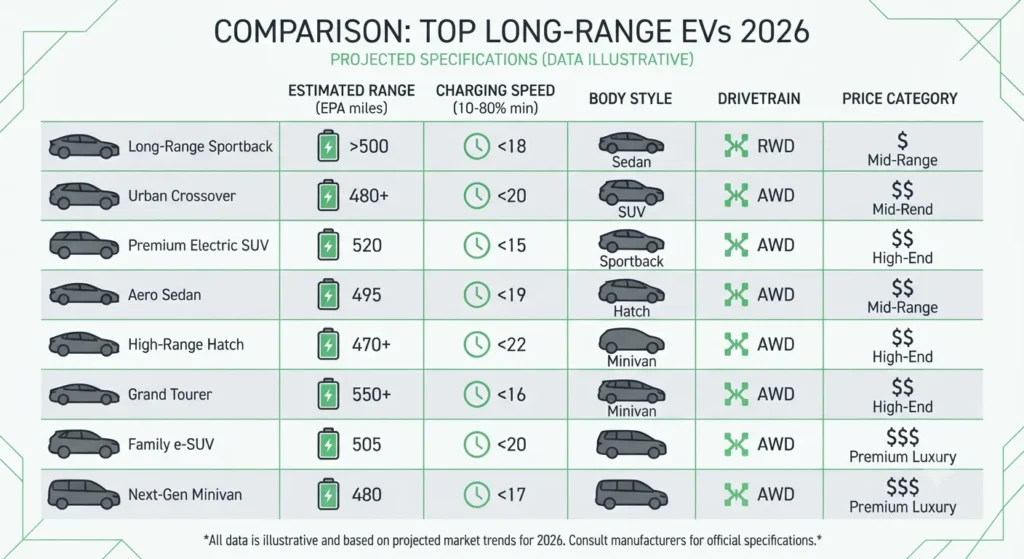
Top 15 Longest Range EVs in 2026
Note: Official range, pricing, battery specifications, and available trims vary by country and are updated regularly by manufacturers. Always verify current specifications before purchasing.
| Rank | EV Model | Estimated Official Range* | Vehicle Type | Fast Charging |
|---|---|---|---|---|
| 1 | Lucid Air | Extremely High | Luxury Sedan | Excellent |
| 2 | Mercedes-Benz EQS | Very High | Luxury Sedan | Excellent |
| 3 | Tesla Model S | Very High | Luxury Sedan | Excellent |
| 4 | Tesla Model 3 Long Range | High | Sedan | Excellent |
| 5 | Hyundai IONIQ 6 | High | Sedan | Excellent |
| 6 | BMW i7 | High | Luxury Sedan | Very Good |
| 7 | Polestar 3 | High | SUV | Very Good |
| 8 | Chevrolet Equinox EV | High | SUV | Good |
| 9 | Kia EV9 | High | SUV | Excellent |
| 10 | Volvo EX90 | High | SUV | Very Good |
| 11 | Audi Q6 e-tron | High | SUV | Excellent |
| 12 | Porsche Macan Electric | High | SUV | Excellent |
| 13 | Rivian R1S | High | SUV | Very Good |
| 14 | Cadillac Lyriq | High | SUV | Good |
| 15 | Genesis Electrified GV70 | Good | Luxury SUV | Good |
*Official range varies depending on battery size, wheel options, drivetrain, and testing standard.
1. Lucid Air
The Lucid Air continues to set the benchmark for maximum electric driving range. Its combination of advanced battery technology, efficient motors, and highly aerodynamic design allows it to travel farther than almost every production EV currently available.
Best for
- Frequent highway travelers
- Luxury buyers
- Drivers covering long daily distances
Pros
- Exceptional driving range
- Very fast charging capability
- Premium interior quality
- Advanced driver technology
- Excellent efficiency
Cons
- Premium price
- Limited service network in some regions
- Large size may not suit every driver
2. Mercedes-Benz EQS
Mercedes designed the EQS with efficiency as its top priority. Its sleek shape reduces air resistance, helping maximize driving range while maintaining a luxurious cabin.
The EQS is ideal for buyers wanting executive-level comfort without sacrificing electric driving distance.
Highlights
- Quiet interior
- Excellent ride comfort
- Advanced infotainment
- Premium materials
- Strong charging performance
3. Tesla Model S
The Tesla Model S remains one of the world’s best-known long-range electric cars.
Its strengths include:
- Efficient powertrain
- Extensive Supercharger compatibility in supported markets
- Strong software ecosystem
- Excellent long-distance capability
Tesla also continues improving efficiency through software updates, which can further optimize real-world driving performance.
4. Tesla Model 3 Long Range
The Model 3 Long Range offers one of the best balances between price, efficiency, performance, and everyday practicality.
Compared with larger luxury EVs, it delivers outstanding efficiency while remaining easier to park and more affordable.
It’s particularly attractive for commuters who regularly drive long distances.
5. Hyundai IONIQ 6
Hyundai focused heavily on aerodynamics when designing the IONIQ 6.
The result is one of the most efficient electric sedans currently available.
Drivers appreciate:
- Competitive driving range
- Ultra-fast charging capability
- Comfortable cabin
- Advanced safety technology
- Strong value for money
6. BMW i7
BMW’s flagship electric sedan combines luxury with impressive long-distance capability.
Rather than focusing solely on maximum range, the i7 delivers a premium ownership experience including:
- Executive seating
- High-end technology
- Smooth ride quality
- Quiet cabin
- Powerful electric performance
7. Polestar 3
The Polestar 3 is aimed at drivers who want an electric SUV without sacrificing efficiency.
Unlike many large SUVs, careful engineering helps it remain competitive in terms of driving range while offering premium comfort and advanced safety systems.
8. Chevrolet Equinox EV
One of the biggest surprises in today’s EV market is how much range affordable electric SUVs now offer.
The Chevrolet Equinox EV demonstrates that buyers no longer need a luxury budget to enjoy long-distance electric driving.
It appeals to families looking for:
- Practical space
- Competitive range
- Everyday usability
- Lower ownership costs
- Modern safety technology
9. Kia EV9
The Kia EV9 proves that a practical three-row electric SUV can also deliver impressive driving range. It’s designed for families who need generous interior space without giving up modern EV technology.
Unlike many full-size SUVs, the EV9 balances passenger comfort, cargo space, and efficiency remarkably well.
Best for
- Large families
- Weekend road trips
- Drivers needing seven-seat flexibility
Pros
- Spacious three-row interior
- Ultra-fast charging on supported DC chargers
- Modern cabin design
- Strong safety features
- Comfortable ride quality
Cons
- Larger size reduces efficiency compared with electric sedans
- Premium trims can become expensive
10. Volvo EX90
The Volvo EX90 combines Scandinavian design with advanced electric technology. Rather than chasing the highest performance numbers, Volvo focuses on safety, comfort, and long-distance practicality.
Drivers looking for a premium family SUV will appreciate its smooth driving experience and refined cabin.
Highlights
- Excellent safety technology
- Comfortable suspension
- Quiet interior
- High-quality materials
- Competitive driving range
11. Audi Q6 e-tron
Audi’s latest premium electric SUV brings together modern battery technology, fast charging, and luxury features.
Its newest EV platform improves both efficiency and charging performance, making it a strong choice for buyers who frequently travel long distances.
Why buyers like it
- Premium cabin quality
- Strong charging performance
- Comfortable highway driving
- Advanced driver assistance systems
- Practical cargo space
12. Porsche Macan Electric
The electric Macan is aimed at drivers who want sports-car handling without giving up everyday practicality.
Instead of focusing only on maximum range, Porsche delivers an excellent balance between performance, charging speed, and driving enjoyment.
Best for
- Driving enthusiasts
- Luxury SUV buyers
- Drivers wanting sporty handling
13. Rivian R1S
The Rivian R1S stands out because it combines impressive driving range with genuine off-road capability.
Many long-range EVs are optimized primarily for highways, but the R1S is designed to handle outdoor adventures while still offering comfortable daily driving.
Strengths
- Excellent off-road capability
- Spacious interior
- Large cargo capacity
- Strong towing capability
- Premium technology
Consider before buying
- Large tires and off-road equipment may reduce real-world efficiency.
- Range depends heavily on wheel and tire selection.
14. Cadillac Lyriq
Cadillac has transformed its electric lineup with the Lyriq, offering a luxury SUV that combines comfort, technology, and competitive range.
Its quiet cabin and refined ride make it particularly appealing for long highway journeys.
Best suited for
- Luxury SUV buyers
- Daily commuters
- Long-distance travelers
15. Genesis Electrified GV70
Genesis has earned a reputation for offering premium features at competitive prices.
The Electrified GV70 may not deliver the absolute highest official range, but it offers one of the strongest overall ownership experiences in the luxury compact SUV segment.
Owners appreciate:
- High-quality interior
- Comfortable ride
- Premium warranty (market dependent)
- Modern technology
- Excellent craftsmanship
Best Electric Car Charger for Home
Which Long-Range EV Is Best for You?
The “best” long-range EV depends entirely on how you’ll use it.
| Driver Type | Recommended EV Type |
|---|---|
| Long-distance commuter | Efficient sedan with maximum range |
| Family | Mid-size or full-size electric SUV |
| Luxury buyer | Premium electric sedan |
| Performance enthusiast | Performance-focused EV |
| Outdoor adventurer | Electric SUV with AWD |
| Budget-conscious buyer | Affordable long-range EV |
Buying the EV with the biggest battery isn’t always the smartest decision.
For many drivers, a slightly smaller battery paired with faster charging and better efficiency provides a better ownership experience.
EPA vs WLTP: Which Range Figure Should You Trust?
When comparing electric vehicles, you’ll often see two official range ratings.
EPA (United States)
The Environmental Protection Agency (EPA) testing method is generally considered more conservative.
Advantages include:
- Closer to real-world driving
- Easier comparison between vehicles
- Widely used in North America
WLTP (Europe and Many Global Markets)
The Worldwide Harmonised Light Vehicles Test Procedure (WLTP) is used across Europe, the UK, and several other regions.
It often produces higher official range figures because of different testing conditions.
Which One Matters More?
If you’re buying in the United States, compare EPA ratings.
If you’re buying in Europe or the UK, WLTP ratings are the official standard.
Either way, remember that your actual range depends on:
- Speed
- Weather
- Terrain
- Traffic
- Passenger load
- Tire pressure
- Climate control usage
Real-World Factors That Affect EV Range
Official figures provide a useful benchmark, but everyday driving conditions rarely match laboratory testing.
Highway Speeds
Driving at 75–80 mph generally uses much more energy than city driving.
Higher speeds increase aerodynamic drag, which is one of the biggest reasons range drops during long motorway journeys.
Cold Weather
Winter is one of the biggest challenges for any EV.
Cold temperatures can reduce available range because energy is used to:
- Warm the battery
- Heat the cabin
- Defrost windows
- Maintain battery performance
Preconditioning the battery before departure can help improve efficiency.
Hot Weather
Very hot climates can also reduce range.
Battery cooling systems consume electricity, especially during fast charging or prolonged highway driving.
Tire Pressure
Underinflated tires increase rolling resistance.
Checking tire pressure regularly is one of the easiest ways to improve efficiency.
Extra Weight
Roof boxes, bike racks, heavy cargo, and towing all increase energy consumption.
The heavier the vehicle, the harder the battery must work.
Wheel Size
Large wheels often reduce range.
Smaller wheels with more aerodynamic designs generally improve efficiency.
Should You Always Buy the Longest Range EV?
Not necessarily.
Many buyers assume the EV with the biggest number is automatically the best purchase.
In reality, other factors can matter just as much.
Consider:
- Charging speed
- Home charging availability
- Public charging network
- Purchase price
- Warranty
- Interior space
- Reliability
- Running costs
- Software support
- Service network
For example, an EV capable of 320 miles with excellent fast charging may be more convenient than one offering 430 miles but slower charging speeds.
How to Maximize the Driving Range of Your EV
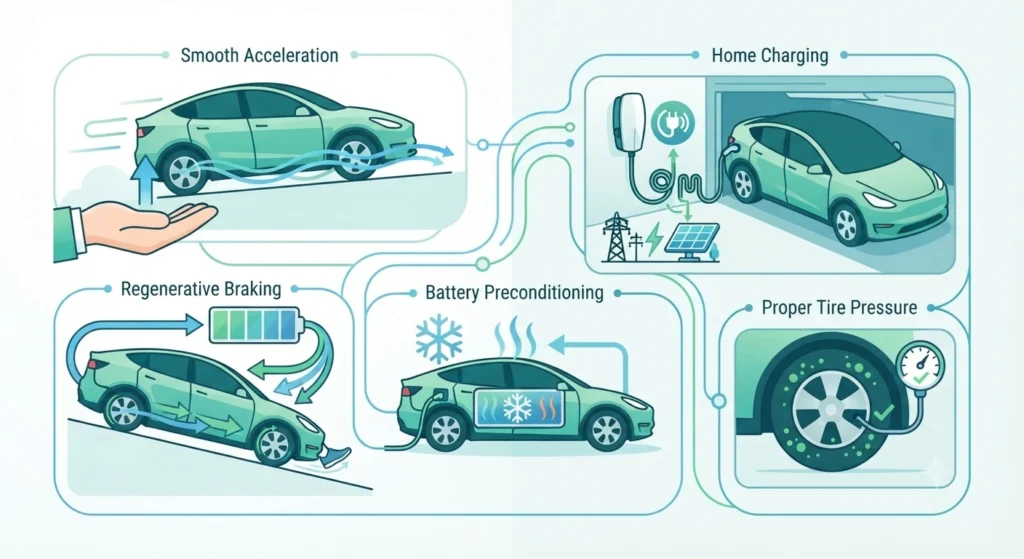
Even the longest range EV won’t achieve its official range if it’s driven inefficiently. Fortunately, a few simple habits can make a noticeable difference without slowing your journey.
1. Drive Smoothly
Rapid acceleration and hard braking consume more energy than steady driving.
Instead:
- Accelerate gradually.
- Maintain a consistent speed whenever possible.
- Leave enough space to avoid sudden braking.
Modern EVs deliver instant torque, which is fun—but using full acceleration frequently will reduce efficiency.
2. Use Regenerative Braking
Regenerative braking converts some of the vehicle’s kinetic energy back into electricity.
Most EVs let you adjust regeneration strength.
Higher regenerative braking is especially useful for:
- City driving
- Stop-and-go traffic
- Mountain roads
- Descending hills
It can help recover energy that would otherwise be lost through conventional braking.
3. Keep Tire Pressure Correct
Low tire pressure increases rolling resistance.
Checking your tires every few weeks can:
- Improve efficiency
- Extend tire life
- Enhance handling
- Improve safety
It’s one of the easiest maintenance tasks that directly affects driving range.
4. Precondition Before Driving
Many EVs allow you to heat or cool the cabin while the vehicle is still plugged in.
This helps because:
- Cabin heating uses electricity.
- Battery conditioning improves efficiency.
- Less energy is taken from the battery after departure.
This feature is particularly valuable during winter.
5. Reduce Unnecessary Weight
Extra weight means the battery must work harder.
Remove items you don’t regularly need, such as:
- Heavy toolboxes
- Sports equipment
- Roof storage boxes
- Bike racks when not in use
Every kilogram matters over long journeys.
6. Plan Charging Stops
A well-planned charging strategy often saves more time than trying to stretch every mile from the battery.
Many navigation systems automatically recommend efficient charging stops based on:
- Remaining battery
- Route
- Weather
- Elevation
- Charger availability
Is Paying More for a Bigger Battery Worth It?
Not always.
Many buyers assume the largest battery automatically offers the best value.
The reality depends on your driving habits.
A Larger Battery Makes Sense If You:
- Drive more than 250–300 miles regularly.
- Frequently travel between cities.
- Have limited charging access.
- Live in very cold climates.
- Tow heavy loads.
A Smaller Battery May Be Enough If You:
- Mostly commute locally.
- Charge at home every night.
- Rarely drive long distances.
- Want a lower purchase price.
- Prefer better efficiency over maximum range.
For many households, a well-designed EV with around 250–350 miles of official range is more than sufficient for everyday driving.
Long Range Sedan vs Long Range SUV
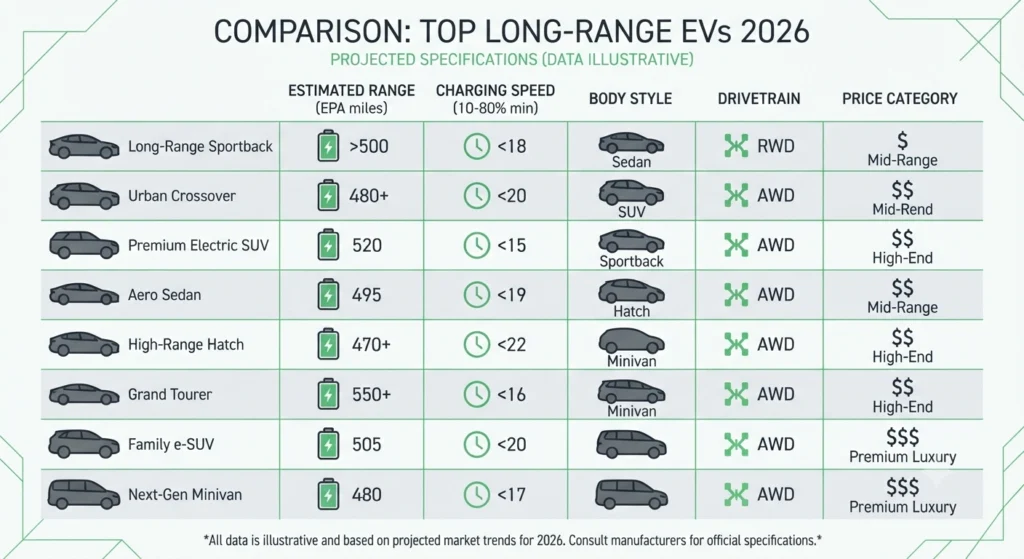
One of the biggest decisions buyers face is choosing between a sedan and an SUV.
| Feature | Long-Range Sedan | Long-Range SUV |
|---|---|---|
| Efficiency | Excellent | Good |
| Aerodynamics | Better | Lower |
| Highway Range | Usually higher | Usually lower |
| Passenger Space | Moderate | Excellent |
| Cargo Capacity | Moderate | Large |
| Driving Position | Lower | Higher |
| Family Friendliness | Good | Excellent |
| Off-Road Capability | Limited | Better on AWD models |
If maximum efficiency is your goal, sedans usually perform better.
If practicality matters more, an SUV is often the better choice.
Should Charging Speed Matter More Than Maximum Range?
For many buyers, yes.
Imagine two vehicles:
Vehicle A
- 450-mile range
- Slow fast charging
Vehicle B
- 340-mile range
- Extremely fast charging
During a long road trip, Vehicle B could actually complete the journey sooner because each charging stop is much shorter.
That’s why experienced EV owners often look at:
- Charging curve
- Peak charging power
- Battery thermal management
- Charging network compatibility
—not just the official range figure.
Practical Buying Tips
Before purchasing any long-range EV, consider these points.
Think About Your Daily Driving
Most people drive far less each day than their vehicle’s maximum range.
Buying significantly more range than you’ll ever use may not be cost-effective.
Check Charging Availability
Ask yourself:
- Can I install a home charger?
- Are public chargers common where I live?
- Are fast chargers available on my regular routes?
Charging convenience often matters more than an extra 30 or 40 miles of range.
Compare Warranty Coverage
Battery warranties differ between manufacturers.
Look for details on:
- Warranty duration
- Mileage limits
- Capacity retention guarantees
- Transferability for future owners
Test the Infotainment System
You’ll interact with the infotainment screen every day.
Make sure it’s:
- Easy to use
- Responsive
- Compatible with your smartphone
- Comfortable for navigation
Research Ownership Costs
Beyond purchase price, compare:
- Insurance
- Maintenance
- Tire replacement
- Charging costs
- Service availability
- Software updates
Lower ownership costs can save thousands over several years.
Common Mistakes to Avoid
Many first-time EV buyers focus on the wrong specifications.
Avoid these common mistakes.
Buying Based Only on Official Range
Range is important, but it isn’t everything.
Charging speed, efficiency, warranty, reliability, and practicality matter too.
Ignoring Home Charging
A home charger dramatically improves EV ownership.
Without convenient charging, even the best electric car can become frustrating.
Assuming All Charging Networks Are Equal
Charging availability varies by country and region.
Before buying, check the charging infrastructure where you actually drive.
Overlooking Cargo and Passenger Space
An EV with excellent range may not fit your family’s needs.
Always consider:
- Rear-seat comfort
- Cargo volume
- Child-seat compatibility
- Roof load capacity
Forgetting About Winter Driving
Cold weather affects every EV.
If you regularly experience freezing temperatures, leave extra range as a safety buffer.
Frequently Asked Questions
What is the longest range EV available in 2026?
Premium electric sedans currently offer the highest official driving ranges. The exact leader depends on the market, model year, battery configuration, and whether EPA or WLTP ratings are being compared.
Is 300 miles of EV range enough?
For most drivers, yes.
A vehicle offering around 300 miles of official range comfortably covers daily commuting, weekend trips, and occasional long-distance travel with planned charging stops.
Does fast charging reduce battery life?
Occasional DC fast charging is generally expected by manufacturers and is accounted for in battery management systems. However, relying on fast charging for every charge may increase battery wear over many years compared with primarily using slower AC charging.
Which body style offers the best range?
Electric sedans usually achieve the highest efficiency because they are lighter and more aerodynamic than similarly sized SUVs
Is EPA or WLTP more accurate?
EPA ratings generally align more closely with real-world driving in North America, while WLTP is the official standard used in Europe and several other global markets.
Should I choose range or charging speed?
Ideally, both.
If you regularly travel long distances, a slightly lower-range EV with significantly faster charging may provide a better overall ownership experience than a higher-range model with slower charging
Conclusion
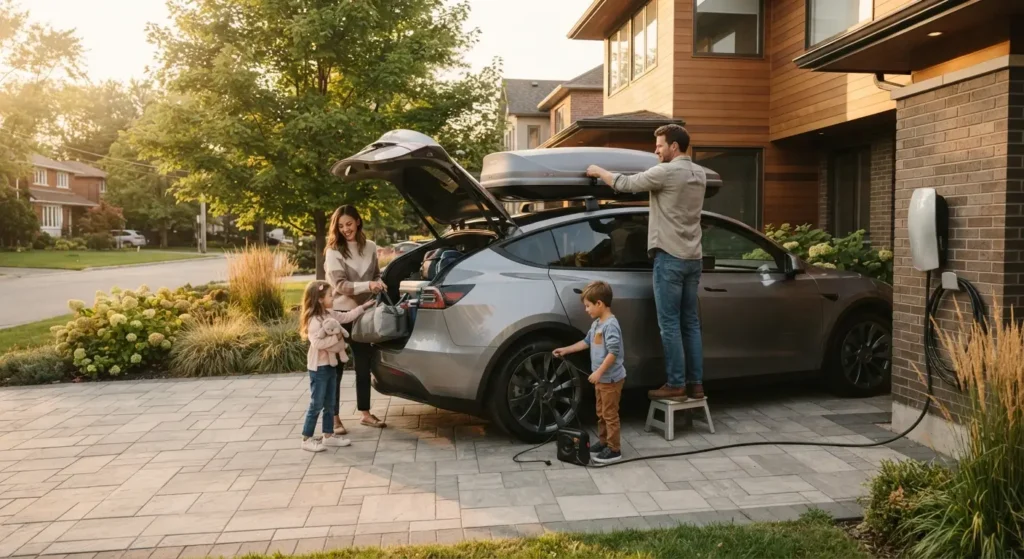
The longest range EV isn’t automatically the best electric car for every driver. While impressive range reduces charging stops and provides extra confidence on longer journeys, it should be balanced against charging speed, efficiency, comfort, practicality, warranty, and total ownership costs.
Before making your decision, compare vehicles using the same testing standard, think honestly about your daily driving habits, and consider where you’ll charge most often. For many buyers, the smartest EV isn’t simply the one with the biggest battery—it’s the one that fits their lifestyle best.