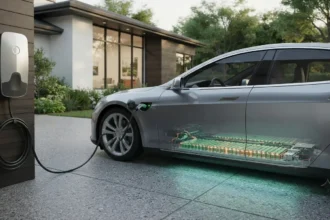
EV battery recycling turns used electric-vehicle batteries into reusable materials such as lithium, nickel, cobalt, copper, aluminium, graphite, and steel. Before recycling, many packs are tested for repair, remanufacturing, or use in stationary energy storage. Batteries that can’t be reused are discharged, dismantled, shredded, separated, and processed through thermal, chemical, or direct-recycling methods.
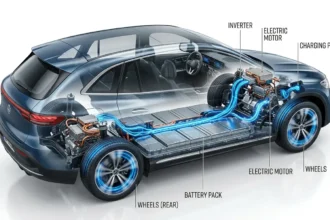
That sounds straightforward, but the real process is more complex. An EV battery is a large, high-voltage system containing hundreds or thousands of cells, cooling hardware, electronics, wiring, structural parts, and valuable active materials. Handling it safely requires specialist equipment and trained technicians.
EV battery recycling is the process of safely collecting, dismantling, and treating used electric-car batteries so valuable materials can return to battery or industrial production. Packs with useful capacity may first serve a second life in stationary storage, while damaged or unsuitable batteries usually go directly to recycling.
Understanding this process matters because millions of electric cars are now entering the global vehicle fleet. Most of their batteries won’t need recycling for many years, but damaged packs, manufacturing scrap, recalled modules, and batteries from early EVs are already feeding a growing recycling industry.
Why EV Battery Recycling Matters
Electric vehicles reduce dependence on petrol and diesel, but their batteries require significant quantities of mined and processed materials.
Depending on the chemistry, a lithium-ion EV battery may contain lithium, nickel, cobalt, manganese, iron, phosphate, graphite, copper, and aluminium. Mining and refining these materials consume energy, affect local environments, and expose manufacturers to supply-chain risks.
Recycling doesn’t remove the need for mining. At least not yet. EV production is still expanding faster than end-of-life batteries are becoming available. However, recovered materials can gradually reduce the amount of newly extracted material needed for future batteries.
The International Energy Agency expects the flow of used EV batteries to grow substantially as older electric cars reach retirement. It also notes that future recycling supply will depend on vehicle lifetimes, exports of used EVs, battery repair, second-life use, and the timing of scrappage.
A stronger recycling system can help in several ways:
- Reduce demand for newly mined battery minerals
- Recover valuable materials already inside the economy
- Improve supply security for battery manufacturers
- Prevent unsafe disposal and informal dismantling
- Lower some environmental impacts associated with raw-material production
- Create a more circular battery supply chain
- Give automakers better control over end-of-life battery handling
Recycling also matters for safety. A damaged lithium-ion battery may retain significant electrical energy even when it can no longer power a vehicle properly. Crushing, puncturing, heating, or incorrectly transporting one can cause short circuits, toxic emissions, or fire.
That is why an EV battery should never enter normal household waste, scrap-metal bins, or informal dismantling channels.
What Happens When an EV Battery Reaches the End of Its Vehicle Life?
A battery leaving an electric car isn’t automatically waste.
Its next step depends on its physical condition, remaining capacity, chemistry, design, ownership history, repairability, and economic value. A professional assessment usually places it into one of four routes.
1. Repair and Return to the Same Vehicle
Some battery problems affect only a module, contactor, sensor, cooling component, wiring connection, or battery-management-system part.
If the pack remains structurally safe, a qualified repair facility may replace the failed component and return the battery to service. This is often the most resource-efficient outcome because it avoids replacing or processing an otherwise usable pack.
Battery repair isn’t available for every vehicle. Some packs are easier to open and service than others, and manufacturer procedures vary. Warranty terms, parts availability, diagnostic access, and local safety rules also affect whether repair is practical.
For owners, this means a battery warning doesn’t always signal complete battery failure. A proper diagnosis should come before any replacement decision. See EV Maintenance Guide for a broader look at EV servicing and ownership.
2. Remanufacturing or Refurbishment
A battery may be removed, inspected, dismantled, and rebuilt using tested modules or cells with similar performance characteristics.
The refurbished pack may return to the original car or be sold as a replacement for another compatible vehicle. Careful matching matters because modules with very different capacity, resistance, temperature behaviour, or age can create imbalance.
Remanufacturing can extend the useful life of older EVs, but quality control is essential. Buyers should look for clear testing records, warranty coverage, professional installation, and evidence that the battery-management system has been correctly configured.
3. Second-Life Use
A pack that no longer meets the demands of driving may still work in a less demanding role.
An EV needs a battery that can deliver predictable range, strong acceleration, rapid power changes, reliable fast charging, and safe operation across heat, cold, vibration, and repeated use. Stationary storage usually places less stress on the battery.
A second-life pack may support:
- Solar-energy storage
- Commercial building energy management
- Backup power
- Off-grid electricity systems
- Charging-site load management
- Grid-balancing projects
- Temporary or mobile power systems
Second-life batteries must still be tested, integrated, cooled, monitored, and protected. They aren’t simply removed from a car and connected to a building.
4. Recycling
A battery goes directly to recycling when it is badly damaged, unsafe, uneconomic to repair, unsuitable for second-life use, or genuinely worn out.
Recycling may also be the better option when the recovered materials are worth more than the battery’s remaining usefulness. This calculation changes with mineral prices, labour costs, transport distances, battery chemistry, and the price of new stationary-storage batteries.
How EV Battery Recycling Works Step by Step
The exact recycling process differs between facilities. Pack construction, chemistry, local regulations, available technology, and the recycler’s business model all influence the route.
Still, most EV battery recycling follows the same broad sequence.
Step 1: Collection and Safe Transportation
The battery first travels from a dealer, repair shop, dismantler, manufacturer, insurance yard, or vehicle recycling facility to an authorised handler.
Transport can be difficult because EV packs are heavy, high-voltage devices. Damaged batteries need special packaging, isolation, documentation, and fire-risk controls. Transport rules vary between countries and regions, so the responsible company must follow local hazardous-goods requirements.
A pack involved in a crash may need monitoring before transport. Swelling, coolant leakage, water exposure, damaged casing, or evidence of overheating can change how it is stored and moved.
Step 2: Identification and Initial Inspection
The recycler identifies the battery’s manufacturer, chemistry, voltage, configuration, condition, and history where records are available.
This step helps determine whether the pack should be:
- Repaired
- Refurbished
- Used in a second-life project
- Disassembled for components
- Sent directly into material recovery
Battery passports, digital service records, clearer labels, and standardised state-of-health data could make this stage faster in the future. At present, access to reliable battery information can vary widely.
Step 3: Electrical Discharge and Isolation
Even an apparently dead EV battery may hold dangerous energy.
Technicians isolate the pack, disconnect high-voltage circuits, and reduce its remaining charge through a controlled process. Some facilities may recover and use the remaining electricity rather than wasting it.
The battery-management system, service disconnects, contactors, and isolation checks all play a role. This work should only be carried out by properly trained personnel using suitable personal protective equipment and insulated tools.
To understand how cells, modules, packs, and battery-management systems work together, read How EV Batteries type
Step 4: Pack Dismantling
Workers or automated equipment remove the outer casing and separate components such as:
- Battery modules
- Cooling plates and pipes
- Electrical cables
- Busbars
- Control electronics
- Steel or aluminium housings
- Plastics and insulation
- Fasteners and structural parts
Some of these materials, particularly steel, aluminium, and copper, can enter established recycling streams.
Pack design makes a major difference here. Bolted parts are generally easier to separate than heavily bonded, welded, or foam-filled assemblies. Better design for disassembly could reduce labour, improve safety, and preserve more value.
Automation is growing, but battery packs differ so much in size and layout that complete robotic dismantling remains challenging.
Step 5: Module and Cell Processing
After dismantling, cells or modules are prepared for material recovery.
Many facilities mechanically shred or crush the cells in a controlled environment. This creates mixed material streams that can be separated using screens, magnets, air classification, density separation, and other methods.
The process may recover:
- Ferrous metals
- Aluminium
- Copper
- Plastics
- A fine powder commonly called black mass
Black mass contains much of the battery’s active material, including combinations of lithium, nickel, cobalt, manganese, iron, phosphate, and graphite, depending on the chemistry.
The black mass then moves into one or more refining processes.
The Main Lithium Battery Recycling Methods
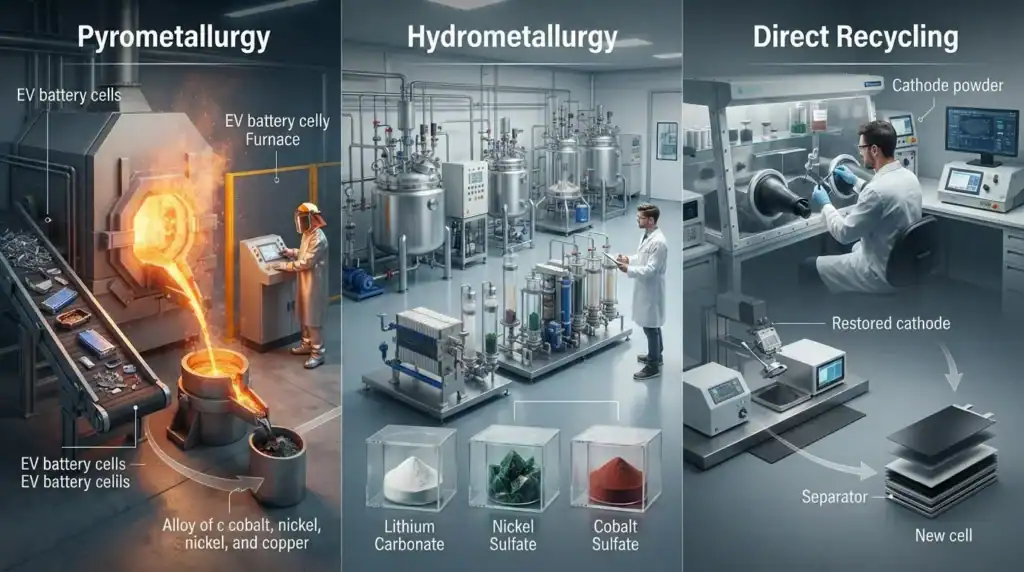
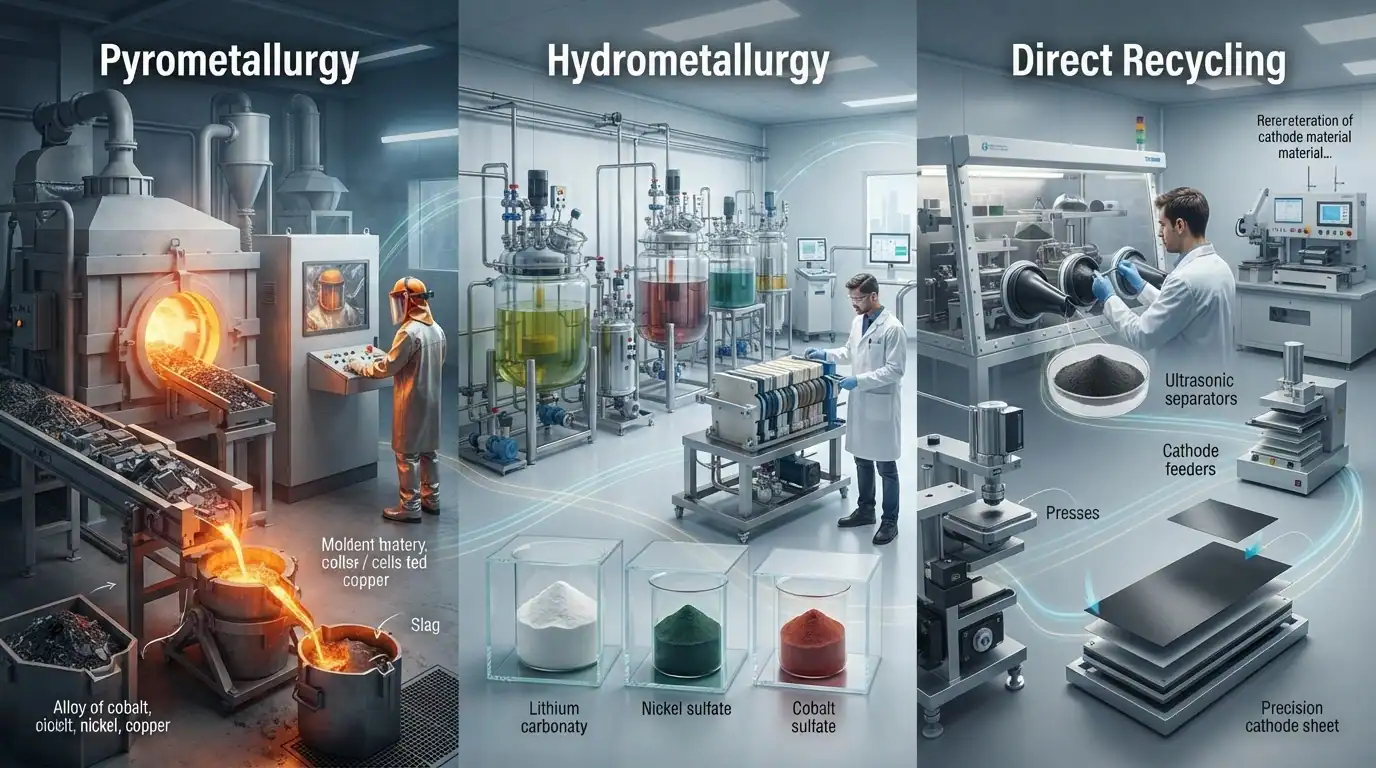
Three methods dominate discussions about lithium battery recycling: pyrometallurgy, hydrometallurgy, and direct recycling.
They aren’t always used separately. A recycler may combine mechanical separation with thermal treatment and chemical refining.
| Recycling method | Basic process | Main strengths | Main limitations |
|---|---|---|---|
| Pyrometallurgy | Uses high temperatures to smelt battery materials | Can handle mixed feedstocks and damaged material | High energy use; some materials may require further recovery steps |
| Hydrometallurgy | Uses chemical solutions to dissolve and separate metals | Can recover battery metals with high selectivity | Requires chemical management, purification, and wastewater controls |
| Direct recycling | Preserves and restores cathode or other active materials | May retain more material value and use less processing | Requires cleaner sorting and is less commercially mature |
Pyrometallurgy
Pyrometallurgy uses high-temperature furnaces to process battery materials.
The heat burns or separates organic components and produces a metal-containing alloy, slag, or other material streams. Nickel, cobalt, and copper are often attractive targets in this process because of their value and behaviour during smelting.
Its main advantage is tolerance. A thermal process may accept mixed battery chemistries and less carefully separated feedstock.
The disadvantages are significant. Furnaces consume substantial energy, require emissions controls, and may not recover every material efficiently. Lithium and aluminium, for example, can move into slag or other streams that need further processing.
Pyrometallurgy is established industrial technology, but it isn’t always the best route when the goal is to preserve the highest possible value from battery materials.
Hydrometallurgy
Hydrometallurgy uses liquids, usually acids or other chemical solutions, to leach metals from black mass.
After dissolution, the recycler applies precipitation, solvent extraction, filtration, crystallisation, or related techniques to separate and purify individual materials.
This method can recover lithium alongside nickel, cobalt, manganese, and other elements. It generally operates at lower temperatures than smelting, although mechanical preparation and chemical handling still require energy and careful environmental control.
Hydrometallurgy’s strengths include selective recovery and the ability to produce purified chemical products. Its drawbacks include reagent use, complex processing, wastewater treatment, and the need to remove contamination.
Direct Recycling
Direct recycling aims to recover battery components without breaking them completely into basic elements.
For example, a recycler may separate cathode material, remove contamination, restore its lithium content, and adjust its structure so it can be used again. The goal is to preserve more of the energy and value already invested in manufacturing the material.
The US Department of Energy’s ReCell Center describes direct recycling as the recovery, regeneration, and reuse of battery components while preserving their chemical structure. It remains less established than pyrometallurgical and hydrometallurgical processing, but researchers see strong potential if technical and commercial barriers can be overcome.
The biggest challenge is sorting. Cathode materials must be identified and kept relatively pure. Mixing different formulations can make it hard to produce a consistent recycled product.
Direct recycling may become more practical as battery tracking improves and recycling plants gain access to larger, more predictable streams of similar batteries.
How Battery Chemistry Changes the Recycling Equation
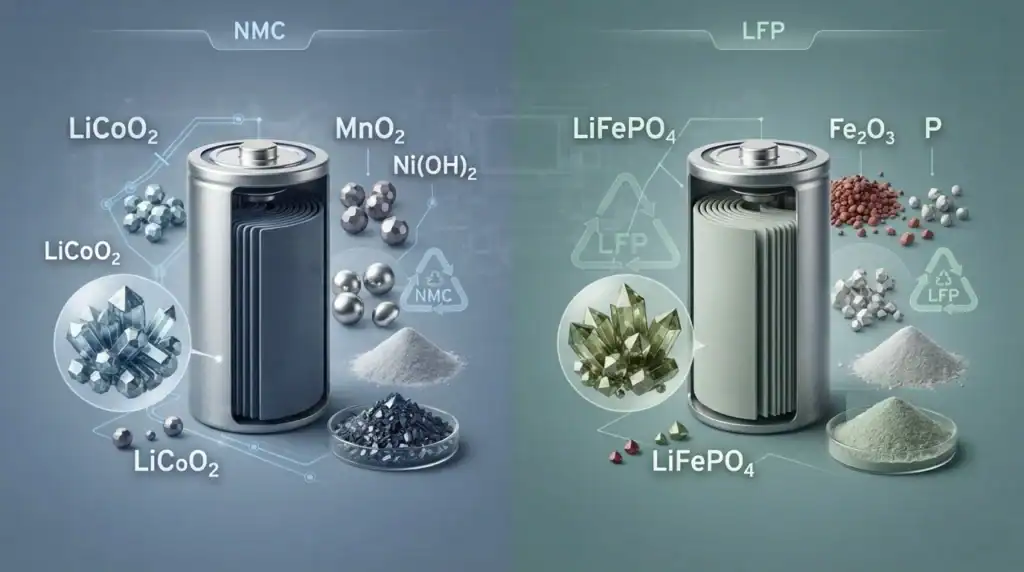
Not every EV battery contains the same materials.
Two common lithium-ion cathode families are nickel-manganese-cobalt, usually called NMC, and lithium iron phosphate, known as LFP. Other chemistries and variations also exist.
NMC Batteries
NMC batteries contain nickel, manganese, and cobalt in different proportions, along with lithium and other battery materials.
Historically, nickel and cobalt have helped make NMC packs attractive to recyclers because recovered materials can carry meaningful economic value. Manufacturers have changed NMC formulations over time, often reducing cobalt content and increasing nickel content.
The exact chemistry matters because it affects both processing and revenue.
LFP Batteries
LFP batteries use lithium, iron, and phosphate in the cathode rather than nickel and cobalt.
They are widely used in electric vehicles, including models sold by companies such as Tesla and BYD, although chemistry can vary by model, production plant, and market. Buyers shouldn’t assume a vehicle’s chemistry without checking reliable manufacturer information.
LFP offers advantages such as good cycle life, thermal stability, and reduced reliance on nickel and cobalt. However, its lower-value cathode materials can make conventional recycling less profitable.
That doesn’t mean LFP batteries shouldn’t be recycled. They still contain lithium, graphite, copper, aluminium, electrolyte, and other recoverable materials. It means recyclers need efficient processes, scale, sensible regulation, and stronger markets for the recovered products.
Battery Chemistry Comparison
| Battery chemistry | Notable cathode materials | Recycling consideration |
| NMC | Lithium, nickel, manganese, cobalt | Higher-value metals can improve recycling economics |
| NCA | Lithium, nickel, cobalt, aluminium | Valuable nickel and cobalt remain key recovery targets |
| LFP | Lithium, iron, phosphate | Lower material value may make profitability more difficult |
| LMO and blended chemistries | Lithium and manganese, sometimes blended with other materials | Processing value depends on the exact formulation |
Battery design matters as much as chemistry. Cell-to-pack construction, adhesives, structural battery systems, cooling arrangements, and software access can all affect dismantling costs.
What Are Second-Life EV Batteries?
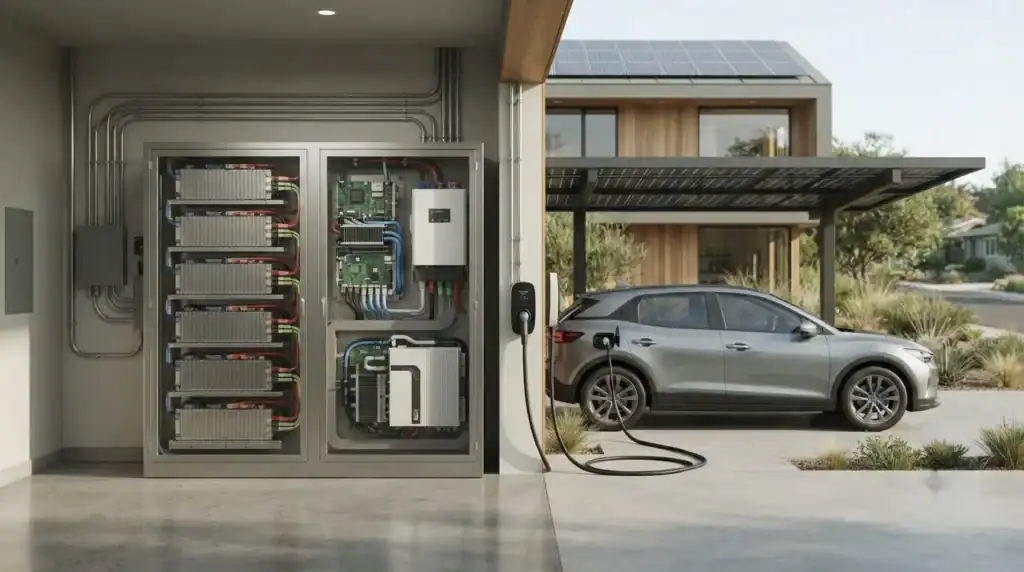
Second-life batteries are used EV batteries repurposed for a different application instead of being immediately recycled.
The idea makes sense because vehicle retirement and battery retirement aren’t always the same thing. A battery may no longer deliver the range, power, charging consistency, or warranty performance expected in a car, yet still store useful energy.
Stationary storage can be a good fit because the battery doesn’t face road vibration, rapid acceleration, extreme power swings, or the same weight and space limits as it did in a vehicle.
A second-life system might store daytime solar generation and release it later. It might help a business reduce peak electricity demand. It could also provide backup power or support an EV charging location where grid capacity is limited.
However, battery reuse has practical limits.
Advantages of Second-Life Batteries
- Extends the useful life of manufactured cells
- Delays energy-intensive material processing
- May provide lower-cost storage when testing and integration are economical
- Supports renewable-energy systems
- Creates value before final recycling
- Reduces immediate waste volumes
Disadvantages and Challenges
- Packs arrive with different ages and usage histories
- State-of-health testing can be difficult
- Vehicle batteries use different shapes, voltages, software, and cooling systems
- Reconfiguration requires skilled labour
- Safety certification may be complex
- New storage batteries are becoming cheaper
- Warranties and long-term performance can be uncertain
- Transport and installation costs may erase expected savings
The IEA has highlighted both second-life use and recycling as potential tools for reducing battery supply-chain impacts. It also notes that declining new-battery prices can weaken the economics of used packs.
For that reason, second life isn’t automatically the best environmental or financial choice. A heavily degraded, damaged, poorly documented, or difficult-to-integrate pack may be better sent directly to a qualified recycler.
Is EV Battery Recycling Environmentally Friendly?
Recycling has environmental benefits, but it isn’t impact-free.
Transporting heavy batteries uses energy. Dismantling requires equipment and facilities. Smelting consumes heat. Chemical refining uses reagents, water, electricity, and treatment systems. Every recycling route produces residual materials that must be managed responsibly.
The fair comparison isn’t “recycling versus no environmental impact.” It is “recycling versus continued reliance on newly mined and refined materials, combined with unsafe or wasteful disposal.”
A well-run recycling system can reduce the need for some primary material production and keep valuable resources in circulation. The environmental outcome depends on:
- The electricity source used by the recycling plant
- Recovery rates for each material
- Transport distance
- Battery chemistry
- Process efficiency
- Pollution controls
- Whether recovered materials displace virgin production
- What happens to plastics, electrolyte, graphite, and low-value residues
The strongest circular model sends recovered battery materials back into battery production rather than downcycling them into lower-value uses.
That closed-loop goal is difficult, but it is central to research at organisations such as the ReCell Center.
EV Battery Recycling Rules Around the World
Battery regulations are developing quickly, and requirements differ by country, state, province, or region.
The European Union’s Battery Regulation, Regulation (EU) 2023/1542, establishes rules covering battery sustainability, waste collection, recycling efficiency, material recovery, recycled content, labelling, and producer responsibilities. Requirements are being introduced in stages rather than all at once.
The regulation sets targets for lithium-based battery recycling efficiency and the recovery of specific materials. Exact deadlines and calculation methods should be checked against current EU legislation because implementing and delegated rules can change how requirements apply.
In the United States, battery handling involves a mixture of federal transport and environmental rules, state programmes, automaker arrangements, and private recycling networks. Canada, the UK, Australia, and other markets also use their own combinations of hazardous-waste controls, product stewardship, producer responsibility, and transport regulation.
For consumers, the practical rule is simple: don’t try to dispose of an EV traction battery yourself. Contact the vehicle manufacturer, authorised dealer, insurer, repairer, dismantler, or approved battery recycler.
Policies and collection systems change frequently. Owners and businesses should verify the latest requirements with their local environmental or transport authority.
What EV Owners Should Know
Most EV drivers won’t personally manage battery disposal. The battery will usually remain in the vehicle for years and may still have value when the car is sold.
Still, a few ownership decisions can improve safety and long-term outcomes.
Keep Battery and Service Records
Maintain invoices, diagnostic reports, warranty documents, repair records, and battery-health reports.
Good records can help a future buyer, repair facility, remanufacturer, or recycler understand the pack’s history. They may also make it easier to determine whether repair or reuse is suitable.
Don’t Judge Battery Health by Range Alone
Range changes with weather, driving speed, tyre pressure, climate-control use, load, road conditions, and charging habits.
A proper battery assessment should consider usable capacity, cell balance, fault codes, charging behaviour, insulation resistance, temperature data, and other vehicle-specific information.
Investigate Battery Warnings Promptly
A warning light may indicate a cooling fault, sensor issue, isolation problem, cell imbalance, software problem, or damaged component.
Continuing to drive without diagnosis can make a small problem more expensive or create a safety risk.
Use Qualified Repairers
High-voltage batteries aren’t suitable for untrained home repair.
Choose technicians with EV-specific training, suitable diagnostic tools, insulated equipment, and a safe high-voltage workspace.
Check Battery Coverage When Buying Used
When considering a used EV, review:
- Remaining battery warranty
- Battery-health information
- Fast-charging history, if reliably available
- Evidence of crash or flood damage
- Charging performance
- Repair records
- Availability and cost of specialist support
- Local options for module repair or refurbished packs
Before choosing your next EV, compare the best electric cars of 2026 by price, range, and features
Follow Manufacturer Charging Guidance
Normal charging doesn’t prevent eventual ageing, but good habits can reduce avoidable stress.
Drivers usually don’t need to keep the battery at 100% every day unless the manufacturer recommends it for that battery chemistry or the trip requires it. Charging advice varies, especially between LFP and nickel-based batteries, so follow the vehicle’s manual and software guidance.
For charging options, see Level 2 vs DC Fast Charging and EV Charging Guide, Costs, Types, Charging Time & Home Installation
Common EV Battery Recycling Mistakes to Avoid
Assuming Every Used Battery Goes Straight Into a Shredder
Many batteries are inspected before recycling. Repair, remanufacturing, parts recovery, and second-life use may preserve more value than immediate material processing.
Calling a Battery “Dead” When It Still Holds Energy
A battery that can’t move a car may still contain dangerous voltage and stored energy. Never open, puncture, crush, burn, or transport a traction battery without professional support.
Believing Recycling Recovers Everything Perfectly
Recovery performance differs by material, chemistry, facility, and process. Steel, copper, aluminium, nickel, cobalt, lithium, graphite, plastics, electrolyte, and binders don’t all follow the same recovery path.
Treating Second Life as the Best Option in Every Case
Reuse can extend battery life, but testing, transport, reconfiguration, certification, cooling, software, and installation add cost. Direct recycling may be more sensible for damaged or poorly documented packs.
Ignoring Battery Chemistry
NMC, NCA, LFP, and other chemistries have different material values and processing needs. A recycling method that works economically for one feedstock may be less attractive for another.
Using an Unverified Battery Buyer
An unusually high offer for a damaged pack may hide unsafe handling or improper export and disposal practices. Use authorised businesses that can explain transportation, storage, testing, and final treatment.
The Future of EV Battery Recycling
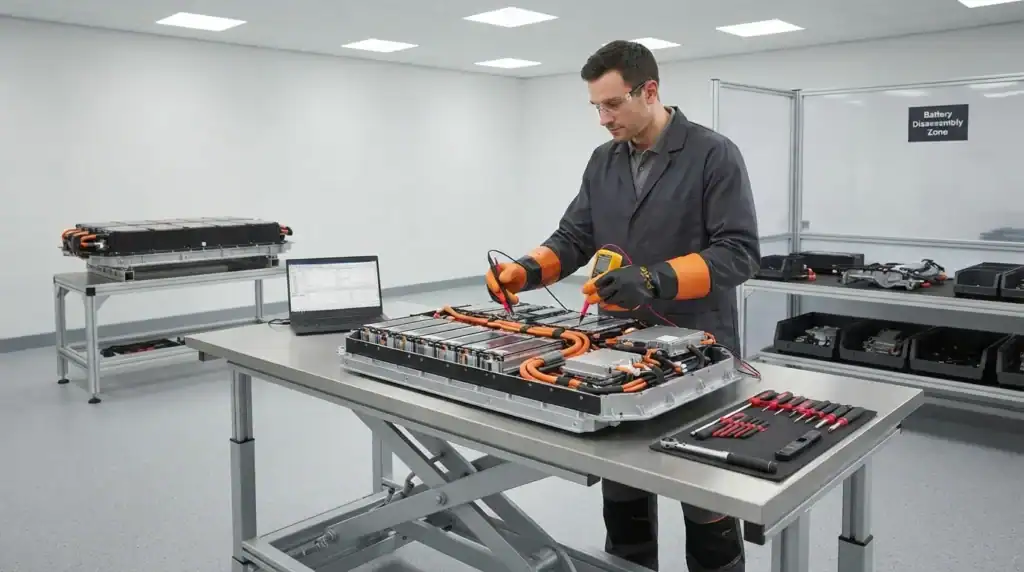
The future of EV battery recycling will depend on more than building larger shredders and chemical plants.
The whole battery system needs to improve, from vehicle design to material tracking.
Better Design for Repair and Disassembly
Packs designed with replaceable modules, accessible fasteners, clear isolation points, and fewer permanent adhesives can be safer and cheaper to service.
Automakers also need to balance repairability with crash protection, water resistance, weight, cost, and structural performance. There is no single design solution for every vehicle.
Battery Passports and Better Data
A digital battery record could include chemistry, manufacturing origin, repair history, carbon information, and state-of-health data.
Reliable information would help repairers, used-car buyers, insurers, second-life operators, and recyclers make better decisions. It could also reduce the risk of mixing incompatible materials.
More Automation
Robotic systems may eventually handle more pack opening, fastener removal, module separation, and sorting.
Automation could reduce worker exposure to high voltage and hazardous materials. The obstacle is variety: batteries differ enormously between brands and generations.
Improved Direct Recycling
Direct recycling could preserve more of the cathode’s manufactured value than methods that break materials down and rebuild them.
Its success will depend on accurate chemistry identification, clean separation, consistent feedstock, and proof that recovered material meets battery-manufacturing standards.
Better Recovery of Graphite and Electrolyte
Commercial recycling has often focused on metals with the clearest economic value. Future plants are likely to place more attention on graphite, lithium, electrolyte components, plastics, and other materials that have historically been difficult or less profitable to recover.
Regional Recycling Supply Chains
Moving damaged batteries across long distances adds cost and risk.
More regional collection, diagnostic, dismantling, and refining capacity could shorten transport routes and support local battery production. However, recycling plants also need enough feedstock to operate economically, so building too much capacity too early can create financial pressure.
Recycling Built Around Changing Chemistries
The market is shifting as LFP grows and manufacturers reduce expensive materials in some nickel-based batteries.
This is good for battery affordability and supply diversification, but it challenges recyclers whose business models depend on high-value cobalt and nickel. Future plants will need flexible processes and revenue models that don’t rely on one chemistry.
Frequently Asked Questions
Can an EV battery be recycled completely?
Not every part is recovered at the same rate or quality. Modern processes can recover many valuable metals and structural materials, but results vary by chemistry, facility, and method. Plastics, electrolyte, binders, and mixed materials can be harder to reuse in high-value applications.
How long do EV batteries last before recycling?
There is no fixed lifespan. Battery life depends on chemistry, temperature, charging, mileage, vehicle design, accident history, and use. Many packs may serve in vehicles for well over a decade, but damaged batteries and manufacturing scrap can reach recyclers much earlier.
What percentage of an EV battery can be recycled?
There is no single honest percentage for every battery. Some claims refer to total mass processed, while others refer to specific material recovery. Always check which materials, calculation method, and process stage a percentage covers.
Are Tesla and other EV batteries recyclable?
Yes. Lithium-ion packs used by Tesla, BYD, Hyundai, Rivian, and other manufacturers contain recoverable materials. The exact recycling route depends on the battery chemistry, pack design, condition, local facilities, and manufacturer arrangements.
Are second-life batteries safe?
They can be safe when professionally tested, engineered, installed, cooled, monitored, and protected. An untested used pack isn’t automatically safe for home energy storage. Certification, fire protection, electrical isolation, and a suitable battery-management system are essential.
Does battery recycling make EVs fully sustainable?
No vehicle is impact-free. Recycling can improve EV sustainability by reducing waste and recovering materials, but it doesn’t eliminate mining, manufacturing emissions, electricity use, tyre pollution, or vehicle-production impacts. It is one part of a broader lifecycle strategy.
The Road From Used Battery to New Resource
EV batteries don’t simply become useless when their vehicle life ends. Some can be repaired. Others can be remanufactured or repurposed for stationary energy storage. Packs that are damaged, unsafe, or truly worn out can enter specialised recycling systems that recover metals and other useful materials.
The strongest future system will combine durable battery design, professional repair, responsible second-life use, safe collection, efficient recycling, and clear material tracking. It must also adapt as the industry moves toward chemistries such as LFP that contain fewer high-value metals.
EV battery recycling won’t eliminate the environmental cost of producing batteries, but it can reduce waste, strengthen material supply, and keep valuable resources in circulation.
For owners, the practical recommendation is straightforward: keep the vehicle’s battery records and use an authorised manufacturer, repairer, dismantler, or recycler whenever a traction battery is damaged or reaches the end of its useful life.