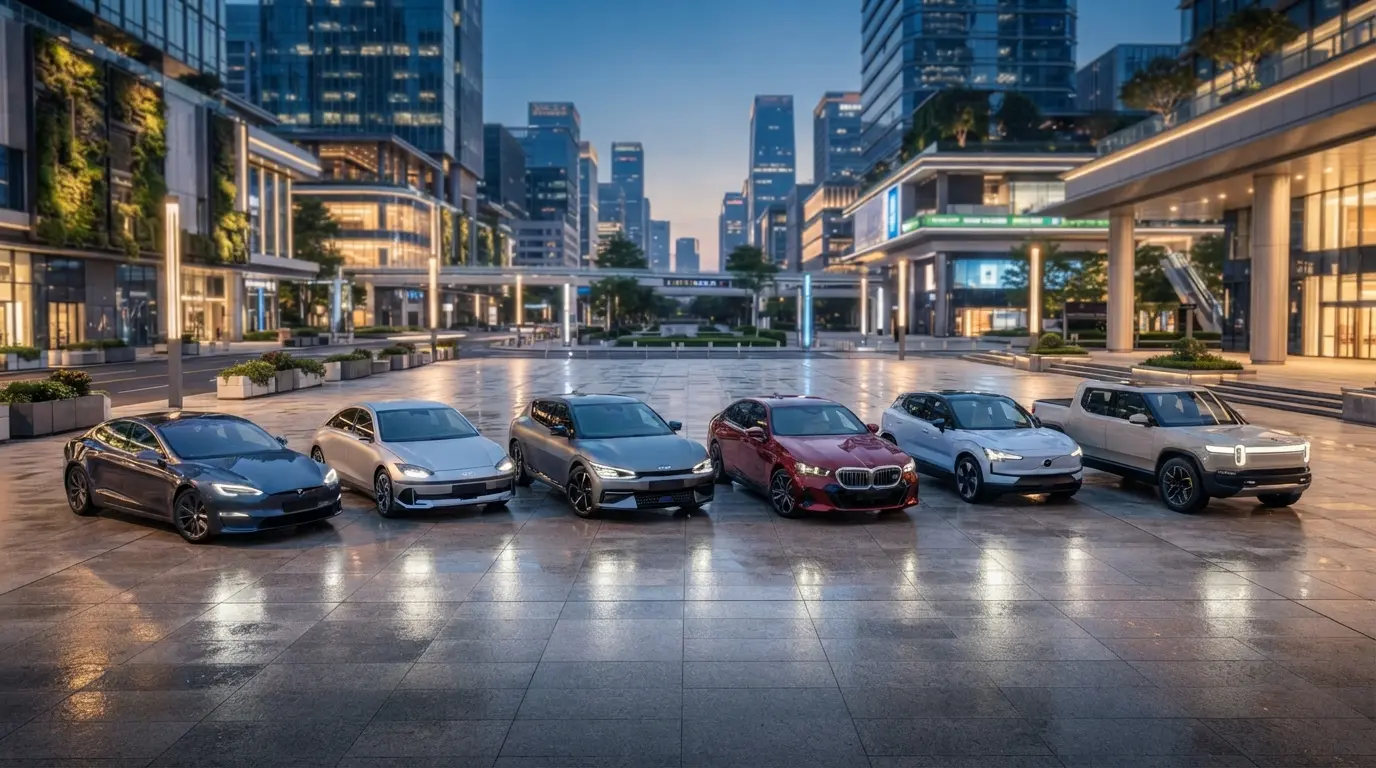
Electric vehicles are no longer a niche choice. In 2026, buyers have more options than ever, from affordable city EVs to premium luxury models and family-friendly SUVs. Longer driving ranges, faster charging, improved battery technology, and competitive pricing have made switching to an EV easier than it was just a few years ago.
If you’re searching for the best electric cars 2026, you’ve probably noticed that dozens of models promise impressive range, advanced technology, and lower running costs. The challenge isn’t finding an electric car—it’s choosing the one that fits your budget, driving habits, and daily needs.
This guide compares the top electric cars available in 2026 based on the factors that matter most:
- Driving range
- Purchase price
- Charging speed
- Performance
- Interior quality
- Technology
- Safety
- Overall value
Whether you’re buying your first EV, replacing a gasoline car, or upgrading to a newer model, this comparison will help you make an informed decision.
Prices, specifications, availability, and incentives vary by country and may change during the year. Always confirm details with your local manufacturer or dealer before purchasing.
Why Trust This Comparison?
Choosing the right EV isn’t just about finding the biggest battery or the longest range.
For this guide, every vehicle has been evaluated using practical buying criteria rather than marketing claims.
The comparison considers:
- Real-world usability
- Manufacturer reputation
- Charging network compatibility
- Technology and safety features
- Interior comfort
- Overall ownership value
- Availability across major markets
Instead of recommending only the most expensive models, we’ve included vehicles that deliver excellent value across different budgets.
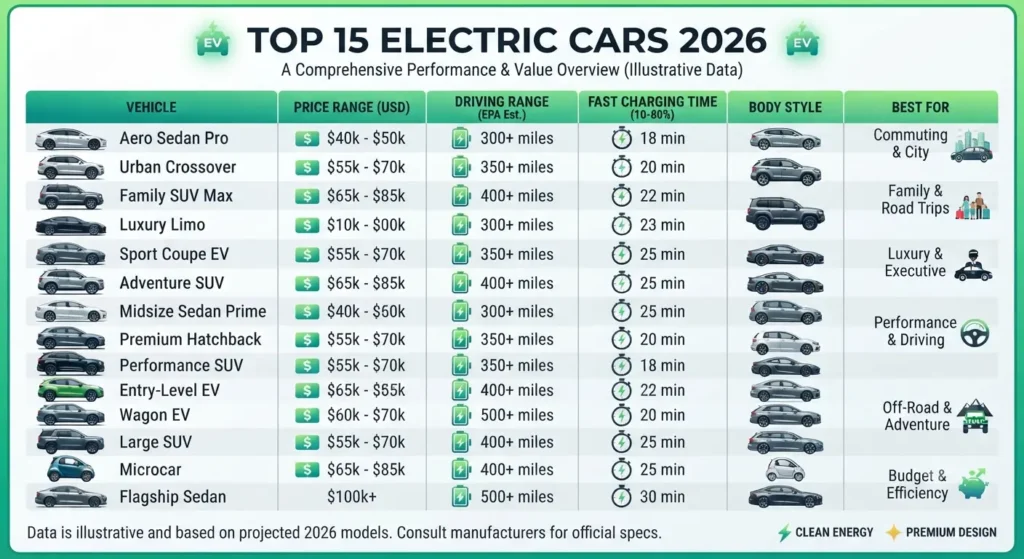
Best Electric Cars 2026 at a Glance
| Electric Car | Best For | Estimated Range* | Charging Speed | Price Range** |
|---|---|---|---|---|
| Tesla Model 3 | Overall Value | Excellent | Excellent | $$ |
| Tesla Model Y | Families | Excellent | Excellent | $$$ |
| Hyundai Ioniq 5 | Everyday Driving | Very Good | Excellent | $$$ |
| Kia EV6 | Performance & Style | Very Good | Excellent | $$$ |
| Kia EV9 | Large Families | Very Good | Excellent | $$$$ |
| BMW i4 | Luxury Sedan | Excellent | Very Good | $$$$ |
| Volvo EX30 | Compact SUV | Good | Very Good | $$$ |
| Volvo EX90 | Premium Family SUV | Excellent | Excellent | $$$$$ |
| Ford Mustang Mach-E | SUV Buyers | Very Good | Very Good | $$$ |
| Chevrolet Equinox EV | Budget SUV | Good | Good | $$ |
| Chevrolet Blazer EV | Sporty SUV | Very Good | Good | $$$ |
| Mercedes-Benz EQE SUV | Luxury | Excellent | Excellent | $$$$$ |
| Audi Q6 e-tron | Premium Technology | Excellent | Excellent | $$$$$ |
| Porsche Macan Electric | Driving Performance | Excellent | Excellent | $$$$$ |
| BYD Seal | Value & Technology | Very Good | Very Good | $$–$$$ |
*Actual driving range depends on weather, speed, terrain, wheels, cargo, and driving style.
**Prices vary by country, taxes, trim level, incentives, and exchange rates.
How We Ranked These Electric Cars
No single electric vehicle is perfect for everyone.
A commuter driving 30 miles each day has very different priorities than a family planning long road trips.
To keep this guide practical, every model was evaluated across several important categories.
1. Driving Range
Range remains one of the biggest buying factors.
Longer range means:
- fewer charging stops
- greater flexibility
- better road-trip capability
- improved resale appeal
However, range isn’t everything. A well-balanced EV with slightly less range but faster charging can be the better choice
2. Charging Performance
Modern EV buyers should look beyond battery size.
Fast charging matters because it reduces waiting time during long journeys.
We considered:
- DC fast charging capability
- AC home charging support
- charging network compatibility
3. Interior Comfort
Many buyers spend hours inside their vehicle every week.
Important factors include:
4. Technology
Today’s electric cars are essentially computers on wheels.
The best models include:
- advanced driver assistance
- wireless software updates
- intuitive infotainment
- smartphone integration
- efficient navigation with charging route planning
5. Safety
Safety is never optional.
Manufacturers continue improving:
- collision avoidance
- adaptive cruise control
- lane keeping assistance
- blind-spot monitoring
- emergency braking
Many modern EVs achieve excellent crash-test ratings in major markets.
6. Overall Value
The cheapest vehicle isn’t always the smartest purchase.
We also considered:
- equipment included
- warranty
- resale value
- expected reliability
- efficiency
- ownership costs
The Top 15 Electric Cars of 2026
1. Tesla Model 3 — Best Overall Electric Car
The Tesla Model 3 continues to set the benchmark for mainstream electric sedans.
Rather than relying on dramatic styling or luxury branding, it focuses on what matters most: efficiency, software, charging convenience, and everyday usability.
For many buyers, it offers one of the strongest combinations of range, technology, and operating costs available in 2026.
Pros
- Excellent driving range
- Access to an extensive fast-charging network in many regions
- Strong software ecosystem
- Responsive performance
- Efficient energy consumption
Cons
- Minimalist interior isn’t for everyone
- Ride quality may feel firm on some trims
- Limited physical buttons
Best For
Drivers looking for the best balance of price, range, technology, and ownership experience.
2. Tesla Model Y — Best Family Electric SUV
The Model Y remains one of the world’s most popular electric SUVs for good reason.
It combines generous cargo space, practical seating, long driving range, and strong performance in a package that works equally well for daily commuting and long-distance travel.
Families also benefit from its large storage capacity and versatile interior.
Pros
- Spacious cabin
- Large cargo area
- Excellent range
- Fast charging
- Advanced software
Cons
- Firm suspension on some versions
- Cabin design may feel too minimalist for some buyers
Best For
Families who want a practical electric SUV with impressive road-trip capability.
3. Hyundai Ioniq 5 — Best Value EV
The Hyundai Ioniq 5 continues to impress thanks to its distinctive design, comfortable cabin, and exceptionally fast charging capability.
Its spacious interior feels larger than many similarly sized SUVs, making it a strong choice for families and commuters alike.
The vehicle also delivers one of the smoothest driving experiences in its class.
Pros
- Ultra-fast charging support
- Spacious interior
- Comfortable ride
- Modern technology
- Competitive pricing
Cons
- Some trims may have limited availability
- Cargo space is good but not class-leading
Best For
Drivers who value comfort, fast charging, and everyday practicality.
4. Kia EV6 — Best Sporty Electric Car
The Kia EV6 offers a more dynamic driving experience without sacrificing practicality.
Its sleek styling, responsive handling, and impressive charging speeds make it an attractive option for buyers who want an EV that’s enjoyable to drive every day.
Inside, the cabin combines quality materials with intuitive technology and generous passenger space.
Pros
- Sporty handling
- Excellent charging speed
- Stylish design
- Comfortable cabin
- Good efficiency
Cons
- Rear visibility could be better
- Sport-focused suspension may feel firm for some drivers
Best For
Drivers looking for an engaging electric vehicle with everyday usability.
5. Kia EV9 — Best Large Family Electric SUV
For buyers needing three rows of seating, the Kia EV9 stands out as one of the strongest options available.
It offers generous passenger space, premium technology, modern safety features, and impressive road-trip capability.
Unlike many large SUVs, it delivers these benefits without the fuel costs associated with traditional gasoline-powered vehicles.
Pros
- Spacious three-row seating
- Modern interior
- Strong safety package
- Excellent family practicality
- Fast charging capability
Cons
- Larger size may not suit city parking
- Higher purchase price than compact EVs
Best For
Large families and buyers who frequently travel with passengers or luggage.
6. BMW i4 — Best Luxury Electric Sedan
The BMW i4 proves that switching to an electric vehicle doesn’t mean giving up the driving experience BMW is known for. It blends strong performance, premium materials, and long-distance comfort into a refined electric sedan that’s equally suited to daily commuting and highway travel.
The cabin feels upscale, with high-quality finishes, supportive seats, and one of the best infotainment systems in the luxury EV segment. Buyers looking for a traditional luxury sedan with electric power will find the i4 hard to overlook.
Pros
- Premium interior quality
- Excellent driving dynamics
- Strong driving range
- Advanced driver assistance features
- Comfortable for long journeys
Cons
- Higher starting price than mainstream EVs
- Rear headroom is slightly limited compared to SUVs
Best For
Professionals and luxury buyers who want premium comfort without sacrificing performance.
7. Volvo EX30 — Best Compact Electric SUV
The Volvo EX30 is designed for drivers who want a compact SUV that’s easy to drive in cities while still offering modern technology and strong safety credentials.
Despite its smaller footprint, the cabin feels practical and thoughtfully designed. Volvo has also focused on sustainable interior materials and minimalist Scandinavian styling.
Its combination of efficiency, safety, and competitive pricing makes it one of the most attractive compact EVs available.
Pros
- Compact and easy to park
- Excellent safety features
- Modern minimalist interior
- Efficient battery options
- Good value
Cons
- Less rear cargo space than larger SUVs
- Rear seating is best suited for two adults
Best For
Urban drivers, couples, and small families.
8. Volvo EX90 — Best Premium Family SUV
If your priority is space, comfort, and safety, the Volvo EX90 deserves serious consideration.
As Volvo’s flagship electric SUV, it offers three-row seating, advanced safety technology, premium materials, and impressive long-distance capability.
The EX90 is aimed at buyers considering large luxury SUVs but who want lower running costs and zero tailpipe emissions.
Pros
- Spacious three-row seating
- Premium interior
- Industry-leading safety technologies
- Excellent road-trip comfort
- Strong range
Cons
- Premium pricing
- Large size may not suit every driver
Best For
Families needing maximum passenger and cargo space.
9. Ford Mustang Mach-E — Best Performance SUV
Although it shares its name with the legendary Mustang, the Mach-E is a practical electric SUV rather than a traditional sports car.
It combines sporty handling with everyday usability, making it one of the most enjoyable electric SUVs to drive.
Ford has continued refining software, charging performance, and efficiency, making the Mach-E increasingly competitive in the global EV market.
Pros
- Fun driving experience
- Comfortable interior
- Multiple battery options
- Good driving range
- Strong technology package
Cons
- Cargo space trails some rivals
- Certain trims can become expensive
Best For
Drivers who want sporty handling without sacrificing practicality.
How Long Do EV Batteries Last?
10. Chevrolet Equinox EV — Best Budget Electric SUV
Not every buyer wants a luxury EV, and that’s exactly where the Chevrolet Equinox EV shines.
It focuses on affordability while still offering modern technology, respectable driving range, and everyday practicality.
For many first-time EV buyers, it’s one of the easiest entry points into electric ownership.
Pros
- Competitive pricing
- Practical interior
- Good driving range
- Modern infotainment
- Family-friendly design
Cons
- Fewer premium features than luxury competitors
- Charging speed varies by trim
Best For
Budget-conscious buyers looking for a practical electric SUV.
How to Choose the Right Electric Car in 2026
Buying an EV isn’t about choosing the model with the biggest battery or the fastest acceleration. The best choice depends on how and where you’ll drive.
Daily Commuting
If you mainly drive to work, run errands, and travel short distances:
- Hyundai Ioniq 5
- Chevrolet Equinox EV
- Volvo EX30
These models offer more than enough range for everyday driving while keeping ownership costs manageable.
Long-Distance Travel
If you frequently travel between cities, prioritize:
- Long driving range
- Reliable fast charging
- Comfortable seats
- Advanced navigation
Top choices include:
- Tesla Model 3
- Tesla Model Y
- BMW i4
- Volvo EX90
Family Use
Families often value:
- Rear-seat comfort
- Cargo space
- Safety features
- Easy child-seat installation
Strong options include:
- Tesla Model Y
- Kia EV9
- Volvo EX90
- Chevrolet Equinox EV
Luxury Buyers
Premium buyers should compare:
- BMW i4
- Volvo EX90
- Mercedes-Benz EQE SUV
- Audi Q6 e-tron
These vehicles emphasize comfort, refinement, and advanced technology.
Buyers on a Budget
Affordable doesn’t have to mean compromising on quality.
Look for:
- Chevrolet Equinox EV
- Volvo EX30
- Hyundai Ioniq 5 (depending on trim and local pricing)
Also consider government incentives where available, as they can significantly reduce purchase costs in some regions.
Understanding EV Prices
Electric vehicle pricing varies widely depending on:
- Country
- Taxes
- Government incentives
- Battery size
- Trim level
- Optional equipment
Rather than focusing only on purchase price, consider the total cost of ownership, including:
- Home charging costs
- Public charging costs
- Maintenance
- Insurance
- Depreciation
- Available tax incentives
In many markets, an EV with a higher upfront price can become more economical over several years due to lower fuel and maintenance expenses.
Related: Electric Car Maintenance Cost Guide
Range vs Charging Speed: Which Matters More?
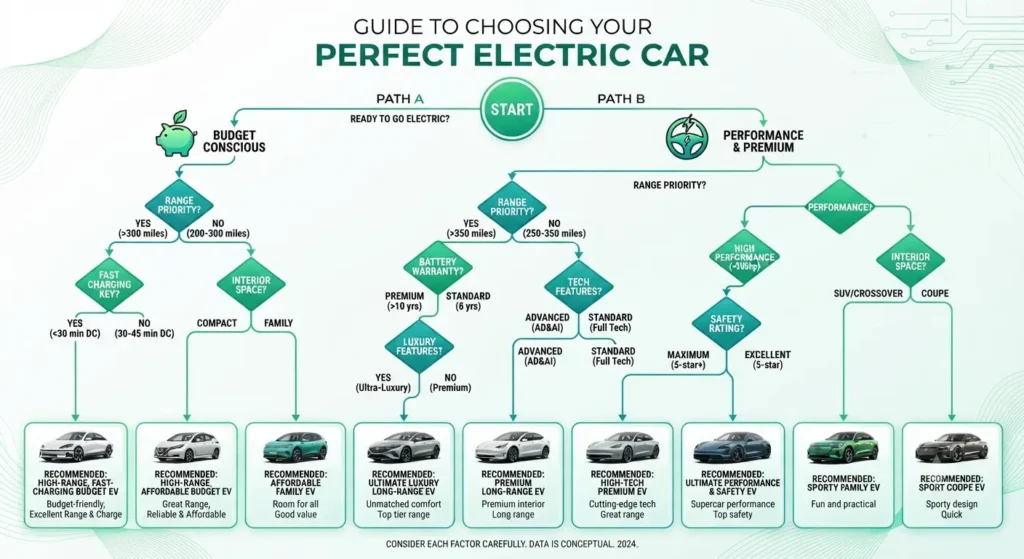
Many buyers focus only on advertised driving range, but charging speed can be just as important.
For example:
- A vehicle with slightly less range but much faster charging may complete long road trips in less time.
- A driver who charges overnight at home may never notice the difference between 280 and 350 miles of range.
When comparing EVs, consider:
- Your average daily mileage
- Availability of home charging
- Access to public fast chargers
- Frequency of long-distance travel
For most people, a balanced combination of range, efficiency, and charging speed is more valuable than having the largest battery.
Should You Buy an Electric Car in 2026?
For many drivers, 2026 is one of the best times to switch to an electric vehicle.
Battery technology continues to improve, charging infrastructure is expanding in many countries, and manufacturers now offer EVs across nearly every price category.
However, before buying, ask yourself:
- Can you install a home charger?
- How often do you take long road trips?
- What’s your realistic daily driving distance?
- Are public charging stations readily available where you live?
- Are there purchase incentives or tax credits in your country?
Answering these questions will help you choose an EV that fits your lifestyle rather than simply buying the most popular model.
11. Mercedes-Benz EQE SUV — Best Premium Comfort
The Mercedes-Benz EQE SUV is built for drivers who want a quiet, luxurious, and technology-rich electric driving experience. Instead of focusing on outright performance, it prioritizes refinement, ride comfort, and advanced driver assistance.
The cabin is packed with premium materials, supportive seating, and one of the most sophisticated infotainment systems available today.
Pros
- Exceptional ride comfort
- High-quality interior materials
- Advanced safety technology
- Quiet cabin
- Strong driving range
Cons
- Premium price
- Optional features can increase the cost significantly
Best For
Luxury buyers who value comfort more than sporty handling.
12. Audi Q6 e-tron — Best Technology
Audi’s latest electric SUV combines modern styling with one of the most advanced technology packages in its class.
The Q6 e-tron offers a refined interior, fast charging capability, and impressive long-distance usability. Audi has also focused on improving efficiency while maintaining the premium feel expected from the brand.
Pros
- Premium interior
- Advanced infotainment
- Fast charging capability
- Comfortable ride
- Excellent build quality
Cons
- Higher purchase price
- Some features depend on trim level
Best For
Drivers looking for a technology-focused premium SUV.
13. Porsche Macan Electric — Best Driving Experience
The Macan Electric proves that electric vehicles can still deliver an engaging driving experience.
Sharp steering, balanced handling, and powerful acceleration make it one of the most enjoyable premium EVs to drive.
Unlike many performance vehicles, it remains practical enough for everyday use.
Pros
- Outstanding performance
- Premium cabin
- Excellent handling
- Fast charging
- High-quality engineering
Cons
- Expensive
- Optional equipment adds significantly to the price
Best For
Drivers who prioritize performance without giving up daily practicality.
14. BYD Seal — Best Value Alternative
BYD has become one of the world’s fastest-growing EV manufacturers, and the Seal is one of its strongest products.
It offers an impressive combination of technology, efficiency, safety, and pricing, making it a compelling alternative to more established brands.
Availability varies depending on the country, but where it’s sold, the Seal delivers excellent value.
Pros
- Competitive pricing
- Modern interior
- Good driving range
- Strong efficiency
- Excellent equipment levels
Cons
- Availability differs by market
- Brand familiarity varies by region
Best For
Buyers looking for premium features without paying luxury-brand prices.
15. Chevrolet Blazer EV — Best Sporty Family SUV
The Chevrolet Blazer EV combines SUV practicality with bold styling and confident road manners.
It offers multiple battery and drivetrain options, making it suitable for a wide range of buyers.
For families wanting something more distinctive than a traditional crossover, the Blazer EV deserves consideration.
Pros
- Attractive design
- Spacious cabin
- Modern technology
- Comfortable ride
- Practical cargo space
Cons
- Availability varies by market
- Charging performance depends on battery configuration
Best For
Families wanting style, practicality, and everyday usability
Practical Tips Before Buying an Electric Car
Buying an EV is a long-term decision. Keep these practical tips in mind before making your purchase.
Think About Your Daily Driving
Most people drive far less than the maximum range offered by modern EVs.
Choose a vehicle that comfortably covers your daily routine instead of paying extra for range you’ll rarely use.
Install Home Charging If Possible
Charging at home is often:
- More convenient
- Less expensive
- Better for battery management
If home charging isn’t possible, research public charging options near your home and workplace.
Related: Electric Car Charger for Home
Compare Total Ownership Costs
Don’t focus only on the purchase price.
Also compare:
- Electricity costs
- Maintenance
- Insurance
- Warranty
- Battery warranty
- Resale value
Consider Future Needs
Ask yourself:
- Will your family grow?
- Do you regularly travel long distances?
- Do you tow trailers?
- Do you need extra cargo space?
Buying slightly larger than your current needs can save money later.
Check Local Incentives
Many countries offer:
- Purchase grants
- Tax credits
- Registration discounts
- Reduced road taxes
Always verify current incentives because they change frequently.
Common Mistakes to Avoid
Buying Based Only on Maximum Range
A huge battery isn’t always necessary.
Efficiency and charging speed often matter more.
Ignoring Charging Infrastructure
Before purchasing an EV, confirm:
- Home charging availability
- Nearby fast chargers
- Workplace charging options
Forgetting to Compare Trim Levels
Different trims can vary significantly in:
- Battery size
- Range
- Charging speed
- Safety features
- Technology
Always compare specifications carefully.
Overlooking Warranty Coverage
Pay close attention to:
- Battery warranty
- Vehicle warranty
- Roadside assistance
- Service network
A strong warranty provides peace of mind for long-term ownership.
Choosing Features You’ll Never Use
Premium packages can quickly increase the purchase price.
Focus on features you’ll actually use rather than every available option.
Frequently Asked Questions
Which is the best electric car in 2026?
For many buyers, the Tesla Model 3 remains one of the strongest all-around choices thanks to its balance of range, charging network, efficiency, technology, and value. However, the best option depends on your budget, driving habits, and local availabilit
Which electric car has the longest range?
Several premium EVs now offer excellent driving ranges, including models from Tesla, Mercedes-Benz, BMW, Audi, and Porsche. Actual range varies depending on battery size, weather, speed, and driving conditions.
Are electric cars cheaper to maintain?
Generally, yes. Electric vehicles have fewer moving parts than gasoline cars, so they typically require less routine maintenance. However, costs can still vary depending on the manufacturer, service schedules, and local labor rates.
Related: Electric Car Maintenance Guide
Is 2026 a good time to buy an electric car?
Yes. Buyers have access to more models, better battery technology, faster charging, and a wider range of price points than ever before. Charging infrastructure is also continuing to expand in many countries
Which electric SUV is the best?
The answer depends on your priorities. The Tesla Model Y is a strong all-around choice, while the Kia EV9 excels for larger families. Buyers seeking luxury may prefer the Volvo EX90 or Mercedes-Benz EQE SUV.
Final Thoughts
The best electric cars 2026 offer something for almost every type of driver. Whether you’re looking for an affordable commuter, a spacious family SUV, a luxury sedan, or a high-performance EV, today’s market provides more choice than ever before.
Rather than focusing on a single specification like driving range or acceleration, consider how the vehicle fits your daily routine, charging options, budget, and long-term ownership costs.
For most buyers, the ideal electric car is the one that delivers the right balance of practicality, efficiency, comfort, technology, and value—not necessarily the most expensive model.
As battery technology continues to improve and charging networks expand, electric vehicles 2026 are becoming an increasingly practical option for drivers around the world. Taking the time to compare features, ownership costs, and real-world usability will help you choose an EV you’ll enjoy for years to come.