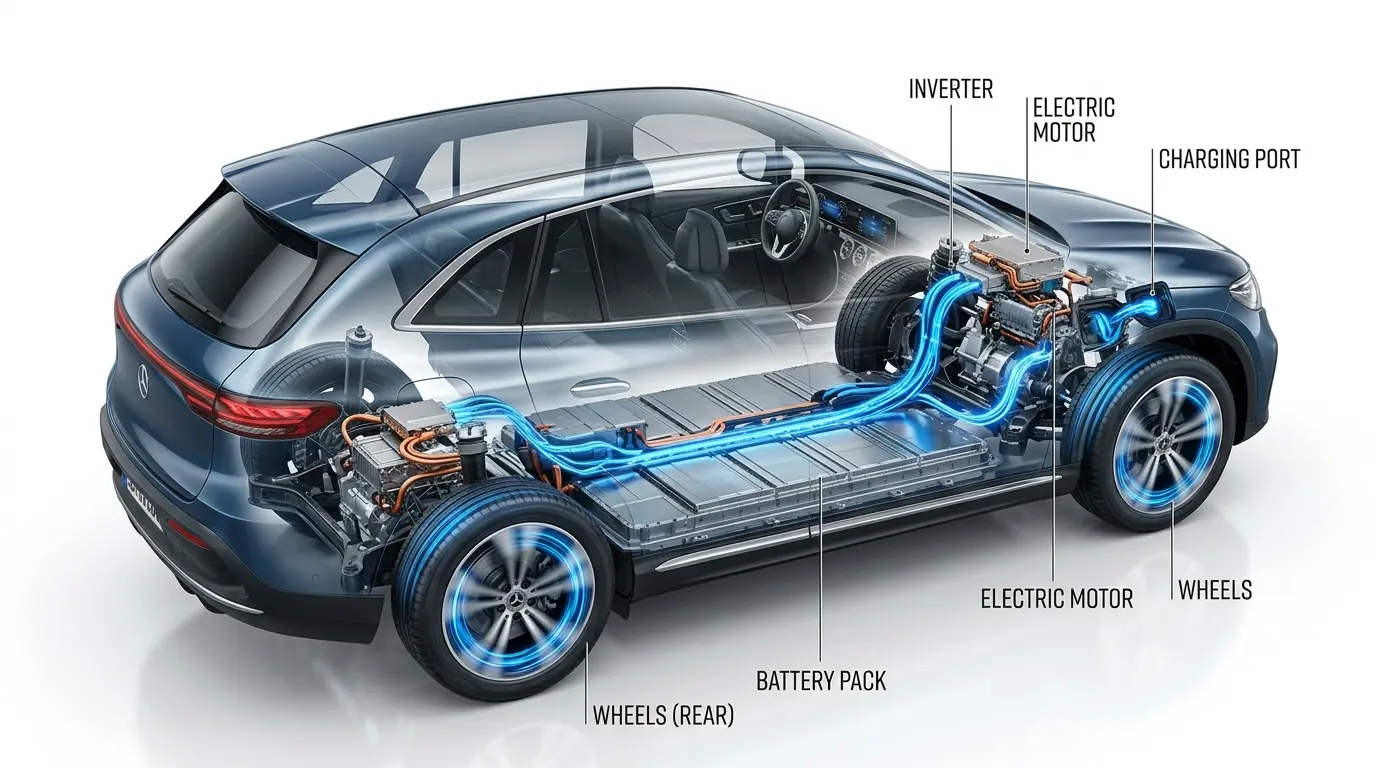
Electric vehicles may look similar to gasoline cars from the outside, but what powers them is completely different. Instead of relying on an engine, fuel tank, and transmission, an EV uses a large electric vehicle battery and one or more electric motors to move the car.
Understanding how EV batteries work doesn’t require an engineering degree. Once you know how the battery stores energy, delivers electricity, and communicates with the rest of the vehicle, the technology becomes much easier to understand.
Modern EV batteries are designed to last for many years while delivering strong performance in different climates and driving conditions. They also include advanced safety systems that continuously monitor battery health, temperature, charging, and power output.
This guide explains what happens inside an EV battery pack, how lithium-ion batteries power an electric vehicle, what the Battery Management System (BMS) does, and why battery technology has become one of the most important parts of modern transportation.
Quick Answer
An electric vehicle battery works by storing electrical energy in thousands of rechargeable lithium-ion cells. During driving, the battery sends electricity to the electric motor, which turns the wheels. During charging, electricity flows back into the battery, where chemical reactions store it for later use. A Battery Management System (BMS) monitors temperature, voltage, and battery health to keep the system safe and efficient.
If you’re new to electric vehicles, start with Electric Car Maintenance Guide before learning how EV battery technology works
Why Understanding EV Batteries Matters
For many drivers, the battery is the biggest unknown when buying an electric vehicle.
Questions like these are common:
- How does an EV battery actually work?
- What’s inside an electric vehicle battery pack?
- Why are lithium-ion batteries used?
- What does the Battery Management System do?
- Why do batteries slowly lose capacity over time?
Knowing the answers helps you become a more informed owner. It also makes it easier to understand topics such as charging speed, driving range, battery lifespan, maintenance, and warranties.
If you’ve already read our How Long Do EV Batteries Last? guide, this article explains why batteries age and how they operate every day.
What Is an EV Battery?
An EV battery is a rechargeable energy storage system that powers an electric vehicle. Unlike the small 12-volt battery found in conventional cars, an EV battery is a high-voltage system capable of supplying enough electricity to move an entire vehicle.
Most modern electric vehicles use lithium-ion batteries because they offer an excellent balance of:
- High energy density
- Long service life
- Fast charging capability
- Low maintenance
- High efficiency
Although different manufacturers may use slightly different battery chemistries, the overall operating principle remains the same.
Instead of burning fuel, the battery stores electricity and delivers it to the electric motor whenever the driver accelerates.
How Does an EV Battery Actually Store Energy?
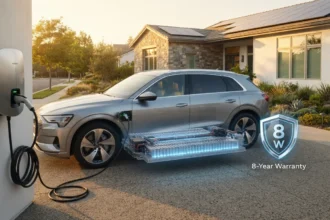
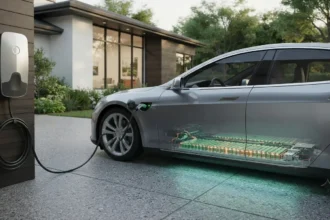
At first glance, an EV battery looks like a large sealed box mounted beneath the vehicle. Inside, however, it’s a carefully engineered system made up of thousands of individual battery cells working together.
The battery doesn’t generate electricity on its own. Instead, it stores electrical energy in chemical form and releases it when the driver accelerates.
When you charge an electric vehicle:
- Electricity flows from the charger into the battery pack.
- Lithium ions move from the battery’s positive electrode (cathode) to the negative electrode (anode).
- The battery stores this energy until it’s needed.
When you start driving:
- Lithium ions move back toward the cathode.
- Electrons flow through the vehicle’s electrical system.
- The electric motor converts that electrical energy into motion, turning the wheels.
This charging and discharging process happens thousands of times during the life of the battery, with the Battery Management System ensuring everything stays within safe operating limits.
The Four Main Parts of an EV Battery Pack
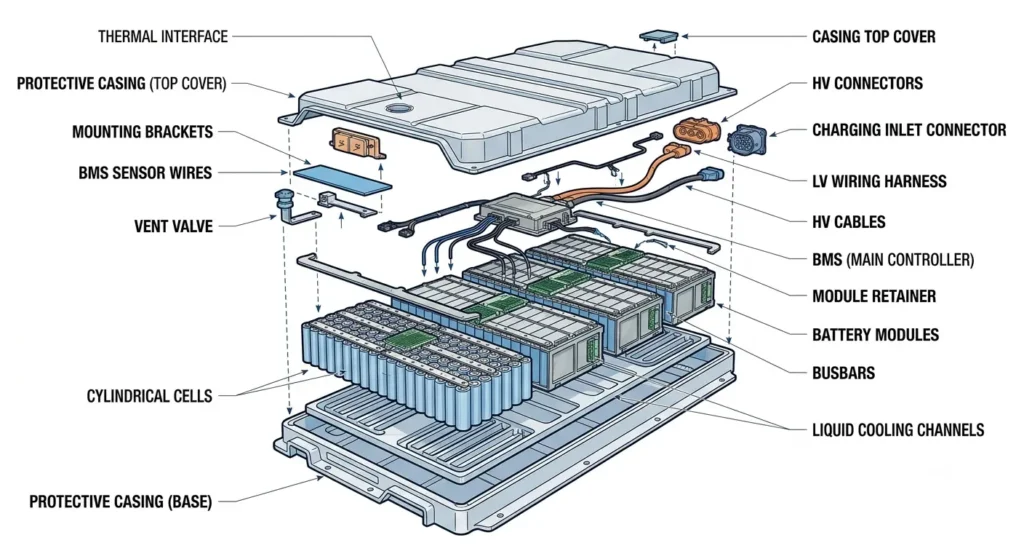
An electric vehicle battery isn’t a single battery like the one found in a flashlight or smartphone. Instead, it’s a complete energy storage system made up of several major components working together.
Battery Cells
Battery cells are the smallest building blocks of an EV battery.
Each cell stores a relatively small amount of energy, so manufacturers combine hundreds or even thousands of cells to achieve the voltage and capacity needed for an electric vehicle.
Modern EVs generally use one of three cell formats:
- Cylindrical cells
- Prismatic cells
- Pouch cells
Each design has advantages in manufacturing, cooling, packaging, and performance.
Battery Modules
Individual cells are grouped into battery modules.
Each module contains multiple cells connected together and often includes temperature sensors and electrical connections.
Using modules offers several advantages:
- Easier manufacturing
- Better cooling
- Improved safety
- Simpler servicing
If a fault occurs, technicians may sometimes replace a module instead of replacing the entire battery pack.
Battery Pack
Several battery modules are assembled into one sealed EV battery pack.
The battery pack also includes:
- High-voltage wiring
- Protective casing
- Cooling system
- Safety disconnects
- Battery Management System (BMS)
Because it’s mounted underneath the vehicle, the pack is designed to resist vibration, moisture, dust, and impacts while protecting the battery from external damage.
Battery Management System (BMS)
The Battery Management System, commonly called the BMS, is the brain of the entire battery pack.
Without it, a modern electric vehicle couldn’t safely charge, discharge, or operate.
The BMS constantly monitors:
- Battery voltage
- Current flow
- Cell temperatures
- State of Charge (SOC)
- State of Health (SOH)
It also performs several important safety functions, including:
- Preventing overcharging
- Preventing deep discharge
- Balancing battery cells
- Managing charging speed
- Detecting faults
- Protecting against overheating
By monitoring thousands of data points every second, the BMS helps maximize battery performance, efficiency, and lifespan.
How Does Electricity Move Through an EV?
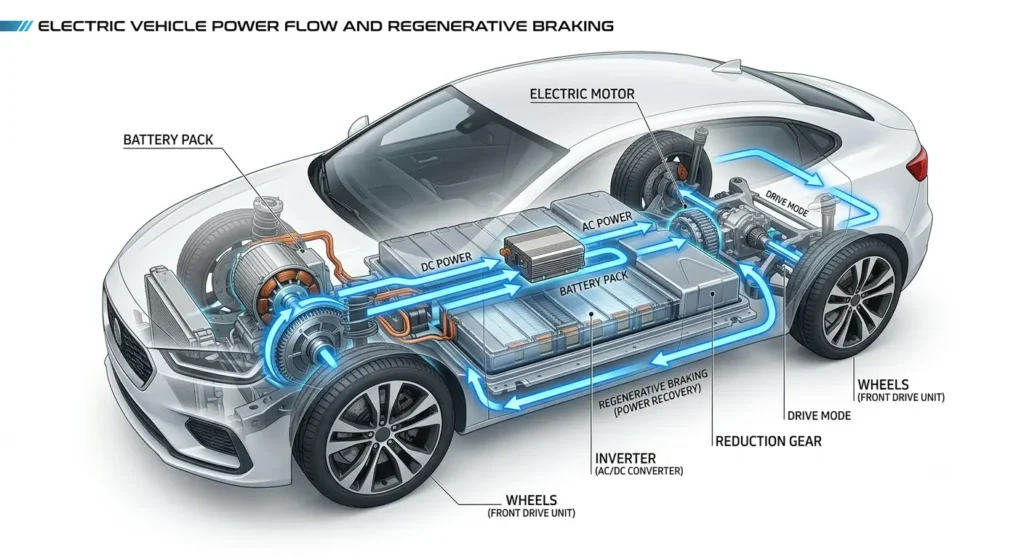
Once the battery has stored electrical energy, it needs an efficient way to deliver that power to the wheels.
Unlike a gasoline vehicle, which burns fuel to create mechanical power, an electric vehicle simply moves electricity through a series of components.
The process happens almost instantly.
Step 1: The Driver Presses the Accelerator
Pressing the accelerator doesn’t open a throttle or inject fuel.
Instead, it sends an electronic signal to the vehicle’s control system requesting power.
Step 2: The Battery Supplies Electricity
The Battery Management System checks that:
- Battery temperature is within a safe range.
- Voltage is stable.
- Current demand is acceptable.
- No battery faults are present.
If everything is operating normally, the battery pack delivers high-voltage direct current (DC) electricity.
Step 3: The Inverter Converts Power
Most electric motors operate using alternating current (AC).
Because the battery stores direct current (DC), the electricity passes through an inverter.
The inverter converts:
DC → AC
It also adjusts how much power reaches the motor depending on how hard the driver accelerates.
Step 4: The Electric Motor Turns the Wheels
The electric motor converts electrical energy into mechanical motion.
That rotational force is transferred through a simple reduction gearbox to the wheels.
Since electric motors produce maximum torque almost instantly, EVs accelerate smoothly without the multiple gear changes found in conventional automatic transmissions.
How Does Charging Work?
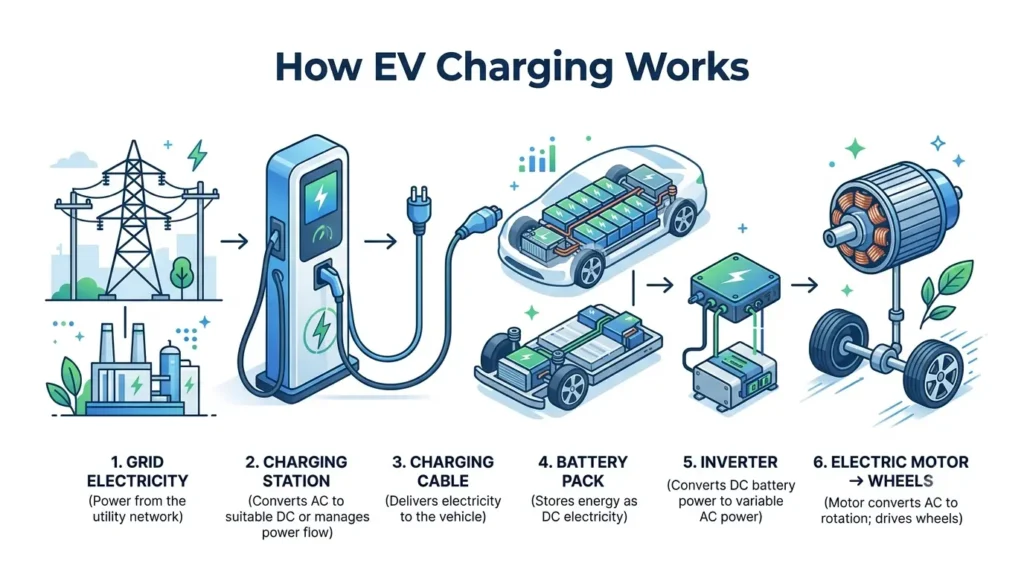
Charging is essentially the reverse of driving.
Instead of electricity leaving the battery, electricity enters it.
Here’s the basic process:
- Electricity comes from the electrical grid.
- It flows through the charging station.
- The vehicle communicates with the charger.
- The Battery Management System determines how much power the battery can safely accept.
- Lithium ions move back inside the battery cells.
- Chemical energy is stored for future driving.
Although this sounds simple, the charging process is carefully managed to protect battery life.
The BMS constantly monitors:
- Battery temperature
- Cell voltage
- Charging speed
- State of Charge (SOC)
As the battery approaches full charge, charging speed is often reduced to minimize stress on the cells.
If you’d like to learn more about charging speeds and connector types, see EV Charging Guide.
AC Charging vs DC Fast Charging
Not all charging methods work the same way.
| Feature | AC Charging | DC Fast Charging |
|---|---|---|
| Power Source | Alternating Current | Direct Current |
| Conversion | Vehicle converts AC to DC | Charger supplies DC directly |
| Typical Location | Home, workplace | Highway charging stations |
| Charging Speed | Slower | Much faster |
| Best For | Daily charging | Long-distance travel |
Home charging is usually the most convenient option for everyday driving, while DC fast charging is designed for road trips and situations where quick charging is necessary.
What Is Regenerative Braking?
One of the biggest differences between electric vehicles and gasoline cars is regenerative braking.
Normally, when you press the brake pedal in a conventional car, the vehicle’s kinetic energy is converted into heat and lost.
Electric vehicles recover part of that energy instead.
When you lift off the accelerator or apply the brakes:
- The electric motor temporarily works as a generator.
- The wheels continue spinning the motor.
- The motor produces electricity.
- Electricity flows back into the battery pack.
This recovered energy helps recharge the battery while driving.
Although regenerative braking doesn’t fully recharge an EV, it can improve efficiency and extend driving range, especially in city traffic where frequent braking occurs.
Why Do EV Batteries Need Cooling Systems?
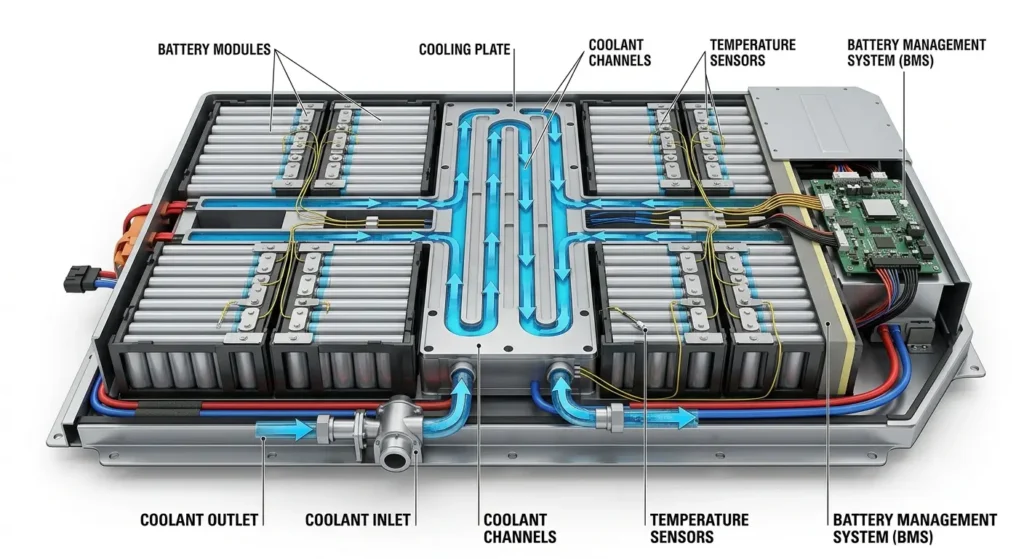
Lithium-ion batteries perform best within a specific temperature range.
If they become too hot or too cold, performance and long-term durability can suffer.
That’s why modern EV battery packs include thermal management systems.
Depending on the vehicle, these systems may use:
- Liquid cooling
- Air cooling
- Battery heaters
- Heat pumps
The cooling system works together with the Battery Management System to maintain consistent operating temperatures during:
- Fast charging
- High-speed driving
- Hot weather
- Cold weather
Good temperature management is one reason modern EV batteries last much longer than many people expect.
To understand charging speeds, connectors, and home charging in more detail, read EV Charging Guide and https://goelectrichub.com/ev-charging-guide/Best Electric Car Charger for Home.
Why Lithium-Ion Batteries Are Used in EVs
Several rechargeable battery technologies exist, but lithium-ion batteries have become the industry standard for most electric vehicles.
They offer several important advantages:
- High energy density
- Long cycle life
- Fast charging capability
- Low self-discharge
- Good efficiency
- Relatively low maintenance
Within the lithium-ion family, different chemistries are used depending on the manufacturer’s priorities.
For a detailed comparison, see EV Battery Types Explained.
LFP vs NMC Batteries
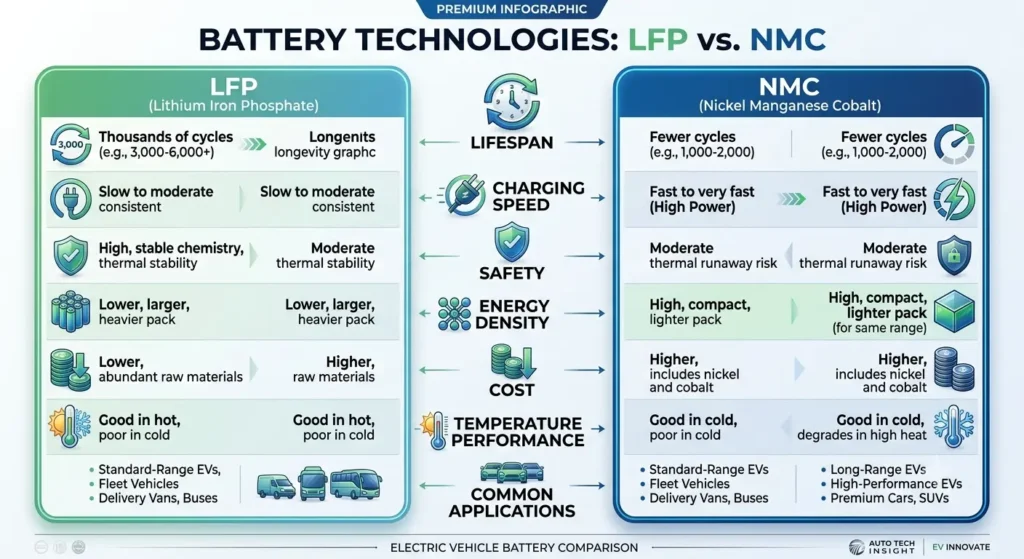
Two battery chemistries dominate today’s EV market.
| Feature | LFP | NMC |
|---|---|---|
| Energy Density | Lower | Higher |
| Driving Range | Usually shorter | Usually longer |
| Lifespan | Generally longer | Generally shorter |
| Cost | Often lower | Often higher |
| Thermal Stability | Excellent | Very good |
| Common Use | Budget and standard-range EVs | Long-range and premium EVs |
Neither chemistry is universally better.
Manufacturers choose one based on the vehicle’s intended purpose, performance goals, cost targets, and expected driving range.
Want a deeper comparison of these battery chemistries? Read EV Battery Types Explained.
Are EV Batteries Safe?
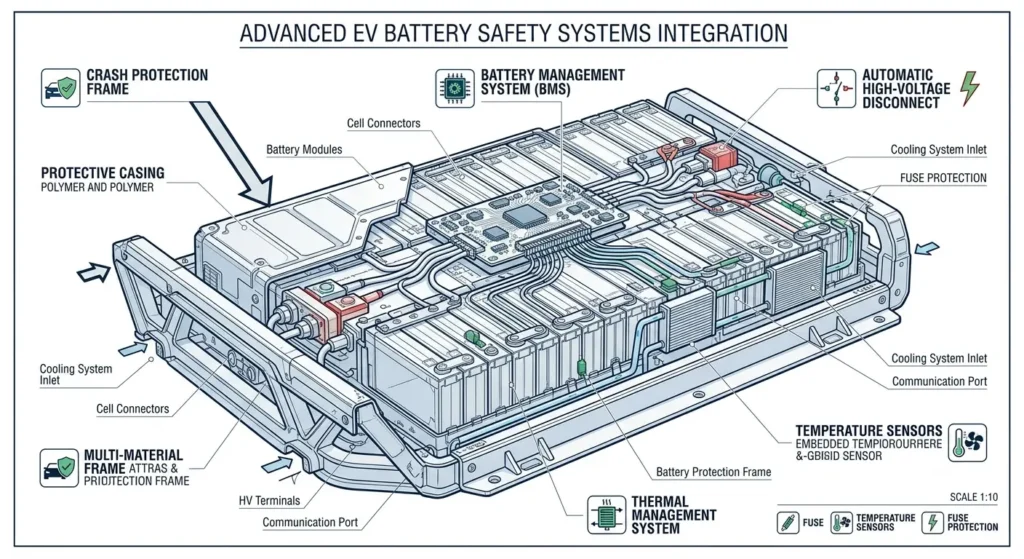
Safety is one of the most common concerns for people considering an electric vehicle. Fortunately, modern EV battery packs are designed with multiple layers of protection.
Manufacturers don’t rely on a single safety feature. Instead, the battery pack combines advanced hardware, software, and structural engineering to reduce risks during normal driving, charging, and even collisions.
Most modern electric vehicle batteries include:
- Battery Management System (BMS)
- Liquid or air cooling system
- High-voltage safety disconnects
- Strong protective battery casing
- Electrical insulation
- Temperature sensors
- Voltage monitoring
- Automatic emergency shutdown systems
Together, these systems continuously monitor the battery and can isolate faults before they become serious problems.
What Happens If an EV Is Involved in an Accident?
One of the biggest myths is that an EV battery will automatically catch fire after a collision.
In reality, manufacturers design battery packs to withstand significant impacts.
During a serious accident:
- High-voltage circuits can disconnect automatically.
- The Battery Management System shuts down power when necessary.
- Protective casings help shield the battery from damage.
- Emergency responders have procedures for handling EVs safely.
Like any vehicle carrying large amounts of energy or fuel, severe damage can create hazards, but modern EVs are engineered to minimize those risks.
How Do EV Batteries Compare to Smartphone Batteries?
People often compare EV batteries to the batteries inside smartphones, but the differences are substantial.
| Feature | Smartphone Battery | EV Battery |
|---|---|---|
| Purpose | Power a mobile device | Power an entire vehicle |
| Voltage | Low voltage | High voltage |
| Cooling | Passive cooling | Active thermal management |
| Monitoring | Basic protection | Advanced Battery Management System |
| Size | Single battery | Hundreds or thousands of cells |
| Expected Lifespan | A few years | Many years under normal use |
Although both use lithium-ion technology, an EV battery is far more complex and is built for demanding, long-term operation.
Practical Tips for Keeping Your EV Battery Healthy
You can’t completely stop battery aging, but good habits can help maintain performance over the long term.
Here are some practical tips:
- Charge according to the manufacturer’s recommendations.
- Use DC fast charging only when you genuinely need faster charging.
- Avoid exposing the vehicle to extreme heat for extended periods when possible.
- Install software updates promptly.
- Use approved charging equipment.
- If storing the vehicle for a long time, follow the manufacturer’s guidance for battery charge level.
Small improvements in daily habits can contribute to better long-term battery health.
Common Mistakes to Avoid
Many misconceptions about EV batteries come from outdated information.
Avoid these common mistakes.
Thinking the Battery Is One Large Cell
An EV battery pack is made up of many individual cells grouped into modules and managed as one system.
Believing Fast Charging Always Damages the Battery
Occasional DC fast charging is part of normal EV use.
Modern Battery Management Systems regulate charging to help protect the battery. Frequent fast charging may contribute to faster degradation over time compared with mostly slower charging, but it doesn’t automatically damage the battery.
Ignoring Battery Temperature
Temperature plays a major role in battery performance.
Both extremely hot and extremely cold conditions can temporarily affect charging speed, efficiency, and available driving range.
Assuming Every EV Uses the Same Battery
Manufacturers use different battery chemistries, cooling systems, and battery management strategies.
That’s why battery performance and longevity can vary between models.
These habits can also help extend battery life. Learn more in https://goelectrichub.com/how-long-do-ev-batteries-last/How Long Do EV Batteries Last?
Frequently Asked Questions
Do all electric vehicles use lithium-ion batteries?
Most modern passenger EVs use lithium-ion batteries, although the exact chemistry varies. Some manufacturers use LFP batteries, while others use NMC or other lithium-ion chemistries.
What does the Battery Management System (BMS) do?
The BMS monitors battery voltage, temperature, current, State of Charge (SOC), and State of Health (SOH). It also helps protect the battery during charging and driving.
Why is an EV battery pack mounted under the floor?
Placing the battery pack beneath the vehicle lowers the center of gravity, improves weight distribution, and helps maximize cabin space.
Can individual battery modules be replaced?
In some cases, yes. Depending on the design of the battery pack and the nature of the fault, manufacturers may replace individual modules instead of the entire battery pack.
Does regenerative braking fully recharge an EV battery?
No. Regenerative braking recovers some energy that would otherwise be lost during deceleration, but it doesn’t replace normal charging.
What’s the difference between battery cells, modules, and packs?
- Battery cells are the smallest energy-storage units.
- Battery modules are groups of cells connected together.
- Battery packs contain multiple modules along with the cooling system, wiring, protective casing, and Battery Management System.
Conclusion
Understanding how EV batteries work makes electric vehicles far less mysterious. Rather than being a single oversized battery, an EV battery pack is a carefully engineered system of cells, modules, electronics, cooling components, and software working together to deliver reliable power.
The Battery Management System plays a critical role by monitoring charging, temperature, voltage, and overall battery health, while technologies such as regenerative braking and thermal management help improve efficiency and extend battery life.
As battery technology continues to evolve, modern EVs are becoming more efficient, more durable, and better suited to everyday driving. If you’re considering an electric vehicle, understanding how its battery works will help you make more informed decisions about charging, maintenance, and long-term ownership.