Key Takeaways
The Polestar 4 is a premium electric SUV coupe that takes a very different approach to rear visibility: it has no conventional rear window. Instead, a roof-mounted rear camera feeds an 8.9-inch digital rearview display. Polestar says the design allows the rear seats to be positioned farther back and creates a larger panoramic-roof area; independent reviewers have found the system usable, although the missing glass takes some adjustment.
For the U.S. market, the current Polestar specification sheet lists the rear-motor version from $56,400 MSRP, with 310 miles of EPA range, while the dual-motor version starts from $62,900 and is rated at 280 miles EPA. Both use a 100-kWh battery and support up to 200-kW DC charging.
U.S. Pricing, Range, and Charging
Performance is a major part of the Polestar 4’s appeal. The rear-motor version makes 272 hp and reaches 60 mph in 6.9 seconds. The dual-motor version produces 544 hp and reaches 60 mph in 3.7 seconds according to Polestar’s current U.S. specifications.
Independent testing adds useful context. Edmunds drove a 2026 Polestar 4 Dual Motor Performance for 286 miles in its EV Range Test, versus a 255-mile EPA rating for that configuration. Edmunds’ test uses a repeatable 60% city/40% highway route, an average speed around 40 mph and climate control set to 72°F, so its result shouldn’t be treated as a universal real-world figure.
Polestar 4 pricing also needs a date attached because manufacturer incentives are changing. In the U.S., Polestar is currently advertising a time-limited $25,000 Clean Vehicle Incentive for cash purchases of eligible new 2026 vehicles and $18,000 for certain financed vehicles, with offers stated as valid through August 31, 2026, subject to conditions. Those are promotional offers, not permanent MSRP reductions.
For UK buyers, Polestar currently lists the rear-motor model from £56,750 and the dual-motor model from £63,750, using WLTP range targets of 385 miles and 367 miles, respectively. Australia has its own local Polestar 4 sales and leasing programs, so U.S. pricing and EPA numbers shouldn’t simply be carried across markets.
What Is the Polestar 4?
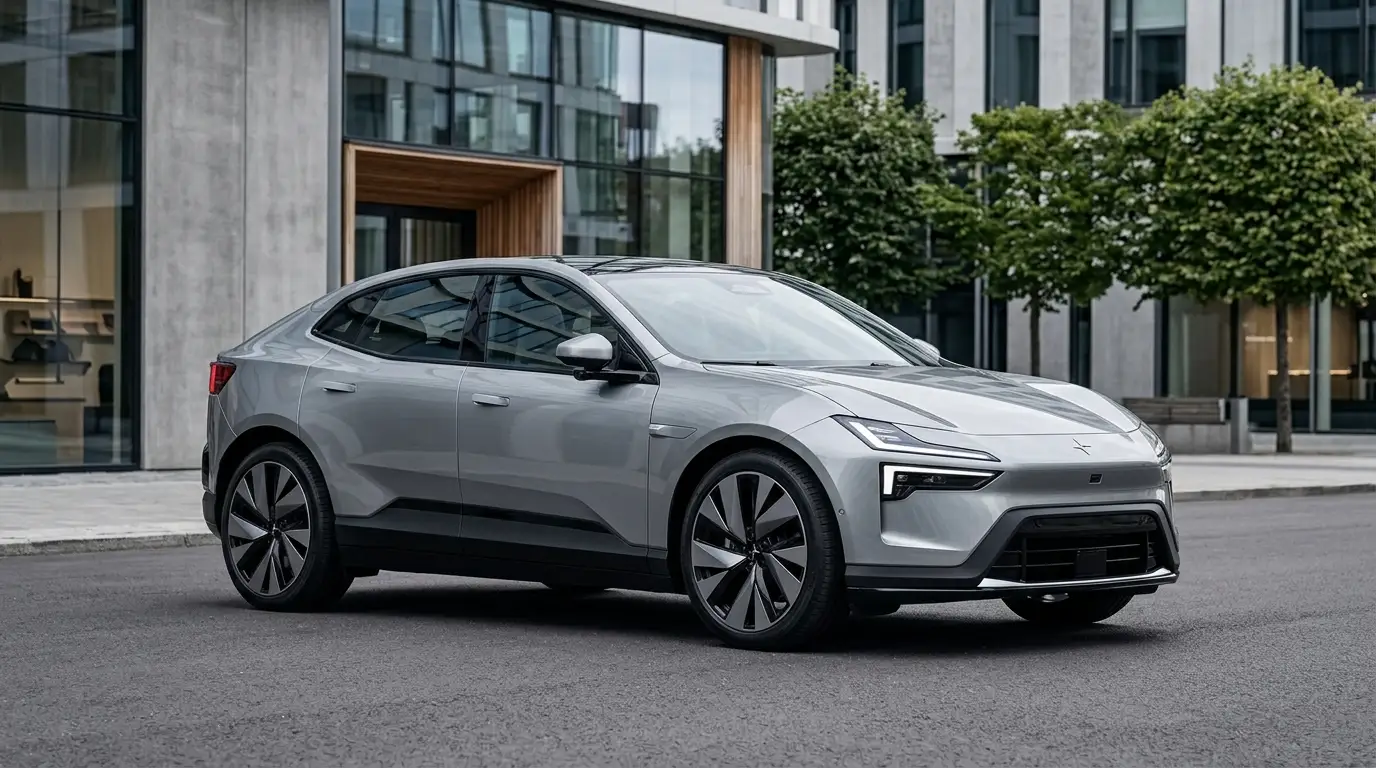
The Polestar 4 is a premium battery-electric SUV coupe positioned between the Polestar 2 and Polestar 3 in Polestar’s lineup. The company describes it as an electric performance SUV coupe, combining a lower, coupe-like roofline with the practical proportions of an SUV.
The unusual part is the rear of the vehicle.
There’s no conventional glass rear window.
Instead, the driver sees a live image from a rear-facing camera mounted toward the top of the vehicle.
That decision affects more than visibility.
It changes the cabin architecture.
Polestar says removing the rear glass allowed designers to extend the rear roof structure and move the rear passengers farther back. That helps create generous rear legroom while also allowing the panoramic glass roof to extend behind the occupants.
On paper, this makes the Polestar 4 a fascinating combination of:
coupe styling + SUV space + long-range EV hardware + digital rear visibility.
The trade-off is that buyers have to become comfortable with a camera replacing something that has existed in passenger cars for more than a century.
That’s the central question of the Polestar 4.
Is the unusual design genuinely useful, or is it novelty for novelty’s sake?
The answer is somewhere in between.
The lack of rear glass creates legitimate packaging benefits.
But it also creates a visibility experience that not every driver will prefer.
How Much Does the Polestar 4 Cost?
The Polestar 4 price varies by market, drivetrain and current offers.
For the United States, Polestar’s current specifications list:
Rear Motor — $56,400 MSRP
Dual Motor — $62,900 MSRP
Those are starting MSRP figures, not necessarily the actual amount every buyer will pay.
Options, destination charges, taxes, registration and other costs can change the final transaction price.
Current U.S. Incentives
This is particularly important in August 2026.
Polestar’s current U.S. offer page advertises $25,000 off MSRP through a Clean Vehicle Incentive for qualifying customers buying an eligible new 2026 Polestar 4 with cash. The offer is stated as valid from August 1 through August 31, 2026, and subject to vehicle availability and other conditions.
Polestar also advertises $18,000 toward eligible 2026 Polestar 4 vehicles for certain customers financing through Polestar Financial Services, with 0% APR up to 60 months under the listed program.
These are manufacturer promotional offers, not a permanent MSRP.
Confirm with Polestar before purchase. Not financial advice.
UK Pricing
Current Polestar UK specifications list:
Rear Motor: £56,750
Dual Motor: £63,750
Polestar UK’s current September 2026 offers page also advertises a £6,500 saving and other finance options through September 30, 2026.
Australia
Australia has its own market-specific Polestar 4 offers. Polestar Australia currently advertises a rear-motor vehicle through a novated-lease program from $249 per week, subject to the specific vehicle and leasing assumptions in the offer.
That isn’t directly comparable with the U.S. MSRP.
Why Market-Specific Pricing Matters
A global EV article should never write:
“The Polestar 4 costs $56,400 worldwide.”
That would be inaccurate.
The same vehicle has:
- different currencies
- taxes
- destination charges
- equipment
- financing
- incentives
- test cycles
- warranty arrangements
The Go Electric Hub framework specifically requires every EV price to identify market, currency, date, model year, trim, fees/taxes and incentive status.
How Much Range Does the Polestar 4 Have?
For the current U.S. lineup, Polestar lists:
| Version | Drive | EPA range |
|---|---|---|
| Rear Motor | RWD | 310 miles |
| Dual Motor | AWD | 280 miles |
| Dual Motor Performance | AWD | 255 miles |
The 255-mile Performance figure is the EPA rating cited by Edmunds for its tested vehicle.
The range gap is meaningful.
Choosing AWD gives you much more power.
But the additional motor and performance hardware come with an efficiency cost.
That’s a useful buying lesson.
If maximum range matters most, choose the rear-motor model.
If acceleration and AWD matter more, choose dual motor.
What About the UK and Europe?
Polestar UK currently lists range targets of:
385 miles WLTP — Rear Motor
367 miles WLTP — Dual Motor
European documentation lists approximately:
620 km WLTP — Rear Motor
590 km WLTP — Dual Motor
These figures should not be compared directly with U.S. EPA numbers as though they’re the same test.
EPA and WLTP use different procedures.
The Go Electric Hub framework explicitly requires the applicable test cycle to be identified and warns against directly equating EPA and WLTP results.
What Is the Polestar 4’s Real-World Range?
This is where independent testing becomes useful.
Edmunds tested the 2026 Polestar 4 Dual Motor Performance and achieved 286 miles in its EV Range Test.
The EPA rating for that configuration is 255 miles.
That means the Edmunds result was:
286 − 255 = 31 miles above EPA
or approximately:
31 ÷ 255 × 100 = 12.2% above the EPA estimate.
That calculation uses the published EPA and Edmunds test numbers.
It doesn’t mean every driver will get 286 miles.
Edmunds’ test methodology uses:
- 60% city
- 40% highway
- about 40 mph average speed
- climate control at 72°F
- efficient drive settings
- speed within 5 mph of posted limits
That makes the test useful for comparison, but it isn’t the same as driving from one U.S. city to another at sustained highway speed.
For highway-heavy drivers, winter drivers or people carrying heavy loads, the result can differ.
What Battery Does the Polestar 4 Use?
The Polestar 4 uses a 100-kWh lithium-ion battery.
Polestar’s U.S. specifications list a 400-volt architecture and a cell-to-pack battery configuration with 110 cells.
That large battery helps explain the vehicle’s long-range capability.
But the battery is only part of the story.
The vehicle’s:
- aerodynamic shape
- drivetrain efficiency
- wheel/tire choice
- curb weight
- software
- regenerative braking
all contribute to energy consumption.
Polestar’s current U.S. specifications show approximately:
35 kWh/100 miles for the rear-motor model
39 kWh/100 miles for the dual-motor model under EPA testing.
Again, those figures are test-cycle measurements rather than guaranteed real-world consumption.
How Fast Does the Polestar 4 Charge?
The Polestar 4 can charge at up to:
200 kW DC
with an advertised 10–80% charging time of around 30 minutes.
For AC charging, Polestar lists:
11 kW
with a stated 0–100% time of around 11 hours using 11-kW AC equipment.
This gives the Polestar 4 a sensible two-part charging strategy.
At Home
Use AC charging overnight.
On Long Trips
Use DC fast charging when you need to recover energy quickly.
A 10–80% window is particularly useful for road trips because drivers rarely need to charge from nearly empty to 100% at a fast charger.
The exact charging experience will still depend on:
- charger capability
- battery temperature
- battery state of charge
- charging conditions
- station performance
A 350-kW station doesn’t mean the vehicle will automatically take 350 kW.
The car’s own maximum charging capability remains the limiting factor.
Does the Polestar 4 Have a Rear Window?
No.
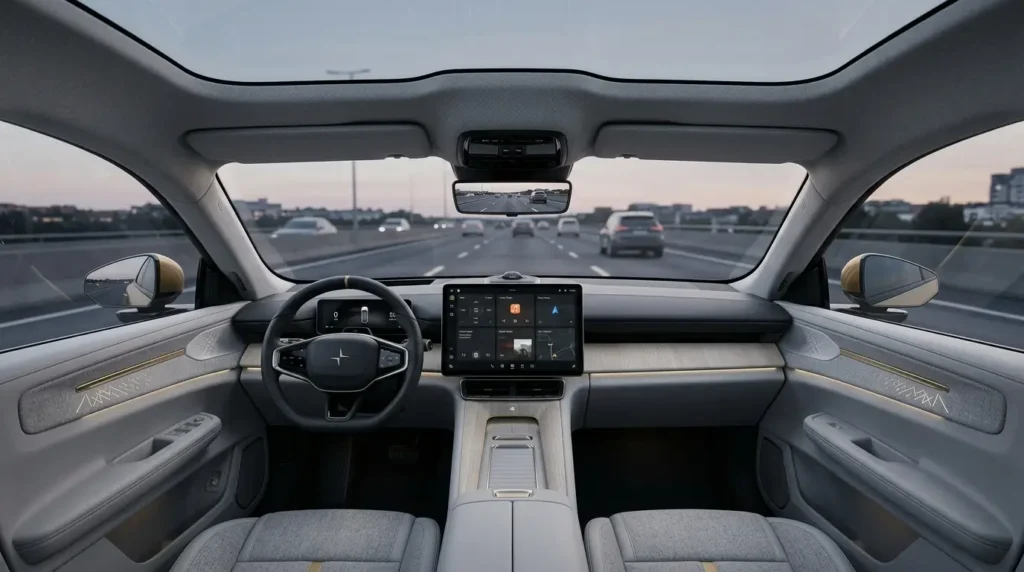
This is probably the single biggest design question in any Polestar 4 review.
Instead of a conventional rear window, Polestar uses a roof-mounted rear camera connected to an 8.9-inch digital rearview mirror.
The screen can display a live camera feed, while Polestar also says it can switch to a conventional mirror view for checking rear passengers.
Why Remove the Rear Window?
Polestar says the decision was made partly to improve interior packaging.
Without the conventional rear glass, the rear-seat occupants can sit farther back.
That contributes to the Polestar 4’s spacious rear passenger area.
It also enables the large panoramic roof to extend farther behind the rear passengers.
So this isn’t simply a styling gimmick.
There is a genuine engineering reason behind it.
Is the Digital Mirror Better?
That’s subjective.
The camera can provide a wide rearward image without the view being blocked by:
- rear headrests
- passengers
- cargo
Polestar itself highlights this as an advantage.
But independent reviews point out the compromise.
Car and Driver describes the missing rear glass as something buyers need to get accustomed to.
Edmunds was more critical in its testing and said it still preferred real glass for improved visibility, particularly while reversing.
That’s useful because it gives both perspectives.
What Happens if the Rear Camera Is Obscured?
This is a sensible ownership question.
The Polestar 4 has traditional exterior side mirrors, while its digital rearview display relies on the roof-mounted rear camera. The camera system therefore shouldn’t be treated as a magic replacement for every form of visual checking.
The vehicle also has multiple cameras and sensors used for parking and driver-assistance functions, including surround-view cameras.
A driver should still understand the camera system and keep the relevant camera areas clean.
The digital mirror is a driver aid.
It doesn’t remove the need for normal observation.
How Fast Is the Polestar 4?
This is where the Polestar 4 moves beyond being merely efficient.
Rear Motor
272 hp
6.9 seconds to 60 mph
253 lb-ft of torque
Dual Motor
544 hp
3.7 seconds to 60 mph
506 lb-ft of torque
Those are very different personalities.
The rear-motor version is the efficiency choice.
It’s also quick enough for normal daily driving.
The dual-motor version is much more aggressive.
The 3.7-second 0–60 mph figure puts it firmly into performance-EV territory.
That additional performance also explains why its EPA range is lower.
More power is available.
More energy can be used.
Larger wheels and performance tires can also affect efficiency.
What Is the Polestar 4 Performance Pack?
The Performance Pack is offered with the dual-motor configuration.
The current Polestar specification page lists:
- 22-inch performance wheels
- Pirelli P Zero tires
- ZF active dampers
- specially tuned chassis
- Swedish-gold detailing
- performance-oriented brake equipment
The Performance Pack therefore isn’t simply an appearance package.
It changes the vehicle’s chassis hardware.
That can appeal to drivers who care about:
- cornering
- braking
- steering response
- acceleration
- road feel
But there is a trade-off.
The current U.S. EPA rating for the Performance version is 255 miles, below the 280-mile standard dual-motor figure and 310-mile rear-motor figure. Edmunds’ independent range test also classified the Performance model as the least efficient member of the Polestar 4 family.
What Is the Polestar 4 Interior Like?
The interior is one of the strongest parts of the vehicle.
Polestar uses a minimalist design language, with a large central display and relatively restrained physical controls.
The U.S. specifications list:
15.4-inch center display
10.2-inch driver display
8.9-inch rearview digital mirror
There are also different material choices, including bio-attributed MicroTech and optional premium interior configurations.
The overall theme is modern rather than traditionally luxurious.
You’re not getting a dashboard full of leather-covered switches.
Instead, the Polestar 4 focuses on:
screen + software + lighting + materials + space.
Rear Passenger Space
This is where removing the rear window becomes more interesting.
Car and Driver reports that the rear seats offer generous legroom, partly because Polestar could move the seating position rearward as a result of the unusual roof/rear structure.
That’s a genuine functional benefit.
How Much Cargo Space Does the Polestar 4 Have?
Polestar’s current U.S. specifications list:
18.6 cubic feet behind the rear seats
54.2 cubic feet with the rear seats folded.
There’s also a small 0.5-cubic-foot front storage compartment.
The official dimensions show a rear load floor measuring approximately:
39 inches with the rear seats upright
and 75 inches with the seats folded, measured at the floor.
This gives the Polestar 4 useful everyday practicality.
It’s still a coupe-style SUV, so it doesn’t have the boxy cargo shape of a traditional wagon or upright SUV.
But the combination of a long load floor and folding rear seats makes it more versatile than the exterior styling might suggest.
What Infotainment Does the Polestar 4 Use?
The Polestar 4 uses a large 15.4-inch central touchscreen and Google’s automotive ecosystem.
The system includes:
- Google Maps
- Google Assistant
- Google Play
- Apple CarPlay
- Over-the-air updates
Polestar’s current vehicle information also highlights Google built-in features and says newer software functionality can be introduced through OTA updates.
This is important because Polestar has increasingly positioned the vehicle as a software-enabled car rather than simply a car with a touchscreen.
That means software performance matters.
Navigation quality matters.
App compatibility matters.
Updates matter.
And the user experience can change over the life of the vehicle.
Does the Polestar 4 Have Apple CarPlay?
Yes.
Polestar’s current specifications list Apple CarPlay among the connectivity features.
That’s useful for buyers who don’t want to rely entirely on the native Google environment.
The vehicle also provides Google built-in features, so owners have the option to use the integrated system rather than mirroring everything from a phone.
How Safe Is the Polestar 4?
The vehicle includes a substantial driver-assistance and safety hardware package.
Polestar’s U.S. specifications list:
- Advanced driver assistance
- Adaptive cruise control
- Collision avoidance
- Forward collision warning
- Lane keeping aid
- Lane departure warning
- Run-off-road mitigation
- Blind-spot monitoring
- Cross-traffic alert
- Driver monitoring
- Rear collision warning
- Traffic-sign information
The listed protective hardware includes an ultra-high-strength steel safety cage, mixed-material crumple zones, pretensioning/load-limiting seatbelts and nine airbags.
Those are manufacturer specifications.
They aren’t the same thing as an independent crash-test rating.
A proper review should keep those two evidence types separate.
Manufacturer safety equipment: verified from Polestar.
Independent crash-test performance: should be cited to the relevant testing organization when available for the exact model and market.
That distinction follows the Go Electric Hub evidence standard, which says manufacturer specifications must not be presented as independent testing.
How Practical Is the Polestar 4 for a Family?
The answer is more positive than the coupe-like exterior suggests.
The rear seats have strong legroom.
The rear cargo area provides 18.6 cubic feet with the seats up and 54.2 cubic feet folded.
There’s also a large panoramic roof.
Car and Driver managed to fit seven carry-on suitcases in the cargo area with the rear seats up and 20 with the seats folded.
That’s not the same as a formal cargo-capacity test from Polestar, but it’s a useful independent illustration of practicality.
The main family concern is the rearward visibility system.
Parents who regularly reverse in busy parking lots may need some time to become comfortable with the digital mirror.
That is exactly where the Polestar 4’s unusual design becomes a personal preference rather than a simple specification.
What Is the Polestar 4’s Efficiency Like?
The current U.S. EPA energy-consumption figures are approximately:
35 kWh/100 miles — rear motor
39 kWh/100 miles — dual motor
Edmunds’ independent test recorded:
38.5 kWh/100 miles
for the Dual Motor Performance.
That’s useful because it shows the Performance model can deliver strong real-world range despite being the least efficient version in the lineup.
But Edmunds also found it consumed more energy than some comparison vehicles on the same test route.
So the Polestar 4 is not a hyper-efficient EV.
It’s better described as:
a powerful, spacious premium EV with strong range
rather than:
an efficiency benchmark.
Polestar 4 vs Tesla Model Y
The Tesla Model Y is one of the obvious alternatives because both are electric crossovers with strong range and broad usability.
The Polestar 4 differentiates itself through:
- premium interior
- unusual coupe-SUV styling
- rear-window-free design
- strong performance
- Google-based infotainment
- available AWD
Tesla’s advantages can include:
- larger charging ecosystem
- mature production
- extensive Supercharger access
- established owner network
This isn’t a simple winner/loser comparison.
Choose the Polestar 4 when distinctive design and premium cabin experience matter.
Choose the Model Y when ecosystem, practicality and charging-network familiarity carry more weight.
[Internal link: Tesla EV Guide] where an existing verified Tesla guide is available.
Polestar 4 vs BMW iX
The BMW iX is another useful comparison because it occupies the premium-electric-SUV space.
The Polestar 4 generally emphasizes:
sportier styling + coupe proportions + high performance.
The BMW iX emphasizes:
larger SUV practicality + premium comfort + established BMW ecosystem.
The two also differ substantially in design philosophy.
The Polestar 4 removes the rear window.
The iX retains conventional rear visibility.
For some buyers, that single difference could settle the decision.
[Internal link: BMW iX / BMW EV guide]
Polestar 4 vs Audi Q6 e-tron
The Audi Q6 e-tron is a more conventional premium electric SUV.
The Polestar 4’s advantages include:
- distinctive design
- 310-mile U.S. EPA range in the rear-motor version
- very strong dual-motor acceleration
- spacious rear seats
- minimalist Swedish-inspired cabin
Audi’s conventional SUV design may appeal more to buyers who prefer familiar ergonomics and traditional visibility.
The better choice depends on priorities rather than one universal specification.
Polestar 4 vs Polestar 3
This is perhaps the most important internal comparison.
Both are premium electric SUVs from Polestar.
The Polestar 3 is the more traditional SUV.
The Polestar 4 is the sportier coupe-SUV.
The 4’s lower roofline and rear-window-free design give it a very different identity.
Polestar itself positions the 4 between the Polestar 2 and 3 in size.
A buyer who wants maximum conventional SUV practicality should look closely at the 3.
A buyer prioritizing the more distinctive design should start with the 4.
Which Polestar 4 Should You Buy?
For most buyers, this is the key decision.
Buy the Rear-Motor Version for Maximum Range
The current U.S. EPA figure is 310 miles.
It’s also the lowest starting MSRP of the two main powertrains.
It has 272 hp and a 6.9-second 0–60 mph target.
For commuting and long-distance driving, this is the logical choice.
Buy Dual Motor for Performance and AWD
Dual motor gives:
544 hp
3.7-second 0–60 mph
all-wheel drive
and up to 3,500 pounds of towing capacity.
The cost is higher purchase price and lower EPA range.
Add the Performance Pack Only for the Right Driver
The Performance Pack makes sense for drivers who specifically want sharper chassis hardware, larger wheels, performance tires and active dampers.
It makes less sense for someone who simply wants the longest range per charge.
Polestar 4 Specs at a Glance
| Specification | Rear Motor | Dual Motor |
|---|---|---|
| Drivetrain | RWD | AWD |
| Power | 272 hp | 544 hp |
| Torque | 253 lb-ft | 506 lb-ft |
| 0–60 mph | 6.9 sec | 3.7 sec |
| EPA range | 310 mi | 280 mi |
| Battery | 100 kWh | 100 kWh |
| Architecture | 400 V | 400 V |
| DC charging | Up to 200 kW | Up to 200 kW |
| 10–80% DC | ~30 min | ~30 min |
| AC charging | 11 kW | 11 kW |
| Towing | Up to 2,000 lb | Up to 3,500 lb |
| U.S. starting MSRP | $56,400 | $62,900 |
| Length | ~190.6 in | ~190.6 in |
| Width | ~79.1 in body | ~79.1 in body |
| Height | ~60.4 in | ~60.4 in |
| Rear cargo | 18.6 cu ft | 18.6 cu ft |
| Rear cargo seats folded | 54.2 cu ft | 54.2 cu ft |
Source: current Polestar U.S. specifications.
Polestar 4 Dimensions and Cargo
The Polestar 4 measures approximately:
190.6 inches long
79.1 inches wide
60.4 inches high
with a 118.1-inch wheelbase according to Polestar’s current U.S. dimensions information.
For an SUV with a coupe-like profile, that wheelbase helps provide useful cabin space.
The rear luggage area measures:
39 inches of floor length behind the rear seats
and approximately:
73.9 inches with the rear seats folded.
That explains why the Polestar 4 feels more practical than its low roofline suggests.
Is the Polestar 4 Good for Long Road Trips?
Yes, especially in the rear-motor configuration.
The current U.S. EPA range reaches 310 miles.
DC charging is rated up to 200 kW, with Polestar stating about 30 minutes from 10% to 80% under the stated charging conditions.
That creates a good road-trip combination:
long range + reasonably fast charging + spacious cabin.
The dual-motor version remains a capable road-trip vehicle.
But if every mile matters, the rear-motor version is the better choice.
Road-trip planning should also consider charging-network availability along the actual route.
A high maximum charging rate doesn’t help if the available charging station is slow or occupied.
What Is the Polestar 4 Warranty?
For the U.S., Polestar currently lists:
4-year / 50,000-mile vehicle warranty
and
8-year / 100,000-mile battery warranty.
The battery warranty includes coverage if state of health falls below 70% of original capacity within the warranty period. Polestar also lists a 12-year corrosion warranty.
For UK buyers, the current official offers page lists:
3-year vehicle warranty
and
8-year battery warranty.
This is another reason not to copy one market’s warranty information into a global EV guide.
What Are the Biggest Polestar 4 Strengths?
Long range
The rear-motor U.S. version reaches 310 miles EPA.
Strong performance
Dual motor makes 544 hp and reaches 60 mph in 3.7 seconds.
Spacious rear cabin
The unusual roof/rear-window architecture helps create generous rear legroom.
Fast charging
Up to 200 kW DC and approximately 30 minutes for 10–80%.
Distinctive design
It’s immediately recognizable.
Good cargo versatility
18.6 cubic feet becomes 54.2 cubic feet with the rear seats folded.
Strong technology package
Google built-in, Apple CarPlay, OTA updates and extensive camera/sensor hardware.
What Are the Biggest Polestar 4 Weaknesses?
No rear window
Some drivers will simply prefer conventional glass.
Blind-spot/visibility concerns
Independent reviewers have noted limitations with rear visibility despite the digital mirror.
Dual-motor efficiency penalty
The AWD versions have lower EPA range than the rear-motor configuration.
Performance Pack range
The Performance model’s EPA figure is 255 miles.
Price can climb
Options and premium packages can push the effective price substantially higher than the base MSRP.
Complex digital experience
The car relies heavily on cameras, software and a large central screen.
That’s attractive to some buyers and less appealing to others.
Is the Polestar 4 a Good Value?
The answer depends heavily on which version and which market you’re considering.
In the U.S., the rear-motor version’s $56,400 MSRP puts it into a competitive premium-EV bracket.
The value proposition becomes stronger when you consider the combination of:
310-mile EPA range
100-kWh battery
200-kW DC charging
premium interior
large rear cabin
and distinctive styling.
The current U.S. promotional offers can materially alter the effective transaction cost for eligible buyers.
But those incentives have a specific date and eligibility requirements.
Confirm with Polestar. Not financial advice.
A buyer who qualifies for a large manufacturer incentive can have a very different purchase proposition from someone paying ordinary MSRP.
How Does the Polestar 4 Compare With the Polestar 3?
The difference is more about philosophy than specification.
Polestar 4
Coupe-like
Rear-window-free
Sportier
Lower roof
Long rear-seat area
Polestar 3
Traditional SUV shape
More conventional rear visibility
An upright design is more appealing.
More SUV-oriented packaging
The Polestar 4 is therefore aimed at buyers who want style and performance without giving up too much utility.
The Polestar 3 is a better fit for buyers who want a more conventional luxury SUV.
Is the Polestar 4 a Good Family EV?
For a two-adult family with children, yes, potentially.
The rear seats are spacious.
The cargo area is useful.
The cabin is quiet and premium-oriented.
The big question is the rear camera.
If you frequently reverse with children, pets or a fully loaded cargo area, you need to be comfortable with the digital rearview system.
Polestar argues that the camera can actually provide a clearer rearward view because headrests and passengers don’t block it.
Edmunds’ independent experience is less enthusiastic.
That disagreement is exactly why a test drive matters.
Does the Polestar 4 Make Sense as a Company/Fleet Vehicle?
It can, but it’s primarily a premium passenger EV rather than a commercial fleet vehicle.
For business users, the relevant questions are:
- Purchase/lease cost
- Depreciation
- Tax treatment
- Charging
- Range
- Annual mileage
- Service
- Warranty
- Driver requirements
The Polestar 4’s strong range can make it suitable for high-mileage executive or sales use.
But this isn’t a direct competitor to a commercial electric van.
The distinction should remain clear.
Polestar 4 USA, UK, Europe and Australia
USA
The U.S. market has EPA range figures and U.S.-specific MSRP.
Rear Motor:
$56,400
310-mile EPA range
Dual Motor:
$62,900
280-mile EPA range
Current August 2026 purchase and finance offers are also available for eligible customers, with conditions and an August 31 deadline.
UK
Current official Polestar UK specifications list:
£56,750 Rear Motor
£63,750 Dual Motor
with WLTP range targets of:
385 miles
and
367 miles respectively.
Current UK promotions include a £6,500 saving on listed Polestar 4 vehicles through September 30, 2026, subject to terms.
Europe
European specifications vary by country.
For example, Polestar’s Austrian specification page lists:
€59,990 Rear Motor
€65,990 Dual Motor
with WLTP range targets of:
620 km
and
590 km respectively.
That demonstrates why a single “European price” isn’t appropriate.
Australia
Polestar Australia is actively selling the Polestar 4, with local offers and leasing programs. Its current website features a 2026 Polestar 4 and market-specific ownership options.
Don’t convert U.S. pricing into AUD and call it Australian MSRP.
What Charging Connector Does the Polestar 4 Use?
Connector information should be handled by market and model year.
The Go Electric Hub framework requires:
U.S./North America: NACS, with CCS1 where applicable.
UK/EU/Australia: Type 2, with CCS2 where applicable.
It also explicitly warns against mixing standards without regional context.
Because charging hardware and market specifications can change, the exact connector should be checked for the current vehicle configuration before publishing a definitive market-specific statement.
This article therefore shouldn’t use the U.S. charging connector as though it automatically applies to every Polestar 4 worldwide.
Polestar 4 Review: What Does Independent Testing Tell Us?
The independent data gives the Polestar 4 a more interesting profile than the spec sheet alone.
Edmunds found:
286 miles actual in its test
versus
255 miles EPA
for the Dual Motor Performance.
Car and Driver’s independent review gave the 2026 Polestar 4 an 8/10 assessment and highlighted:
- perky acceleration
- spacious cabin
- pleasant interior design
while identifying:
- no rear glass
- large blind spots
- lower AWD range
as drawbacks.
That’s a useful synthesis.
The vehicle isn’t perfect.
But its biggest weaknesses are highly specific.
You aren’t buying an ordinary electric SUV and discovering unexpected limitations.
The major trade-offs are visible from the start.
Polestar 4: Manufacturer Claim vs Independent Evidence
| Topic | Evidence | Classification |
|---|---|---|
| 310-mile range | Polestar U.S. specification | Manufacturer/official EPA figure |
| 280-mile AWD range | Polestar U.S. specification | Manufacturer/official EPA figure |
| 255-mile Performance range | EPA figure reported by Edmunds | Official test rating |
| 286-mile Performance test | Edmunds | Independent test |
| 272 hp RWD | Polestar | Manufacturer specification |
| 544 hp AWD | Polestar | Manufacturer specification |
| 3.7-sec 0–60 | Polestar | Manufacturer specification |
| 200-kW DC charging | Polestar | Manufacturer specification |
| 10–80% in ~30 min | Polestar | Manufacturer specification |
| 18.6 cu ft cargo | Polestar | Manufacturer specification |
| Seven carry-on bags with seats up | Car and Driver | Independent observation |
| No rear window | Polestar + independent reviews | Verified design fact |
| Digital mirror usability | Polestar + independent reviews | Mixed evidence/subjective |
This separation matters because the Go Electric Hub framework explicitly requires claims to be classified as verified facts, manufacturer claims, official tests, independent tests, calculations, estimates or opinions rather than blending them together.
Polestar 4 Buying Guide
Choose Rear Motor if:
You want the longest U.S. EPA range.
You don’t need extreme acceleration.
A lower starting MSRP is preferred.
You value efficiency over AWD.
Choose Dual Motor if:
You need AWD.
You want 544 hp.
Acceleration to 60 mph in 3.7 seconds is preferred.
You want the higher towing limit.
Choose Performance if:
You care about handling and chassis tuning.
You’re willing to sacrifice some range.
You like the performance hardware.
Skip the Polestar 4 if:
You strongly prefer a physical rear window.
You don’t like screen-heavy interiors.
A very upright SUV is what you want.
You need the easiest possible conventional rear visibility.
What Should You Check During a Test Drive?
This vehicle is unusual enough that a normal 10-minute dealership drive isn’t ideal.
Spend time on:
Reversing
Use the digital rearview mirror.
Try reversing into a parking space.
Pay attention to how quickly your brain adapts.
Highway Driving
Evaluate:
- wind noise
- ride
- steering
- seating
- camera display
Rear Seats
Sit in the second row.
Check legroom and headroom.
Cargo
Open the rear hatch.
Load something bulky.
Check how the sloping roof affects practical storage.
Infotainment
Try:
- navigation
- climate controls
- audio
- Apple CarPlay
- driver display
This is particularly important because software is central to the Polestar 4 ownership experience.
Polestar 4 Review FAQ
The current U.S. Polestar specification lists the rear-motor Polestar 4 from $56,400 MSRP and the dual-motor version from $62,900 MSRP. Manufacturer incentives may temporarily reduce the effective purchase price for eligible buyers, but those offers are separate from MSRP and have specific dates and conditions.
The U.S. rear-motor Polestar 4 is rated for up to 310 miles EPA, while the dual-motor model is rated for up to 280 miles. The Dual Motor Performance has a lower 255-mile EPA rating. European versions use WLTP figures instead, so EPA and WLTP should not be directly compared.
No. The Polestar 4 replaces the conventional rear window with a roof-mounted rear camera and an 8.9-inch digital rearview display. Polestar says the design creates additional rear-seat and panoramic-roof space.
It works as intended and provides a live rear camera view, but its usefulness is partly subjective. Polestar argues that the camera avoids obstruction from passengers and headrests, while Edmunds has said it still prefers conventional glass for visibility.
The rear-motor version produces 272 hp and reaches 60 mph in 6.9 seconds. The dual-motor version produces 544 hp and reaches 60 mph in 3.7 seconds according to Polestar’s current U.S. specifications.
The dual-motor Polestar 4 uses all-wheel drive, while the rear-motor version uses rear-wheel drive. AWD increases power and traction but reduces the official U.S. range from 310 miles to 280 miles.
The Polestar 4 uses a 100-kWh lithium-ion battery with a 400-volt architecture. Polestar lists up to 200-kW DC charging and an approximately 30-minute 10–80% charging time.
Polestar lists up to 200 kW DC charging, with approximately 30 minutes for a 10–80% charge. AC charging is listed at up to 11 kW, with about 11 hours for a full 0–100% charge using an 11-kW AC supply.
The current U.S. specification lists 18.6 cubic feet of rear cargo capacity with the seats up and 54.2 cubic feet with the rear seats folded. It also has a small 0.5-cubic-foot front storage compartment.
Polestar lists a maximum towing capacity of 2,000 pounds for the rear-motor version and 3,500 pounds for the dual-motor version in the current U.S. specifications.
Yes. Apple CarPlay is included among the connectivity features listed in Polestar’s current U.S. specifications. The car also has Google built-in services, including Google Maps and Google Assistant.
Edmunds measured 286 miles from a 2026 Polestar 4 Dual Motor Performance in its standardized EV Range Test, compared with a 255-mile EPA rating for that configuration. Other drivers can see different results depending on speed, weather, temperature, HVAC use and driving conditions.
It can be. The rear seats provide generous legroom, while the rear cargo area offers 18.6 cubic feet with the seats upright. The unusual rear camera system is the main family-specific issue to evaluate during a test drive, particularly for drivers who frequently reverse in tight spaces.
Neither is universally better. The Polestar 4 emphasizes premium design, rear-seat space, performance and its distinctive camera-based rear visibility system. The Model Y may be more attractive to buyers prioritizing Tesla’s ecosystem, charging network familiarity and mainstream crossover practicality.
The Polestar 4 is the more coupe-like and visually distinctive choice, while the BMW iX is a more conventional premium electric SUV. The best option depends on whether you prioritize design and performance or conventional SUV packaging and BMW’s broader ownership ecosystem.
Yes. Polestar UK currently lists the Polestar 4 and provides market-specific prices, WLTP range targets and purchase/finance offers. Current UK specifications list the rear-motor model from £56,750 and dual motor from £63,750.
Yes. Polestar Australia currently markets the Polestar 4 and has local purchase and leasing programs. Australian pricing and finance arrangements should be checked directly with Polestar Australia rather than converted from U.S. or UK prices.
In the U.S., Polestar lists a four-year/50,000-mile vehicle warranty and an eight-year/100,000-mile battery warranty, including protection if battery state of health drops below 70% within the applicable period. Other markets have different warranty terms, so buyers should use their local Polestar documentation.
Final Verdict: Is the Polestar 4 Worth Buying?
The Polestar 4 is one of the more interesting premium electric SUVs currently available because its defining feature isn’t a bigger battery or a more powerful motor.
It’s the way Polestar has redesigned the back of the vehicle.
Removing the rear window sounds like a bad idea at first.
Then you see the reasoning.
No rear glass allowed Polestar to move the rear passengers farther back and extend the panoramic roof.
That helped create an unusually spacious rear cabin for a coupe-shaped EV.
Rear Visibility and Cabin Experience
The digital camera system isn’t perfect.
Edmunds’ testers still preferred conventional glass for some situations.
But Car and Driver found the system worked well enough that the absence of rear glass wasn’t a deal-breaker.
That makes this a genuine test-drive issue, rather than a simple specification flaw.
The rest of the Polestar 4 package is strong.
U.S. Versions and Performance
The rear-motor U.S. version gives you:
310 miles EPA range
272 hp
6.9-second 0–60 mph
100-kWh battery
200-kW DC charging
and a $56,400 starting MSRP.
The dual-motor version raises performance dramatically:
544 hp
3.7 seconds to 60 mph
AWD
and
3,500 pounds of towing capacity.
The trade-off is lower range and a higher purchase price.
Independent testing gives the vehicle another positive signal.
Edmunds achieved 286 miles with the Dual Motor Performance in its standardized range test, beating that configuration’s 255-mile EPA estimate.
That’s useful evidence, although one test shouldn’t be treated as a universal range promise.
The rear-motor Polestar 4 is the version I’d choose for a buyer who prioritizes range, efficiency and value.
The dual motor is the better choice for someone who specifically wants AWD and high performance.
The Performance Pack is harder to justify for a typical commuter because its benefits are concentrated in handling and chassis response rather than range or comfort.
The bigger question is whether you can live with the unusual rear visibility system.
Some buyers will adapt quickly.
Others will always prefer glass.
That’s why the Polestar 4 isn’t a vehicle I’d recommend buying without sitting in one and testing the camera system personally.
There’s also a strong international case for the car.
The UK has an established Polestar 4 offering with WLTP range up to 385 miles for the rear-motor version.
Australia has an active local Polestar 4 sales and leasing program.
And the U.S. market currently has unusually aggressive manufacturer incentives on eligible 2026 vehicles, although those promotions are time-limited.
So the buying proposition can change significantly depending on country, date and qualification.
Final Rating Framework
Range: Strong
Charging: Strong
Performance: Excellent in dual motor
Interior: Strong
Rear-seat space: Excellent for the shape
Cargo: Good
Technology: Strong
Uniqueness: Excellent
Conventional practicality: Good, with the rear-camera caveat
Value: Strong when current incentives apply
Best version for most buyers: Rear Motor
Best version for performance: Dual Motor
Biggest reason to hesitate: No conventional rear window
Bottom Line
The Polestar 4 is a strong premium EV for buyers who want long range, serious performance, a spacious cabin and a design that doesn’t look like every other electric SUV.
Its biggest strength and biggest weakness are the same feature:
the missing rear window.
For some drivers, the camera is a clever solution that creates a better cabin.
For others, it will remain an unnecessary compromise.
That makes the Polestar 4 less about finding a universally “best” trim and more about finding the configuration and ownership experience that fit your priorities.
Overall verdict: worth serious consideration, especially in the rear-motor configuration for range-focused buyers and the dual-motor version for performance-focused drivers.