Comparing Teslas used to mean juggling five models, a dozen trims, and a configurator that changed beneath you. In 2026, the job is simultaneously simpler and more surprising: the Model S and Model X are gone — production ended, no replacements confirmed — leaving a three-vehicle lineup that Tesla has quietly restructured top to bottom, added a three-row Model Y to, and repriced more than once. Most comparison pages on the internet now describe a lineup that no longer exists.
Tesla’s 2026 US lineup is three vehicles: the Model 3 sedan (from $36,990), the Model Y SUV (from $39,990, now including the six-seat, three-row Model Y L), and the Cybertruck (from $69,990). Ranges span roughly 294 to 357 miles depending on trim; weights run from about 3,900 lb (Model 3) to nearly 7,000 lb (Cybertruck); and Full Self-Driving is subscription-only at $99/month across the board.
This page is built as a working reference, not an article you read once: every current model and trim compared on range, price, weight, charging speed, and acceleration — in scannable tables — followed by the analysis that turns numbers into a decision. Configurator prices move often (Tesla’s have shifted repeatedly since the early-2026 lineup restructure), so treat figures as a verified snapshot and confirm on the live configurator before ordering. Everything else here is built to stay useful between your visits.
The 2026 Tesla Lineup at a Glance
The master table — every vehicle Tesla currently sells in the US:
| Model | Body | Seats | Starting price | Range (best trim) | 0–60 (quickest) | Weight class |
|---|---|---|---|---|---|---|
| Model 3 | Compact sedan | 5 | $36,990 | Up to ~363 mi (LR RWD class) | ~2.9–3.1 s (Performance) | ~3,900–4,050 lb |
| Model Y | Compact SUV | 5 | $39,990 | Up to 357 mi (Premium RWD) | 3.3 s (Performance) | ~4,150–4,400 lb |
| Model Y L | Midsize 3-row SUV | 6 | Launch Series pricing (~$61K class) | ~327 mi class | ~4.1 s class | ~4,500+ lb |
| Cybertruck | Full-size pickup | 5–6 | $69,990 | ~320+ mi class | ~2.6 s (Cyberbeast) | ~6,600–6,900 lb |
| — | Discontinued 2026 | — | — | ~4,560–4,760 lb (reference) | ||
| — | Discontinued 2026 | — | — | ~5,185–5,390 lb (reference) |
Three structural facts to carry into every section below: the lineup runs entry-to-truck with no flagship sedan or full-size SUV anymore; every Tesla now charges via the native NACS port into the Supercharger network (the standard our NACS guide covers); and FSD is rental-only — the $99/month subscription detailed in our complete FSD guide, with no purchase option since February 2026.
What Happened to the Model S and Model X?
The biggest lineup news in a decade deserves its own explanation, because half the comparison content online hasn’t caught up.
Tesla ended Model S and Model X production entirely in 2026. The flagships that built the brand — the S launched in 2012 and was never fundamentally redesigned; the X brought the Falcon doors in 2015 — exited after final-inventory sell-downs (marked by a notable price increase on remaining stock, the classic last-call maneuver), with no confirmed successors. The pragmatic causes: both sold in small and shrinking volumes against their own cheaper siblings, occupied premium price points the market increasingly answered with newer rivals, and consumed production capacity Tesla’s strategy — volume vehicles plus autonomy programs — values elsewhere.
What it means practically: the used market is now the only Tesla flagship market. S and X values gain a scarcity floor (no new supply, ever) while carrying the aging-fleet reliability caveats our Tesla reliability analysis documents for older examples. Shoppers who wanted a new large Tesla now cross-shop the Model Y L inside the brand — or the luxury EV field outside it. And spec-hunters should note the discontinued pair’s figures remain in our weight table below, because “how much does a Model X weigh” doesn’t stop being asked when production stops.
For those heading to that used flagship market, the two-minute framework: late-production examples (the final refresh years) carry the matured hardware — updated interiors, the latest computers, the ironed-out builds — and now sit at their most rational prices ever, discontinued-but-supported being historically a sweet spot; early examples (2012–2017 S, 2015–2019 X) are enthusiast purchases with the screen, door, and suspension line-items priced in. Parts and service continue (Tesla supports discontinued fleets, and OTA updates don’t check production status), but the trajectory question — how a software-defined car ages a decade after its line closes — is genuinely novel territory the first S owners are pioneering for everyone. Buy the newest flagship your budget reaches, inspect per the aging-Tesla checklist, and enjoy owning the cars that started all of this.
Tesla Range Compared: Every Current Trim
The number everyone compares first — EPA-estimated ranges across the 2026 lineup:
| Vehicle & trim | EPA range | Notes |
|---|---|---|
| Model 3 Standard | 321 mi | On 18″ wheels; entry trim |
| Model 3 Premium/LR class | up to ~363 mi | The sedan efficiency champion |
| Model 3 Performance | ~306 mi | 21″ wheels tax the range |
| Model Y RWD | 321 mi | Entry SUV trim |
| Model Y AWD | 294 mi | Cheapest AWD; shortest current range |
| Model Y Premium RWD | 357 mi | Longest-range Tesla on sale |
| Model Y Premium AWD | 327 mi | The volume sweet spot |
| Model Y Performance | ~306–327 mi | Speed over miles |
| Model Y L (Launch Series) | ~327 mi class | Three rows, minimal range penalty |
| Cybertruck AWD | ~320+ mi | Class-competitive for a full-size EV truck |
Reading the table like an owner rather than a spec sheet:
The 294–363 spread is really a wheels-and-motors story. RWD single-motor trims on small wheels top the chart; AWD adds capability and subtracts miles; big wheels and performance tuning subtract more. The pattern is universal to EVs — we documented the identical physics on the Ioniq 9 — and it means the range you buy is substantially a configuration choice, not a model choice.
Real-world expectations: EPA figures are honest baselines, not guarantees. Sustained 75-mph highway driving typically returns 80–90% of rated range; deep winter can take a similar bite (mitigated by heat-pump efficiency and preconditioning habits); towing with a Cybertruck reshapes the math entirely, as our Cybertruck guide details. Plan trips on ~85% of the sticker figure and the car will spend its life pleasantly surprising you.
Context check: 357 miles leads Tesla’s lineup but not the industry — several rivals now clear 400+ EPA miles, a field our longest-range EV ranking tracks. Tesla’s counterargument is the charging network and speed consistency, which is the next table’s story.
How Much Does a Tesla Weigh?
The most-searched Tesla spec nobody’s configurator shows — curb weights across the lineup, current and discontinued:
| Model | Curb weight (approx.) | Everyday equivalent |
|---|---|---|
| Model 3 | 3,880–4,050 lb | A midsize gas sedan + a passenger |
| Model Y | 4,150–4,400 lb | A midsize gas SUV |
| Model Y L | ~4,500+ lb | A loaded three-row crossover |
| Model S (discontinued) | 4,560–4,760 lb | A full-size luxury sedan |
| Model X (discontinued) | 5,185–5,390 lb | A large luxury SUV |
| Cybertruck | 6,600–6,900 lb | A heavy-duty pickup territory |
Why weight actually matters — the four practical consequences behind the curiosity:
Tires. Mass plus instant torque is why EV tires wear faster and cost more — the ownership line-item our EV tires guide quantifies. A 4,400 lb Model Y treats rubber very differently than the 3,300 lb gas crossover it replaced.
Efficiency and braking. The battery is most of the extra mass and sits low, which is why handling stays composed — but physics still collects on efficiency (heavier trims consume more per mile) and stopping distances, partially offset by regenerative braking doing the daily deceleration work.
Towing and being towed. The Cybertruck’s near-7,000 lb curb weight underpins its 11,000 lb rating — and means flatbed-only recovery, a quiet EV-wide reality worth knowing before the roadside call.
Garages, lifts, and limits. Older parking structures, home lifts, and some weight-restricted roads care about the number directly; Cybertruck owners in particular learn their local bridge postings.
Tesla Prices Compared: The 2026 Ladder
Every current starting point, verified as a snapshot (Tesla’s configurator has moved prices repeatedly since the early-2026 trim restructure — confirm live before ordering):
| Vehicle & trim | Starting MSRP |
|---|---|
| Model 3 Standard | $36,990 |
| Model Y RWD | $39,990 |
| Model Y AWD | $41,990 |
| Model 3 Premium class | mid-$40Ks |
| Model Y Premium classes | high-$40Ks–low-$50Ks |
| Model 3 Performance | ~$54,990 |
| Model Y Performance | ~$57,490 |
| Model Y L / Launch Series | ~$61K class |
| Cybertruck AWD | $69,990 |
| Cybertruck Cyberbeast | $100K+ |
The pricing context notes that change decisions:
The credit is gone. The federal EV tax credit ended for new purchases — stickers are net prices now, which reshuffles Tesla’s competitiveness versus rivals in both directions and makes state/local incentives the only remaining softener.
FSD is a monthly subscription, not an option. Since February 2026, driver-assistance ambition costs $99/month (with basic lane-centering itself folded into the subscription on the newest builds — a change that surprises returning buyers). Budget it as a utility bill, not a checkbox; the full economics live here.
The spread tells the strategy. $36,990 to $100K+ with nothing above except discontinued inventory: Tesla now competes on volume and the truck, ceding the flagship tier it created — context worth carrying into any brand-versus-brand shop across the best EVs field.
Charging Speed Compared: The Table That Wins Road Trips
Range gets the attention; replenishment rate wins the actual trip. Tesla’s current fleet, measured by miles recovered in a 15-minute Supercharger session:
| Trim | Miles added in 15 min | Rate |
|---|---|---|
| Model Y Premium RWD | ~181 mi | 12.1 mi/min — lineup champion |
| Model Y Premium AWD | ~169 mi | 11.3 mi/min |
| Model Y L | ~164 mi | 10.9 mi/min |
| Model Y Performance | ~144 mi | 9.6 mi/min |
| Model 3 (Standard class) | ~150+ mi class | 225 kW peak |
The pattern across the lineup: roughly half the EPA range recovers in 15 minutes — the consistency that, paired with Supercharger density, remains Tesla’s strongest practical advantage even as 800-volt rivals post higher peak-kW headlines. (The peak-versus-curve distinction — why a lower peak with a flatter curve often wins real stops — is the core lesson of our charging time explainer.) For trip math: a coffee-length stop restores 150+ miles on most trims, which is why Tesla road-tripping stays undramatic despite mid-pack spec-sheet peaks.
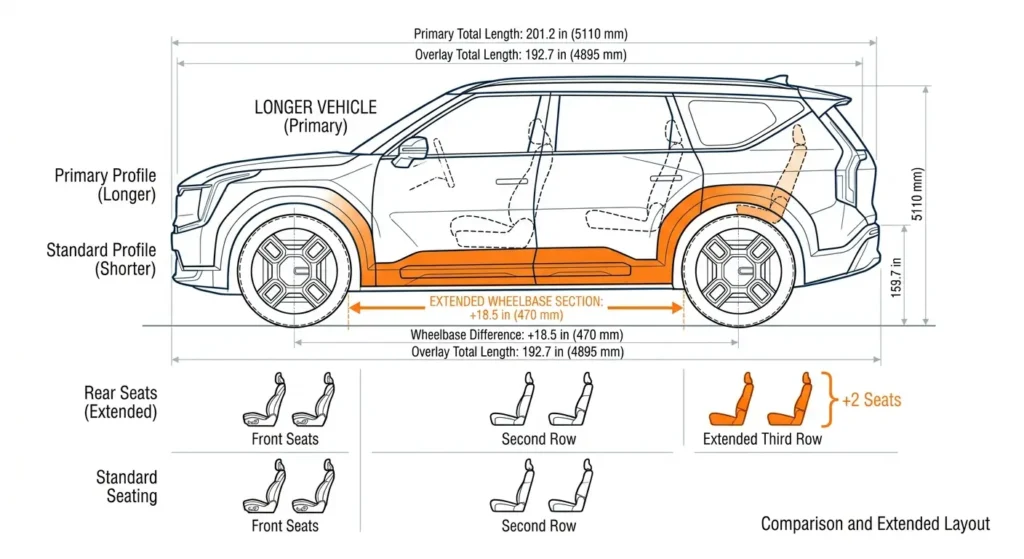
The Model Y L: Tesla’s 6-Seater, Explained.
The lineup’s newest member earns its own section — it’s the answer to a search a lot of families have been running for years.
What it is: the Model Y L, added in July 2026 — a longer-wheelbase, three-row, six-seat Model Y with second-row captain’s chairs, launched (in classic Tesla fashion) as a fully-equipped Launch Series trim first, in the ~$61K class. It began life in China, and its expansion — including documented vehicle bodies moving toward Tesla’s Texas plant ahead of the US addition — made it the worst-kept secret of the model year.
What it solves: the family gap the discontinued Model X left behind. Six genuine seats with walk-through access, ~327-mile-class range (a remarkably small penalty for the stretch), and the full Y-platform reliability inheritance — the same platform Consumer Reports crowned most reliable EV. For the “Tesla minivan” searchers our van coverage addresses, this is the real, orderable answer.
What it isn’t: a full three-row SUV. The third row remains kid-first territory versus the genuinely adult-capable rows in the Ioniq 9 / EV9 class, and cargo-behind-the-third-row is weekend-bag scale. The honest positioning: the best family Tesla ever sold, and still a size class below the dedicated three-row field — choose by how often row three carries grown-ups.
Acceleration and Performance Compared
The stoplight table — because half of Tesla shopping is this column:
| Trim | 0–60 mph | Character |
|---|---|---|
| Cybertruck Cyberbeast | ~2.6 s | Physics-mocking; tri-motor party trick |
| Model 3 Performance | ~2.9–3.1 s | The driver’s pick — adaptive suspension, sport seats |
| Model Y Performance | 3.3 s | Family rocket |
| Model Y L / Launch class | ~4.1 s | Quick despite three rows |
| Cybertruck AWD | ~4.1 s | 6,800 lb hiding it well |
| Model Y Premium AWD | 4.6 s | The everyday-brisk default |
| Model 3/Y RWD trims | 5.4–5.8 s | “Slow” only by Tesla’s warped scale |
| Model Y Standard-class | 6.8 s | The one genuinely modest Tesla |
Two honest notes on reading it. First, every figure above embarrasses the equivalent gas vehicle — the 5.8-second “base” Model 3 matches yesterday’s sport sedans; Tesla recalibrated the scale so thoroughly that its slowest car is quick. Second, the Performance trims charge real costs beyond MSRP: range drops (those 21-inch wheels), consumption rises (~3.1 mi/kWh on a Y Performance versus 3.6+ on efficiency trims), insurance notices the acceleration class, and tires — already the EV ownership tax — wear fastest exactly here. Buy the speed knowingly; the Premium trims deliver 90% of the daily experience at meaningfully lower running costs.
Cost Per Mile: The Comparison That Outlasts the Sticker
Purchase price is one day; energy cost is every day. The efficiency spread across the lineup, converted to what it means at the plug:
| Trim class | Efficiency | Energy per 1,000 miles |
|---|---|---|
| Model 3 efficiency trims | ~4.0+ mi/kWh class | ~250 kWh |
| Model Y RWD/Standard class | ~3.8–4.0 mi/kWh (138 MPGe) | ~260 kWh |
| Model Y Premium AWD | ~3.6 mi/kWh (123 MPGe) | ~275 kWh |
| Model Y Performance | ~3.1 mi/kWh | ~320 kWh |
| Cybertruck | ~2.4–2.6 mi/kWh class | ~400 kWh |
Turn those into money with your own numbers — the arithmetic is deliberately simple: (1,000 ÷ mi/kWh) × your home rate. At a typical US home rate, the spread between a Model 3 and a Cybertruck runs roughly $20–25 per thousand miles; at fast-charging prices it widens to $60+ — which over a 15,000-mile year quietly amounts to a monthly-subscription-sized difference between trims. The same formula prices any road trip: miles ÷ efficiency × the charger’s per-kWh rate.
The ownership context around the energy line: maintenance runs light and similar across the lineup (the no-oil, long-brake EV dividend our maintenance guide itemizes), insurance scales with trim speed and — sharply — for the Cybertruck’s repair profile, and depreciation currently favors the volume models over the truck, per the curves in our Cybertruck and reliability coverage. Net: the total-cost ranking largely mirrors the efficiency table — the boring trims are cheap twice, at purchase and per mile — which is precisely why the Premium RWD keeps winning this page’s recommendations.
Which Tesla Should You Buy? The Decision Matrix
The tables, converted to answers:
Best value overall: Model Y Premium RWD. Longest range in the lineup (357 mi), fastest practical charging, the reliability-champion platform, high-$40Ks money. If one trim is the default recommendation, it’s this.
Best on a budget: Model 3 Standard. $36,990 for 321 miles and the full software/network experience — the affordability leader, with the honest note that the cheapest trims shed comfort features (and the AWD Model Y’s 294 miles shows the cost-cutting reaches range too).
Best for families: Model Y L — with the three-row caveat above. Six seats, minimal range penalty, Launch Series completeness.
Best for speed: Model Y or Model 3 Performance (3.3s / ~3.0s class) — or the Cyberbeast if speed must come with a bed and 2.6 seconds of absurdity.
Best for work and adventure: Cybertruck AWD — judged on the bed-and-power system our full Cybertruck guide details, bought with its first-generation reliability profile understood.
Nobody’s pick anymore: a new Model S or X — because there aren’t any. Flagship shoppers go used (scarcity floor, aging-fleet diligence) or cross-brand.
How to Use This Comparison (and How Fresh the Data Is)
Since this page lives in our Tools & Calculators section rather than the news feed, a word on how it’s built and maintained — the meta-information that separates a reference from an article.
Sourcing: every figure comes from Tesla’s published specifications, EPA filings, and verified configurator snapshots — cross-checked against independent instrumented testing where it exists (charging rates especially). Where Tesla’s configurator and third-party databases disagree mid-restructure, the configurator wins, and the table notes the volatility.
Freshness rules: prices are the perishable layer — Tesla has repriced repeatedly since the early-2026 trim restructure, so treat every dollar figure as a dated snapshot and the live configurator as truth on order day. Ranges, weights, and charging rates are stable within a model year; lineup structure (the S/X discontinuation, the Y L addition) is the layer we update the moment it moves.
The intended workflow: shortlist from the master table → configure your range on the wheels-and-motors rule → pressure-test the budget with the cost-per-mile formula against your electricity rate → sanity-check the decision matrix → verify live pricing → cross-shop the one rival that beats your priority via our rankings. Ten minutes, current data, no ghost models — which is the entire reason this page exists.
Practical Tips
- Verify configurator pricing the day you order. The 2026 restructure era has moved prices repeatedly; every figure here is a dated snapshot by design.
- Buy range by configuration, not model. RWD + small wheels is the range recipe on any Tesla; a Premium RWD Y out-ranges most of the lineup above and below it.
- Budget FSD as $1,188/year, or budget zero. Subscription-only means the decision is monthly and reversible — and means used Teslas with legacy VIN-tied FSD carry real extra value, per our FSD guide’s used-market section.
- Weight-check your infrastructure if you’re going Cybertruck. Garage lifts, parking structures, and tire budgets all read the 6,900 lb line differently than a sedan’s.
- Family shoppers: measure your actual third-row passengers. The Y L versus the dedicated three-row class is decided by teenager height, not spec sheets.
- Flagship hunters: shop the S/X used market with the aging-Tesla checklist. Scarcity supports values; screens, doors, and suspension histories still demand the inspection discipline from our reliability guide.
Common Mistakes to Avoid
Comparing against a lineup that no longer exists. The S and X are discontinued; articles ranking “all five Teslas” are describing 2025. Any comparison content — including saved spreadsheets — needs the 2026 reset.
Reading the entry price as the typical price. $36,990 buys the decontented Standard; the trims most buyers actually configure land $8–15K higher. Budget from the trim, not the headline.
Assuming Autopilot still includes what it used to. On the newest builds, even basic lane-centering rides the FSD subscription — a structural change from every previous model year that catches returning owners off guard.
Treating EPA range as trip range. Plan on ~85% for highway reality, less in deep winter or towing — the universal EV discipline, not a Tesla flaw.
Ignoring wheel choice’s range tax. The same trim can differ meaningfully on range by wheel selection alone; the configurator shows it, buyers skip it, owners google it later.
Forgetting the credit is gone. Post-incentive stickers changed the cross-shop math against every rival simultaneously; old “after $7,500” comparisons mislead in both directions.
FAQs
Three vehicles: the Model 3 sedan (from $36,990), the Model Y SUV (from $39,990, including the new three-row Model Y L), and the Cybertruck pickup (from $69,990). The Model S and Model X ended production entirely in 2026 with no confirmed replacements, leaving the used market as the only flagship source.
The Model Y Premium RWD leads the current lineup at 357 EPA miles, with the Model 3’s long-range configurations close behind in the ~360-mile class. The shortest-range current Tesla is the $41,990 Model Y AWD at 294 miles — configuration (drive motors and wheel size) matters as much as model choice.
By model: Model 3 roughly 3,880–4,050 lb, Model Y about 4,150–4,400 lb (Model Y L slightly more), the discontinued Model S 4,560–4,760 lb, Model X 5,185–5,390 lb, and the Cybertruck 6,600–6,900 lb. The battery pack accounts for most of the premium over comparable gas vehicles.
Production ended in 2026 after years of shrinking volumes against Tesla’s own cheaper models, with the company’s capacity and strategy prioritizing volume vehicles and autonomy programs. Final inventory sold down with a notable price increase, and no successors have been confirmed — used examples now carry a permanent scarcity floor.
A longer-wheelbase, six-seat, three-row Model Y variant added in July 2026, launched as a fully-equipped Launch Series trim in the ~$61,000 class with second-row captain’s chairs and ~327 miles of range. It’s the family answer to the discontinued Model X — best for kid-scale third-row duty rather than regular adult passengers.
The new-vehicle span runs $36,990 (Model 3 Standard) to over $100,000 (Cybertruck Cyberbeast), with the volume trims clustering between $40,000 and $58,000. Note the federal EV tax credit has ended, FSD is a separate $99/month subscription, and Tesla’s configurator pricing has shifted repeatedly through 2026 — verify live before ordering.
In practical terms, the Model Y Premium RWD — recovering about 181 miles in 15 minutes (12.1 miles/minute) at a Supercharger, the lineup’s best rate. Across the range, most trims restore roughly half their EPA range in a 15-minute session, which is the consistency that keeps Tesla road trips undramatic.
Same platform, different bodies: the Model 3 is cheaper, more efficient, and the better pure driver; the Model Y trades a little of each for cargo flexibility, family practicality, and the crown of most reliable EV on sale. Most buyers who haul anything choose the Y; most who don’t save the money.
Use the formula (miles ÷ efficiency) × electricity rate: at typical US home rates, most Teslas run roughly $30–45 per 1,000 miles at home, with the Cybertruck’s ~2.5 mi/kWh appetite running higher and Supercharger pricing multiplying everything by two to three. Efficiency trims (Model 3, Model Y RWD classes) sit at the cheap end — the per-mile spread between trims quietly rivals a streaming budget over a year.
No — production ended in 2026, and the final inventory (marked by a last-call price increase) has sold through. The used market is now the only source, where late-production examples offer the matured hardware at newly rational prices, and early examples are enthusiast buys with known aging line-items. Tesla continues parts, service, and software support for the discontinued fleet.
Verdict: A Smaller Lineup That’s Easier to Choose From
The 2026 comparison lands somewhere unexpected: Tesla’s range is the narrowest it’s been in a decade — and the most coherent. Three vehicles, honestly tiered, all NACS-native, all subscription-FSD, with the Model Y Premium RWD as the objective sweet spot, the Model 3 Standard as the value floor, the Y L quietly solving the family question the departed Model X left open, and the Cybertruck as the polarizing outlier it was born to be.
Use this page as intended: pick your row from the decision matrix, verify the live configurator price (they move), apply the 85% range rule to your longest regular trip, and cross-check the broader field before committing — because a lineup this clear makes the remaining question less “which Tesla?” and more “Tesla, or the specific rival that beats it at your one priority?” Either answer, made with current data, beats the internet’s five-model ghosts.