Solar panels can supply some or all of the electricity an electric vehicle needs, but the amount of solar required depends on how much you drive, how efficient your EV is, how much electricity your solar system produces, and when your car is available to charge. There is no single panel count that works for every EV or every home.
The most useful way to size a system is to connect your EV’s electricity demand with your home’s actual solar production and charging schedule. Our calculator below estimates annual EV electricity use, the portion that can come from solar, the number of panels required, solar system size, charging cost per mile, annual savings, and the approximate payback for adding solar capacity.
Solar EV charging savings calculator
Estimate how much solar can save on EV charging compared with grid electricity, how many panels your driving needs, and how quickly additional solar capacity could pay for itself.
Payback on adding panels for the EV
Typical installed prices per kWp: US ~$2,500–3,000; UK ~£1,200–1,500; EU ~€1,100–1,500. Enter your quote for accuracy.
How this works: the EV’s annual electricity = distance ÷ efficiency plus ~10% charging losses. The solar share you set determines how much of that can realistically come off the roof; each solar kWh saves you the grid price minus the export rate (using it yourself means giving up the export income — the honest accounting). Panel count assumes ~440 W modules; array size = the EV’s solar kWh ÷ your region’s yield. Payback divides the added install cost by the yearly saving and ignores degradation (~0.5%/yr) and future price changes, both small against the headline. Home batteries raise the achievable solar share substantially but add their own cost — a topic for its own article. Yields per PVGIS / NREL PVWatts typical values. Estimates only.
What the calculator estimates
The tool can estimate:
- annual electricity required by the EV
- electricity supplied by solar
- the remaining grid-charging share
- solar versus grid charging cost per mile
- approximate number of solar panels
- solar-array size in kWp
- annual EV charging savings
- estimated payback for additional solar capacity
The calculator currently models EV electricity as annual driving divided by EV efficiency, with an approximately 10% charging-loss assumption. It then applies the share of charging that can realistically happen while solar generation is available.
For actual system design, use a location-specific solar-production model such as NREL’s PVWatts. PVWatts estimates energy production for grid-connected photovoltaic systems using inputs such as location and system characteristics.
Planning tip: Your solar panel requirement is determined by energy demand and local solar production—not simply by the size of your EV battery.
How Solar Panels Charge an Electric Car
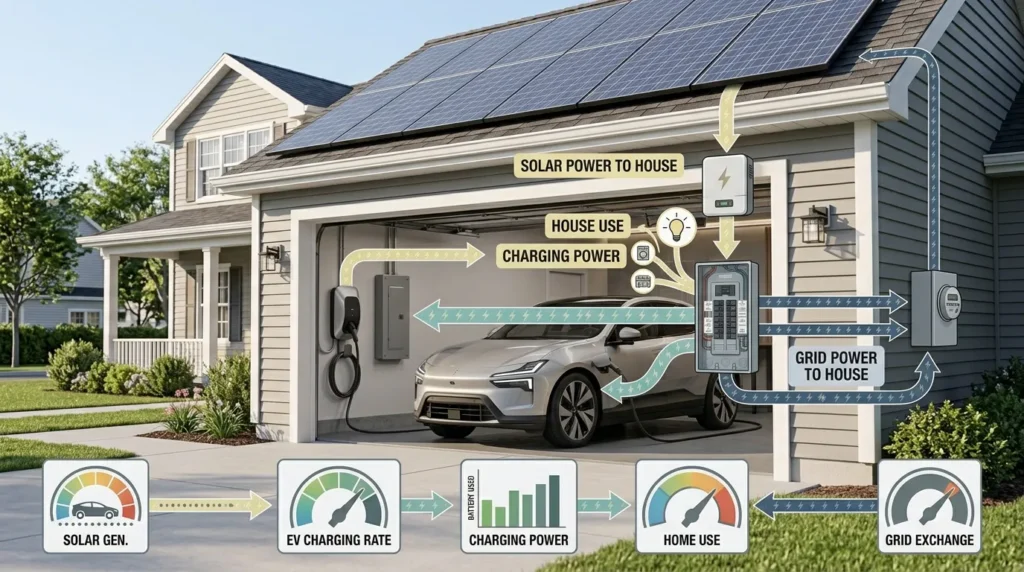
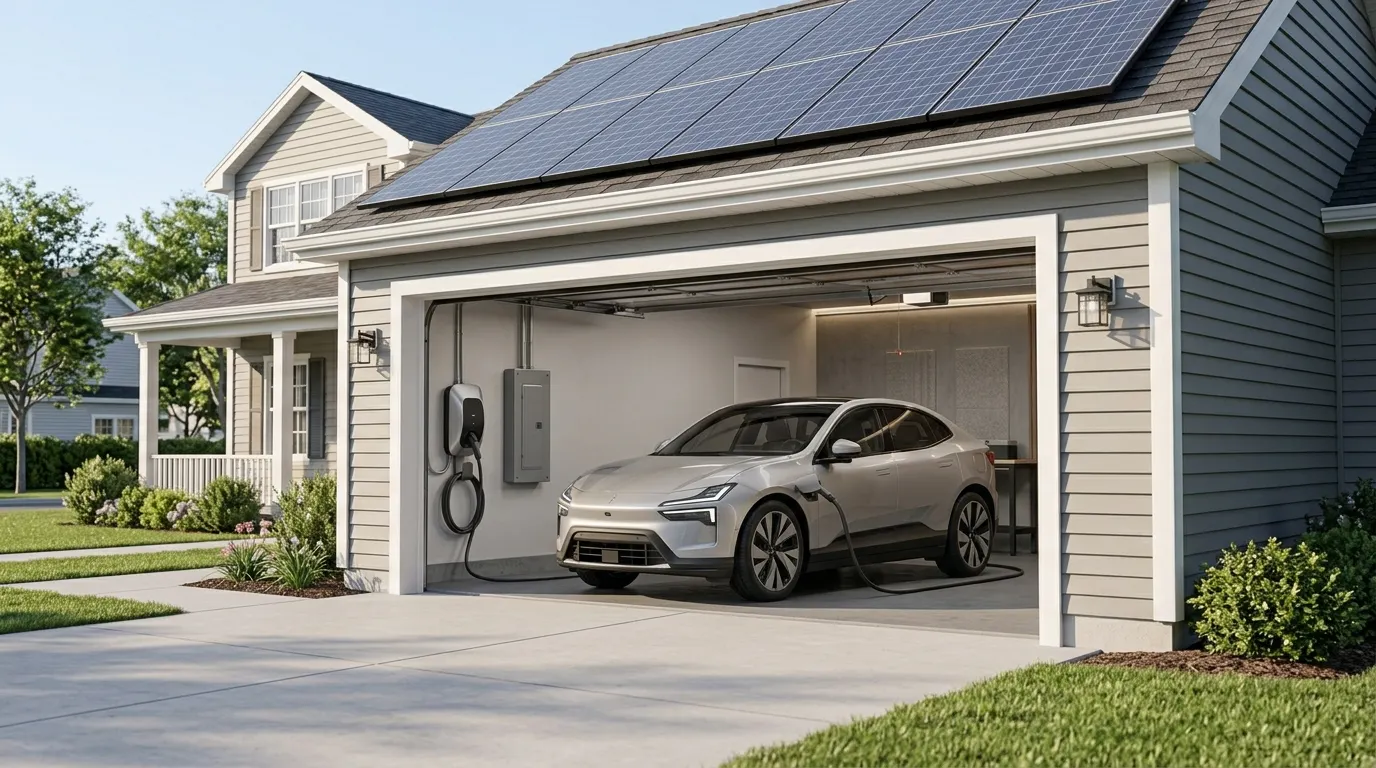
A rooftop photovoltaic system converts sunlight into electricity for the home. The EV then uses electricity from the home’s electrical system when it is connected to a charging system.
The important point is that the solar panels do not need to be physically connected directly to the vehicle.
A typical home arrangement looks like this:
Sunlight → solar panels → home electrical system → EV charging equipment → EV battery
The amount of EV charging actually supplied by solar depends on when the solar system is producing electricity and when the vehicle is available to charge.
The U.S. Department of Energy explains that solar photovoltaic systems generate electricity through PV modules and that a complete residential PV system also includes other equipment needed to make the generated electricity useful in the home.
That is why a home with a large solar array can still draw electricity from the grid for EV charging at certain times.
How Many Solar Panels Do You Need to Charge an Electric Car?

There is no universal answer to how many solar panels to charge an electric car.
The number depends mainly on four variables:
- how far you drive
- how efficiently your EV uses electricity
- how much electricity each installed kW of solar produces at your location
- how much of your EV charging can actually be supplied by solar
For example, a driver who travels relatively few miles and has a highly efficient EV may require much less solar generation than a driver who travels substantially farther in a less-efficient vehicle.
Annual driving changes the calculation
Start with the amount of driving you expect over a year.
A vehicle driven 15,000 miles per year needs more electricity than the same vehicle driven 8,000 miles per year.
That means a panel count based only on the car’s battery size can be misleading. Battery capacity tells you how much energy the battery can store; it does not tell you how much electricity your household needs to provide for a full year of driving.
EV efficiency matters
The basic relationship is straightforward:
Annual EV electricity ≈ annual driving ÷ EV efficiency
For example, an EV that averages 3.5 miles per kWh will need more electricity to cover a given distance than one averaging 4.0 miles per kWh.
Actual charging losses should also be considered. Our calculator uses an approximately 10% loss assumption as part of its model, which means its electricity estimate is deliberately higher than simply dividing miles by efficiency.
Solar production varies by location
Two identical solar arrays can produce different amounts of electricity because solar resource, orientation, tilt, shading, temperature, system losses, and other factors affect energy yield.
The Department of Energy notes that PV energy yield is influenced by conditions such as heat, dirt, and shade, while NREL’s PVWatts is specifically designed to estimate PV energy production for a given location and system configuration.
For that reason, a fixed statement such as “every EV needs 10 panels” is not technically defensible.
Solar Panels for EV Charging: How to Estimate System Size
A better calculation works backward from your electricity requirement.
Suppose your EV needs a certain number of kWh per year. You then estimate how much of that demand should be supplied by solar and how much electricity your local solar system can produce per kWp.
A simplified planning relationship is:
Required solar capacity ≈ solar electricity needed ÷ annual solar production per kWp
The calculator uses a regional yield assumption to estimate required system size and then converts that into an approximate panel count using a 440 W module assumption.
That number is an estimate, not a design specification.
Why panel count alone can be misleading
Consider two homeowners with identical EVs.
One drives 7,000 miles annually and charges the car while solar production is available.
The other drives 18,000 miles annually and leaves the vehicle away from home throughout much of the day.
They should not expect the same solar system to produce the same practical EV-charging benefit.
The second homeowner may have a larger theoretical solar requirement and a lower percentage of EV electricity directly supplied by daytime solar unless charging is shifted to suitable hours or energy is stored.
Charging an Electric Car With Solar: The Daytime Problem
One of the most important variables in solar EV economics is when the car is parked at home.
Your solar panels can generate electricity during daylight hours, but the EV cannot consume that electricity while it is somewhere else.
The calculator therefore includes a setting for the percentage of charging that can happen while the sun is producing electricity.
This is a more useful assumption than simply asking how many panels are on the roof.
A car parked at home during the day
A homeowner who can charge during daylight hours may be able to use a greater portion of their solar generation directly for the EV.
That can improve self-consumption and reduce the amount of electricity purchased from the grid.
A car parked at work during the day
Someone who commutes away from home may have fewer opportunities to charge directly from rooftop solar during peak production hours.
The solar system can still reduce household electricity purchases overall, but the EV-specific solar share may be lower.
A home battery changes the timing equation
Battery storage can allow electricity produced earlier in the day to be used later when the vehicle returns home.
That can increase the potential solar share of EV charging, but a battery adds equipment and financial considerations of its own. This calculator does not attempt to model a complete home-battery investment decision.
How Much Can Solar Save on EV Charging?
Solar charging savings depend on what electricity would have cost without the solar generation and what value that electricity would have had if exported instead.
This distinction matters.
Suppose one solar kWh can either:
- be used by the EV, avoiding a grid purchase, or
- be exported under the home’s applicable electricity arrangement.
The economic value of using the solar electricity for the EV is related to the difference between the avoided grid cost and the value of exporting that electricity.
Our calculator therefore uses:
Solar self-consumption value per kWh ≈ grid electricity price − export rate
rather than treating every self-consumed solar kWh as if it had the full retail electricity value.
This can produce a more conservative planning estimate than simply multiplying solar generation by the retail electricity rate.
Solar vs Grid EV Charging Cost
Charging an EV from solar does not mean the electricity has literally become free.
There can be:
- solar system investment
- financing costs
- maintenance considerations
- opportunity cost from exporting solar
- inverter and system losses
- changes in electricity rates
- changes in utility compensation rules
For an existing solar system, however, additional EV charging can make productive use of electricity generated on-site.
The calculator shows a solar-versus-grid cost-per-mile comparison based on the assumptions entered by the user.
For the broader question of what it costs to operate an EV on electricity, see the EV charging cost guide. The two questions are related but not identical: installation/solar economics concern the energy system, while charging cost concerns the energy consumed by the vehicle.
How Much Electricity Does an EV Use Per Year?
The calculation starts with driving distance and efficiency.
Formula
Annual EV electricity before charging losses = annual driving distance ÷ EV efficiency
Then the calculator applies its charging-loss assumption.
For example, using an illustrative vehicle that travels 12,000 miles annually at 3.5 mi/kWh:
12,000 ÷ 3.5 = 3,429 kWh
Applying a 10% loss assumption gives approximately:
3,429 ÷ 0.90 ≈ 3,810 kWh
This is an illustrative calculation, not a claim that every EV loses exactly 10% during charging.
Vehicle efficiency itself can also vary with speed, temperature, weather, terrain, HVAC use, tires, payload, and driving conditions. A vehicle’s official efficiency rating and real-world energy use are not necessarily identical.
How Large Should a Solar System Be for an EV?
Once annual EV electricity is estimated, the next question is how much solar production is required to cover the desired portion.
Suppose the calculator estimates that your EV needs approximately 4,000 kWh of electricity per year and you want solar to supply 60% of that demand.
The target solar electricity would be:
4,000 × 0.60 = 2,400 kWh per year
If a location-specific analysis suggests that each kWp of installed PV produces a certain annual amount of electricity, the required array size can then be estimated from that production figure.
NREL’s PVWatts calculator is useful for this type of location-specific assessment because it can estimate annual, monthly, and hourly PV production and allows users to account for system characteristics.
For a real installation, a solar professional can incorporate roof orientation, shading, structural conditions, equipment selection, local permitting, and the site’s electricity consumption.
Can Solar Panels Charge an EV?
Yes. Solar panels can supply electricity used to charge an EV through a home’s electrical system.
The practical arrangement is normally solar generation feeding the home electrical system, with the EV charging equipment drawing electricity from that system.
The DOE says EV drivers commonly charge at home using Level 1 or Level 2 AC equipment. It describes residential Level 2 charging as using 240-volt service in typical home applications.
You therefore do not generally need a special device simply because the electricity originates from rooftop solar.
What matters more is how the solar system, home’s electrical system, and charging equipment are designed and operated together.
Do You Need a Solar EV Charger?
Not necessarily.
The phrase solar EV charger can refer to charging equipment or systems marketed around solar-powered EV charging, but having rooftop solar does not automatically mean you need a special “solar charger.”
The key distinction is between:
Solar generation
and
EV charging equipment
A conventional compatible home EV charger can use electricity generated by the home’s solar system. Whether the charging equipment can actively coordinate charging with solar production depends on the equipment, home-energy system, controls, and configuration.
This article is therefore not a charger-buying guide. For help selecting home charging hardware, see Go Electric Hub’s best electric car charger for home guide.
Charging an EV With Solar at Home
For many homeowners, the goal is not necessarily to make every charging session 100% solar.
A more realistic goal can be to increase the percentage of the vehicle’s annual electricity supplied by on-site solar.
That distinction becomes important when evaluating system size.
More solar is not automatically better
Adding more panels can increase annual generation, but the additional electricity has to be valuable enough to justify its cost.
Once household demand and EV demand are already covered during valuable periods, additional solar generation may be exported or otherwise compensated according to the applicable utility arrangement.
That’s why the calculator asks for an export rate rather than assuming every unused solar kWh has zero value.
Your electricity rate matters
A household paying a higher effective electricity price may place a different economic value on self-consumed solar than a household paying a lower rate.
Time-of-use tariffs can complicate this further because electricity prices can vary by time of day.
For an individual property, the best input is usually based on the homeowner’s actual utility rate structure rather than a generic national assumption.
Solar EV Charging and Payback
The calculator also estimates the payback period for adding solar capacity specifically to support EV charging.
The basic calculation is:
Payback period ≈ additional solar investment ÷ annual EV-related solar savings
This is useful as a screening calculation, but it should not be mistaken for a complete financial model.
The result can change when:
- electricity rates change
- export compensation changes
- solar installation costs change
- actual solar production differs from the estimate
- EV mileage changes
- the vehicle’s efficiency changes
- financing is included
- maintenance or equipment replacement is considered
The calculator currently estimates added system cost by multiplying the required kWp by the user’s entered installed cost per kWp, then dividing that investment by annual savings.
Why we do not promise a specific payback
A national “solar EV payback” number can be attractive in a headline but misleading for an individual homeowner.
A more useful answer is:
What does the calculation look like for your mileage, electricity rate, solar resource, charging schedule, and proposed system cost?
That is exactly where a calculator provides more value than a generic average.
Example: Solar Panels for an EV
Consider a hypothetical U.S. driver with:
- 12,000 miles of annual driving
- 3.5 mi/kWh EV efficiency
- approximately 10% charging losses
- 60% of EV charging supplied by solar
First:
12,000 ÷ 3.5 = 3,429 kWh
With the calculator’s illustrative loss assumption:
3,429 ÷ 0.90 ≈ 3,810 kWh/year
At a 60% solar share:
3,810 × 0.60 ≈ 2,286 kWh/year from solar
The required solar-array size would then depend on the site’s annual production per kWp.
That last step is where a fixed national panel count becomes unreliable. A homeowner in one part of the United States can have a very different solar yield from someone elsewhere, and roof orientation or shading can further change the result.
NREL’s PVWatts is specifically intended for estimating PV production according to location and system configuration, making it more appropriate for site-specific modeling than a one-size-fits-all panel rule.
What Affects Solar EV Charging Savings?
Several inputs can move the result substantially.
Annual mileage
More driving usually means more electricity demand.
Vehicle efficiency
A more efficient EV needs less electricity to cover the same distance.
Solar resource
Solar production varies by location and system conditions.
Daytime charging opportunity
The more often the EV is available when solar is generating, the greater the potential for direct solar use.
Grid electricity price
A higher avoided electricity cost can increase the economic value of solar self-consumption.
Solar export value
If surplus electricity can be exported, the opportunity cost of using that electricity for the EV should be considered.
Solar installation cost
A lower installed cost can shorten the simple payback period, while a higher project cost can extend it.
These variables are why a useful solar charging calculator should ask about more than just the EV model.
Solar Panels vs Grid Electricity for EV Charging
Rooftop solar and grid electricity are not mutually exclusive.
Most grid-connected homes can use both.
When solar output is insufficient, electricity can come from the grid. When solar generation exceeds the home’s immediate consumption, the excess may be exported or handled according to the property’s electrical and utility arrangements.
That means a homeowner does not have to size solar large enough to eliminate all grid electricity to benefit from solar EV charging.
A partial solar contribution can still reduce grid purchases.
The right target depends on the homeowner’s priorities:
Maximum solar coverage: larger solar investment may be appropriate.
Lowest upfront investment: a smaller system may make more sense.
Balanced economics: size the system according to expected electricity demand and the value of both self-consumption and exports.
Common Mistakes When Sizing Solar for EV Charging
Using the EV battery size as the panel calculator
A 75-kWh battery does not mean you need enough solar to generate 75 kWh every time you charge.
What matters for system sizing is the amount of electricity the vehicle consumes over time.
Assuming every solar kWh will charge the car
The vehicle may not be home while solar production is highest.
Using the same panel count for every location
Solar production is location-dependent.
Ignoring charging losses
Electricity drawn from the home’s electrical system and energy ultimately stored in the battery are not perfectly identical.
Treating the calculator output as a solar quote
A planning tool cannot see your actual roof, shading, electrical infrastructure, utility tariff, or installer proposal.
Adding panels without checking their economic value
More generation is useful only when the additional production has sufficient value relative to the investment.
Assuming a home battery automatically improves the economics
A battery can increase the amount of solar energy available after sunset, but it also has its own cost, losses, warranty considerations, and replacement economics.
How to Get a More Accurate Solar EV Estimate
For a homeowner considering an actual installation, use the calculator as the first planning step and then improve the inputs.
Step 1: Use your real annual mileage
Look at your previous year’s driving rather than guessing.
Step 2: Use a realistic EV efficiency value
Prefer an appropriate vehicle-specific value for your model and usage rather than assuming every EV has the same efficiency.
Step 3: Estimate your solar production
For a U.S. site, NREL’s PVWatts can provide a location-specific starting point for estimated PV production.
Step 4: Check when your car is normally home
This can be one of the most important practical inputs for direct solar charging.
Step 5: Use your actual electricity rate
Look at your utility bill and rate plan.
Step 6: Check your export arrangement
Understand what happens to solar electricity that your home and EV do not consume.
Step 7: Get a site-specific solar proposal
A qualified installer can evaluate roof conditions, shading, electrical equipment, system design, permitting, and other factors that an online calculator cannot see.
A Note About Solar Incentives for 2027
Tax-credit information deserves particular caution because the rules have changed.
The IRS currently states that the Residential Clean Energy Credit is not available for qualified property expenditures made after December 31, 2025 following the changes made by the 2025 legislation.
Therefore, a 2027 homeowner should not assume that an older article’s federal residential solar tax-credit calculation still applies.
State, local, utility, financing, and other programs can have separate rules, so any incentive included in a real financial calculation should be checked against the current official program terms.
The calculator’s solar investment field should therefore be treated as an input for the user’s actual quoted project cost—not as an automatic promise of a tax credit or rebate.
Frequently Asked Questions
There is no universal number. The requirement depends on annual driving, EV efficiency, local solar production, system losses, and how much of your charging can realistically be supplied by solar. The calculator estimates the required array size and approximate panel count from those inputs.
Yes. Rooftop solar can generate electricity that flows through the home’s electrical system and is used by EV charging equipment. A dedicated “solar charger” is not automatically required just because a home has solar.
It can reduce the amount of electricity purchased from the grid, but the economic benefit depends on the home’s solar investment, electricity price, export value, system production, and charging schedule. Solar charging should be evaluated as part of the overall energy economics of the home.
It depends on how much the vehicle is driven and how efficiently it uses electricity. A practical calculation starts with annual miles divided by the EV’s electricity efficiency, then accounts for charging losses and the desired solar share.
Yes. A grid-connected home solar system can supply electricity for EV charging through the home’s electrical system. The amount supplied by solar depends on solar production and when the vehicle is available to charge.
Final Takeaway
The question is not simply “How many solar panels will charge my EV?”
The better question is:
How much electricity does my EV need, how much solar can my property produce, how much of that electricity can realistically serve the car, and what is that energy worth compared with buying it from the grid?
That is why solar sizing for an EV should be based on annual driving, vehicle efficiency, solar production, charging timing, electricity rates, export value, and system cost rather than a fixed panel number.
Use the calculator at the top of this page to build a personalized planning estimate. Then use location-specific solar production data and a professional site assessment before making an installation decision.