Introduction
One of the first questions people ask before buying an electric vehicle is:
How much does it cost to charge an electric car?
Unlike gasoline vehicles, where drivers immediately think about fuel prices per gallon or liter, electric cars use electricity measured in kilowatt-hours (kWh). The final charging cost depends on several factors, including your electricity rate, battery size, vehicle efficiency, charging method, and where you charge your vehicle.
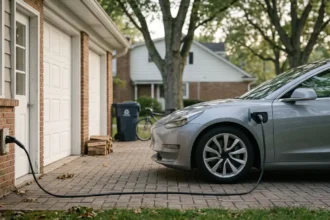
For many EV owners, charging an electric car at home is significantly cheaper and more convenient than visiting a fuel station. A driver can plug in overnight, wake up with a charged battery, and avoid frequent trips to public charging stations.
However, EV charging costs are not identical for everyone. Someone charging a small electric hatchback at home may spend much less than someone driving a large electric SUV and relying on expensive public fast chargers.
Understanding charging costs helps you answer important ownership questions:
- How much will I spend every month charging my EV?
- Is charging cheaper than buying gasoline?
- Should I install a home charger?
- How much does fast charging cost?
- How much does it cost to charge popular EVs like Tesla models?
In this guide, we will break down everything you need to know about electric car charging costs, from simple home charging calculations to public charging prices, monthly expenses, and ways to reduce your electricity bill.
How Is Electric Car Charging Cost Calculated?
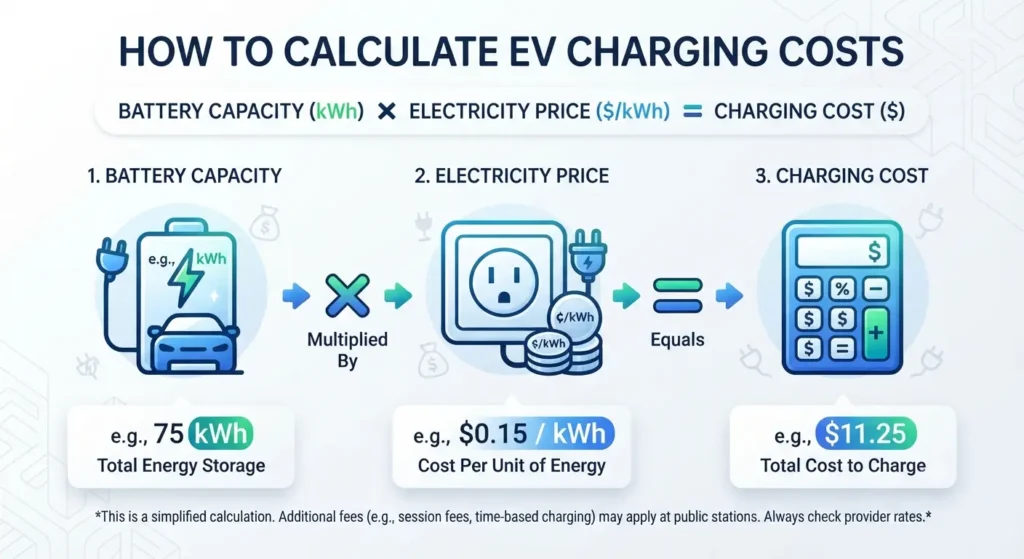
The easiest way to calculate EV charging cost is:
Battery capacity (kWh) × Electricity price ($/kWh) = Charging cost
An electric vehicle battery stores energy in kilowatt-hours.
For example:
- Battery size: 75 kWh
- Electricity price: $0.16 per kWh
Calculation:
75 × 0.16 = $12
A full battery charge would cost approximately $12.
However, real-world charging is usually not from empty to full. Most EV drivers charge when the battery reaches around 20–40% and often stop charging around 80–90% for daily driving.
Understanding Kilowatt-Hours (kWh)
Many new EV owners find electricity measurements confusing because they are different from gasoline.
A gasoline vehicle uses:
- Gallons
- Liters
An electric vehicle uses:
- Kilowatt-hours (kWh)
A kWh represents the amount of electrical energy stored or used.
A simple example:
If an EV has:
- 60 kWh battery
It can store 60 units of electrical energy.
A larger battery usually means:
- Longer driving range
- Higher charging cost
- More energy required to recharge
Why EV Charging Costs Are Different for Every Driver
Two people can own the same electric vehicle and pay different charging costs.
Why?
Because charging expenses depend on:
Electricity Rates
Electricity prices vary by:
- Country
- State
- Region
- Energy provider
- Time of use
Someone charging an EV in a region with cheaper electricity will spend less than someone in an area with higher electricity prices.
Driving Distance
Your monthly mileage has a direct effect on charging costs.
A person driving:
- 300 miles per month
will spend much less than someone driving:
- 2,000 miles per month
Vehicle Efficiency
Not all EVs use electricity at the same rate.
A smaller, lighter electric vehicle may travel farther using less energy.
A large electric SUV usually requires more electricity because of:
- Higher weight
- Larger battery
- Increased energy demand
Average Cost to Charge an Electric Car
There is no single charging price that applies everywhere.
The cost can range from a few dollars to more than $30 depending on:
- Battery size
- Charging location
- Electricity prices
- Charger type
Generally:
- Home charging is the cheapest option
- Workplace charging may be affordable
- Public charging usually costs more
- DC fast charging is often the most expensive
Home Charging: The Cheapest Way to Charge an EV
For most electric vehicle owners, home charging becomes the main charging method.
The reason is simple:
You control the electricity source.
Instead of paying public charging network fees, you only pay your normal electricity rate.
Home charging offers:
- Lower cost
- Convenience
- Overnight charging
- No waiting at charging stations
Many EV owners complete most of their weekly charging while their vehicle is parked at home.
How Much Does It Cost to Charge an EV at Home?
The cost depends on:
- Battery size
- Electricity price
- Charging efficiency
Example:
A vehicle with:
- 80 kWh battery
- Electricity cost of $0.15/kWh
Calculation:
80 × $0.15 = $12
A complete charge costs about $12.
If that charge provides:
300 miles of range
The energy cost is:
$12 ÷ 300 miles
This means the EV costs only a few cents per mile to operate.
Level 1 Home Charging Cost
Level 1 charging uses a standard household electrical outlet.
It is the simplest charging method because it usually requires no special installation.
Advantages
- Lowest upfront cost
- Works with existing outlets
- Good for low-mileage drivers
Disadvantages
- Slow charging speed
- May not add enough range overnight for heavy drivers
Level 1 charging is suitable for:
- People who drive short distances
- Plug-in hybrid owners
- Drivers with flexible charging schedules
Level 2 Home Charging Cost
Level 2 charging is the most popular home charging solution for full EV owners.
It requires:
- Dedicated electrical circuit
- Proper installation
- Compatible charger
Advantages:
- Much faster charging
- Better daily convenience
- More suitable for larger batteries
Many homeowners choose Level 2 chargers because they can add significant range overnight.
Best Electric Car Charger for Home 2026
Level 1 vs Level 2 Charging Cost Comparison
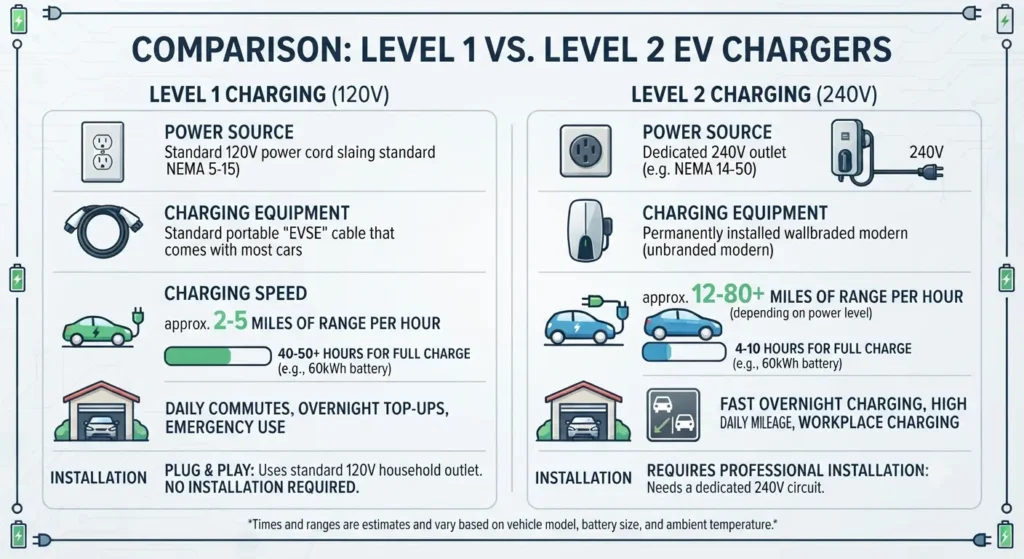
Choosing between Level 1 and Level 2 charging affects both convenience and your overall EV ownership experience. The electricity cost itself is usually similar because both use your home’s electricity supply, but the difference comes from charging speed and installation requirements.
Level 1 Charging
Level 1 charging uses a standard household outlet.
It is the simplest option because most homes already have compatible outlets.
Typical users:
- Drivers with short daily commutes
- People who drive fewer miles
- Plug-in hybrid owners
- Owners who do not need fast overnight charging
The main limitation is speed. A large EV battery can take many hours or even more than a day to fully recharge.
Level 2 Charging
Level 2 charging uses a higher-powered electrical connection.
It is commonly installed in homes because it provides a practical balance between speed and cost.
Typical users:
- Daily EV drivers
- Families with larger electric vehicles
- Drivers who want convenient overnight charging
A Level 2 charger does not necessarily make electricity cheaper, but it allows you to recover more driving range in less time.
Level 1 vs Level 2 Charging Comparison Table
| Feature | Level 1 Charging | Level 2 Charging |
|---|---|---|
| Power Source | Standard household outlet | Dedicated electrical circuit |
| Installation Cost | Usually very low | Higher due to installation |
| Charging Speed | Slow | Much faster |
| Best For | Low-mileage drivers | Daily EV owners |
| Home Suitability | Basic charging needs | Most full EV owners |
| Electricity Cost | Similar home electricity rate | Similar home electricity rate |
Does Installing a Home EV Charger Increase Charging Costs?
Many people assume installing a Level 2 charger makes EV ownership more expensive.
The charger itself does not increase the electricity price. You are still paying your normal electricity rate.
However, installation can add an upfront cost.
Installation expenses vary depending on:
- Electrical panel capacity
- Distance from the panel to parking area
- Local electrician rates
- Required upgrades
Some homes already have the necessary electrical capacity, while others may need additional work.
Before installing a charger, it is useful to get an electrician’s assessment.
Best Electric Car Charger for Home 2026
Public EV Charging Cost Explained
While home charging works for many EV owners, public charging remains important.
Drivers use public chargers when they:
- Travel long distances
- Live in apartments
- Need emergency charging
- Take road trips
Public charging prices vary widely depending on the charging provider, location, and charger speed.
How Much Does Public EV Charging Cost?
Public charging can be priced in different ways.
Common pricing methods include:
Cost Per kWh
Many charging networks charge based on electricity consumed.
Example:
If a charger costs $0.40 per kWh:
Adding 40 kWh of energy would cost:
40 × $0.40 = $16
Time-Based Pricing
Some locations charge by the amount of time connected to the charger.
This method is becoming less common because it does not always reflect the actual electricity used.
Membership Pricing
Some charging networks offer memberships that provide:
- Lower charging rates
- Monthly plans
- Additional benefits
Frequent public charger users may save money through these programs.
DC Fast Charging Cost
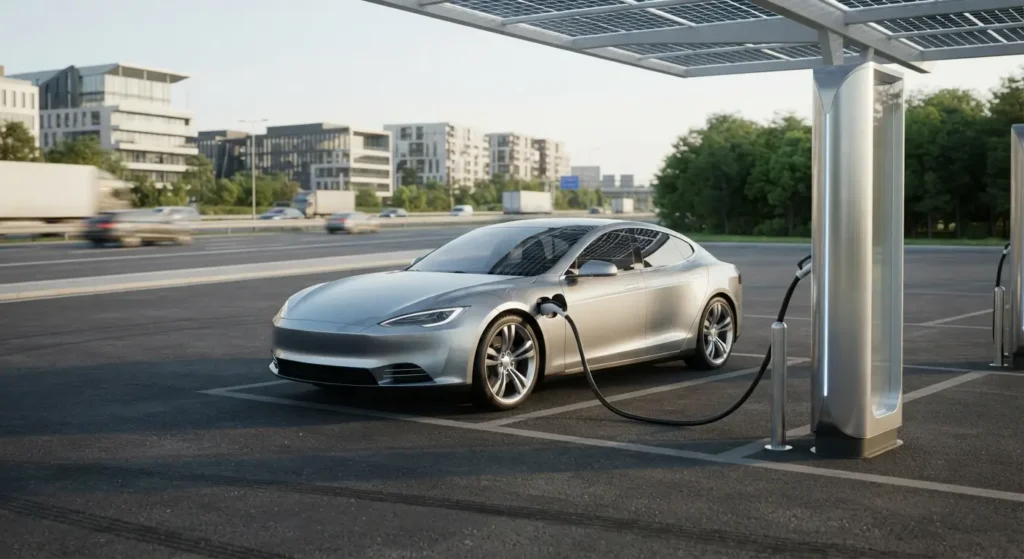
DC fast charging is designed for speed.
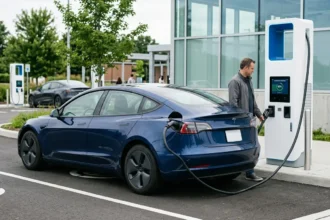
Unlike home chargers, which are mainly used when a vehicle is parked for several hours, DC fast chargers are built for quick charging during travel.
They are commonly found at:
- Highways
- Rest areas
- Shopping centers
- Travel stops
The convenience comes with a higher price.
Why Is DC Fast Charging More Expensive?
DC fast chargers require:
- Expensive equipment
- High-power electrical connections
- Maintenance
- Network management
Because of these costs, fast charging is usually more expensive than charging at home.
For occasional road trips, the extra cost may be worth the time saved.
For daily charging, home charging is usually more economical.
How Much Does It Cost to Charge a Tesla?
One of the most searched EV charging questions is:
How much does it cost to charge a Tesla?
The answer depends on:
- Tesla model
- Battery capacity
- Electricity rates
- Charging location
Tesla vehicles have different battery sizes, meaning the cost of a full charge varies between models.
For example:
- A smaller Tesla battery requires less electricity.
- A long-range Tesla with a larger battery requires more energy.
Tesla Home Charging Cost
Charging a Tesla at home follows the same calculation as any other EV.
Formula:
Battery size × electricity rate = charging cost
Example:
A Tesla with a 75 kWh battery:
Electricity price:
$0.16 per kWh
Calculation:
75 × 0.16 = $12
The exact amount changes based on local electricity prices.
Tesla Supercharger Cost
Tesla Superchargers provide fast charging and are designed for convenience.
The cost depends on:
- Location
- Electricity rates
- Time of use
- Local pricing rules
Supercharging is usually more expensive than home charging.
Many Tesla owners use:
- Home charging for daily driving
- Superchargers for long trips
This combination provides both affordability and convenience.
EV Charging Cost Per Month
Monthly charging expenses depend mainly on how much you drive.
A person who drives a few hundred miles each month will spend much less than someone with a long daily commute.
The main factors are
Example Monthly EV Charging Costs
Low-Mileage Driver
Driving:
500 miles per month
Mostly:
Home charging
Expected cost:
Lower monthly electricity expense.
Average Driver
Driving:
1,000–1,200 miles per month
Charging:
Mostly at home
Expected cost:
Moderate monthly charging cost.
High-Mileage Driver
Driving:
2,000+ miles per month
Charging:
Combination of home and public charging
Expected cost:
Higher electricity expenses.
EV Charging Cost by Vehicle Type
Different electric vehicles consume different amounts of energy.
A small electric car generally costs less to charge than a large electric SUV.
Example Comparison
| Vehicle Type | Battery Size | Charging Cost Impact |
|---|---|---|
| Compact EV | 40–60 kWh | Lower |
| Sedan EV | 60–90 kWh | Medium |
| Electric SUV | 80–120 kWh | Higher |
| Performance EV | Large battery | Higher |
Battery size is one of the biggest factors affecting charging expenses.
USA vs UK Electric Car Charging Costs
EV charging costs vary significantly between countries.
United States
Factors affecting cost:
- State electricity prices
- Utility company rates
- Public charging networks
Some regions have relatively affordable electricity, while others have higher energy costs.
United Kingdom
UK drivers often consider:
- Home electricity tariffs
- Smart charging plans
- Public charging subscriptions
Many UK EV owners choose home charging because public charging can be significantly more expensive.
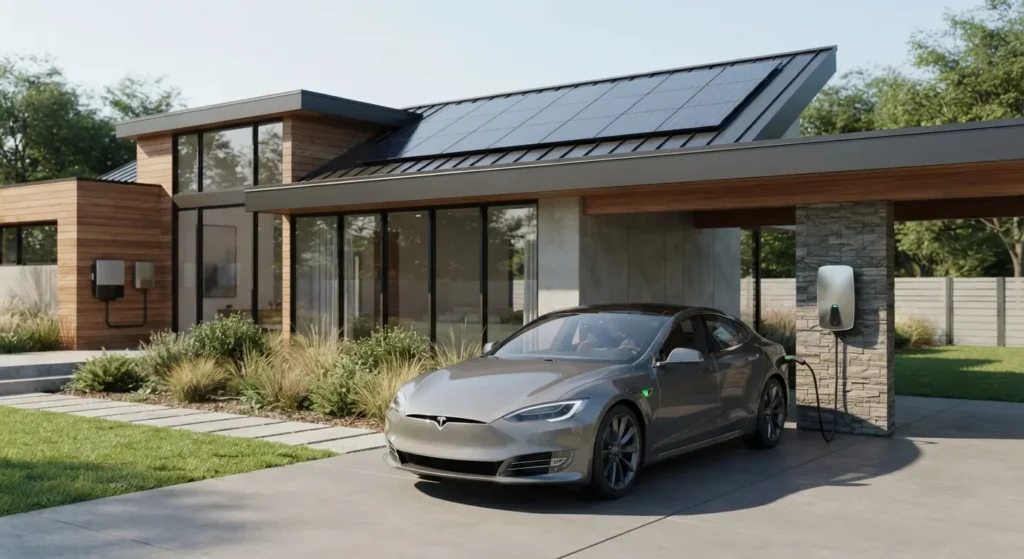
Charging an EV With Solar Panels
Some EV owners combine solar energy with electric vehicle charging.
Solar charging can reduce dependence on grid electricity.
Benefits:
- Lower long-term charging costs
- Renewable energy use
- Better energy independence
However, solar installation requires upfront investment, and savings depend on:
- System size
- Local sunlight
- Electricity prices
- Vehicle usage
Ways to Reduce Electric Car Charging Costs
1. Charge During Cheaper Electricity Hours
Some electricity providers offer lower rates during off-peak periods.
Charging overnight may reduce costs.
2. Charge Mostly at Home
Home charging is usually the most affordable option.
Use public fast chargers mainly when convenience matters.
3. Use Smart Charging Features
Many modern EVs and chargers offer:
- Scheduled charging
- Energy monitoring
- Cost optimization
These features help control electricity usage.
4. Maintain Efficient Driving Habits
Driving style affects energy consumption.
Helpful habits:
- Smooth acceleration
- Proper tire pressure
- Avoid unnecessary heavy loads
Electric Car Charging Cost vs Gasoline Cost
One of the biggest reasons people consider switching to an electric vehicle is the potential reduction in daily running costs.
Fuel prices can change frequently, while electricity costs are often easier to predict. However, the actual savings depend on your location, driving habits, vehicle efficiency, and charging method.
An EV does not eliminate transportation costs completely. Owners still need to consider:
- Electricity expenses
- Insurance
- Tires
- Maintenance
- Charging equipment
- Vehicle depreciation
However, energy costs are often one area where electric vehicles can provide savings.
Comparing Energy Costs: EV vs Gas Vehicle
A gasoline vehicle pays for fuel based on:
- Fuel price per gallon or liter
- Vehicle fuel efficiency
- Distance driven
An EV pays for energy based on:
- Electricity price per kWh
- Battery efficiency
- Charging losses
- Distance driven
The comparison depends on the vehicles being compared.
A highly efficient EV will generally use less energy per mile than a large electric SUV.
Example: EV Charging Cost vs Gasoline Fuel Cost
Imagine two drivers:
Driver A: Electric Vehicle Owner
Uses:
- Home charging
- Moderate electricity rates
- Efficient driving habits
Their energy cost per mile may remain relatively low.
Driver B: Gasoline Vehicle Owner
Uses:
- Regular gasoline
- Frequent fuel station visits
- A vehicle with average fuel economy
Their fuel costs may be higher depending on fuel prices.
The exact savings vary, but many EV owners find that charging costs are one of the strongest financial benefits of electric vehicle ownership.
Electric Car Maintenance Guide
Factors That Can Increase Your EV Charging Costs
Although EV charging is often affordable, some habits can increase expenses.
Understanding these factors helps you avoid unnecessary costs.
1. Using Public Fast Chargers Too Often
DC fast chargers are extremely useful, especially during road trips.
However, using them as your main charging method can become expensive.
Why?
Because public charging providers include costs for:
- Equipment installation
- Electricity demand charges
- Maintenance
- Network operation
A driver who charges mostly at home may spend significantly less than someone who depends entirely on public charging.
2. Charging During Expensive Electricity Hours
Some electricity providers use time-based pricing.
This means electricity prices may change throughout the day.
For example:
- Peak hours may cost more
- Overnight hours may cost less
EV owners with smart chargers can schedule charging during cheaper periods.
3. Ignoring Charging Efficiency Losses
Not all electricity from the charger reaches the battery.
Some energy is lost during charging because of:
- Heat generation
- Battery management systems
- Charging equipment
This means the electricity used from the grid can be slightly higher than the energy stored in the battery.
4. Driving Inefficiently
EVs are highly efficient, but driving habits still matter.
Factors that increase energy consumption:
- Aggressive acceleration
- High-speed driving
- Heavy cargo
- Underinflated tires
- Extreme temperatures
Efficient driving helps you travel farther using the same amount of energy.
Mistakes to Avoid When Estimating EV Charging Costs
Many new EV owners make incorrect assumptions about charging expenses.
Avoiding these mistakes will give you a more realistic ownership estimate.
Mistake 1: Looking Only at Battery Size
A larger battery does not always mean higher ownership costs.
A large battery may provide:
- Longer range
- Less frequent charging
- Better road-trip convenience
The important factor is energy consumption, not battery size alone.
Mistake 2: Assuming Public Charging Prices Are the Same Everywhere
Public charging prices vary significantly.
Different networks may have different:
- kWh rates
- Connection fees
- Membership discounts
- Idle fees
Always check the charging provider’s pricing before relying on a network.
Mistake 3: Forgetting Home Charger Installation Costs
A home charger can improve convenience, but installation may require additional spending.
Possible costs include:
- Electrical work
- Wiring upgrades
- Permits
- Labor
These expenses are usually one-time costs rather than ongoing charging expenses.
Mistake 4: Charging Only to 100% Every Day
Many EV owners do not need a full charge every day.
Charging habits depend on:
- Battery chemistry
- Manufacturer recommendations
- Daily driving needs
For many drivers, charging to a lower percentage for daily use can be more practical.
Mistake 5: Not Tracking Charging Expenses
Tracking your charging costs helps you understand your real EV ownership expenses.
Useful information to monitor:
- Monthly electricity usage
- Charging location
- Cost per kWh
- Driving distance
Many EV apps provide charging history and energy reports.
How to Calculate Your Own EV Charging Cost
You can estimate your charging expenses using a simple process.
Step 1: Find Your Electricity Rate
Check your electricity bill.
Look for:
- Cost per kWh
Step 2: Find Your EV Battery Size
Vehicle specifications usually list:
- Battery capacity in kWh
Step 3: Multiply the Numbers
Formula:
Battery capacity × electricity price = charging cost
Example:
Battery:
60 kWh
Electricity:
$0.18/kWh
Calculation:
60 × 0.18 = $10.80
A full charge would cost approximately $10.80.
Example Charging Cost Scenarios
Small Electric Car
Battery:
45 kWh
Electricity:
$0.15/kWh
Approximate full charge:
45 × 0.15 = $6.75
Medium Electric Sedan
Battery:
75 kWh
Electricity:
$0.15/kWh
Approximate full charge:
75 × 0.15 = $11.25
Large Electric SUV
Battery:
100 kWh
Electricity:
$0.15/kWh
Approximate full charge:
100 × 0.15 = $15
These examples are estimates only. Actual costs vary depending on electricity rates and charging efficiency.
How Businesses and Apartment Residents Can Reduce EV Charging Costs
Not every EV owner has a private garage.
People living in apartments or shared housing may need different solutions.
Options include:
Workplace Charging
Some employers provide EV charging stations.
Benefits:
- Convenient during working hours
- May reduce home charging needs
Shared Residential Chargers
Apartment buildings are increasingly adding EV charging infrastructure.
Residents should check:
- Charging fees
- Availability
- Installation plans
Public Charging Memberships
Frequent public charging users may benefit from subscription plans.
These can reduce charging costs depending on usage.
Future of EV Charging Costs
EV charging technology continues to improve.
Future developments may include:
- Faster charging speeds
- Better battery efficiency
- More affordable chargers
- Improved smart charging systems
- Greater renewable energy integration
As charging infrastructure expands, EV ownership is expected to become easier for more drivers.
Frequently Asked Questions
How much does it cost to charge an electric car?
The cost depends on battery size, electricity rates, and charging location. Home charging is usually the most affordable option, while public fast charging often costs more.
Is charging an electric car cheaper than gasoline?
In many situations, yes. EV charging often costs less per mile than gasoline, but the exact savings depend on local energy prices and vehicle efficiency.
How much does it cost to charge an EV at home?
Home charging costs depend on your electricity rate and vehicle battery size. Many drivers spend several dollars to around $20 or more for a full charge, depending on the vehicle.
How much does it cost to charge a Tesla?
Tesla charging costs vary by model, battery capacity, electricity rates, and whether you charge at home or use Superchargers.
Are public EV chargers expensive?
Public chargers are usually more expensive than home charging, especially DC fast chargers. They are mainly valuable for convenience and long-distance travel.
How can I lower my EV charging costs?
You can reduce charging expenses by charging at home, using off-peak electricity rates, maintaining efficient driving habits, and avoiding unnecessary fast charging.
Conclusion
The answer to how much it costs to charge an electric car depends on several factors, but the overall process is simple once you understand how EV charging works.
Your final cost depends on:
- Battery size
- Electricity rates
- Charging location
- Vehicle efficiency
- Driving habits
For most EV owners, home charging provides the best balance of affordability and convenience. Public chargers remain an important option for road trips and drivers without home charging access, but they usually come at a higher price.
Before purchasing an electric vehicle, estimating your expected charging costs can help you understand the true cost of ownership. With the right charging strategy, many drivers can enjoy lower energy expenses while benefiting from cleaner and more efficient transportation.