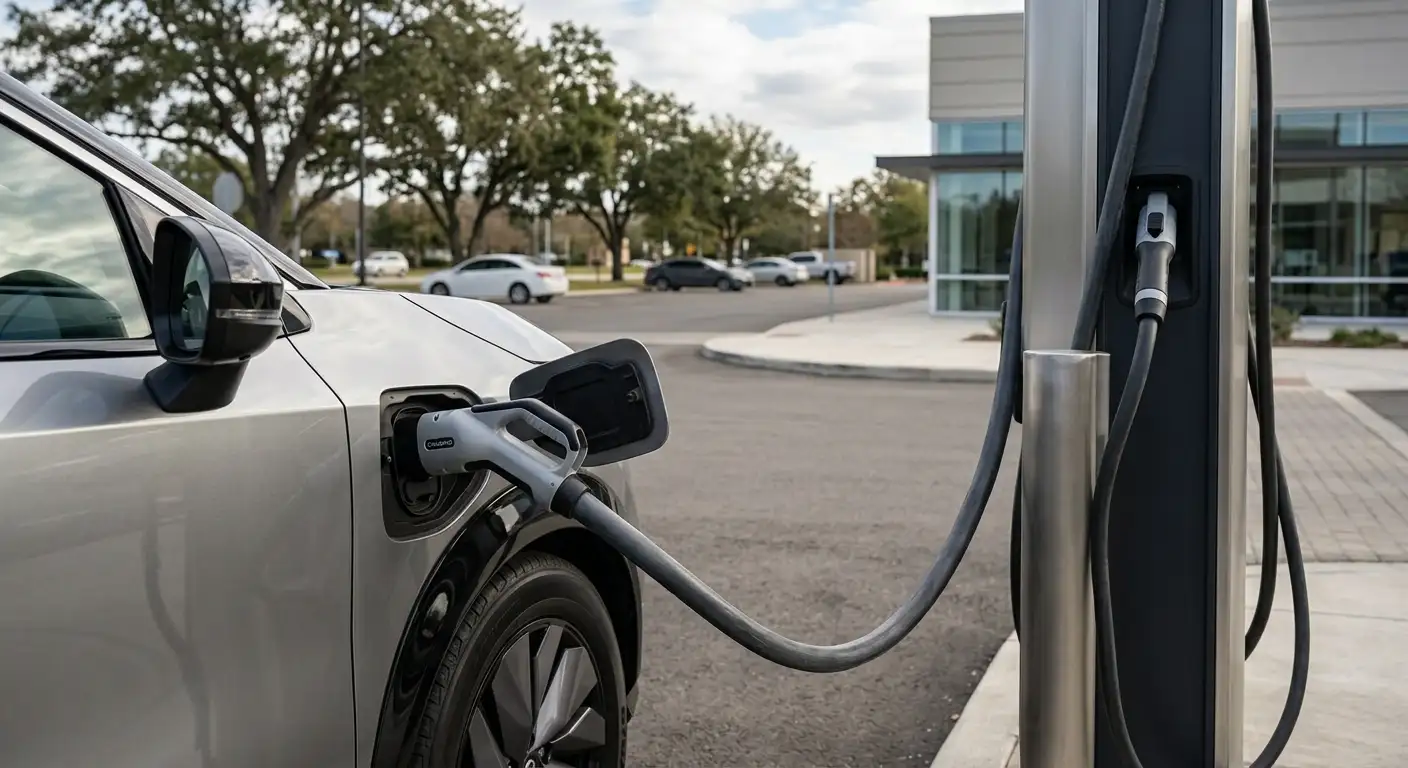
CHAdeMO is a DC fast-charging standard used primarily by older electric vehicles in the United States and other markets. In the U.S., the Department of Energy currently identifies CHAdeMO, CCS1, and J3400/NACS as the three DC fast-charging connector types. CHAdeMO remains relevant for legacy EVs, but it has a much smaller role in new U.S. passenger EV adoption as manufacturers increasingly use NACS/J3400.
That doesn’t mean CHAdeMO suddenly stopped mattering.
For owners of compatible EVs, the connector can still determine whether a public fast charger is usable. And the standard itself continues to evolve. In May 2026, the CHAdeMO Association released CHAdeMO 2.1, adding support for charging currents up to 800 amps, new safety requirements, and Plug and Charge functionality. The association says the specification enables charging power up to 800 kW with the specified connector/cable configuration.
The key distinction is this:
CHAdeMO still has technical life, but that doesn’t mean it is the connector most new U.S. EV buyers should seek out.
What Is CHAdeMO?
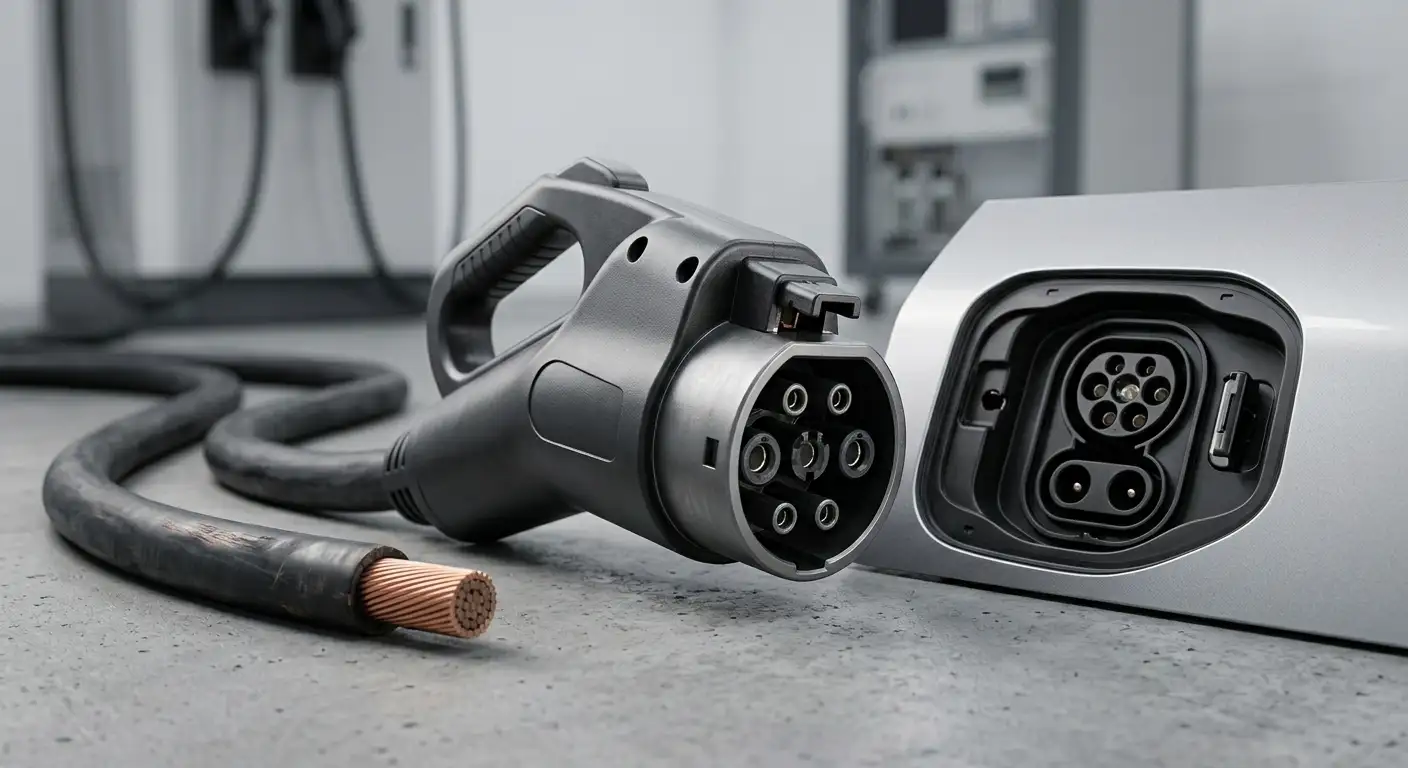
CHAdeMO is a DC fast-charging standard developed for electric vehicles.
Unlike AC home charging, where the vehicle’s onboard charger converts AC electricity into DC for the battery, a DC fast charger sends DC power directly to the battery under controlled communication between the vehicle and charging equipment.
The CHAdeMO connector was designed specifically around that fast-charging relationship between the EV and charging station.
The U.S. Department of Energy currently lists CHAdeMO alongside CCS1 and J3400/NACS as the three DC fast-charging connector types in the United States.
What makes CHAdeMO different?
One of the easiest ways to understand the ecosystem is to separate the connector from the charging standard.
CHAdeMO is associated with a large DC charging connector and its communication protocol.
CCS1 combines the familiar J1772 AC connector with two additional DC pins.
NACS, standardized in North America as SAE J3400, uses the compact Tesla-derived connector for both AC and DC charging.
That’s why a CHAdeMO-equipped EV can’t simply pull up to any modern fast charger and plug in.
The connector has to match.
What Does CHAdeMO Mean?
CHAdeMO is commonly expanded as “CHArge de MOve,” a name associated with the idea of charging while moving.
The standard was developed in Japan and became especially important for early high-volume EVs.
For U.S. drivers, the most recognizable CHAdeMO vehicle is the earlier-generation Nissan LEAF.
That history matters because CHAdeMO’s current U.S. role is heavily tied to vehicles already on the road rather than the newest EV launches.
How Does CHAdeMO Charging Work?
At a high level, the process looks simple:
EV → CHAdeMO connector → charger communication → power delivery → battery monitoring → charging control
The technology underneath that process is more sophisticated.
The charging equipment and vehicle communicate about the charging session so that power can be delivered within the limits of the battery and vehicle.
That communication helps coordinate things such as:
- charging current
- charging voltage
- battery state
- safety conditions
- stopping or reducing power
- fault conditions
The U.S. Department of Energy explains that the EV charge controller is responsible for handling communication between the electric vehicle and charging station, with standardized communication protocols supporting compatibility and interoperability.
So the connector itself isn’t the whole story.
A plug may physically fit, but the vehicle and charger still need a compatible communication and charging system.
Is CHAdeMO a Fast Charger?
Yes. CHAdeMO is designed for DC fast charging.
That’s important because people sometimes see “CHAdeMO” and think it is a general charging plug in the same sense as a home AC connector.
It isn’t.
In the U.S. charging ecosystem, CHAdeMO is specifically associated with DC fast charging. The Department of Energy groups it with CCS1 and J3400 under DC fast charging connectors.
The exact charging speed you get depends on much more than the connector.
Your actual session can be limited by:
- the vehicle’s maximum charging rate
- battery temperature
- battery state of charge
- charger capability
- electrical conditions
- charging curve
- vehicle software
That’s why a CHAdeMO connector’s theoretical capability shouldn’t be confused with the charging speed of an older CHAdeMO vehicle.
CHAdeMO vs CCS1 vs NACS
For U.S. drivers, this is probably the most useful comparison.
| Feature | CHAdeMO | CCS1 | NACS / J3400 |
|---|---|---|---|
| DC fast charging | Yes | Yes | Yes |
| AC + DC through same connector | No | No; separate AC pins with combo system | Yes |
| U.S. legacy importance | High | Medium/High | Growing rapidly |
| Main role today | Older compatible EVs | Many existing non-Tesla EVs | Increasingly common in new EVs |
| Typical new-EV direction in U.S. | Limited | Declining relative role | Strong |
| Adapter ecosystem | Vehicle/network dependent | Expanding | Expanding |
The Department of Energy currently identifies all three as U.S. DC fast-charging connector types, while noting that most vehicle manufacturers have made commitments around J3400/NACS for newer vehicles.
The important takeaway
For a new EV buyer in 2026, NACS/J3400 is generally more strategically important than CHAdeMO.
For someone who already owns a CHAdeMO vehicle, however, the question isn’t what is popular in new cars.
The question is:
Can I still reliably charge my car where I drive?
That’s a very different decision.
Is CHAdeMO Still Used in the United States?
Yes.
The U.S. Department of Energy still recognizes CHAdeMO as one of the country’s DC fast-charging connector types.
But there is a major difference between being still supported and growing quickly.
CHAdeMO’s role in the U.S. passenger-car market is largely legacy-focused.
The newest Nissan LEAF is a good illustration.
Nissan’s current U.S. 2026 LEAF uses a built-in NACS port for DC fast charging rather than CHAdeMO. Nissan also says the 2026 LEAF has a separate J1772 connection for Level 1 and Level 2 charging.
That means a modern Nissan EV isn’t simply continuing the old CHAdeMO formula.
The industry’s new-vehicle direction has moved.
But thousands of existing EVs can continue operating for years, which is why CHAdeMO availability remains important.
Which Electric Cars Use CHAdeMO?
The connector became especially associated with early Japanese EVs.
Nissan LEAF
Earlier LEAF models are the most important CHAdeMO reference point for U.S. consumers.
This is especially useful when buying a used EV.
A shopper may find an inexpensive older electric vehicle and assume it will work anywhere newer EVs can charge.
That’s where connector compatibility becomes critical.
The 2026 LEAF is different: Nissan now gives it a built-in NACS port for DC fast charging.
So don’t simply search for “Nissan LEAF charging.”
You need to know:
model year → charging inlet → market → exact vehicle configuration
That follows the Go Electric Hub EV specification rule requiring model year, configuration, and market to be verified rather than assumed.
Why Did CHAdeMO Become So Important?
CHAdeMO was one of the first widely deployed DC fast-charging approaches for mainstream EVs.
When early electric vehicles needed faster public charging, having a standardized high-power charging connection was a major advantage.
The technology helped make longer-distance electric driving more practical before today’s connector landscape became more fragmented.
The rise of CCS and later NACS changed the market.
As more automakers adopted competing standards and the North American charging ecosystem evolved, CHAdeMO became increasingly associated with older vehicles.
That doesn’t erase its historical importance.
It explains why the standard is still relevant when researching used EVs and legacy charging infrastructure.
Why Are New U.S. EVs Moving Away From CHAdeMO?
The answer is largely about industry direction and interoperability.
J3400/NACS has become increasingly important for North American vehicle and charger deployment. The Department of Energy says SAE standardized the Tesla-derived NACS connector as J3400 and notes that most vehicle manufacturers have made commitments to incorporate J3400 on newer EVs.
The connector also has an architectural advantage from a consumer perspective:
One compact connector can support AC and DC charging.
By contrast, CHAdeMO historically requires a separate AC charging connection on many vehicles.
That doesn’t make CHAdeMO technologically “bad.”
It means the automotive market converged toward a different physical and interoperability model.
Is CHAdeMO Dead?
No. But its role is changing.
Calling CHAdeMO “dead” is too simplistic because the standard continues to receive technical development and remains relevant to existing vehicles.
In August 2026, the CHAdeMO Association even called for preservation of infrastructure support for legacy EVs. Its news page also shows continuing work on charging standards and interoperability.
At the same time, calling CHAdeMO a major future U.S. passenger-EV connector would also be misleading.
For the American market, the better description is:
CHAdeMO is a legacy-focused charging ecosystem with ongoing technical development.
That distinction matters.
A 2016 EV owner and a person shopping for a new EV in 2026 have completely different questions.
What Is CHAdeMO 2.1?
This is where the story gets more interesting.
The CHAdeMO Association released CHAdeMO 2.1 on May 29, 2026. The new protocol specifies requirements for charging current up to 800 amps, clarifies safety behavior after loss of the protective-earth conductor, and adds a Plug and Charge specification.
The association says the updated protocol can support DC charging power up to 800 kW using its specified configuration.
That is a very different number from the charging performance of typical older passenger EVs.
Don’t make this mistake.
CHAdeMO 2.1 capability does not mean your existing CHAdeMO car can suddenly charge at 800 kW.
The vehicle still determines how much power it can accept.
The charger also matters.
And battery architecture, thermal limits, and state of charge still influence the real session.
So CHAdeMO 2.1 is primarily important as a protocol-development milestone, not a promise of 800-kW charging for legacy EV owners.

What New Features Does CHAdeMO 2.1 Add?
The 2026 specification includes several notable developments.
Higher charging current
CHAdeMO 2.1 specifies requirements for charging currents up to 800 amps.
Higher potential charging power
CHAdeMO Association says the specification enables up to 800 kW with the specified connector/cable configuration.
Improved safety behavior
The specification clarifies what the charger and vehicle should do if the protective-earth conductor is interrupted, including opening EV contactors within one second under the stated condition.
Plug and Charge
CHAdeMO 2.1 includes a new Plug and Charge specification developed with Honda and PLUGO.
The association says the system is designed to combine CHAdeMO-CAN communication with telematics-based security and can also be implemented without telematics for a simpler approach.
That is significant because charging convenience isn’t only about power.
Authentication and payment are part of the user experience too.
Does CHAdeMO Support Plug and Charge?
CHAdeMO 2.1 now includes a Plug and Charge specification.
The CHAdeMO Association says the functionality had already been launched and was operational in Japan from 2025 through the Honda/PLUGO implementation it references.
But again, protocol support and vehicle support are different things.
A new standard revision can define capabilities that aren’t present in older hardware.
That’s why existing EV owners shouldn’t assume that CHAdeMO 2.1 means a software update will transform an old vehicle’s charging system.
Does CHAdeMO Support Bidirectional Charging?
CHAdeMO has played an important role in bidirectional charging research and deployment, including vehicle-to-grid and related applications.
That’s one of the more interesting parts of CHAdeMO’s history.
Instead of electricity flowing only:
grid → charger → vehicle
bidirectional systems can potentially allow energy to move:
vehicle → home/grid/load
under supported hardware and software configurations.
This can make an EV more than transportation.
It can become a mobile energy resource.
But compatibility is the key.
An EV needs the correct hardware, software, and market support for bidirectional power use. The presence of a CHAdeMO connector alone does not guarantee vehicle-to-home or vehicle-to-grid functionality.
CHAdeMO continues to maintain technical work around charging and related interoperability.
CHAdeMO vs NACS: Which Is Better in the USA?
For a new U.S. EV buyer, NACS/J3400 is generally the more forward-looking connector choice.
The U.S. Department of Energy says J3400 standardizes the NACS connector across the North American industry and describes NACS as capable of both AC and DC charging through the same connector.
For an existing CHAdeMO EV owner, however, buying a different connector isn’t necessarily an option.
Your vehicle has the inlet it has.
So the practical priority becomes:
Where can I charge today?
That’s why owners of older CHAdeMO EVs need to pay much more attention to station-level connector availability than someone buying a current NACS EV.
CHAdeMO vs CCS1
CCS1 became another major U.S. DC fast-charging standard.
The Department of Energy describes CCS1 as a combination system built around the SAE J1772 connector, with two additional lower DC pins for fast charging.
CHAdeMO and CCS1 therefore take different approaches to connector design.
CHAdeMO
A dedicated DC fast-charging connector.
CCS1
A combined connector system that adds DC pins to the AC charging interface.
What does that mean for an owner?
You cannot assume a CCS1 station will work with a CHAdeMO car.
You need to verify the connector offered at the specific charging location.
Is CHAdeMO Faster Than CCS1 or NACS?
There isn’t a useful universal answer.
Saying:
“CHAdeMO is faster”
or
“NACS is faster”
without specifying the vehicle and charger would be misleading.
Actual charging speed is influenced by:
- vehicle charging limit
- charger power
- battery temperature
- battery state of charge
- charging curve
- electrical architecture
- software limits
CHAdeMO 2.1’s theoretical capability has increased dramatically, but legacy passenger vehicles don’t automatically inherit that capability.
For real-world charging, the vehicle’s specification matters more than the headline maximum of the connector standard.
How Do CHAdeMO EV Owners Find Fast Chargers?
This is probably the most useful practical section for an existing owner.
Before starting a long trip, verify:
1. Connector type
Make sure the station actually lists CHAdeMO.
2. Station availability
A station may appear in an app but be occupied, offline, or unavailable.
3. Charging speed
Check whether the station offers the output your vehicle can use.
4. Route redundancy
Have a backup station where possible.
5. Vehicle compatibility
Confirm the exact EV model and model year.
Do not rely only on a station photo.
A charging location can have multiple connector types, and the Department of Energy notes that a charging port may support different connector options while only one vehicle charges from that port at a time.
Should You Buy a Used CHAdeMO EV in 2026?
This is where the answer becomes conditional.
A used CHAdeMO EV can make sense when:
You have a low purchase budget.
Most of your driving is local.
You can charge at home.
You know where compatible DC fast chargers are located.
You’re comfortable owning a vehicle with a legacy charging connector.
It is less attractive when:
You take frequent long-distance trips.
Heavy reliance on public fast-charging stations is important to your driving needs.
You want the broadest compatibility with today’s newest fast-charging infrastructure.
You’re buying primarily for long-term future-proofing.
The key isn’t whether CHAdeMO is “dead.”
The question is whether the charging network around your life works for the vehicle you are buying.
What Should CHAdeMO Owners Check Before a Road Trip?
A little planning can prevent a lot of frustration.
Start with the exact vehicle.
Then confirm:
connector → route → stations → backup stations → charger status
Don’t assume that a charger available to a NACS or CCS1 vehicle is automatically available to your CHAdeMO EV.
And don’t build a trip around the theoretical maximum charging speed.
Your car’s charging curve is what you’ll actually experience.
For broader charging education, Go Electric Hub already has an EV Charging Guide and a dedicated NACS Charger Explained article. These are strong internal destinations because they answer the next questions a reader is likely to have.
Are CHAdeMO Chargers Being Removed?
The long-term infrastructure trend in the U.S. is moving away from CHAdeMO for new mainstream passenger-EV deployment.
But that’s not the same as saying every existing CHAdeMO charger will disappear tomorrow.
The current U.S. charging ecosystem still recognizes CHAdeMO as an active DC fast-charging connector type, while the CHAdeMO Association continues working on technical standards and explicitly called in August 2026 for infrastructure support for legacy EVs.
The practical takeaway:
Expect CHAdeMO to remain important for legacy vehicles for some time, but don’t confuse legacy support with the direction of new U.S. vehicle adoption.
What Does CHAdeMO’s Future Look Like?
CHAdeMO’s future in passenger cars and its future as a charging technology are two different stories.
Passenger EV market
The U.S. passenger-vehicle market is increasingly oriented toward J3400/NACS and away from CHAdeMO. The current 2026 Nissan LEAF’s move to NACS is a good real-world example of that shift.
Technical development
CHAdeMO itself is still evolving.
The 2.1 specification released in 2026 raises current capability, adds safety provisions, and introduces Plug and Charge functionality.
Legacy ecosystem
This may ultimately be CHAdeMO’s most important U.S. role.
Millions of charging decisions don’t begin with a new-car configurator.
They begin with:
“I already own this EV. Where can I charge it?”
As long as compatible vehicles remain on the road, charging support remains useful.
The Biggest CHAdeMO Mistakes
Mistake 1: Assuming CHAdeMO works everywhere
It doesn’t.
Always check the connector.
Mistake 2: Confusing CHAdeMO with CCS1
They are different charging systems.
Mistake 3: Assuming the connector determines charging speed
The vehicle and charger both matter.
Mistake 4: Treating CHAdeMO 2.1 as an upgrade for every old EV
A newer protocol doesn’t automatically change the hardware capability of an older vehicle.
Mistake 5: Ignoring model year
The Nissan LEAF is an excellent example: older versions are strongly associated with CHAdeMO, while the current U.S. 2026 LEAF uses NACS for DC fast charging.
Mistake 6: Planning a road trip without backup charging
Legacy charging coverage needs more deliberate planning.
CHAdeMO and the 2026 Nissan LEAF
The Nissan LEAF deserves special mention because it shows how quickly charging standards can change.
Older U.S. LEAF models are closely associated with CHAdeMO.
The current 2026 LEAF is not.
Nissan says the all-new 2026 LEAF has a built-in NACS port for Level 3 DC fast charging, while a separate J1772 connection supports Level 1 and Level 2 charging. Nissan also says 2026 LEAF owners can access compatible Tesla Superchargers through the vehicle’s NACS setup.
That doesn’t make earlier LEAFs obsolete.
It simply demonstrates why connector compatibility should always be checked by model year.
Should You Look for CHAdeMO When Buying an EV?
For a new U.S. EV, I would not choose the vehicle because it has CHAdeMO.
The more logical approach is to compare the complete charging ecosystem available to the vehicle.
That includes:
connector → network access → home charging → public charging → vehicle charging rate → route coverage
For a used EV, however, CHAdeMO can still be perfectly workable when the price is right, and your driving pattern matches the vehicle.
The difference is that you’re buying into a legacy ecosystem, so your decision needs more infrastructure research.
How CHAdeMO Fits Into the Go Electric Hub Charging Ecosystem
This article should connect naturally to the rest of the site’s charging cluster.
For readers who want to understand current North American charging standards:
For people learning the bigger charging picture:
For fast-charging fundamentals:
For broader network trends:
EV Charging Infrastructure 2026
CHAdeMO: The Bottom Line
CHAdeMO is in an unusual position in 2026.
It is less important to the new U.S. passenger-EV market than it once was, but it remains important to people who already own compatible vehicles.
The U.S. Department of Energy still recognizes CHAdeMO as one of the nation’s DC fast-charging connector types.
At the same time, new EVs are increasingly moving toward J3400/NACS. Nissan’s 2026 LEAF is a straightforward example of that transition.
And yet CHAdeMO itself is still being developed.
The 2026 CHAdeMO 2.1 release adds requirements for up to 800-amp charging, improves safety provisions, and introduces a Plug and Charge specification.
So the fairest way to describe CHAdeMO isn’t:
“dead.”
And it isn’t:
“the future of U.S. charging.”
It’s this:
CHAdeMO is a mature, legacy-focused fast-charging standard that still matters to existing EV owners while the new U.S. vehicle market moves toward NACS/J3400.
For someone shopping for a new EV, that makes CHAdeMO mostly a compatibility question.
For someone who already owns a CHAdeMO vehicle, it’s still a practical part of everyday life.
And for the charging industry, CHAdeMO 2.1 shows that the underlying standard continues to evolve.
Frequently Asked Questions
CHAdeMO is a DC fast-charging standard for electric vehicles. In the United States, the Department of Energy currently lists it alongside CCS1 and J3400/NACS as a DC fast-charging connector type.
Yes. It remains relevant to existing EVs and is still recognized within the U.S. DC fast-charging landscape, although newer U.S. passenger EVs are increasingly moving toward NACS/J3400.
For a new U.S. EV, NACS/J3400 generally has the stronger market direction. For an existing CHAdeMO vehicle, the better option is the charging network that actually supports your car along your normal routes.
CHAdeMO became especially associated with earlier Japanese EVs, most notably older Nissan LEAF models. The current 2026 Nissan LEAF uses a built-in NACS port for DC fast charging instead.
CHAdeMO 2.1 is the protocol revision released in May 2026. It specifies requirements for charging currents up to 800 amps, adds safety provisions, and introduces a Plug and Charge specification. CHAdeMO Association says the specification supports up to 800 kW under the specified configuration.
Yes. CHAdeMO is a DC fast-charging system. The actual charging speed depends on the EV, battery, charger, and charging conditions rather than the connector’s theoretical maximum alone.