For a decade, charging an electric car in North America meant navigating a mess of incompatible plugs — Tesla drivers on one network, everyone else on another, and a drawer full of adapters in between. That era is ending, and it ended faster than almost anyone in the industry predicted. The winner is a connector called NACS, and if you’re buying, owning, or even just researching an EV in 2026, it now shapes almost every charging decision you’ll make.
NACS (North American Charging Standard) is the EV charging connector originally developed by Tesla, opened to the industry in 2022, and standardized as SAE J3400. It handles both AC home charging and DC fast charging through one compact plug, and by 2026 virtually every automaker selling EVs in the US and Canada has adopted it — giving nearly all new EVs native access to Tesla’s Supercharger network, the largest fast-charging network in North America.
That’s the headline. Underneath it are the questions that actually matter to you: what happens to the millions of CCS cars already on the road, which adapter you need (and which direction it points), why plugging an 800-volt car into a Supercharger can be slower than you’d expect, what “J3400” on a charger label means, and whether any of this affects Europe. This guide answers all of it — the plug, the politics, and the practical decisions.
What Is NACS, Exactly?
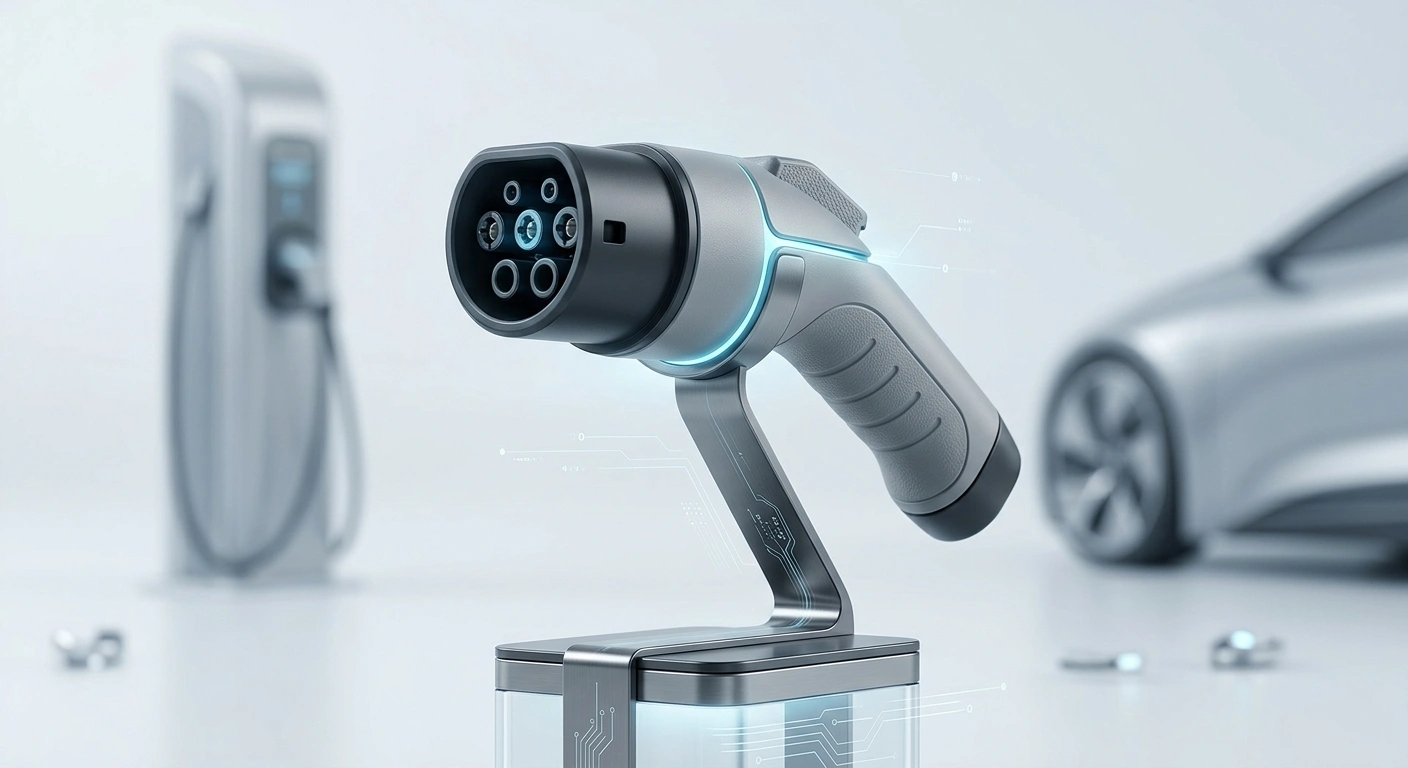
NACS stands for North American Charging Standard. Physically, it’s the slim, elegant charging connector Tesla has used since the Model S launched in 2012 — the one that looks almost too small to be doing the job, especially next to the chunky alternatives.
Its defining engineering trick is doing two jobs with one set of pins. The same compact connector carries slow AC charging (your garage, overnight) and high-power DC fast charging (road trips, 15–30 minute stops) — the plug and the car negotiate which is which electronically. The competing CCS design solved the same problem by bolting two extra DC pins beneath an AC connector, which is why a CCS1 inlet looks like a figure-eight and needs a bigger door on the car.
For years, this was simply “the Tesla plug” — proprietary, excellent, and exclusive. Two moves changed everything. In November 2022, Tesla published the design as an open standard anyone could use, and renamed it NACS. Then SAE International — the standards body behind most automotive norms — took it through formal standardization as SAE J3400, crucially swapping Tesla’s proprietary communication protocol for the industry-standard ISO 15118 that the rest of the charging world already spoke. That second step mattered as much as the first: it turned a company’s connector into an industry standard, with no single company controlling it.
So when you see “NACS” and “J3400” used interchangeably on chargers, spec sheets, and car configurators — that’s why. Same physical plug; J3400 is its formal standards name. If a charging station lists J3400 support, your NACS-equipped car plugs in.
One more piece of orientation for newer EV drivers, because charging vocabulary trips up everyone at first: the connector standard (NACS vs CCS) is a separate question from the charging level. Level 1 is a standard wall outlet, Level 2 is a home or destination wallbox, and DC fast charging (sometimes called Level 3) is the road-trip stuff — and all three levels exist on both connector standards. NACS didn’t change what the levels mean or how fast each one is; it changed the shape of the plug delivering them. If those levels are new territory, our EV charging guide maps the whole system in one place, and everything in this article will slot neatly on top of it.
How NACS Won: The Fastest Standards Flip in Automotive History

Understanding how this happened isn’t just trivia — it explains why the transition is irreversible, which matters when you’re deciding what to buy.
Through 2023, North America’s charging picture was a stalemate. Tesla’s Supercharger network was the largest, most reliable fast-charging system on the continent — and closed to everyone else. Every other automaker used CCS1 and relied on third-party networks whose reliability problems had become the single biggest complaint in EV ownership surveys. Drivers of expensive non-Tesla EVs routinely arrived at broken chargers; Tesla drivers routinely didn’t. That reliability gap, more than the connector design itself, is what broke the dam.
Ford moved first in May 2023, announcing its EVs would gain Supercharger access via adapter and that future models would carry the NACS port natively. GM followed within weeks. Then the procession: Rivian, Mercedes-Benz, Honda, Nissan, Hyundai, Kia, Toyota, Subaru, BMW, Lucid, Volvo and Polestar, and eventually the Volkswagen Group with Audi, Porsche, and Scout. Each announcement made the next one more inevitable — no automaker could afford to be the brand whose customers couldn’t use the best charging network.
The final holdout, Stellantis (Jeep, Dodge, Ram, Chrysler), committed in November 2025, with Supercharger access for its EVs beginning in early 2026 in North America and extending to Japan and South Korea in 2027 — a detail worth noticing, because it signals NACS spreading beyond North America into select Asian markets.
From open-sourcing to full industry adoption took roughly eighteen months of announcements — a reversal of a continent’s infrastructure standard at a speed with no real precedent in automotive history. By 2026, the practical result is simple: virtually every new EV sold in the US and Canada ships with a NACS port, and the Supercharger network — tens of thousands of fast-charging stalls across more than 28,000 locations when counting the markets Stellantis cited — serves them all.
NACS vs CCS: What’s Actually Different

Both connectors deliver the same electricity to the same batteries. The differences are in design philosophy and, now, in destiny.
| NACS (SAE J3400) | CCS1 (Combined Charging System) | |
|---|---|---|
| Physical size | Compact, lightweight, one-hand operation | Larger two-part connector, heavier cable |
| AC and DC charging | Same pins, one slim inlet | Separate DC pins below the AC section |
| Communication protocol | ISO 15118 (as J3400) | ISO 15118 |
| Primary network | Tesla Supercharger + growing third-party support | Electrify America, EVgo, ChargePoint and others |
| New-vehicle fitment in 2026 | Nearly all new North American EVs | Phasing out on new models |
| Long-term North American outlook | The standard | Supported for years via dual cables and adapters, but legacy |
| Europe | Not replacing the European standard | Europe stays on CCS2 |
Three practical takeaways hide in that table.
First, the ergonomics gap is real and daily. A NACS cable is dramatically lighter and easier to handle than a thick liquid-cooled CCS lead — a small thing on paper that every owner notices in a cold, rainy parking lot.
Second, the protocol convergence is why adapters work so smoothly now. Because J3400 adopted the same ISO 15118 communication language CCS already used, an adapter only has to bridge the physical pins — the car and charger already speak the same digital language, including Plug & Charge automatic payment.
Third, CCS isn’t vanishing overnight — by design. Millions of CCS vehicles are on the road and will be for a decade-plus. Federally funded charging sites in the US have been required to include CCS connectors, and most new charging hardware ships with dual NACS-and-CCS cables. The transition is being managed as a long overlap, not a switch-flip. Nobody’s existing car got stranded — which is exactly how a standards transition should work.
Which Cars Have NACS — and Who Needs an Adapter
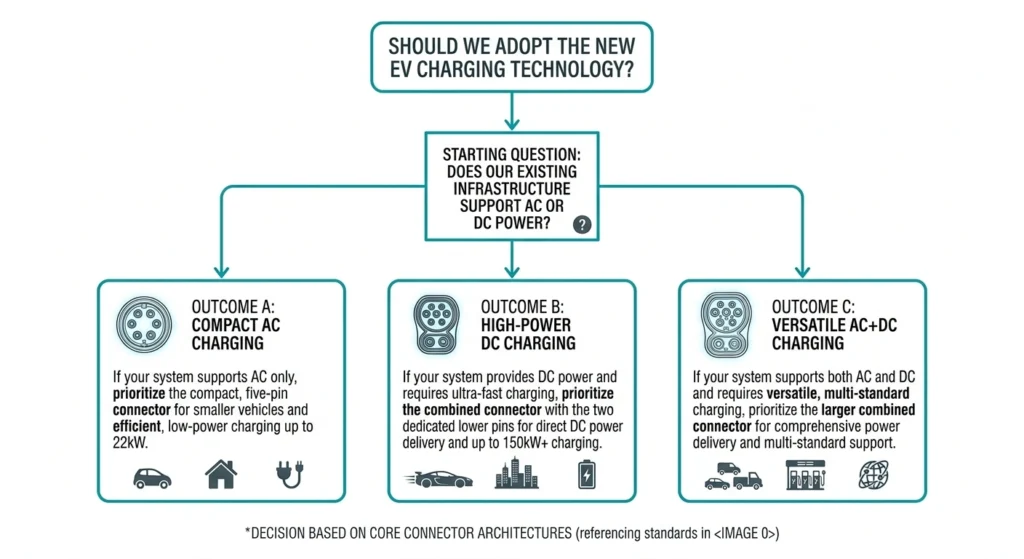
In 2026, every EV on the road falls into one of three buckets. Knowing yours takes ten seconds and settles every adapter question.
Bucket 1: Native NACS port (most new EVs). Teslas, obviously — plus the current waves of new models from Ford, GM, Rivian, Hyundai, Kia, Honda, Toyota, BMW, Mercedes, Lucid, Volvo, Polestar, the VW Group brands, and Stellantis as their NACS-equipped generations roll out. These cars plug straight into Superchargers and NACS-equipped chargers with nothing extra. Their catch runs the other direction: at an older CCS-only station, they need a NACS-to-CCS adapter (often called a J3400-to-CCS1 adapter) to use it. Many automakers include or sell one; keeping it in the trunk is the 2026 equivalent of carrying jumper cables.
Bucket 2: CCS car with approved Supercharger access (most 2018–2025 non-Tesla EVs). These use a CCS-to-NACS adapter to charge at Superchargers — but hardware is only half the requirement. Access also depends on your automaker having activated Supercharger support for your model, usually alongside a software update that handles authentication and billing through your car brand’s or Tesla’s app. An adapter from a random marketplace without that software handshake gets you a connector that fits and a session that won’t start. Use your automaker’s approved adapter and activation path.
Bucket 3: Older CCS car without activation (early EVs, some imports). No Supercharger access yet — you charge on the CCS networks exactly as before, and those networks remain fully operational. Check your manufacturer’s announcements periodically; activation waves have been rolling through older models brand by brand.
One nuance for used-EV shoppers: a car’s charging bucket now meaningfully affects its long-term convenience and arguably its resale value. Two otherwise-identical used EVs — one with native NACS or activated adapter access, one without — offer genuinely different road-trip experiences. It belongs on your checklist alongside battery health, and our used electric car buying guide covers where it fits in the full inspection.
The Voltage Catch: Why the Same Plug Charges Different Cars at Different Speeds
Here’s the detail that produces the most confusion at charging stalls in 2026, and the one most NACS explainers skip entirely.
The NACS connector standardized the plug — it did not standardize the electrical architecture behind it. Tesla’s vast installed base of V3 Superchargers operates at around 400 volts, matching Tesla’s own vehicles. But many of the newest and best non-Tesla EVs — Hyundai’s and Kia’s E-GMP models, Porsches, Lucids, and others — use 800-volt-class architectures for ultra-fast charging.
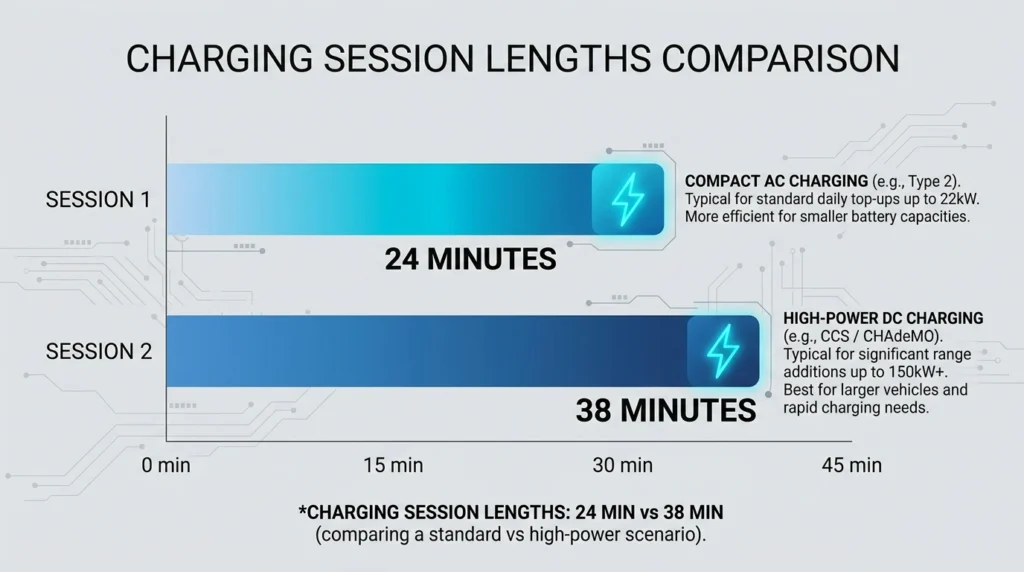
When an 800-volt car plugs into a 400-volt Supercharger, the car must internally convert the voltage, and charging speed drops well below what the car achieves on an 800-volt-capable station. The real-world result: a car that can charge 10–80% in around 24 minutes on a high-powered 800V CCS or NACS station might need 35–40 minutes for the same charge at a 400V Supercharger — same plug, very different stop. We saw exactly this pattern in our Hyundai Ioniq 9 review: native NACS port, brilliant charging hardware, and a meaningful speed difference depending on which station you pick.
Tesla’s newer V4-generation charging hardware supports higher voltages and closes this gap as it rolls out, but the installed base changes slowly. Until it does, the practical rule for 800-volt car owners is worth memorizing: the Supercharger network is your reliability backstop; 800V-capable stations are your speed play. Route planning apps that filter by charger power and voltage class turn this from trivia into saved minutes on every trip.
For 400-volt cars — which includes every Tesla and the majority of the current fleet — none of this applies, and the Supercharger is both the reliable and the fast choice. Know which architecture your car has (the spec sheet will say 400V or 800V), and this entire section becomes a ten-second routing decision. For the fuller picture of charging speeds by level and station type, our EV charging guide and charging time explainer break down the numbers.
NACS at Home: What Changes in Your Garage
Less dramatic than the road-trip story, but relevant the day you buy a wallbox.
Home charging is AC charging, where speeds are set by your electrical circuit, not your connector — so NACS changes nothing about how fast you charge at home. What changes is the plug on the end of the cable. Home charger manufacturers now sell J3400/NACS versions of their wallboxes alongside the classic J1772 versions, and the buying logic is straightforward:
- Your EVs are (or will be) NACS-native: buy a NACS wallbox and skip the adapter dance forever.
- You have a CCS/J1772 car now and might switch later: either connector works — a J1772 wallbox charges a NACS car through the simple passive adapter most NACS cars include, and vice versa. Adapters for AC charging are cheap and uncomplicated compared to DC ones.
- Two-EV household with mixed ports: one wallbox plus one adapter covers both cars; there’s no need for parallel hardware.
The deeper home-charging decisions — circuit sizing, installation costs, smart-charging features — are unchanged by the connector shift, and our guide to the best home EV chargers walks through them. The connector is now just the last checkbox on the order form. And if you’re starting from a standard wall outlet, Level 1 charging still works identically regardless of plug shape.
What About Europe and the Rest of the World?
Short version: NACS is a North American story, with Asian footnotes — Europe is not switching.
Europe standardized on CCS2 (a different connector from North America’s CCS1) years ago, backed by EU regulation, a dense and still-growing charging network, and — the detail Americans often miss — Tesla itself: European Teslas use CCS2 ports and European Superchargers use CCS2 cables, many already open to all brands. There is no European connector war for NACS to win; the interoperability NACS created in North America largely already exists there.
The expansion beyond North America runs instead through select Asian markets: the Stellantis adoption explicitly includes Japan and South Korea from 2027, alongside Supercharger presence in those countries. Other right-hand-drive and Asia-Pacific markets remain a mixed picture of CHAdeMO legacy (Japan’s homegrown standard, now fading), CCS2, and GB/T in China — which runs its own standard entirely and is developing next-generation ultra-fast charging on a separate track.
The practical implication is only for movers and importers: a North American NACS car and a European CCS2 charger don’t meet without serious intervention, and importing EVs across those regions carries charging-compatibility baggage worth understanding before, not after, the shipping quote.
The Network Effect: What NACS Did to Charging Networks Themselves
The connector story gets the headlines, but the network story is where your actual charging experience changed — because NACS didn’t just standardize a plug, it reshuffled the competitive landscape of every company that operates chargers.
The Supercharger network became everyone’s network. This is the transition’s single biggest practical gift. Tesla’s network earned its reputation on two things the third-party networks struggled with: uptime (stalls that simply work, session after session) and density (enough stalls per site that queuing is the exception). Opening that to all brands instantly raised the floor of the road-trip experience for every NACS-equipped driver. The flip side is shared reality: popular corridor sites now serve every brand’s road-trippers, and holiday-weekend congestion at marquee locations is a genuine phenomenon. The network is bigger than ever; so is its customer base.
Third-party networks retooled instead of retreating. Electrify America, EVgo, ChargePoint, and the rest didn’t fight the standard — they adopted it, adding NACS cables alongside CCS across new deployments. For drivers, this produced the quietly excellent dual-cable era: one stall, two connectors, any car. It also sharpened competition on the thing that actually differentiates networks now that plugs don’t: reliability, pricing, and site experience. A standardized connector turned charging networks into something much closer to gas stations — interchangeable infrastructure competing on service — and that commoditization works entirely in your favor.
Automakers became charging companies. A subtler shift: with hardware standardized, brands now compete on the software wrapped around charging — route planners that precondition your battery, apps that bundle multi-network billing, and charging-cost programs baked into the purchase. When you compare EVs in 2026, the charging experience differences live in this layer, not in the port. It’s worth ten minutes of any test drive to poke through the car’s charging interface, because that software is now part of what you’re buying.
And station design itself is evolving past its Tesla-only assumptions. The early awkwardness of the transition — short Supercharger cables designed for Tesla’s port position meeting cars with inlets on the “wrong” corner, drivers parking across two spaces to reach — is being engineered away as new sites deploy longer cables and pull-through stalls sized for the whole market, including cars towing trailers. If your early adapter-era experience involved creative parking geometry, know that the infrastructure is actively growing out of it.
Plug & Charge: The Payment Experience NACS Unlocked
One more piece of the puzzle deserves its own section, because it’s the part of the transition you’ll feel every single session: how you pay.
The old third-party charging ritual was its own small misery — an app per network, accounts and RFID cards, payment terminals in various states of function, sessions that failed at the authentication step more often than at the electrical one. Tesla drivers, meanwhile, just plugged in: the car identified itself to the charger, the session started, the card on file got billed. No screen, no app fumbling, no standing in the rain negotiating with a terminal.
That experience — Plug & Charge — is precisely what the ISO 15118 protocol underneath J3400 was chosen to enable for everyone. The car carries a digital certificate; the charger reads it through the cable; authentication and billing happen in the handshake. As automakers activate support and networks upgrade, plug-in-and-walk-away is becoming the default across brands rather than a Tesla exclusive.
The transition-era caveats, honestly stated: activation is per-brand and per-network, rolling out unevenly — your car might Plug & Charge flawlessly on one network and still want an app on another. Billing routes vary (some brands bill through their own app ecosystem, some through the network’s). And the first session with any new network typically still involves a one-time account setup where you load a payment method. The trajectory, though, is unambiguous: each software update and network upgrade moves more of your charging into the plug-and-walk-away column.
Two practical notes while the rollout completes. Keep one backup payment path — a network app or contactless card — for the edge cases, exactly as you’d keep the adapter for legacy stations. And when buying, ask specifically whether the model supports Plug & Charge on the networks you’ll actually use; it’s a small spec-sheet line that separates a seamless ownership experience from a phone-juggling one, and salespeople rarely volunteer it.
Why Tesla Gave Away Its Biggest Advantage
A question worth pausing on, because the answer explains why this standard is stable: why would Tesla hand its competitors the network that sold its cars?
The closed Supercharger network was arguably Tesla’s strongest moat for a decade — the answer to every charging-anxiety objection, exclusive to its customers. Opening it traded that exclusivity for three things. Revenue: every non-Tesla car charging at a Supercharger pays Tesla, converting a cost center serving one brand into an energy-retail business serving the whole market. Policy: public funding programs for charging infrastructure favored open-access networks, positioning Tesla’s hardware to win deployments a proprietary system couldn’t touch. Standard-setting power: by open-sourcing before regulators or committees imposed an alternative, Tesla ensured the industry converged on its engineering — every future charger, cable, and adapter built to the geometry it had already perfected at scale.
The automakers’ side of the trade was equally rational: their customers’ loudest pain point — unreliable public charging — was solved overnight by a signature, at the cost of a port change they’d have faced eventually anyway.
Understanding these incentives matters for one buyer-relevant reason: nobody in this arrangement benefits from unwinding it. Standards fail when a major player has an incentive to defect; here, Tesla profits from every plug, automakers’ customers depend on the access, and the networks have already retooled. The NACS settlement is stable not because everyone agreed to be nice, but because everyone’s interests point the same direction — which is exactly the kind of standard you can safely build a ten-year car purchase on.
What NACS Means for Your Next EV Decision
Pull all of this into buying advice, and it comes down to four situations.
Buying a new EV in North America: the decision has essentially been made for you — it will have a NACS port, and Supercharger access comes with it. Your remaining diligence is small: confirm an included or available NACS-to-CCS adapter for legacy stations, and check the car’s voltage architecture so you know its fast-charging sweet spot. Between two otherwise-equal cars, the 800-volt one is more future-proof as high-power stations proliferate; the comparison field in our best electric cars ranking notes who runs what.
Driving a 2018–2025 CCS EV: your car lost nothing. Your networks still work, and your path to the Supercharger network is your automaker’s approved adapter plus activation. Sort that out once — it’s an afternoon of app setup — and your charging map roughly doubles.
Driving an older or unactivated CCS EV: status quo continues, with periodic manufacturer announcements worth watching. And dual-cable deployment on new stations means even the newest infrastructure keeps serving you.
Shopping used: add “charging bucket” to your inspection sheet. Native NACS or activated adapter access is a convenience feature with real daily value; its absence isn’t disqualifying, but it should be priced.
The strategic picture underlying all four: connector uncertainty — for years a genuine, rational reason to hesitate on an EV — is functionally over in North America. Whatever else factors into your decision, “will I be able to charge it?” now has the most boring answer it has ever had. Boring, in infrastructure, is what winning looks like.
Practical Tips
- Learn your car’s two facts: port type and voltage class. NACS or CCS, 400V or 800V. Those two answers resolve every charging-stop decision this article describes.
- Buy adapters from your automaker’s approved path, not the cheapest listing. DC fast-charging adapters carry serious current; certification and the software handshake both matter. This is not the accessory to save $40 on.
- Label and stow the adapter permanently in the car. The adapter you left in the garage covers zero road trips. Glovebox or frunk, always.
- Filter route planners by charger power, not just plug shape. Especially for 800-volt cars: “NACS-compatible” and “fast for my car” are different filters. Ten seconds of filtering beats fifteen minutes of slow charging.
- At dual-cable stations, take the native cable for your port when both are free. Fewer interfaces, fewer failure points, and you leave the other cable for the driver who needs it.
- Re-check your automaker’s Supercharger activation status each software update. Access waves have rolled out model-by-model; cars have gained networks overnight via nothing but an update and an app login.
Common Mistakes to Avoid
Assuming the plug fitting means the session will start. For CCS cars at Superchargers, access requires the approved adapter and your brand’s activation. The connector is necessary, not sufficient — the most common first-timer confusion of the transition era.
Buying an uncertified DC adapter. High-current DC through a marketplace-grade adapter is a genuine safety and reliability risk, and unsanctioned hardware may simply fail the authentication handshake. AC adapters are simple; DC adapters are not the place for improvisation.
Expecting Supercharger speed to match your car’s spec-sheet maximum. If your car is 800-volt and the stall is 400-volt, the bottleneck is physics, not a malfunction. Know your architecture and stop troubleshooting a working system.
Writing off CCS infrastructure as obsolete. Dual cables, federal requirements, and a decade of CCS cars on the road mean those stations remain useful and maintained — including as the uncrowded option when a Supercharger site is queued.
Treating Europe and North America as one story. Advice, adapters, and assumptions do not transfer across the Atlantic. CCS2 territory has its own settled answer, and NACS content — including this article — describes North America plus its expanding Asian footnotes.
Forgetting the home-charging adapter question when switching car brands. Households upgrading from a CCS car to a NACS car (or running both) sometimes discover the mismatch the first evening. One cheap AC adapter, purchased in advance, deletes the problem.
FAQs
NACS (North American Charging Standard) is the EV charging connector created by Tesla, opened to the industry in 2022 and standardized as SAE J3400. One compact plug handles both AC home charging and DC fast charging, and by 2026 nearly all new EVs sold in North America use it — with native access to Tesla’s Supercharger network.
Physically, yes — NACS is the connector Tesla vehicles have always used in North America. The difference is governance: since standardization as SAE J3400, it’s an open industry standard using the same communication protocol as CCS (ISO 15118), controlled by a standards body rather than by Tesla alone.
Yes. New EVs with native NACS ports plug in directly, and most 2018-onward CCS EVs can charge at Superchargers using their automaker’s approved CCS-to-NACS adapter once the brand has activated access — typically handled through a software update and app-based billing. Older models without activation still rely on CCS networks.
Both deliver identical charging capability; the differences are design and destiny. NACS is smaller and lighter, using one set of pins for AC and DC, while CCS1 adds separate DC pins to a larger connector. In North America, NACS is now fitted to nearly all new EVs, while CCS remains supported through adapters and dual-cable stations for the existing fleet.
It depends on your port and destination. NACS-port cars need a NACS-to-CCS adapter only at older CCS-only stations. CCS-port cars need their automaker’s approved CCS-to-NACS adapter (plus brand activation) for Superchargers. Home AC charging crosses between connectors with a simple, inexpensive adapter either way.
Most installed Superchargers are 400-volt hardware, so 800-volt cars must convert the voltage internally, cutting speed — a 24-minute charge elsewhere can take roughly 35–40 minutes there. It’s physics, not a fault. Newer V4-generation Tesla hardware supports higher voltages; until it’s widespread, use 800V-capable stations for the fastest stops.
Is Europe switching to NACS?
No. Europe standardized on the CCS2 connector — including European Teslas and Superchargers — backed by EU regulation, so the interoperability NACS created in North America already broadly exists there. NACS expansion beyond North America is instead reaching markets like Japan and South Korea from 2027 alongside automaker adoption.
Verdict: The Plug War Is Over — Here’s What to Do With the Peace
NACS winning North America is the rare industry story where the ending is genuinely good for the person holding the cable. One connector, one dominant network open to everyone, adapters bridging the legacy fleet, and a managed overlap that stranded nobody — eighteen months of corporate announcements delivered what a decade of committee standardization couldn’t.
What remains for you is housekeeping, not strategy: know your car’s port and voltage class, get the approved adapter if you need one and keep it in the car, and filter your route planner by power, not just plug. Do that once, and the connector question — the thing that anchored a thousand “EVs aren’t ready” arguments — disappears from your ownership experience entirely.
If you’re now weighing which NACS-equipped EV deserves your driveway, start with our best electric cars of 2026 — and if home setup is the next box to tick, the home charger guide will have a wallbox on your wall before the car arrives.