Introduction
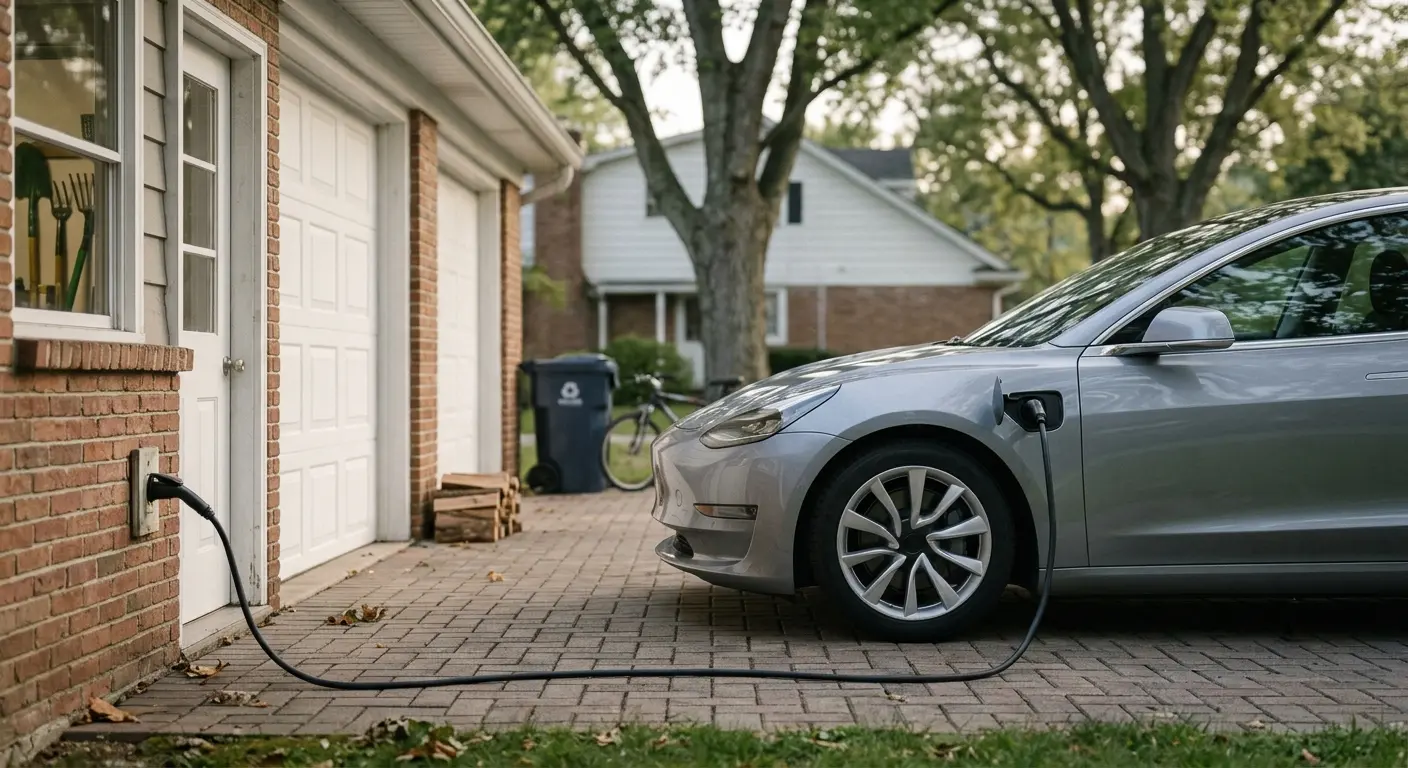
A Level 1 EV charger is the simplest way to charge an electric vehicle at home. It typically uses a standard household electrical outlet, so you don’t need the dedicated electrical work that’s often associated with faster home charging. For drivers with short commutes, low daily mileage, or long overnight parking periods, that simplicity can be enough.
The trade-off is charging speed. Level 1 charging is much slower than Level 2 AC charging and far slower than Level 3 DC fast charging. That doesn’t automatically make it a poor choice. The right setup depends on how far you drive, how long your EV sits parked, your home’s electrical system, and how often you need to replenish a larger amount of energy.
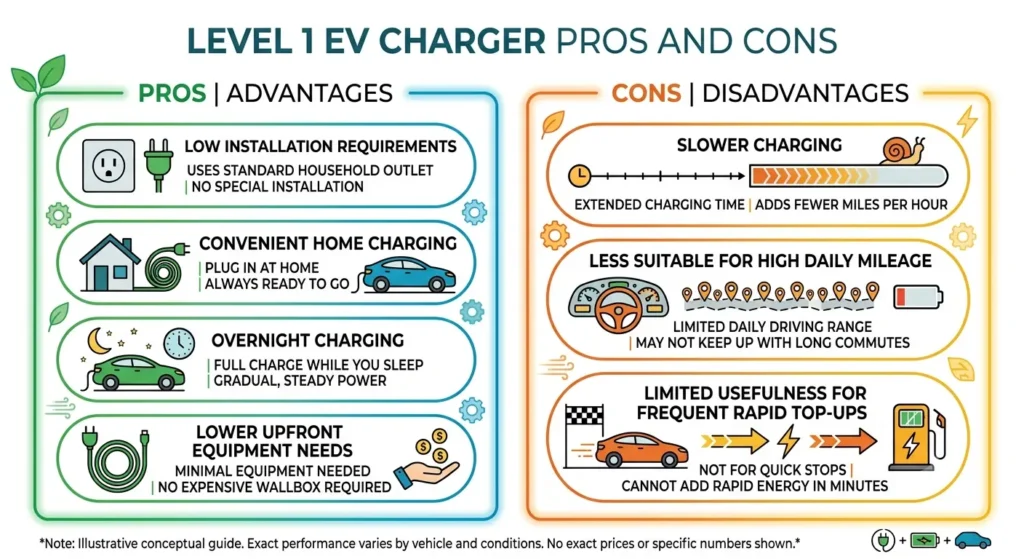
A Level 1 EV charger is a practical option for drivers who park for long periods and don’t need to replace a large amount of battery energy every day. It generally uses a household AC outlet and adds energy gradually, making overnight charging possible for many commuters. The exact charging rate and usable range added vary by vehicle and electrical supply.
For someone driving a modest distance each day, Level 1 charging can be surprisingly useful. Imagine a driver who leaves home in the morning, returns in the evening, and doesn’t use the car again until the next day. The vehicle may have many hours to charge while parked.
A different picture emerges for a driver covering long distances every day. If you regularly return home with a low battery and need to add a substantial amount of range before leaving again, Level 1 charging may feel frustratingly slow.
This guide explains how Level 1 charging works, what it costs, how its speed compares with other charging options, and how to decide if it’s enough for your routine. You’ll also see where Level 1 fits alongside Level 2 home charging and Level 3 DC fast charging.
How Long Does It Take to Charge an Electric Car? EV Charging Time Explained
What Is a Level 1 EV Charger?
A Level 1 EV charger is a basic AC charging setup that supplies electricity to an electric vehicle from a standard household electrical outlet in compatible markets. The vehicle’s onboard charger converts the incoming AC electricity into DC energy that the battery can store.
Unlike DC fast charging, the charger itself isn’t sending DC electricity directly into the battery. That’s one of the main reasons the charging process is slower.
For many EV owners, Level 1 charging is the starting point. A vehicle can be parked at home, plugged in, and left to charge over several hours. There’s no need to visit a public charging station simply to add a small amount of energy after an ordinary commute.
The exact equipment supplied with an EV varies by manufacturer and market. Some vehicles may include portable charging equipment designed for household outlets, while others may require you to purchase suitable equipment separately.
It’s also worth separating the phrase “Level 1 charger” from the electrical outlet itself. The outlet provides the electricity, while the portable charging equipment manages the connection between the outlet and vehicle. The equipment includes safety controls and communicates with the car during charging.
The terminology also varies by region. In North America, Level 1 charging is commonly associated with household AC outlets and compatible EV charging equipment. In the UK, Europe, and Australia, charging terminology and household electrical standards differ, and domestic AC charging is often discussed in terms of charging modes and power levels rather than the North American Level 1 label.
That regional difference matters if you’re researching equipment online. A product designed for one market may not be appropriate for another because of differences in plugs, electrical systems, connector standards, and regulations.
EV Charging Guide: Costs, Types, Charging Time & Home Installation
How Level 1 EV Charging Works
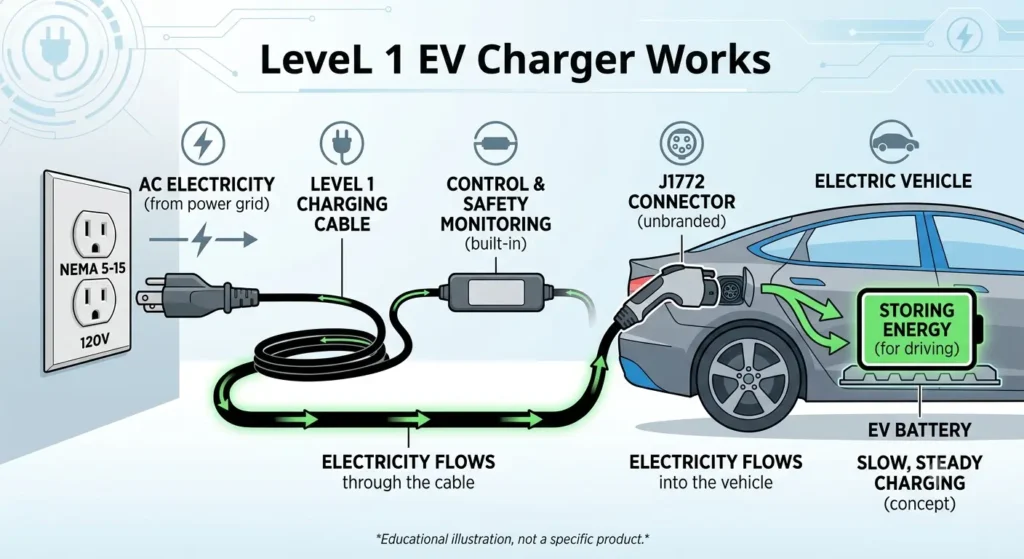
The process is fairly straightforward. You connect the charging equipment to a suitable household outlet, connect the vehicle, and the EV manages the charging process. The car determines how much power it can accept based on its charging system and current battery conditions.
The onboard charger plays a key role. Electricity arrives as AC power, passes through the vehicle’s charging system, and is converted into the DC power the battery needs. Charging normally slows as the battery approaches a high state of charge.
The exact charging behaviour varies by EV, battery chemistry, temperature, software, and other factors. That’s why charging time shouldn’t be judged only by looking at battery capacity. Two EVs with similar battery sizes can behave differently during charging.
What Equipment Do You Need for Level 1 Charging?
For basic Level 1 charging, you’ll generally need:
- A compatible electric vehicle
- Suitable portable EV charging equipment
- An appropriate household electrical outlet
- A safe location for the charging equipment and cable
- A charging connector compatible with your vehicle
The exact connector depends on the market and vehicle. In North America, many modern EVs use NACS or CCS1 for charging, depending on the vehicle and model year. In the UK, Europe, and Australia, Type 2 is widely used for AC charging, while CCS2 is commonly used for DC fast charging.
Don’t assume that a cable physically fitting an outlet means the installation is automatically suitable for continuous EV charging. A household outlet and its wiring need to be in good condition and appropriate for the intended load. If the outlet is old, damaged, loose, discoloured, or showing signs of overheating, stop using it and have it inspected by a qualified electrician.
Level 3 EV Charger: How Fast Is It & What Does It Cost?
How Fast Is Level 1 EV Charging?
Level 1 charging is slow compared with Level 2 and Level 3 charging, but “slow” doesn’t always mean impractical. The actual charging rate depends on the vehicle, electrical supply, charging equipment, battery temperature, and other conditions.
A Level 1 setup generally adds energy gradually over many hours rather than rapidly replenishing a battery during a short stop. That makes it best suited to situations where the vehicle remains parked for a long time.
Think about a typical weekday. You might arrive home in the evening, plug in the EV, and leave it connected until the next morning. A driver who travels a moderate distance each day may replace much of the energy used during that day’s driving during the overnight parking period.
Someone who drives significantly farther may not recover all the energy they used. If that pattern continues, the battery’s state of charge could gradually become lower unless the driver uses Level 2 or public DC fast charging.
The key point is that charging speed should be judged against your driving routine.
What Affects Level 1 Charger Speed?
Several factors influence how quickly an EV charges.
The vehicle’s onboard charger is one factor. The car determines how much power it can accept from the charging source.
Electrical supply is another consideration. Household systems vary by country, property, and circuit configuration, so the available power depends on the outlet and circuit used.
Battery temperature can affect charging. A very cold battery may charge differently from one that’s at a more suitable operating temperature.
State of charge matters too. Charging behaviour can change as the battery fills, particularly at higher states of charge.
Energy consumption changes the range you gain from charging. An efficient EV may travel farther using the same amount of stored energy than a larger or less efficient vehicle.
Weather and driving conditions affect the other side of the equation. Cold temperatures, high speeds, heating, air conditioning, hills, and heavy loads can increase energy consumption.
This is why there isn’t one universal answer to “How many miles does Level 1 add per hour?” The answer depends on the EV and conditions. A useful way to think about it is in terms of your daily energy use.
How Much Range Can You Add Overnight?
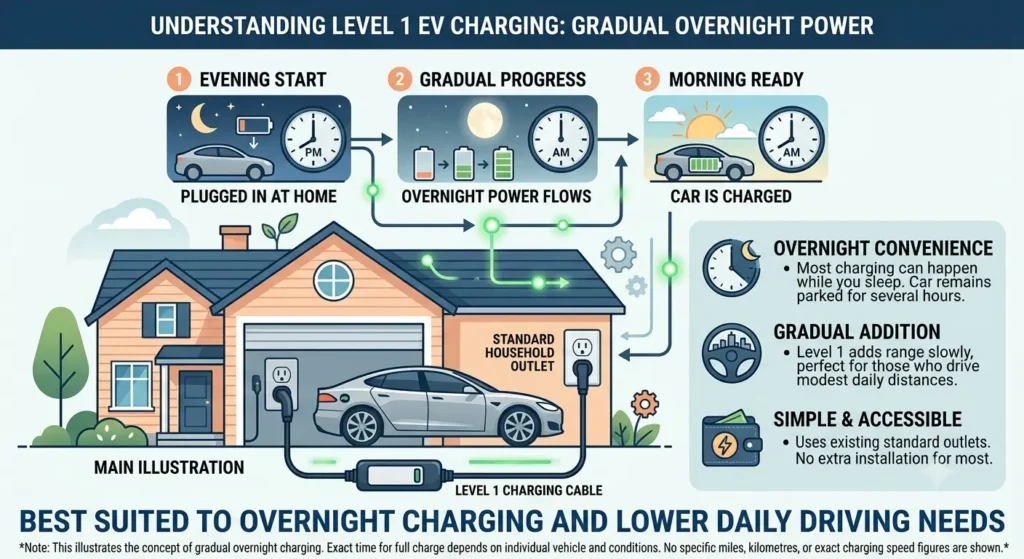
An overnight charging session can add useful driving range, but the exact amount varies significantly by vehicle and conditions. A small, efficient EV driven gently in mild weather may gain a useful amount of range during a long overnight session. A larger EV with higher energy consumption may add less usable driving distance from the same charging period.
The best approach is to track your own vehicle. Start by checking how much battery percentage you typically use during your daily commute. Then observe how much battery percentage the car recovers after being plugged in overnight.
Remember that displayed range is an estimate. Real-world driving range differs from official claimed figures because of weather, speed, traffic, road conditions, heating or cooling, and payload.
Why Real-World Charging Speed Varies
Charging isn’t a fixed process that produces identical results every time. A cold winter evening can produce different results from a mild spring night. A vehicle with battery preconditioning may behave differently from one that starts charging with a cold battery.
Your home’s electrical system can also affect the available charging rate. That’s why manufacturers and charging providers often present charging performance as an expected range rather than a guarantee.
For daily use, consistency matters more than chasing a theoretical maximum. If your vehicle reliably gains enough energy during its normal parking period, the setup may be perfectly suitable for your needs.
How Much Does Level 1 EV Charging Cost?
The cost of Level 1 EV charging is usually tied more to the electricity you consume than to the charging method itself. If you’re charging at home, the main ongoing expense is the electricity used to refill the battery. Your local electricity tariff determines the price you pay.
The charging equipment can also have an upfront cost, particularly if your EV didn’t come with suitable portable charging equipment. Compared with public DC fast charging, home charging can often be less expensive per unit of energy, but this varies by electricity tariff, charging network, location, and time of use.
What Determines Your Home Charging Cost?
Your electricity rate is the biggest variable. The amount of energy your EV needs is another. Charging losses also mean the electricity drawn from the home can be higher than the energy ultimately stored in the battery.
To estimate your cost, multiply the electricity used for charging by your local price per unit of electricity. Your provider’s tariff, time-of-use rates, and any applicable fees can change the result.
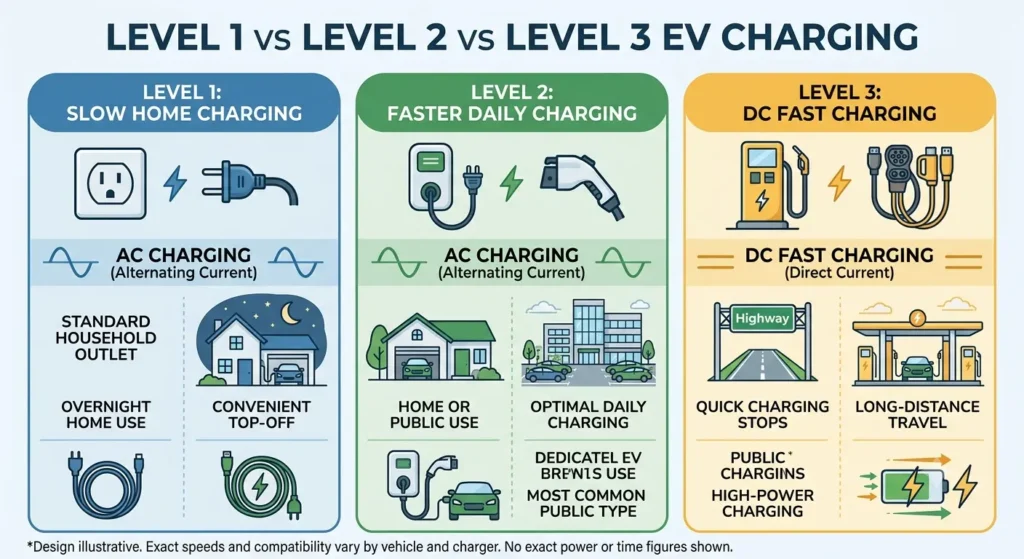
Level 1 vs Level 2 vs Level 3 Charging
| Charging type | Typical setting | Best suited to | Installation needs |
|---|---|---|---|
| Level 1 | Household AC outlet | Overnight home charging and lower daily driving needs | Usually minimal, but the outlet and circuit must be suitable |
| Level 2 | Dedicated AC charging equipment | Faster home charging and regular daily driving | May require dedicated electrical work |
| Level 3 | Public DC fast charging | Road trips and faster charging stops | Generally public or commercial infrastructure |
Level 1 is focused on convenience and simplicity. Level 2 is usually the preferred option for faster AC charging at home. Level 3, commonly called DC fast charging, is built for rapid charging at public stations, making it especially useful for longer trips and quick top-ups.
For many owners, Level 1 is enough if the car sits parked for long periods and daily driving is modest. Level 2 becomes more attractive when you need to replenish more energy between trips. Level 3 is useful when time matters, especially during longer journeys.
Is Level 1 Charging Enough for Your Daily Driving?
Start with your routine rather than the charger label. How far do you drive on a normal day? How many hours is your EV parked at home? Do you have access to public charging during the week?
If your car is parked overnight for many hours and your daily driving is modest, Level 1 may cover a large part of your routine. If you regularly drive long distances, Level 2 may be a better fit.
Public DC fast charging can fill the gaps, but relying on it for every daily top-up may be less convenient and can cost more than home charging, depending on the network and local electricity prices.
Can You Install a Level 1 Charger at Home?
In many cases, you don’t need a dedicated charger installation for basic Level 1 charging because the equipment can connect to a suitable household outlet. However, the outlet, wiring, and circuit still need to be appropriate for continuous EV charging.
If you’re unsure about the condition of the outlet or electrical circuit, ask a qualified electrician to inspect it. Local electrical rules differ by country and region, so follow the requirements that apply where you live.
When Should You Consider Level 2 Instead?
Consider Level 2 if Level 1 can’t replace the energy you use during your normal parking window. It’s also worth considering if you regularly arrive home with a low battery and need the vehicle ready for a longer trip the next morning.
A dedicated Level 2 setup can also make sense for households with high daily mileage or more than one EV. The right choice depends on your driving needs, property electrical capacity, installation requirements, and budget.
Practical Tips for Using a Level 1 EV Charger
- Use a suitable outlet in good condition.
- Keep the charging cable protected from damage and avoid creating trip hazards.
- Check the charging equipment and plug regularly for unusual heat, damage, or discolouration.
- Track your daily battery use for a week to see if overnight charging keeps pace.
- Use scheduled charging if your vehicle or home electricity plan supports it.
- Keep public fast charging as a backup when your daily routine needs more energy than Level 1 can provide.
Common Level 1 EV Charging Mistakes
Mistake 1: Assuming Slow Charging Is Always Bad
Fix: Compare charging time with the hours your car normally sits parked. A slow charger can work well if the vehicle has enough time to charge between trips.
Mistake 2: Ignoring the Electrical Outlet
Fix: Don’t use a damaged or overheated outlet. If you’re unsure about the wiring or circuit, have it checked by a qualified electrician.
Mistake 3: Comparing Claimed Range With Real-World Results
Fix: Remember that weather, speed, traffic, heating, air conditioning, road conditions, and payload can change real-world range.
Frequently Asked Questions
Is a Level 1 EV charger enough for daily driving?
It can be enough for drivers with modest daily mileage and long overnight parking periods. The answer depends on how much energy you use each day and how much your vehicle can recover while parked. Drivers with longer commutes may find Level 2 charging more practical.
Is Level 1 charging cheaper than Level 2?
The electricity cost depends mainly on your home tariff and the energy your vehicle uses. Level 1 may have lower upfront equipment and installation needs, while Level 2 can offer more convenient charging. Your local electricity price and installation requirements determine the overall cost difference.
Can you leave a Level 1 EV charger plugged in overnight?
Many EVs are designed for overnight charging with compatible equipment, but the outlet and electrical system must be suitable. Follow the vehicle and charging equipment manufacturer’s instructions. Stop using an outlet if it becomes unusually hot, damaged, loose, or discoloured.
Does Level 1 charging damage an EV battery?
Normal charging with compatible equipment is part of ordinary EV use. Battery ageing is influenced by many factors, including time, temperature, charging habits, and battery chemistry. Follow the manufacturer’s guidance for charging and battery care.
Is Level 1 better than Level 2 for home charging?
Neither is automatically better. Level 1 can suit lower daily mileage and long parking periods, while Level 2 is more useful for drivers who need to replenish more energy in less time. Your routine and home’s electrical capacity should guide the choice.
Conclusion
A Level 1 EV charger can be a practical home charging solution if your daily driving is modest and your vehicle sits parked for long periods. Its slower charging speed becomes a problem mainly when your driving routine consistently uses more energy than you can replace overnight.
Before upgrading, track your daily battery use and overnight charging results. If Level 1 keeps pace, you may not need a faster setup. If it doesn’t, compare Level 2 home charging with public DC fast charging and choose the option that fits your routine.