
Introduction
Electric car maintenance is one of the biggest reasons many drivers switch from petrol or diesel vehicles. An EV has fewer moving parts, no engine oil, no spark plugs, and no exhaust system. That doesn’t mean an electric vehicle is maintenance-free. Every EV still needs regular inspections, tire care, brake checks, cabin filter replacement, and software updates to stay reliable and efficient.
Many first-time buyers believe they’ll never have to service an EV. In practice, that’s one of the biggest misunderstandings about electric vehicle ownership. While an EV usually needs less routine maintenance than a conventional car, it still benefits from scheduled inspections that help prevent expensive repairs and keep the vehicle performing as expected.
If you’re planning to buy your first EV or you’ve already been driving one for several months, understanding electric car maintenance can save both time and money. It also helps protect battery health, improve safety, and maintain resale value over the long term.
This guide explains everything you need to know about electric car service, maintenance schedules, annual costs, common maintenance tasks, and practical ownership advice based on real-world driving situations.
Direct Answer
Electric car maintenance involves regularly inspecting tires, brakes, suspension, filters, fluids used for cooling systems where applicable, software updates, and battery health. Electric vehicles generally require less routine servicing than petrol or diesel cars because they have fewer wear components, but they still need scheduled maintenance to remain safe, reliable and efficient.
What Is Electric Car Maintenance?

Electric car maintenance is the process of inspecting, servicing and replacing components that naturally wear during everyday driving. Unlike conventional vehicles, electric cars don’t require oil changes or many engine-related services because they use an electric motor instead of an internal combustion engine.
That difference changes the entire ownership experience.
Instead of focusing on engine maintenance, EV servicing concentrates on components that affect safety, efficiency, and long-term reliability.
These include:
- Tires
- Brakes
- Suspension
- Steering
- Battery cooling systems (where applicable)
- Cabin air filters
- Windshield wipers
- Software updates
- Charging equipment inspection
The maintenance schedule varies by manufacturer and driving conditions. Someone driving mostly in urban traffic will experience different wear patterns than a driver who regularly travels long motorway distances.
Climate also plays an important role.
Cold winters can reduce battery efficiency and increase tire wear because many drivers install winter tires. Very hot climates place additional stress on cooling systems and battery temperature management.
Understanding these factors helps owners maintain realistic expectations rather than assuming every EV follows the same service schedule.
How EV Maintenance Differs from Petrol and Diesel Cars
The biggest difference is the absence of an internal combustion engine.
A conventional vehicle contains hundreds of moving engine components working together under extremely high temperatures. Those components require continuous lubrication, fuel delivery, and exhaust management.
An electric motor is mechanically much simpler.
Because of this, EV owners don’t normally deal with services such as:
- Engine oil changes
- Oil filters
- Fuel filters
- Spark plugs
- Timing belts
- Exhaust systems
- Catalytic converters
- Engine air filters
Removing these maintenance items immediately reduces routine servicing requirements.
That doesn’t mean nothing wears out.
Electric vehicles remain heavy machines travelling at road speeds every day. Tires wear, suspension components age, brakes need inspection, and cabin filters eventually become dirty.
The maintenance focus simply shifts from engine components to chassis, safety systems, and electrical diagnostics.
Another noticeable difference is regenerative braking.
Most EVs recover energy while slowing down. Since the electric motor performs much of the braking effort, traditional brake pads often wear more slowly than those on petrol or diesel cars.
However, brake systems still require regular inspection because corrosion, moisture and lack of use can affect braking performance over time.
Why Electric Vehicles Usually Require Less Routine Servicing
One reason many owners appreciate EVs is their simpler mechanical design.
An electric drivetrain contains significantly fewer moving components than a combustion engine.
Fewer moving parts generally mean fewer opportunities for mechanical wear.
For example, there is no engine oil circulating through hundreds of components.
There are no spark plugs firing thousands of times every minute.
There is no gearbox in many EV designs with multiple gears continuously shifting under load.
Without these systems, scheduled servicing becomes simpler.
Manufacturers instead focus on inspection-based maintenance.
Technicians typically examine the condition of major components rather than replacing large numbers of consumable engine parts.
Software also plays a much larger role.
Many modern electric vehicles receive software improvements that can enhance charging behaviour, battery management, or vehicle functions without replacing physical components.
Here’s the part many new buyers don’t expect before purchasing an EV.
A well-maintained electric vehicle still depends heavily on routine inspections.
Skipping inspections simply because there are fewer service items isn’t good practice.
Minor issues caught early usually remain inexpensive to fix.
Ignoring them for several years often leads to higher repair costs later.
Which Parts Still Need Regular Inspection?
Even though electric vehicles eliminate many traditional maintenance tasks, several components deserve regular attention throughout ownership.
Tires usually receive the most wear.
Electric vehicles produce instant torque, which can increase tire wear if drivers accelerate aggressively. Since EV battery packs also add weight, maintaining correct tire pressure becomes especially important.
Brake systems should also be checked regularly.
Although regenerative braking reduces brake pad wear, brake discs can still develop surface corrosion if they’re rarely used.
Suspension components experience loads similar to those in conventional vehicles.
Potholes, rough roads, and everyday driving gradually wear out bushings, shock absorbers, and steering components regardless of the vehicle’s powertrain.
Cabin air filters deserve replacement according to manufacturer recommendations because they help maintain clean air inside the vehicle.
Windshield wipers remain another overlooked maintenance item.
Poor visibility during heavy rain affects every vehicle equally, whether it’s powered by electricity, petrol or diesel.
Charging equipment should also receive occasional inspection.
Home charging cables, connectors and plugs should remain clean, dry and free from visible damage.
Using damaged charging equipment isn’t recommended and should be addressed before further charging.
By understanding these routine maintenance items, you’ll quickly realise that EV ownership isn’t maintenance-free.
Instead, it’s maintenance that focuses on different systems than those found in conventional vehicles.
Do Electric Cars Need Maintenance?
The short answer is yes.
Electric cars absolutely need maintenance, but the type of maintenance is different from what most people associate with vehicle servicing. Since there is no engine oil, fuel system, or exhaust system, several traditional service items disappear. At the same time, other components remain just as important as they are in any road vehicle.
Many new EV owners hear that electric vehicles are “maintenance free.”
That statement isn’t accurate.
What usually happens is that people compare an EV with a petrol car and notice fewer routine service appointments. Fewer appointments don’t mean zero maintenance.
A neglected EV can still develop problems.
Tires can wear unevenly.
Brake discs can corrode.
Suspension parts eventually age.
Cabin filters become clogged.
Wheel alignment can move out of specification after hitting potholes.
Charging connectors can become dirty.
Software updates may improve charging behaviour, battery management and vehicle performance.
Owning an electric car still means checking your vehicle regularly instead of waiting for something to break.
Components That Naturally Wear Over Time
Every vehicle contains parts designed to wear gradually.
Electric cars are no exception.
One of the fastest-wearing components is the tire.
Electric motors deliver maximum torque almost instantly. Quick acceleration combined with the additional battery weight can increase tire wear compared with some petrol vehicles if you drive aggressively.
That’s why checking tire pressure every month is one of the simplest ways to reduce maintenance costs.
Brake components also deserve attention.
Regenerative braking allows the electric motor to slow the vehicle while recovering energy. Because of this, brake pads often last much longer than many drivers expect.
However, longer life doesn’t eliminate inspections.
Brake discs can develop corrosion if friction brakes are rarely used, especially in wet climates or where road salt is common during winter.
Suspension components also experience normal wear.
Examples include:
- Shock absorbers
- Control arm bushings
- Ball joints
- Steering links
- Wheel bearings
These components don’t care whether your car runs on electricity or petrol.
Road conditions remain the biggest factor affecting their lifespan.
Windshield wiper blades also wear naturally.
Sunlight, dust, and changing weather gradually reduce rubber flexibility.
Replacing them when they leave streaks improves visibility and safety.
Cabin air filters deserve similar attention.
A dirty filter restricts airflow through the climate control system and can reduce interior air quality.
Replacing it according to the manufacturer’s schedule keeps the ventilation system working efficiently.
Components That Rarely Need Servicing
This is where electric vehicles become attractive from a maintenance perspective.
Several expensive maintenance jobs simply don’t exist.
For example, you won’t normally need:
- Engine oil changes
- Oil filter replacement
- Spark plug replacement
- Fuel injector cleaning
- Fuel filter replacement
- Timing belt replacement
- Exhaust repairs
- Catalytic converter replacement
Removing these maintenance items saves both money and workshop visits over the life of the vehicle.
The electric motor itself also requires very little routine maintenance.
Unlike a combustion engine with hundreds of moving parts, an electric motor has a much simpler mechanical design.
In practice, most owners spend more time checking tire condition than worrying about the motor.
The battery pack is another area people often misunderstand.
Many buyers assume the battery requires constant servicing.
Modern battery management systems automatically monitor charging, temperature, and operating conditions while you drive.
Drivers don’t manually service the battery itself during normal ownership.
Instead, technicians inspect related systems during scheduled maintenance.
If the manufacturer recommends checking battery coolant or other supporting systems, those inspections become part of routine servicing.
What Most New EV Owners Get Wrong
One common misunderstanding is believing lower maintenance means ignoring service schedules completely.
Skipping inspections usually creates bigger problems later.
Imagine driving for several years without checking wheel alignment.
Uneven tire wear develops gradually.
Eventually, you replace tires much sooner than expected.
A simple alignment check could have prevented unnecessary expense.
Another mistake is ignoring regenerative braking.
Some owners assume brake components never need inspection because they rarely use the brake pedal.
Unfortunately, corrosion can become a bigger issue when conventional brakes aren’t exercised regularly.
Using the brakes firmly from time to time, where safe to do so, helps keep braking surfaces clean.
Charging equipment is another overlooked area.
Home charging cables often remain outdoors for long periods.
Regularly checking connectors for dirt, moisture or physical damage helps maintain safe charging.
Software updates also deserve attention.
Manufacturers frequently release improvements that optimise charging behaviour, battery management and vehicle performance.
Ignoring updates means missing improvements that may benefit daily driving.
Perhaps the biggest misconception is comparing service frequency with maintenance quality.
Just because an EV visits the workshop less often doesn’t mean maintenance matters less.
Regular inspections remain one of the best ways to maximise reliability throughout the vehicle’s life.
Electric Car Maintenance Schedule
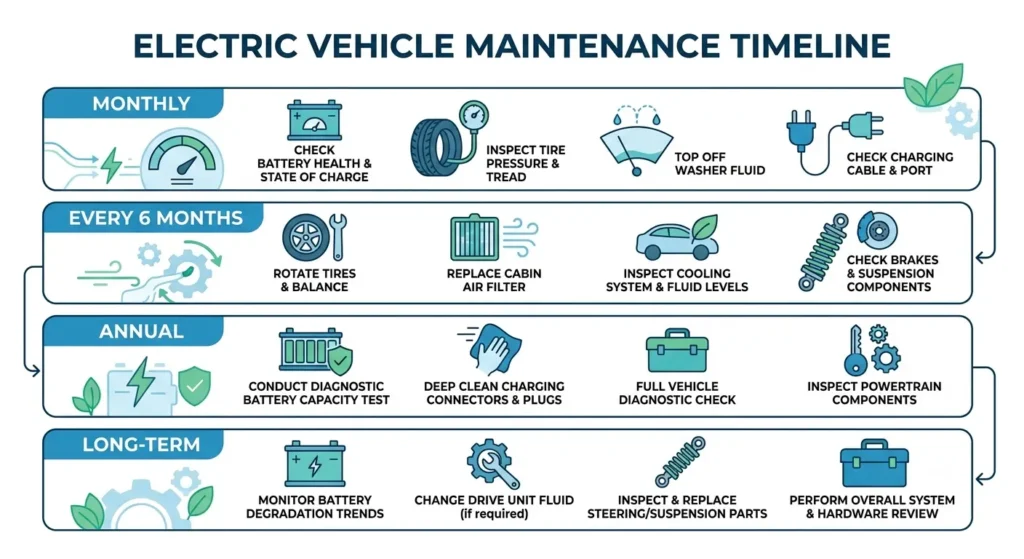
One of the biggest advantages of owning an electric vehicle is having a simpler maintenance schedule.
Instead of replacing engine-related components every few thousand miles, EV owners mainly focus on inspections, safety checks and wear items.
The exact schedule varies by manufacturer and driving conditions.
Someone driving mainly in city traffic experiences different wear than someone regularly travelling long motorway distances.
Climate also influences maintenance.
Hot weather places additional demand on battery cooling systems.
Cold temperatures affect tire pressure, and winter driving conditions increase exposure to road salt.
Rather than following one universal schedule, manufacturers provide maintenance intervals that suit their vehicles.
Still, most EV maintenance follows a similar pattern.
Monthly Checks
Monthly inspections only take a few minutes but can prevent expensive repairs later.
The first item is tire pressure.
Electric vehicles are generally heavier than similar petrol cars because of the battery pack.
Incorrect tire pressure reduces efficiency, increases tire wear, and affects handling.
Use the manufacturer’s recommended pressure rather than guessing.
Next, inspect tire tread.
Look for:
- Uneven wear
- Sidewall damage
- Embedded objects
- Cuts
- Cracks
Small problems discovered early are usually easier and cheaper to resolve.
Check windshield washer fluid regularly.
Good visibility remains essential in every season.
Walk around the vehicle occasionally.
Look for damaged lights, loose trim or obvious fluid leaks.
Although EVs don’t leak engine oil, some systems still use cooling fluids depending on the model.
Charging equipment should also receive a quick inspection.
Make sure charging cables remain clean, and connectors show no visible signs of overheating or damage.
Every Six Months
Twice each year, it’s worth performing a slightly more detailed inspection.
Rotate tires if recommended by the manufacturer.
Rotation promotes more even wear and helps extend tire life.
Inspect brake components.
Even if regenerative braking reduces pad wear, technicians should still examine:
- Brake discs
- Brake pads
- Brake lines
- Brake fluid condition
Wheel alignment is another worthwhile check, especially after striking potholes or kerbs.
Poor alignment often causes uneven tire wear long before the driver notices steering problems.
Cabin air filters should also be inspected.
If airflow seems weaker or unpleasant smells appear inside the vehicle, replacement may be necessary depending on driving conditions.
Drivers living in dusty environments often replace filters sooner than those driving mostly on clean roads.
Annual Inspection
A yearly service provides a more comprehensive assessment of the vehicle.
Technicians generally inspect:
- Suspension
- Steering
- Tires
- Brakes
- Cooling systems where applicable
- High-voltage electrical systems
- Charging ports
- Software updates
- Safety systems
Diagnostic equipment checks whether the vehicle has stored any fault codes that require attention.
Many issues can be detected long before warning lights appear on the dashboard.
Professional inspections also verify that recalls or software updates have been completed.
Keeping software current can improve charging performance, battery management and overall vehicle operation.
Long-Term Electric Car Maintenance
Looking after an electric vehicle over several years is mostly about consistency rather than frequent repairs. Small routine checks often make a bigger difference than waiting until a warning light appears.
Most owners notice that the first few years involve very little unexpected maintenance. As mileage increases, wear items gradually become the focus.
These include:
- Tires
- Brake components
- Suspension parts
- Wheel alignment
- Cabin air filters
- Wiper blades
- 12-volt battery (where fitted)
One area that’s often forgotten is the 12-volt battery.
Although the high-voltage battery powers the vehicle, most EVs still use a conventional 12-volt battery for lighting, locking systems, infotainment and vehicle electronics.
Like any lead-acid battery, it won’t last forever.
Manufacturers usually inspect it during scheduled servicing and replace it when performance begins to decline.
Suspension components also deserve attention as mileage increases.
Even if your EV spends most of its life on smooth roads, bushings and dampers gradually wear through normal use.
Drivers regularly travelling on rough roads or carrying heavy loads may notice suspension wear sooner than those using their EV mainly for commuting.
Wheel bearings are another long-term maintenance item.
They normally last many years but should always be inspected if unusual humming or vibration develops while driving.
Charging equipment should also remain part of your long-term maintenance routine.
Inspect your home charging cable every few months.
Check for:
- Damaged insulation
- Bent connector pins
- Dirt inside connectors
- Loose fittings
- Signs of overheating
Never continue using a charging cable that appears damaged.
Replacing a cable is far cheaper than risking charging problems or electrical faults.
Another long-term habit worth developing is keeping service records.
Even if your EV requires fewer workshop visits, documented maintenance helps maintain resale value.
Future buyers appreciate evidence that inspections, software updates and scheduled servicing were completed correctly.
Electric Car Service Explained
Servicing an electric vehicle looks different from servicing a petrol or diesel car.
Many people expect technicians to spend hours working on the battery pack or electric motor.
That rarely happens during routine maintenance.
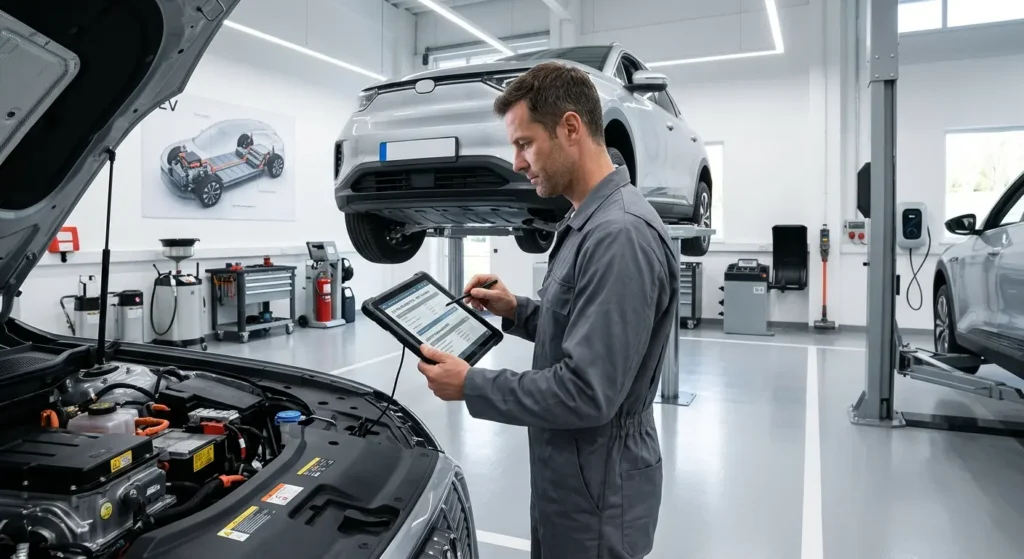
Instead, an EV service focuses on inspection, diagnostics and checking wear components.
Because electric drivetrains contain fewer mechanical parts, technicians spend more time evaluating the vehicle’s overall condition rather than replacing engine-related components.
Modern workshops also rely heavily on diagnostic software.
Electronic systems continuously monitor different vehicle functions and can identify developing faults before they become obvious during everyday driving.
This allows many problems to be corrected early.
What Happens During an EV Service?
A typical electric car service starts with a visual inspection.
Technicians check the exterior for obvious damage before moving underneath the vehicle.
The suspension receives careful attention because it supports the additional weight of the battery pack.
Control arms, bushings, steering joints, and dampers are inspected for wear or damage.
Brake components are then examined.
Although regenerative braking reduces pad wear, technicians still inspect:
- Brake pads
- Brake discs
- Brake fluid
- Brake lines
- Calipers
The goal isn’t simply measuring brake pad thickness.
Technicians also look for corrosion, uneven wear, and signs that moving components require cleaning or maintenance.
Tires receive another detailed inspection.
They’ll usually check:
- Tread depth
- Uneven wear
- Sidewall condition
- Tire pressure
- Wheel balance (if required)
Because tires directly affect efficiency and driving range, keeping them in good condition benefits both safety and energy consumption.
Next comes the electrical inspection.
Rather than dismantling the battery pack, technicians use diagnostic equipment to communicate with the vehicle.
The system checks for stored fault codes, software updates, and any alerts affecting battery management or charging performance.
Where applicable, cooling systems are also inspected.
Some EVs use liquid cooling to help maintain battery temperature.
Technicians inspect coolant levels according to manufacturer recommendations instead of replacing fluids unnecessarily.
Charging ports also receive attention.
The connector should remain clean, dry, and free from damage.
Any signs of corrosion or excessive wear should be investigated before they affect charging reliability.
Dealer vs Independent EV Specialist
Choosing where to service your electric vehicle depends on several factors.
Many owners continue visiting the dealer throughout the warranty period.
Dealership technicians receive manufacturer-specific training and have direct access to official diagnostic software, service bulletins, and technical updates.
That can be reassuring if your vehicle receives software improvements or warranty work.
However, independent EV specialists have become increasingly common.
Many invest in advanced diagnostic equipment and employ technicians experienced with multiple electric vehicle brands.
For routine maintenance, an experienced independent workshop may offer competitive pricing while still providing high-quality service.
Before choosing a workshop, ask a few questions.
For example:
- Do they regularly service electric vehicles?
- Do they have EV-trained technicians?
- Can they perform software diagnostics?
- Are they familiar with your vehicle brand?
- Do they use approved replacement parts where necessary?
Experience matters more than workshop size.
A specialist independent garage with strong EV knowledge may provide better service than a workshop that rarely works on electric vehicles.
If your vehicle remains under warranty, always check the manufacturer’s servicing requirements.
Following the recommended maintenance schedule helps avoid unnecessary warranty complications.
How Long Does an Electric Car Service Usually Take?
One pleasant surprise for many owners is that routine EV servicing is often straightforward.
Inspection-based services may take only a few hours depending on the work required.
If tire rotation, wheel alignment, or cabin filter replacement is included, the appointment naturally becomes a little longer.
Software updates can also affect service duration.
Some updates install quickly.
Others require additional time because multiple vehicle systems must be reprogrammed and tested before returning the car to the owner.
Diagnostic inspections usually don’t require dismantling large sections of the vehicle.
Instead, technicians connect specialist equipment that communicates directly with onboard control modules.
If no faults are found, the process can be relatively efficient.
Unexpected repairs naturally extend workshop time.
For example:
- Suspension component replacement
- Brake repairs
- Tire replacement
- Cooling system maintenance
- Charging connector repairs
These jobs depend on parts availability and workshop workload.
Booking your service in advance also helps reduce waiting times, especially during busy seasonal periods.
Electric Car Maintenance Cost

One of the biggest reasons people consider buying an electric vehicle is the expectation of lower running costs.
In many cases, that expectation is realistic.
An electric car usually has fewer routine maintenance items than a petrol or diesel vehicle, which often means fewer workshop visits and fewer replacement parts over its lifetime.
That doesn’t mean maintenance is free.
You’ll still pay for inspections, tires, brake servicing, cabin air filters and other wear items. The difference is that most of the expensive engine-related maintenance found in conventional vehicles simply doesn’t exist.
Instead of budgeting for regular oil changes, timing belt replacements or exhaust repairs, EV owners mainly budget for periodic inspections and consumable components.
The exact maintenance cost varies depending on several factors.
These include:
- Vehicle model
- Annual mileage
- Driving style
- Climate
- Tire choice
- Workshop labour rates
- Country and region
Someone driving 8,000 miles (13,000 km) each year in mild weather will usually have different maintenance costs than someone covering 25,000 miles (40,000 km) annually through harsh winters.
Looking after your vehicle consistently also has a direct impact on long-term costs.
Ignoring simple inspections often turns inexpensive maintenance into larger repair bills.
Typical Annual Electric Car Maintenance Costs
Most routine EV servicing focuses on inspection rather than replacing numerous components.
During a normal ownership year, common maintenance expenses may include:
- Scheduled inspection
- Tire rotation
- Wheel alignment if needed
- Cabin air filter replacement
- Brake inspection
- Windshield wiper blades
- Washer fluid
- Diagnostic check
- Software updates where applicable
Labour rates vary significantly between countries and workshops.
Dealer servicing is often more expensive than an experienced independent EV specialist, although warranty requirements may influence where you choose to have your vehicle serviced.
Another factor many owners forget is tire replacement.
Electric vehicles often weigh more than comparable petrol cars because of the battery pack.
Combined with instant electric torque, this can increase tire wear if acceleration is aggressive.
Driving smoothly usually extends tire life while also improving driving range.
Brake maintenance is generally less frequent because regenerative braking reduces wear on brake pads.
However, brake inspections remain important since corrosion can develop even when pad wear is minimal.
Replacing a cabin air filter is another routine expense.
Fortunately, this is normally one of the more affordable maintenance items.
Overall, many owners find annual EV maintenance predictable because there are fewer unexpected routine service requirements.
What Has the Biggest Impact on Maintenance Costs?
Not every electric vehicle costs the same to maintain.
Several factors influence your overall ownership costs.
Annual Mileage
Higher mileage naturally increases wear.
The more you drive, the more frequently you’ll inspect or replace:
- Tires
- Wiper blades
- Cabin filters
- Suspension components over time
Someone driving mostly at weekends will normally spend less on maintenance than a daily commuter.
Driving Style
Aggressive acceleration may be enjoyable, but it increases tire wear considerably.
Electric motors deliver maximum torque almost instantly.
Repeated hard acceleration places additional stress on tires and suspension.
Smooth driving generally reduces maintenance costs while improving efficiency.
Road Conditions
Road quality matters.
Driving on rough roads every day accelerates wear on:
- Suspension
- Steering
- Wheel alignment
- Tires
Drivers mainly using smooth motorways often experience slower suspension wear.
Climate
Weather also influences maintenance.
Cold winters can increase corrosion on brake components because of moisture and road salt.
Very hot climates place additional demand on battery cooling systems where fitted.
Seasonal tire changes may also become necessary depending on local conditions.
Workshop Choice
Many owners compare dealership servicing with independent EV specialists.
Dealers often have direct manufacturer support and official software access.
Independent specialists may offer competitive pricing while still providing high-quality maintenance.
Choosing a workshop based purely on price isn’t always the best decision.
Experience with electric vehicles usually matters more.
Electric Car vs Petrol Car Maintenance
The largest savings usually come from eliminating engine-related servicing.
A petrol vehicle typically requires multiple maintenance items throughout its life that simply don’t exist on an EV.
Examples include:
- Engine oil
- Oil filters
- Spark plugs
- Fuel filters
- Exhaust components
- Timing belts or chains depending on design
- Emissions-related components
Electric vehicles avoid many of these costs.
Instead, maintenance focuses on inspection and wear components.
Here’s a simple comparison.
| Maintenance Item | Electric Car | Petrol Car |
|---|---|---|
| Engine oil | No | Yes |
| Oil filter | No | Yes |
| Spark plugs | No | Yes |
| Exhaust repairs | No | Yes |
| Fuel filter | No | Yes |
| Tire replacement | Yes | Yes |
| Brake inspection | Yes | Yes |
| Wheel alignment | Yes | Yes |
| Cabin air filter | Yes | Yes |
| Wiper blades | Yes | Yes |
| Suspension inspection | Yes | Yes |
| Software updates | Common | Less common |
The table doesn’t mean every electric vehicle will always cost less to own.
Unexpected repairs can happen with any vehicle.
However, the routine maintenance schedule is generally simpler because many engine service items have been eliminated.
Most Common EV Maintenance Tasks
Although electric vehicles require less routine servicing, several maintenance jobs remain essential throughout ownership.
Understanding these tasks helps prevent unnecessary repairs and improves reliability.
Most of them are simple.
Many only require regular inspection rather than expensive replacement.
Tire Maintenance
Tires are usually the fastest-wearing component on an electric vehicle.
Several reasons explain why.
First, EVs are generally heavier because of the battery pack.
Second, electric motors produce instant torque.
Both factors place additional stress on tires, particularly during rapid acceleration.
Checking tire pressure every month is one of the easiest maintenance habits you can develop.
Incorrect pressure can:
- Reduce driving range
- Increase tire wear
- Affect braking performance
- Reduce handling stability
Always use the pressure recommended by the vehicle manufacturer.
Don’t rely solely on visual inspection.
A tire that looks properly inflated may still be below the recommended pressure.
Tread depth should also be checked regularly.
Uneven wear often indicates alignment or suspension problems.
Rotating tires at recommended intervals helps distribute wear more evenly and can extend overall tire life.
One mistake many owners make is replacing tires with the cheapest available option.
Electric vehicles often benefit from tires designed for higher loads and lower rolling resistance.
Choosing suitable replacements helps maintain efficiency, comfort, and safety.
Brake Inspection
One of the biggest advantages of regenerative braking is reduced brake pad wear.
Many EV owners drive thousands of miles with minimal brake pad wear because the electric motor performs much of the slowing process.
That doesn’t mean the braking system can be ignored.
Brake discs can develop corrosion if friction brakes aren’t used regularly.
This is especially common in wet climates.
Technicians normally inspect:
- Brake discs
- Brake pads
- Brake lines
- Brake fluid
- Calipers
- Parking brake operation
Using the friction brakes occasionally during normal driving, where safe to do so, helps keep braking surfaces clean.
Ignoring brake inspections simply because regenerative braking exists isn’t recommended.
Cabin Air Filter Maintenance
The cabin air filter is one of the most overlooked maintenance items on an electric vehicle.
Unlike an engine air filter, the cabin filter doesn’t affect how the motor performs. Instead, it keeps dust, pollen, pollution, and other airborne particles from entering the passenger compartment through the heating and air conditioning system.
If you’ve ever noticed weak airflow, unpleasant smells, or windows that fog up more often than usual, a dirty cabin filter may be the reason.
Most manufacturers recommend inspecting the cabin air filter during scheduled servicing and replacing it when necessary. Drivers who regularly travel in dusty areas, heavy traffic, or regions with high pollen levels may need replacement sooner than someone driving mainly on clean roads.
Replacing a cabin filter offers several benefits:
- Better air quality inside the vehicle
- Improved heating and cooling performance
- Reduced strain on the climate control system
- Less dust circulating through the cabin
Many cabin filters are relatively inexpensive compared with other maintenance items, making this one of the simplest ways to keep your EV comfortable throughout the year.
Suspension and Steering Inspection
Electric vehicles are often heavier than similar petrol models because of the battery pack mounted underneath the floor.
That extra weight improves stability and lowers the centre of gravity, but it also means suspension components work continuously to support the vehicle.
During routine servicing, technicians normally inspect:
- Shock absorbers
- Springs
- Bushings
- Ball joints
- Steering linkage
- Control arms
- Anti-roll bar links
Driving on rough roads, speed bumps or potholes gradually wears these components.
Most owners won’t notice suspension wear immediately because it develops slowly.
Common warning signs include:
- Knocking noises
- Uneven tire wear
- Poor steering response
- Vehicle pulling to one side
- Increased vibration
Ignoring these symptoms can eventually affect both comfort and safety.
Wheel alignment is closely connected to suspension health.
If alignment changes after hitting a pothole, tire wear increases quickly.
Checking alignment whenever steering feels unusual can often prevent replacing tires earlier than expected.
Windshield Wipers and Washer System
Windshield wipers rarely receive much attention until visibility becomes poor.
Rubber blades gradually harden because of sunlight, temperature changes, and daily use.
When this happens, you may notice:
- Streaks across the windshield
- Skipping blades
- Squeaking noises
- Poor visibility during rain
Replacing worn wiper blades is inexpensive and usually takes only a few minutes.
The washer system also deserves regular attention.
Always keep enough washer fluid in the reservoir, particularly before long journeys or during winter when road spray can quickly reduce visibility.
Blocked washer nozzles should be cleaned promptly to ensure even spray coverage across the windshield.
Good visibility remains one of the simplest yet most effective safety improvements any driver can maintain.
Battery Cooling System
Many modern electric vehicles use liquid cooling to help keep the battery within its preferred operating temperature.
Not every EV uses the same cooling design, so always follow the manufacturer’s maintenance recommendations.
Technicians may inspect:
- Coolant level
- Cooling hoses
- Pumps
- Connections
- Signs of leaks
The purpose of the cooling system is to help maintain stable battery temperatures during:
- Fast charging
- Long-distance driving
- Hot weather
- Heavy vehicle loads
Unlike engine coolant in traditional cars, battery cooling systems generally require much less frequent attention.
Owners should avoid opening or servicing high-voltage battery systems themselves.
These systems contain dangerous voltages and should only be inspected by trained technicians using appropriate safety procedures.
If warning lights appear relating to battery temperature or cooling, arrange a professional inspection instead of continuing to drive without investigation.
Software Updates
One maintenance task unique to modern electric vehicles is software management.
Software controls many vehicle functions, including:
- Battery management
- Charging behaviour
- Climate control
- Driver assistance systems
- Infotainment
- Energy efficiency
Manufacturers periodically release updates to improve vehicle performance or correct software issues.
Some vehicles receive updates remotely through over-the-air technology.
Others require installation during a service appointment.
Ignoring available updates may mean missing improvements that could benefit everyday driving.
Examples include:
- Improved charging compatibility
- Better battery temperature management
- Enhanced energy efficiency
- Stability improvements
- User interface enhancements
Before installing updates, ensure they come directly from the vehicle manufacturer or an authorised service centre.
EV Battery Maintenance Best Practices
The battery is the most valuable component in an electric vehicle.
Naturally, many owners worry about keeping it healthy for as long as possible.
Fortunately, modern battery management systems already do much of the work automatically.
Drivers simply need to develop good charging habits.
Follow Sensible Charging Habits
One of the biggest myths surrounding EV ownership is that every charge must reach 100%.
In reality, many manufacturers recommend using full charges only when necessary for longer trips.
For everyday driving, following your manufacturer’s guidance helps balance convenience with long-term battery care.
Fast charging is another area where balance matters.
DC fast charging is extremely useful during long journeys.
For routine daily charging, many owners rely mainly on home AC charging because it fits naturally into everyday life.
Using both methods appropriately helps create a practical charging routine.
Manage Temperature
Temperature affects every rechargeable battery.
Very hot or extremely cold conditions can temporarily influence charging speed and available driving range.
Most modern EVs include sophisticated thermal management systems that automatically help regulate battery temperature.
Whenever possible:
- Park in shade during very hot weather.
- Use covered parking during severe winter conditions.
- Pre-condition the vehicle before driving if your EV supports this feature.
- Follow manufacturer recommendations for charging in extreme temperatures.
Real-world range will always vary depending on weather, speed, terrain, and vehicle load.
Understanding this helps set realistic expectations throughout the year.
Long-Term Storage
If your EV won’t be driven for several weeks, check your owner’s manual for storage recommendations.
In general, avoid leaving the vehicle unused for extended periods without considering battery charge.
Many manufacturers recommend storing the vehicle with a moderate state of charge rather than completely full or completely empty.
If practical, occasionally checking the vehicle during long storage periods helps ensure everything remains in good condition.
Simple Battery Health Tips
Battery longevity isn’t determined by one single habit.
Instead, it’s the result of consistent everyday care.
Helpful practices include:
- Keep tires properly inflated to improve efficiency.
- Install software updates when available.
- Avoid unnecessary aggressive acceleration.
- Use the correct charging equipment.
- Follow the manufacturer’s maintenance schedule.
- Address warning lights promptly instead of ignoring them.
Most owners discover that battery maintenance is much easier than they expected.
The vehicle continuously monitors battery performance, leaving the driver free to focus mainly on sensible charging habits and routine inspections.
How EV Batteries Work
EV Battery Warranty Explained
Common Electric Car Maintenance Mistakes
Owning an electric vehicle is generally simpler than owning a petrol or diesel car, but that simplicity sometimes causes drivers to overlook basic maintenance. Small mistakes repeated over months or years can reduce efficiency, increase operating costs, and shorten the lifespan of wear components.
Fortunately, most of these mistakes are easy to avoid.
Ignoring Tire Pressure
This is probably the most common mistake among EV owners.
Even a small drop in tire pressure affects:
- Driving range
- Tire life
- Braking distance
- Handling
Because electric vehicles are usually heavier than comparable petrol cars, correct tire pressure becomes even more important.
Check pressures at least once each month and before long journeys.
Delaying Wheel Alignment
Many people only think about wheel alignment after replacing tires.
In reality, alignment should also be checked if:
- The steering wheel is no longer straight.
- The car pulls to one side.
- Tire wear looks uneven.
- You recently hit a pothole or kerb.
Correct alignment improves both efficiency and tire life.
Skipping Brake Inspections
Regenerative braking reduces brake pad wear.
It does not eliminate brake maintenance.
Brake discs can corrode if they’re rarely used.
A professional inspection helps identify corrosion, sticking calipers, or worn components before they become safety concerns.
Ignoring Software Updates
Modern electric vehicles depend heavily on software.
Updates may improve:
- Charging compatibility
- Battery management
- Vehicle stability
- Infotainment
- Energy efficiency
Installing official manufacturer updates helps keep the vehicle operating as intended.
Using Damaged Charging Equipment
Charging cables are often left outdoors.
Inspect them regularly.
Look for:
- Cracked insulation
- Bent connector pins
- Dirt
- Moisture
- Loose fittings
Replace damaged charging equipment instead of attempting temporary repairs.
Waiting for Warning Lights
Many owners assume servicing only becomes necessary after a warning light appears.
That’s rarely the best approach.
Routine inspections often identify developing problems before they become expensive repairs.
Preventive maintenance almost always costs less than reactive maintenance.
Expert Tips to Reduce Electric Car Maintenance Costs
After spending years comparing different electric vehicles and ownership experiences, one pattern becomes obvious.
Drivers who follow simple maintenance habits usually spend less over the lifetime of the vehicle.
Here are some practical ways to reduce ownership costs.
Drive Smoothly
Rapid acceleration increases tire wear.
Smooth driving extends tire life while improving driving range.
Rotate Tires
Regular tire rotation promotes even wear.
Replacing four tires together is far more expensive than extending their lifespan through simple maintenance.
Keep the Vehicle Clean
Wash the vehicle regularly, especially during winter where road salt is common.
Cleaning the underside helps reduce corrosion on exposed suspension and brake components.
Follow the Manufacturer’s Service Schedule
Every EV is different.
Following the recommended inspection schedule helps identify problems before they become major repairs.
Choose an Experienced EV Workshop
Experience matters.
Whether you choose a dealership or an independent specialist, make sure technicians regularly work on electric vehicles.
Keep Service Records
Document every inspection and maintenance visit.
Complete service records improve resale value and give future buyers greater confidence.
Frequently Asked Questions
Do electric cars need oil changes?
No.
Electric vehicles don’t use engine oil because they don’t have an internal combustion engine. This eliminates one of the most common maintenance tasks found on petrol and diesel vehicles. Owners should instead focus on inspections, tires, brakes, suspension, and software updates.
How often should an electric car be serviced?
The exact schedule depends on the manufacturer and driving conditions. Most vehicles follow inspection-based servicing rather than frequent replacement of engine components. Always follow the maintenance intervals listed in your owner’s manual.
Are electric cars cheaper to maintain?
In many cases, yes.
Electric vehicles generally require fewer routine maintenance items because they eliminate engine oil, spark plugs, exhaust systems and several other traditional service components. Actual ownership costs still vary depending on mileage, tires, workshop rates and local conditions.
What maintenance does an electric car need?
Routine maintenance usually includes:
- Tire inspections
- Tire rotation
- Brake inspection
- Suspension checks
- Cabin air filter replacement
- Wheel alignment
- Windshield wiper replacement
- Charging equipment inspection
- Software updates
The exact schedule depends on the vehicle manufacturer.
Can any mechanic service an electric vehicle?
Basic maintenance such as tires or brakes can often be completed by experienced workshops.
For high-voltage systems, battery diagnostics or manufacturer software updates, choosing technicians trained to work on electric vehicles is recommended.
How long do EV brakes last?
Brake life varies according to driving style and the strength of regenerative braking.
Many EV owners experience slower brake pad wear than drivers of petrol vehicles because regenerative braking reduces reliance on the friction brakes.
Regular inspections remain important because corrosion can still occur.
How much does electric car maintenance cost?
Maintenance costs vary depending on the vehicle, annual mileage, labour rates and local market conditions.
Routine servicing usually focuses on inspections and wear items rather than engine-related maintenance, making ownership more predictable for many drivers.
Does charging affect maintenance?
Charging itself isn’t considered maintenance.
Using appropriate charging equipment, following manufacturer recommendations, and keeping charging connectors clean can help maintain reliable charging performance over time.
Conclusion
Electric car maintenance is much simpler than many people expect, but it should never be ignored. Although EVs eliminate engine oil changes, spark plugs, exhaust repairs, and several traditional service items, they still rely on routine inspections to remain safe and efficient.
The most successful EV owners are usually those who develop consistent maintenance habits rather than waiting for problems to appear. Checking tire pressure, inspecting charging equipment, replacing cabin air filters when needed, and following the manufacturer’s service schedule can prevent unnecessary repair costs later.
Every electric vehicle is different, so your owner’s manual should always be the primary reference for maintenance intervals and servicing requirements. Combined with regular inspections from a qualified EV technician, these simple habits help improve reliability, protect resale value, and make electric vehicle ownership easier over the long term.