Introduction: What Is a Level 3 EV Charger and Why Does It Matter?
Level 3 EV charger is the fastest type of commonly available public EV charging, using direct current (DC) to deliver much more power than typical Level 1 or Level 2 AC charging. For drivers who spend long hours on the road, commute between cities, or need to add substantial range during a short stop, DC fast charging can make an electric car much easier to use.
The trade-off is that Level 3 charging usually costs more than charging at home with Level 1 or Level 2 equipment. It also depends heavily on your EV’s maximum charging capability, the charger’s available power, battery temperature, battery state of charge, and the charging network you use.
Level 3 EV chargers are generally the fastest public charging option for electric cars, often adding a substantial amount of driving range in a relatively short stop. Actual charging speed depends on the EV, battery temperature, state of charge, charger output, and connector. Public DC fast charging costs vary by network and location, while home Level 2 charging is usually the more practical option for routine overnight charging.
This guide explains how Level 3 charging works, how quickly it can charge an EV, how much it can cost, and how it compares with Level 1 and Level 2 charging. You’ll also learn what a Level 3 charger installation involves, why most homes don’t use one, and how to decide when DC fast charging makes sense for your driving routine.
Level 3 EV Charger: Quick Answer
A Level 3 EV charger, commonly called a DC fast charger, supplies DC power directly to an EV’s battery at a much higher rate than Level 1 or Level 2 AC charging. Charging can be much faster, but the actual rate varies by vehicle and charger. Public pricing also varies by network, location, and billing method.
For most EV owners, Level 3 charging is best used for road trips and time-sensitive charging stops. Level 2 charging generally makes more sense for daily home charging because it can replenish the battery while the vehicle is parked for several hours or overnight.
What Is a Level 3 EV Charger?
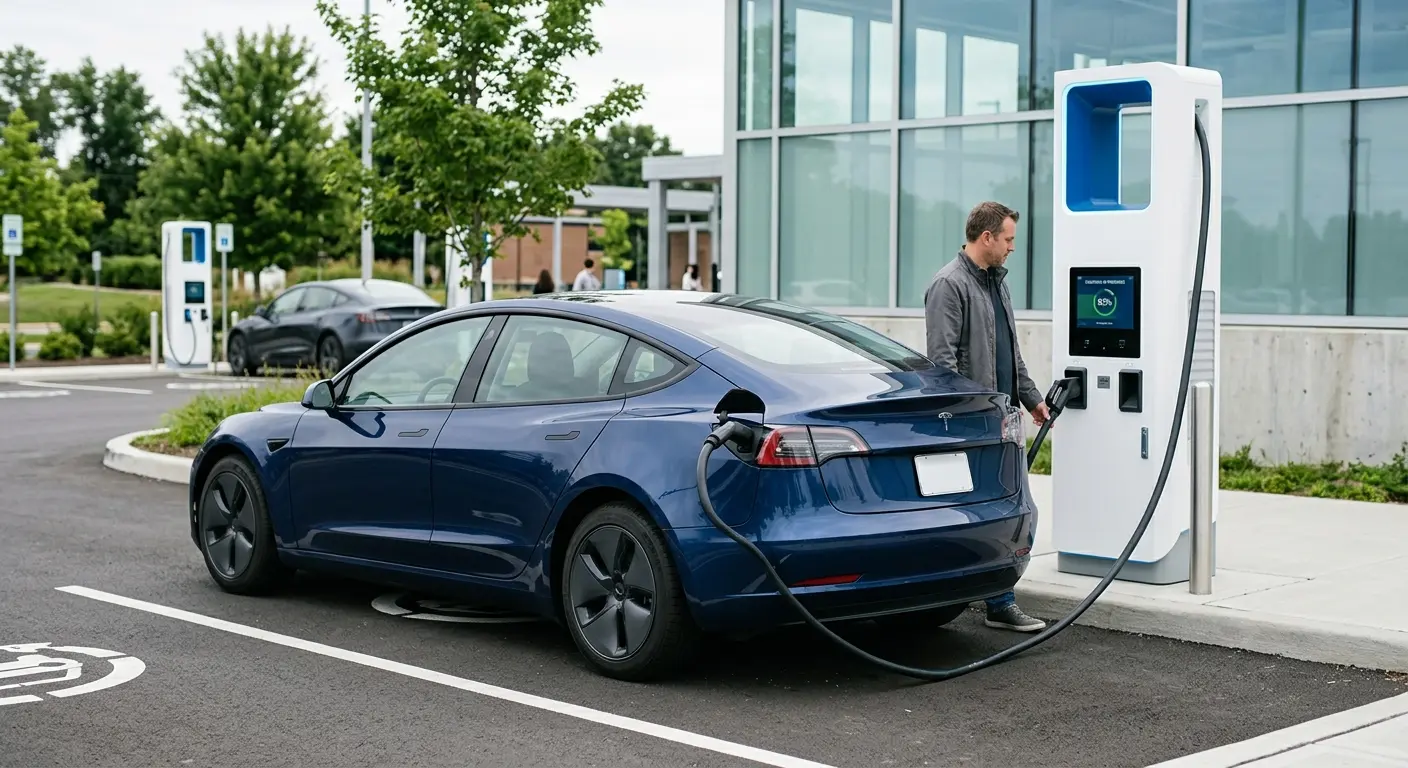
A Level 3 EV charger is a high-powered charging system designed to charge an electric vehicle much faster than conventional AC charging. In everyday conversation, you’ll often hear Level 3 charging and DC fast charging used interchangeably.
The basic difference comes down to how electricity reaches the vehicle’s battery.
With Level 1 and Level 2 charging, the vehicle receives alternating current, or AC. The EV’s onboard charger converts that AC electricity into DC power that the battery can store.
A DC fast charger handles much of that conversion outside the vehicle. It sends DC electricity directly toward the battery through the charging system, allowing significantly higher charging power than typical AC charging.
That doesn’t mean every Level 3 charger charges every EV at the same speed.
Your vehicle has a maximum DC charging rate. The charging station has its own maximum output. The battery management system also controls how much power the battery can safely accept at any moment.
The actual charging speed is therefore determined by the interaction between the vehicle and the charger.
How Level 3 Charging Differs From Level 1 and Level 2
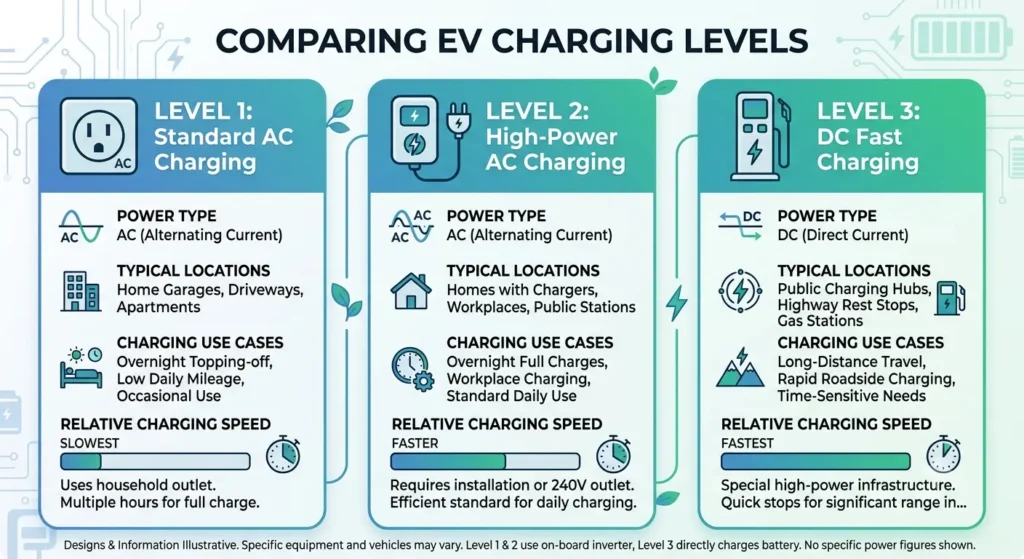
Level 1 charging is the simplest form of EV charging. In many markets, it uses a standard household electrical outlet and is mainly suited to drivers with low daily mileage or those who leave their vehicle parked for long periods.
Level 2 charging uses higher-power AC equipment and is much faster than Level 1. It’s common in homes, workplaces, apartment buildings, hotels, shopping centers, and public parking locations.
Level 3 charging is designed for situations where you need significantly more energy in less time.
| Charging type | Power delivery | Typical setting | Best use |
|—|—|—|—|
| Level 1 | Low-power AC | Home | Low daily driving and long parking periods |
| Level 2 | Higher-power AC | Home and public locations | Daily charging and overnight charging |
| Level 3 | High-power DC | Public fast-charging sites | Road trips and quick charging stops |
These categories describe broad charging levels rather than one universal charging speed. Actual power varies by equipment, vehicle, electrical infrastructure, and market.
For most EV owners, Level 1 is the slowest option, Level 2 is the everyday workhorse, and Level 3 is the rapid option used when charging time matters more.
Why Level 3 Charging Uses DC Power
EV batteries store energy as direct current. The electricity supplied by many buildings and household electrical systems is alternating current.
During AC charging, the vehicle’s onboard charger converts AC electricity into direct current before the battery can store it.
With DC fast charging, the conversion equipment is located within the charging station. The station supplies DC power to the vehicle’s battery system.
This allows the charging station to provide much higher charging power than typical home AC equipment.
The battery management system remains in control throughout the process. It monitors factors such as battery temperature, state of charge, and charging conditions, then communicates with the charging equipment to regulate power.
That’s why DC fast charging isn’t simply a case of sending as much electricity as possible into the battery.
The vehicle needs to balance speed with battery protection, temperature management, and charging efficiency.
How Fast Is a Level 3 EV Charger?
A Level 3 EV charger can charge an electric vehicle far faster than Level 1 or Level 2 equipment, but there isn’t one universal charging speed. The vehicle’s maximum DC charging rate, charger output, battery temperature, state of charge, and charging curve all affect the result.
Public DC fast chargers are available across a wide range of power levels. Some are designed for moderate-speed fast charging, while higher-powered units can deliver substantially more power to compatible vehicles.
However, a higher-rated charger doesn’t guarantee a faster session.
Imagine an EV that can accept a lower maximum DC charging rate than the output advertised by a charging station. Plugging into that station won’t make the vehicle exceed its own limit.
Now consider the opposite situation. An EV may be capable of accepting high charging power, but the station may have a lower output limit. The vehicle can only receive what the charger and electrical system can provide.
This is why you should think of charging speed as a relationship between three main elements:
1. The EV’s maximum charging capability.
2. The charging station’s available power.
3. The battery’s current condition.
The most useful figure isn’t always the charger’s maximum output. It’s the charging performance your specific EV can actually achieve.
Typical Level 3 Charging Speed
The phrase “Level 3 charging speed” can be misleading if you expect one fixed number.
Some DC fast chargers provide lower power, while high-powered public chargers can provide considerably more. The EV itself may accept only a portion of that available power.
Vehicle manufacturers may publish a maximum DC charging rate or quote a charging time over a specific battery percentage range. These figures can help you compare vehicles, but they don’t represent every charging session.
Real-world conditions can change the result.
A vehicle arriving at a charger with a relatively low state of charge may accept high power initially. As the battery fills, charging power usually reduces. This is known as charging taper.
That means the first part of a charging session can be much faster than the final part.
For road trips, this matters a lot.
If you’re trying to minimize charging time, stopping for a shorter session and continuing your journey may be more efficient than waiting for the battery to reach 100%.
The best stopping point depends on your EV, route, weather, charger availability, and how much range you need for the next part of the trip.
How Much Range Can You Add During a Short Charging Stop?
The amount of range you add during a DC fast-charging stop depends on your vehicle’s efficiency, battery capacity, charging curve, and the length of the stop.
Two EVs connected to the same charger for the same amount of time can gain different amounts of driving range.
An efficient EV may travel farther on the same amount of stored energy than a less efficient model. A vehicle with a strong charging curve may also accept more energy during the same period.
This is why charging in miles or kilometres of added range can be easier for drivers to understand than looking only at kilowatts.
For example, a driver planning a long highway trip doesn’t necessarily need to fill the battery completely. They may only need enough energy to reach the next reliable charging stop.
Real-world driving range will still vary with speed, outside temperature, wind, road conditions, heating or air conditioning use, passengers, cargo, and driving style.
Why Charging Speed Changes as the Battery Fills
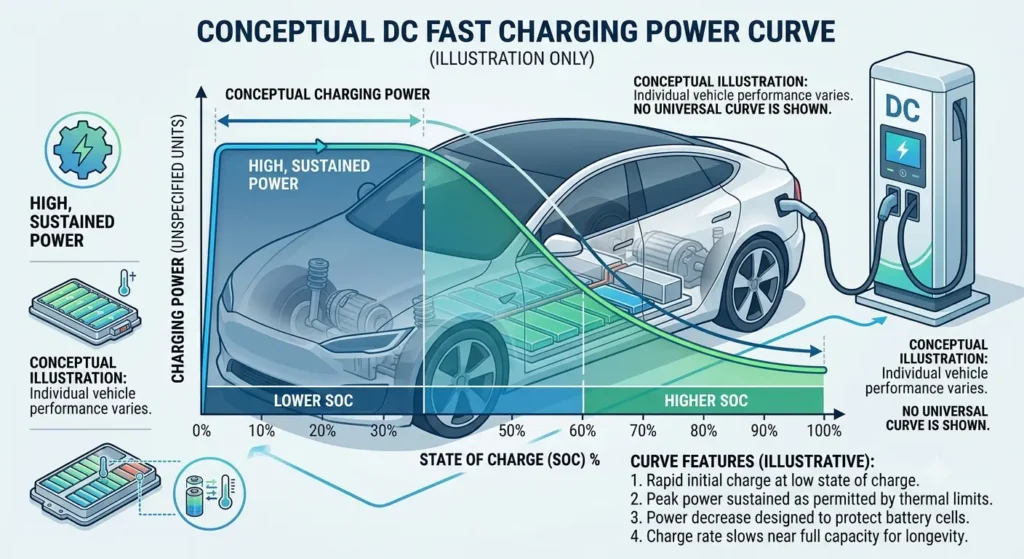
One of the biggest misconceptions about DC fast charging is that the vehicle will maintain its maximum charging rate from the beginning to the end of the session.
In practice, charging power usually changes as the battery fills.
When the battery has a low state of charge, the vehicle may be able to accept a high level of power. As the battery approaches a higher state of charge, the system generally reduces the charging rate.
This protects the battery and helps manage heat and charging conditions.
The result is a charging curve rather than a flat line.
That’s one reason drivers often stop charging before reaching 100% during long trips. The final portion of the battery can take disproportionately longer than the earlier portion.
The exact curve varies by vehicle.
Some EVs maintain relatively strong charging power through a wider portion of the session. Others taper earlier.
If you’re comparing EVs for frequent road trips, it’s worth looking beyond maximum charging power. The vehicle’s overall charging curve and the time it takes to add useful range can be more meaningful.
What Affects Real-World DC Fast Charging Speed?
Several factors can change the speed you experience at a Level 3 charger:
– Your EV’s maximum DC charging rate.
– The charger’s maximum output.
– The current state of charge.
– Battery temperature.
– Whether battery preconditioning is active.
– The number of vehicles sharing a charging site’s available power.
– The charging network’s equipment and electrical supply.
– The vehicle’s charging software and battery management system.
– Weather conditions that affect battery temperature.
Cold temperatures can be particularly significant.
A battery that’s too cold may not accept high charging power immediately. Some EVs can precondition the battery before reaching a planned fast charger, helping it reach a more suitable temperature for charging.
How Does DC Fast Charging Work?
DC fast charging works by supplying direct current to the EV’s battery through a dedicated high-power charging system. The charging station manages the power conversion and communicates with the vehicle, while the EV’s battery management system controls how much power the battery can safely accept.
The process starts when you connect the vehicle to the charger.
The EV and charging station communicate with each other. They exchange information about the vehicle’s charging requirements and the available power.
Once the session begins, the station supplies DC electricity through the appropriate charging connector.
The vehicle continuously monitors the battery.
Temperature, state of charge, voltage, current, and other operating conditions influence the charging rate.
The charging system can then increase or reduce power as conditions change.
This process happens automatically. You don’t need to manually tell the battery how much electricity to accept.
AC Charging vs DC Fast Charging
AC charging and DC fast charging both deliver electricity to an EV, but the power conversion process is different.
With AC charging, the electricity enters the vehicle as alternating current. The onboard charger converts it into direct current for the battery.
The onboard charger’s capacity places a limit on how much AC power the vehicle can accept.
DC fast charging moves the main conversion equipment outside the vehicle. The charging station converts the electricity and supplies DC power to the vehicle’s battery system.
This allows the charging station to provide much higher charging power than typical home AC equipment.
| Feature | AC charging | DC fast charging |
|—|—|—|
| Common charging levels | Level 1 and Level 2 | Level 3 |
| Main power conversion | Inside the vehicle | At the charging station |
| Common location | Home, workplace, public parking | Public fast-charging locations |
| Typical use | Daily charging | Longer trips and quick stops |
| Charging speed | Lower | Higher |
| Installation complexity | Usually lower | Usually much higher |
The distinction matters when choosing charging equipment.
If your main goal is to charge at home overnight, Level 2 AC charging is usually the more practical solution.
If your priority is adding substantial energy during a road trip, DC fast charging is much more useful.
What Happens Inside the Vehicle During DC Fast Charging?
The battery doesn’t simply receive electricity at one constant rate.
The vehicle’s battery management system continuously monitors the charging process.
The system manages the flow of energy based on battery conditions and the limits of the vehicle.
Temperature is one factor.
A battery that’s too cold or too hot may not accept the same charging power as a battery operating within a more suitable temperature range.
State of charge is another.
As the battery fills, the vehicle typically reduces charging power.
This is why a vehicle may charge quickly at a lower state of charge but take much longer to move from a high state of charge toward full.
The battery management system also helps protect the battery from operating outside its designed limits.
For drivers, the practical takeaway is simple. The fastest charging session isn’t always the one where you wait until the battery is full.
If you’re traveling, you may get back on the road sooner by charging enough to reach your next destination or charging stop.
Why the Car Controls the Charging Rate
A Level 3 charger can offer high power, but the vehicle decides how much power it can accept at a given moment.
This prevents the charger from forcing an unsuitable charging rate onto the battery.
Think of the charger and EV as a conversation.
The charger makes power available. The vehicle communicates what it can accept. The charging system adjusts the output based on those requirements.
That’s why the same DC fast charger can produce different results with different EVs.
It also explains why two identical vehicles may charge differently under different conditions.
One vehicle may arrive with a warm battery after highway driving. Another may arrive after sitting outside overnight in freezing weather.
Even if both cars use the same charger, their batteries may accept different charging rates.
For road-trip planning, your EV’s charging curve can therefore matter as much as the advertised maximum charging power.
Level 3 vs Level 2 Charging: What’s the Difference?
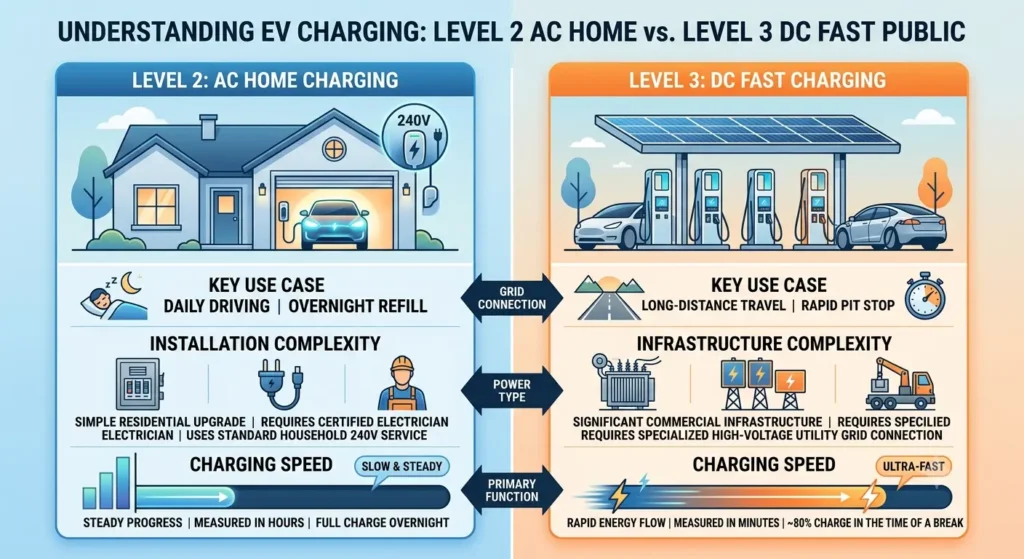
The main difference between Level 3 and Level 2 charging is speed and charging environment. Level 2 charging uses AC power and is commonly used at homes and workplaces, while Level 3 charging uses DC power and is mainly found at public fast-charging locations.
Neither option is universally better.
They solve different problems.
Level 2 is designed around longer parking periods. You plug in at home, go to sleep, and return to a charged vehicle. The same idea applies at workplaces and destinations where the car remains parked for several hours.
Level 3 is designed around shorter stops.
You arrive, connect the vehicle, add energy, and continue your journey.
That difference shapes the cost, installation requirements, and ideal use case for each system.
Charging Speed Comparison
Level 3 charging is significantly faster than Level 2 in most situations, but exact speeds vary widely.
A Level 2 charger may be perfectly adequate if your vehicle is parked overnight.
For example, a driver who commutes a moderate distance each day may use only a portion of the battery before returning home. Overnight charging can replenish that energy without requiring a fast charger.
A road-trip driver has a different need.
If you’re traveling several hundred miles, waiting overnight at every stop isn’t practical. DC fast charging allows you to add energy during breaks that fit naturally into your journey.
The best comparison isn’t simply “fast versus slow.”
It’s “how much energy do you need, and how long will the vehicle be parked?”
If the car is sitting for eight hours, Level 2 may be more than fast enough.
If you have 30 minutes before continuing a highway journey, Level 3 is usually the better fit.
Home Charging vs Public Fast Charging
Home charging and public fast charging serve different roles in an EV owner’s routine.
Home charging is convenient because you don’t need to make a separate trip to a charging station.
You can connect the vehicle when you arrive home and let it charge while you’re doing something else.
Public DC fast charging is more time-focused.
You may need to plan your route around charger locations, check whether stations are available, and account for charging fees.
Public charging can also be more expensive than charging at home, depending on electricity prices and network rates.
For many EV owners, the ideal setup is a combination of both.
Use home Level 1 or Level 2 charging for most daily energy needs.
Use Level 3 charging when traveling long distances or when you need to restore a meaningful amount of range quickly.
Cost, Convenience and Daily Use
The most convenient charging option depends on where you park.
If you have access to home charging, Level 2 can be extremely convenient. The vehicle can charge while you’re sleeping, working from home, or doing other activities.
Level 3 charging is convenient in a different way.
It’s convenient because it reduces the amount of time you need to wait for a useful amount of energy.
The downside is that you need to travel to a public charger, and pricing can be less predictable.
Some networks charge by energy consumed. Others may use time-based or session-based pricing, depending on local regulations and business models.
Before relying on a specific network, check its pricing structure and payment requirements.
Which Charging Option Fits Different Driving Habits?
Your driving routine should determine your charging strategy.
Mostly short city trips Level 1 may be enough if the vehicle is parked for long periods and daily mileage is low.
Regular commuting: Level 2 is usually the most practical option if home or workplace charging is available.
Frequent long-distance travel: Level 3 charging becomes much more valuable because it reduces charging stops during longer journeys.
Apartment living without dedicated charging: Public Level 2 and Level 3 stations may become a larger part of your routine.
Mixed driving: A combination of home Level 2 charging and occasional public DC fast charging often works well.
The key is to match the charging method to the time your car spends parked.
Level 3 EV Charging Cost: How Much Does DC Fast Charging Cost?
The cost of using a Level 3 EV charger varies by charging network, location, electricity prices, payment method, and the amount of energy your vehicle receives. Public DC fast charging can cost more than home charging, but it offers faster energy delivery when time matters.
There isn’t one global price for Level 3 charging.
A driver in one city may pay a different rate from someone using the same type of charger in another region.
The charging network may also offer different pricing structures.
Some stations charge by the kilowatt-hour, where permitted.
Others may charge by time, by session, or through a combination of fees.
Membership plans can also change the price.
Some networks offer lower rates to subscribers, while non-members may pay a higher rate.
Always check the current price shown by the charging network before starting a session.
How Public DC Fast Charging Prices Are Set
Public charging operators have several costs to manage.
These can include electricity, property, equipment, maintenance, software, network operations, and demand-related electricity charges.
Those costs can influence the price drivers pay.
Location also matters.
A charger installed at a busy highway service area may have different operating costs from one installed at a shopping center or municipal parking facility.
The provider may also use different pricing models depending on local rules.
That’s why you shouldn’t assume every Level 3 charger charges the same amount.
For long trips, checking charging prices before departure can help you estimate your travel costs.
You can also compare different charging networks along your route when multiple options are available.
Per-kWh, Per-Minute and Session-Based Pricing
The billing method can affect how you calculate your charging cost.
A per-kWh price is relatively straightforward. You pay according to the amount of electricity delivered.
Time-based pricing charges according to how long the vehicle is connected or actively charging.
Session-based pricing may apply a fixed fee for starting or using the charger.
Some locations may combine these approaches.
For example, a provider might charge for energy while also applying additional fees under certain conditions.
Idle fees are another consideration.
A network may charge you for remaining connected after the vehicle has finished charging, particularly at busy locations.
The exact rules vary by provider and market.
Before plugging in, check the charging station’s pricing information in the network’s app, website, or on-screen interface.
How to Estimate the Cost of a Charging Session
You can estimate your charging cost with a simple calculation when the station charges by energy.
Estimated charging cost = energy added × price per kWh
For example, if you add 40 kWh and the station charges $0.50 per kWh, the energy portion of the session would be $20.
That doesn’t necessarily represent the final amount you’ll pay.
Taxes, connection fees, session charges, or other costs may apply depending on the provider.
The amount of energy you need also depends on your battery state of charge.
If you arrive with more energy remaining, you may need less electricity.
If you’re starting with a low battery, you may need more.
Your vehicle’s efficiency matters too.
An EV that uses less energy per mile may provide more driving distance from the same amount of electricity.
For a simple trip estimate, you can compare the cost of charging with your expected energy consumption.
Remember that real-world energy use changes with speed, weather, terrain, heating, air conditioning, cargo, and driving style.
Why Charging Costs Vary by Network, Location and Time
The same EV may cost different amounts to charge depending on where you plug in.
Public charging networks set their own pricing structures within local rules.
Electricity costs can also vary by region.
Some charging providers may have time-based pricing, while others may use a flat rate.
Membership status can make a difference as well.
For frequent users, a subscription may reduce charging costs. For occasional users, paying the standard rate may be simpler.
The best approach is to check pricing before every longer trip.
Don’t assume that the fastest charger is always the most expensive, or that the cheapest charger will always be the slowest. Pricing structures vary enough that it’s worth comparing your options.
Level 3 Charger Installation: What Does It Take?
Installing a Level 3 charger is far more complex than installing typical home Level 2 charging equipment. A high-powered DC fast charger can require substantial electrical capacity, suitable site infrastructure, professional installation, permits, utility coordination, and ongoing maintenance.
This is why Level 3 chargers are commonly installed at commercial locations, highway stops, dealerships, workplaces, fleet depots, and public charging hubs.
A residential property may not have the electrical infrastructure needed for a high-powered DC charging system.
Even if the property can support the required electrical service, the cost and complexity may make the project difficult to justify.
For most homeowners, Level 2 charging provides a better balance between charging speed, installation complexity, and daily usefulness.
Why Level 3 Installation Is Different From Home Level 2 Installation
A typical Level 2 home charger can often work with the electrical service available at a residential property, subject to a qualified assessment.
Level 3 charging can require substantially more electrical capacity.
The installation may involve:
– Electrical service upgrades.
– New distribution equipment.
– Heavy-duty wiring.
– Dedicated electrical protection.
– Concrete foundations or equipment pads.
– Trenching and underground conduit.
– Communications equipment.
– Permits and inspections.
– Utility coordination.
The exact requirements depend on the charger’s power rating, site design, local electrical rules, and available utility service.
A professional electrical assessment is essential before deciding whether a property can support the installation.
Electrical Capacity and Site Requirements
The available electrical capacity is one of the first questions to answer.
A property may have enough power for household needs but still lack the capacity required for high-powered DC charging.
The utility may need to provide a larger electrical service connection.
In some cases, the project may require new transformers or other infrastructure.
The physical site also matters.
A charging station needs suitable space for the equipment and vehicles.
You may need to consider parking layout, cable reach, accessibility, drainage, lighting, signage, and protection from vehicle impacts.
For commercial locations, these details can become a significant part of the project.
Permits, Utility Connections and Professional Installation
A Level 3 charger should be installed by qualified professionals familiar with high-power EV charging systems.
Depending on location, permits and inspections may be required.
The utility may also need to review the proposed electrical load.
This process can take longer than a standard home charger installation.
Before committing to equipment, get a site assessment.
Ask the installer to explain:
– Required electrical capacity.
– Expected installation work.
– Utility requirements.
– Permit requirements.
– Equipment costs.
– Labour costs.
– Expected operating costs.
– Maintenance requirements.
Costs vary widely by site and country, so a generic installation price can be misleading.
Ongoing Maintenance and Operating Considerations
Public DC fast chargers have more complex equipment than basic home charging systems.
Operators need to consider preventive maintenance, software updates, payment systems, connectivity, cable condition, cooling systems, and equipment reliability.
A charger that isn’t available when drivers need it doesn’t provide much value.
For businesses considering installing a Level 3 charger, uptime can be as important as maximum charging power.
The project should therefore be evaluated as an ongoing operation rather than a one-time equipment purchase.
Can You Install a Level 3 Charger at Home?
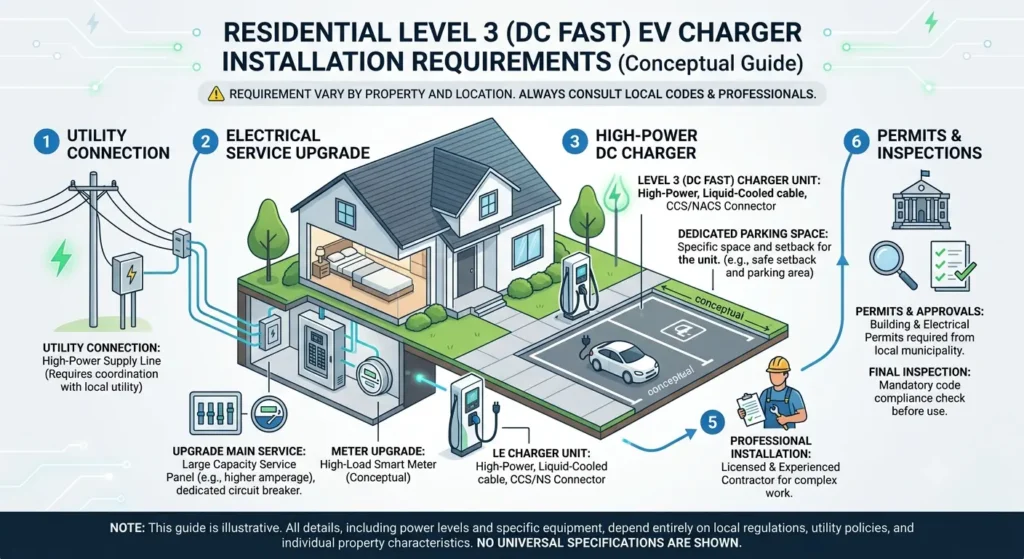
A Level 3 charger can technically be installed at some residential properties, but it’s far more complicated and expensive than installing a typical Level 2 home charger. Most households don’t need Level 3 charging because Level 2 can replenish overnight energy while the vehicle is parked.
The first question isn’t “Can I buy the charger?”
It’s “Can my property support the electrical and physical requirements?”
That distinction is easy to miss.
A high-powered DC charger may require electrical infrastructure that isn’t available at a typical home.
Even when installation is technically possible, the total project cost may be difficult to justify.
Why Most Homes Use Level 2 Instead
Most drivers don’t need to charge their EV from nearly empty to full in a short period at home.
The car usually sits parked for several hours.
That’s the perfect environment for Level 2 charging.
You arrive home after work, connect the vehicle, and leave it charging overnight.
By morning, you’ve added energy without making a separate charging stop.
Level 2 equipment is also generally simpler to install than a high-powered DC fast charger.
For daily driving, the convenience of overnight charging often outweighs the need for extremely high charging speed.
When a Home Level 3 Installation May Be Possible
There are situations where a residential DC fast charger could make sense.
A high-mileage driver may need rapid charging at home.
A private fleet operator could also have a reason to consider faster charging.
Large properties with suitable electrical infrastructure may have more options than a typical suburban home.
However, the feasibility depends on the site.
Electrical service, equipment location, utility requirements, permits, space, and local regulations all matter.
A qualified professional should assess the property before you purchase equipment.
Space, Electrical Infrastructure and Cost Considerations
The equipment itself is only one part of the project.
You also need to consider electrical upgrades, installation labour, trenching, switchgear, permits, and potential utility work.
The total cost can vary dramatically.
A site that already has suitable electrical capacity may be easier to develop than one requiring major infrastructure upgrades.
That’s why online estimates should be treated as broad guidance rather than a guaranteed price.
Get a site-specific quote.
What to Ask an Installer Before Choosing DC Fast Charging
Ask the installer:
– What electrical service does my property have?
– What power level can the site support?
– Will the utility need to upgrade the connection?
– What permits are required?
– Where will the equipment be installed?
– What ongoing maintenance will be needed?
– Is Level 2 sufficient for my actual driving needs?
That last question matters.
If Level 2 can comfortably meet your daily energy requirements, the simpler system may be the better choice.
Level 3 EV Charger Connector Types and Compatibility
Level 3 charging connectors vary by region and vehicle. North American drivers may encounter NACS or CCS1, while drivers in the UK, Europe, and Australia commonly encounter CCS2 for DC fast charging and Type 2 for AC charging. Always check your specific vehicle and market.
Connector terminology can be confusing because charging standards have changed over time.
The most important thing is to identify which connector your EV supports for DC fast charging.
A charging station may have multiple connector options, but that doesn’t mean every EV can use every cable.
NACS and DC Fast Charging in North America
NACS is increasingly used for DC fast charging in North America.
Drivers should still check their specific vehicle and model year because connector availability and compatibility vary.
Some vehicles use NACS directly, while others may use CCS1 or support access through an approved adapter.
The practical rule is simple.
Before planning a road trip, confirm that your EV can physically connect to the charging network you intend to use.
Also check whether your vehicle has the necessary software or adapter support.
CCS1 in North America
CCS1 has been widely used for DC fast charging in North America.
It combines AC charging contacts with additional DC charging pins.
Vehicles equipped with CCS1 can use compatible DC fast-charging stations.
The transition toward NACS means the North American charging landscape is changing, so EV buyers should check the charging connector fitted to the specific vehicle they’re considering.
CCS2 and Type 2 Charging in the UK, Europe and Australia
CCS2 is commonly used for DC fast charging in the UK, Europe, and Australia.
Type 2 is widely used for AC charging in these markets.
These standards shouldn’t be mixed with North American connector terminology.
If you’re researching an EV in the UK, EU, or Australia, focus on the connector standards used in your local market and the vehicle you’re buying.
How to Check Your EV’s Charging Compatibility
Start with the vehicle manufacturer’s specifications.
Check the owner’s manual and the manufacturer’s charging information.
You can also check the connector physically fitted to the vehicle.
Before a long trip, confirm:
– Connector compatibility.
– Maximum DC charging rate.
– Charging network availability.
– Payment requirements.
– Adapter requirements, if applicable.
– Whether the station is operational.
A little preparation can prevent a frustrating arrival at a charger you can’t use.
Level 3 Charging Speed: What Can Reduce It?
Level 3 charging speed can be reduced by cold weather, battery temperature, high state of charge, vehicle charging limits, charger power, and battery preconditioning. The maximum power listed on a charging station is therefore only one part of the real-world charging experience.
The biggest mistake is assuming that a charger advertised at a certain power level will deliver that power continuously.
Charging is dynamic.
The vehicle may start at a high rate and then gradually reduce power.
Cold Weather and Battery Temperature
Cold batteries generally don’t accept high charging power as readily as batteries operating within a suitable temperature range.
In winter, an EV may need time to warm the battery before accepting faster charging.
This can increase the time needed to reach a useful state of charge.
Some EVs can automatically precondition when you set a DC fast charger as a destination in the built-in navigation system.
If your EV supports this feature, using it can help prepare the battery for charging.
Battery State of Charge
Charging speed typically changes as the battery fills.
The lower portion of the battery may charge relatively quickly.
As the battery reaches a higher state of charge, the vehicle often reduces power.
For road trips, this is one reason experienced EV drivers don’t always wait for 100%.
Adding enough energy to reach the next reliable charger can be faster than waiting for the final portion of the battery.
Battery Preconditioning
Battery preconditioning adjusts the battery temperature to a more suitable level for charging or driving.
The exact system varies by EV.
Some vehicles automatically precondition when you select a compatible fast charger in the built-in navigation system.
Others may provide manual controls.
If you’re planning a fast-charging stop in cold weather, check how your vehicle handles battery preconditioning.
Charger Power vs Vehicle Charging Limits
A charger may advertise a high maximum output, but your EV may accept less.
For example, an EV with a lower maximum DC charging rate won’t automatically charge faster because it’s connected to a higher-powered station.
The vehicle’s charging limit still applies.
The reverse is also true.
A high-capability EV connected to a lower-powered charger will be limited by the station.
Why Claimed Charging Speed Isn’t Always Real-World Speed
Manufacturer charging claims often depend on specific conditions and battery ranges.
Your results can differ.
Weather, traffic, battery temperature, state of charge, and charger availability all affect the session.
Use official charging figures as a guide, not a promise.
Level 3 EV Charging Cost vs Level 2 Home Charging
Level 3 charging often costs more per unit of energy than home charging, but it provides something Level 2 can’t always offer, rapid energy delivery during a journey. The best choice depends on how much you drive, where you park, and how much you value charging time.
For daily use, home charging can be attractive because the vehicle is already parked.
You don’t need to make an extra trip.
You don’t need to wait.
You simply connect the car and continue with your routine.
Public DC fast charging has a different value.
You’re paying for speed and convenience during a trip.
Comparing Public DC Fast Charging With Home Electricity Costs
Home electricity rates vary significantly by location and tariff.
Public charging prices also vary by network and location.
Because of that, there’s no universal rule that every public fast charger costs a specific amount more than home charging.
The most useful approach is to compare your actual local rates.
Check your electricity bill or utility tariff.
Then compare it with the public charging network’s current price.
Remember to include additional public charging fees where applicable.
When Faster Charging Can Be Worth the Extra Cost
The value of Level 3 charging is highest when time matters.
Suppose you’re driving between cities.
You have a limited break before continuing.
A faster charging session may let you add enough energy to continue without a long delay.
That can be worth paying more than your home electricity rate.
For routine overnight charging, the same premium may not provide much benefit.
Your vehicle is already sitting there.
How to Keep Fast-Charging Costs Under Control
Use Level 3 charging strategically.
– Charge at home when practical.
– Compare network prices before long trips.
– Use membership plans only if the savings justify the subscription.
– Avoid unnecessary charging to 100% during road trips.
– Check for idle fees.
– Plan charging stops around your route.
The goal isn’t to avoid DC fast charging.
It’s to use it when its speed provides real value.
Level 3 EV Charger Comparison Table: Level 1 vs Level 2 vs Level 3
| Feature | Level 1 | Level 2 | Level 3 |
|—|—|—|—|
| Power type | AC | AC | DC |
| Typical location | Home | Home and public | Public |
| Charging speed | Slowest | Faster | Fastest common public option |
| Installation | Usually simplest | Moderate | Complex |
| Best for | Low daily mileage | Daily charging | Road trips |
| Typical cost model | Home electricity | Home or public electricity | Public network pricing |
| Overnight charging | Yes | Yes | Usually unnecessary |
| Long-distance travel | Less practical | Useful at destinations | Highly useful |
| Home installation | Common | Common | Uncommon |
The table shows why no single charging level works for every driver.
Level 1 can be enough for someone with low daily mileage.
Level 2 is often the best fit for home charging.
Level 3 is most valuable when you need to add energy quickly.
Practical Tips for Using a Level 3 EV Charger
Plan Around Your Vehicle’s Charging Curve
Don’t plan every charging stop around reaching 100%.
Check your EV’s charging curve if reliable data is available.
A shorter stop at a lower state of charge may add useful energy faster than waiting for the battery to fill completely.
Precondition the Battery When Supported
If your EV supports battery preconditioning, use the feature when appropriate.
Follow the manufacturer’s instructions.
This can help the battery reach a suitable temperature before a DC fast-charging session.
Charge Only as Much as You Need for the Next Leg
Road trips are easier when you think about the next charging stop.
You don’t always need maximum battery percentage.
Consider the distance to your next reliable charger, expected weather, driving conditions, and a sensible reserve.
Check Charger Availability Before Arriving
A station can be busy, offline, or temporarily unavailable.
Check the network app or another reliable source before committing to a route.
For important trips, identify a backup charging location.
Avoid Treating DC Fast Charging as Your Only Charging Method
If you have access to home or workplace charging, use it for routine energy needs.
DC fast charging is a useful tool.
It doesn’t have to be your default charging method every day.
Common Level 3 Charging Mistakes and How to Fix Them
Mistake: Assuming Every EV Charges at the Same Speed
Fix: Check your specific EV’s maximum DC charging rate and real-world charging curve.
The charger may be capable of high power, but your vehicle controls how much energy it accepts.
Mistake: Confusing Charger Power With Actual Vehicle Speed
Fix: Look at the vehicle’s charging capability as well as the station’s output.
A high-powered station doesn’t guarantee maximum speed for every EV.
Mistake: Ignoring Battery Temperature
Fix: Learn how your vehicle handles battery preconditioning.
Cold weather can affect charging performance, particularly when the battery hasn’t been warmed through driving or preconditioning.
Mistake: Waiting for 100% at a Fast Charger
Fix: Consider whether you actually need a full battery.
The charging rate often drops as the battery fills, so continuing to 100% can add considerable waiting time.
Mistake: Assuming Home Level 3 Charging Is Simple
Fix: Get a professional site assessment first.
Electrical capacity, utility requirements, permits, equipment, and installation complexity can make residential DC fast charging very different from installing a typical home Level 2 charger.
Frequently Asked Questions About Level 3 EV Chargers
How Fast Is a Level 3 EV Charger?
A Level 3 EV charger can charge much faster than Level 1 or Level 2 equipment, but actual speed varies by vehicle, charger output, battery temperature, and state of charge. The vehicle may also reduce charging power as the battery fills. Check your EV’s charging specifications for the most useful estimate.
Is Level 3 Charging the Same as DC Fast Charging?
In common EV terminology, Level 3 charging generally refers to DC fast charging. The terms are often used interchangeably, although naming conventions can vary by region and charging provider. The key difference is that DC fast charging supplies direct current through high-powered equipment, allowing much faster charging than typical AC charging.
How Much Does Level 3 EV Charging Cost?
Level 3 charging costs vary by network, location, electricity prices, payment method, and billing structure. Some providers charge by kilowatt-hour, while others may use time-based or session-based pricing. Check the current price before charging, and remember that additional fees or membership rates may apply.
Can You Install a Level 3 Charger at Home?
Some residential properties may technically support a Level 3 charger, but installation is much more complex than installing Level 2 equipment. Electrical service capacity, utility requirements, permits, space, and equipment costs all need to be considered. For most households, Level 2 charging is the more practical home solution.
Is Level 3 Charging Bad for an EV Battery?
Using DC fast charging as designed by the vehicle manufacturer isn’t automatically harmful to the battery. However, frequent high-power charging can affect battery aging differently from slower AC charging, depending on the vehicle and battery system. Modern EVs use battery management systems to control charging and protect the battery.
Is Level 3 Charging Faster Than Level 2?
Yes. Level 3 charging is designed to deliver significantly more power than Level 2 charging, making it much faster for adding energy during road trips. The actual difference depends on the specific EV and chargers involved. Your vehicle’s maximum charging capability can limit the speed even at a high-powered station.
What Is the Difference Between Level 3 and DC Fast Charging?
Level 3 and DC fast charging are commonly used to describe the same general category of high-powered EV charging. The terminology can vary between markets and charging providers. In practical terms, the important point is that this charging method supplies DC power at much higher rates than typical Level 1 and Level 2 AC charging.
How Often Should You Use a Level 3 EV Charger?
There’s no universal schedule for DC fast charging. Use it when the speed is useful, such as during long trips or when you need to add energy quickly. If you have convenient home Level 2 charging, that can handle much of your routine charging. Follow your vehicle manufacturer’s charging guidance.
Conclusion: Is a Level 3 EV Charger Right for You?
A Level 3 EV charger is one of the most useful tools for long-distance electric driving because it can add substantial energy much faster than Level 1 or Level 2 charging. The actual speed depends on your EV, the charging station, battery temperature, and state of charge.
For most drivers, Level 2 charging remains the practical choice for home use, while DC fast charging fills the gap when you’re traveling or need energy quickly.
Before choosing an EV, check its DC charging capability as well as its official driving range. If you regularly take long trips, charging speed and charging curve can have a major effect on how long you spend at public charging stations.
Your next step is to check your EV’s maximum DC charging rate, identify the connector it uses in your market, and compare the charging networks along the routes you drive most often.
EV charging time → How Long Does It Take to Charge an Electric Car?
EV charging cost → How Much Does It Cost to Charge an Electric Car?
home EV charger → Best Electric Car Charger for Home
EV charging guide → EV Charging Guide
EV battery lifespan → How Long Do EV Batteries Last?