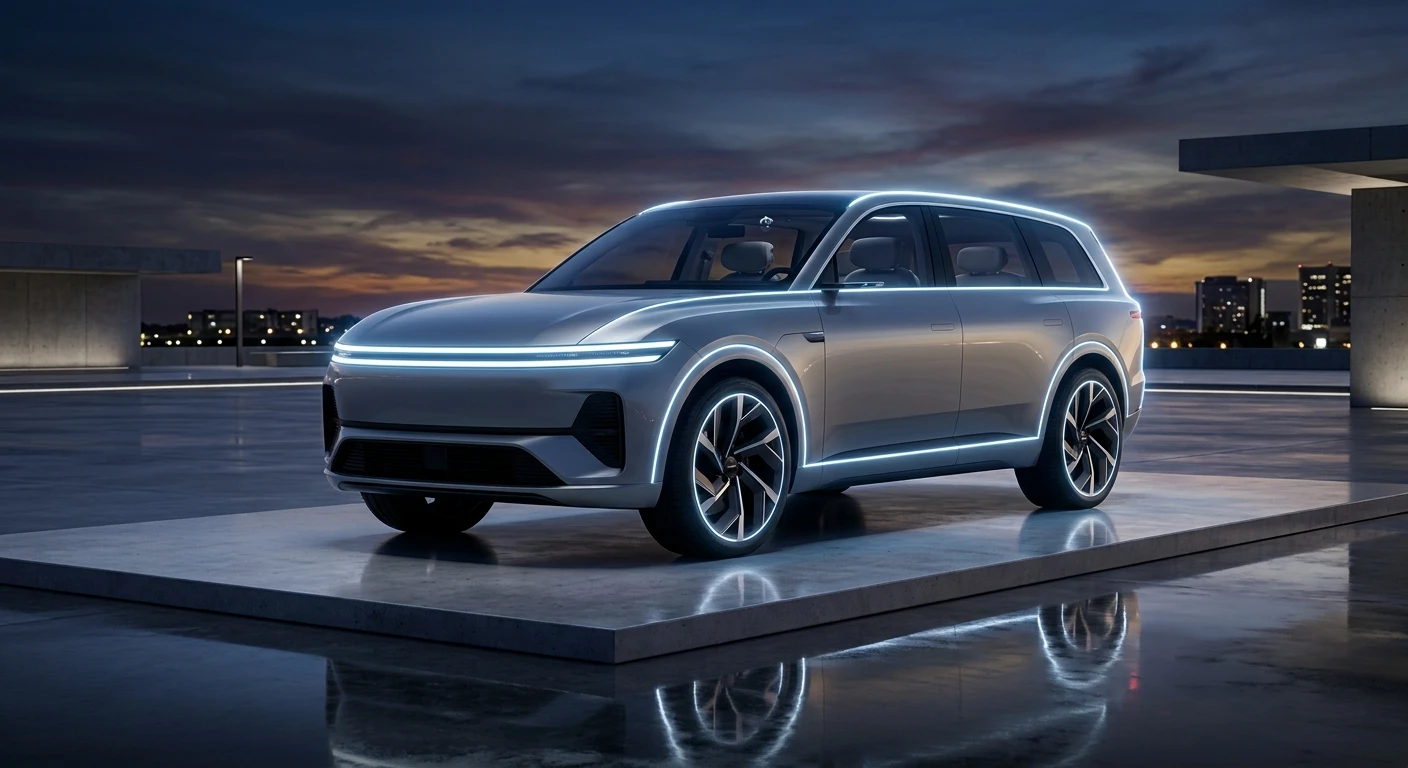
Every few years, a luxury brand attempts a statement car — the vehicle that announces it’s done climbing and intends to lead. For Genesis, Hyundai’s luxury division, that car is the GV90: a full-size, three-row electric SUV with concept-car theatrics headed for production, including the feature that has the internet’s full attention — B-pillarless coach doors on a modern SUV.
The Genesis GV90 is the brand’s upcoming flagship: a full-size, three-row luxury electric SUV previewed by the Neolun Concept, with its official debut confirmed for September 9, 2026. It’s expected to ride on a next-generation EV platform with a battery over 100 kWh, offer optional rear coach doors on top versions, and start around $100,000 in the US as a 2027 model — positioning it against the Mercedes EQS SUV, Cadillac Escalade IQ, and the upcoming Range Rover EV.
Because the GV90 sits weeks from its reveal as this is written, this guide separates three things with unusual care: what Genesis has confirmed, what credible reporting expects, and what remains speculation. You’ll get the full picture — the doors, the platform, the delayed launch saga, the price logic, and the honest advice on whether this is a car worth waiting for — without the wishful blur that fills most pre-launch coverage.
What Is the Genesis GV90?
The GV90 is Genesis’s first full-size SUV of any kind — electric or otherwise — and the vehicle designated to take over flagship duties for the entire brand.
That’s a bigger deal than one more model launch. Genesis arrived in the US in 2015 as a value-forward luxury play and spent a decade methodically earning design credibility, award-winning interiors, and a real foothold against the German establishment. What it never had was a standard-bearer above the GV80 — the halo vehicle that defines what the badge means at the top. The GV90 is that car, sitting above everything else Genesis builds and, tellingly, launching as an EV rather than another combustion flagship. The brand is planting its most important flag on electric ground.
Its public preview was the Neolun Concept, unveiled in New York in March 2024 — a monolithic, startlingly clean full-size SUV built around what Genesis calls “reductive design”: minimal lines, a wraparound interpretation of the brand’s two-line lighting signature, and those dramatic B-pillarless coach doors that open opposite each other to expose the entire cabin like a lounge. The production GV90 translates that concept, and the credible reporting since suggests the translation is closer than concept-to-production usually gets.
Size-wise, expect true full-size dimensions — larger than the GV80, with three rows and the presence to park beside an Escalade without apologizing. This is the class where luxury SUVs carry chauffeurs as often as drivers, and the GV90’s whole design brief reads accordingly.
Release Date: The September 9, 2026 Debut — and the Delay Behind It
Here’s the confirmed timeline, including the part most coverage glosses over.
The GV90 was originally expected to reach production earlier — but the program was delayed due to what was described as “unresolved technical challenges,” pushing the schedule back and leaving the launch window uncertain through much of the past year. That fog lifted in mid-2026: Genesis confirmed the GV90’s official launch for September 9, 2026, with the unveiling anchored in its home Korean market first.
For other markets, the realistic sequence follows the standard Genesis playbook: Korean sales open first, with the US arrival expected as a 2027 model — meaning deliveries on American driveways land months after the September debut, with exact timing, trims, and specifications firming up between now and then. European availability remains unconfirmed and historically follows even later in Genesis rollouts, where the brand’s footprint is still growing.
The delay deserves one honest paragraph rather than a euphemism. Flagship EV programs across the industry have hit schedule slips — software complexity, new-platform validation, and battery supply have humbled nearly every automaker’s timeline. A delay to resolve technical issues before customer deliveries is, bluntly, the correct order of operations; the launches that should worry buyers are the ones that ship first and patch later. Even so, it’s a data point: this is a first-generation vehicle on new technology, and first-year buyers of any such vehicle — from any brand — are volunteering for the shakedown cruise. We’ll return to that in the buying advice.

Genesis GV90 Price: What “Around $100,000” Actually Means
No official pricing exists yet — treat every number here as informed expectation, to be verified at launch.
The reporting from Korea sketches the range: a standard GV90 around 100 million won (roughly $65,000–$70,000 in Korea’s market), with the coach-door flagship versions reported to reach 200 million won — about $130,000. Translating Korean pricing to US MSRPs is never one-to-one (taxes, spec levels, and market positioning all shift), and the consistent expectation from credible outlets is a US starting price around $100,000 for the 2027 model, climbing meaningfully for the theatrical top trims.
That positioning tells you exactly which fight Genesis picked. Around and above $100K sits the Mercedes EQS SUV, the Cadillac Escalade IQ, the BMW iX at its upper reaches, and the incoming Range Rover EV — with the Maybach EQS SUV and ultra-luxury territory hovering above the coach-door versions. Genesis’s brand history says it will undercut the Germans spec-for-spec while out-theatering them on design; that’s been the playbook since the first G90 sedan, and there’s no signal the GV90 breaks from it.
Worth flagging for value-minded readers: this pricing places the GV90 roughly $40,000 above the mechanically related Hyundai Ioniq 9 — the excellent three-row EV from the same corporate group that we covered in our full Ioniq 9 review. Part of this guide’s job is helping you decide whether the GV90’s luxury delta is worth that gap; the comparison section takes it head-on.
The Coach Doors: The Feature Everyone’s Searching For
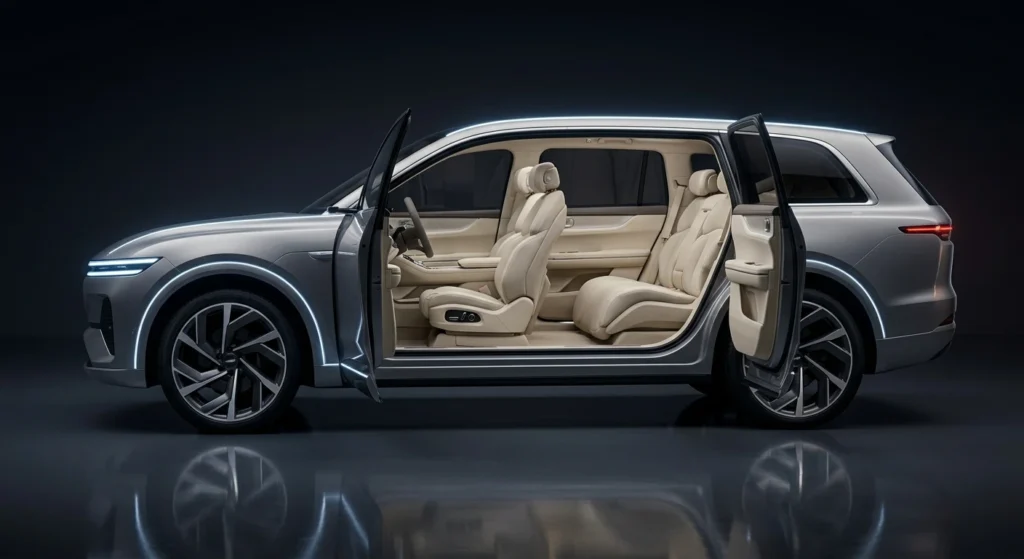
The GV90’s signature party trick deserves its own section, because it’s both more real and more limited than the viral renders suggest.
What they are. Coach doors — rear doors hinged at the back, opening opposite the fronts — with no fixed B-pillar between them. Swing both open and the cabin presents itself as one uninterrupted opening, the effect Rolls-Royce has monopolized for decades and the Neolun Concept wore spectacularly. Beyond theater, the practical case is genuine: entry and exit become graceful rather than gymnastic, which matters enormously in the chauffeur-driven markets this car courts and for anyone who’s helped an elderly parent out of a third row.
The engineering behind them. Removing the B-pillar removes the structure that conventional SUVs rely on for side-impact protection and roof strength — which is why the feature is vanishingly rare. Hyundai Motor Group has filed patents around reinforcing door and body structures to deliver pillarless strength without the pillar, effectively relocating crash structure into the doors and surrounding body. It’s a serious, expensive engineering commitment — and a reminder that this feature exists at this price point for a reason.
The crucial expectation to set. Reporting consistently indicates coach doors will not be standard across the GV90 range: expect them on limited flagship or special-edition versions, with standard front-hinged rear doors on the volume trims. If the coach doors are your reason for wanting this car, you’re shopping the top of the range — likely the six-figure-plus end — and possibly a limited-allocation model. The render-fueled assumption that every GV90 opens like a Phantom is the first misconception this article exists to correct.
Design: From Neolun Concept to Production
Genesis design chief credibility is on the line with this translation, and the signals so far suggest confidence.
The Neolun’s exterior language — the “reductive” monolith, surfaces calm enough to read as sculpture — is expected to survive substantially intact. The brand’s two-line lighting signature evolves here into its most elaborate form: elongated to wrap around the wheel arches, with the lower line descending into a V-shaped motif standing in for a traditional grille, since an EV needs none. Reporting points to micro lens array (MLA) headlamp technology enabling remarkably thin lighting housings — the kind of detail that separates flagship execution from trim-level styling.
Functional theater joins the visual kind: electric side steps are expected to deploy for entry — practical on a vehicle this tall, ceremonial in effect, and another cue borrowed from the ultra-luxury tier above. Spy shots of camouflaged prototypes testing on public roads through development have consistently shown the concept’s proportions holding: long wheelbase, upright stance, minimal overhang drama.
Expect the production reveal to soften some concept jewelry — that’s universal — but the GV90’s design bet is unmistakable: while German rivals iterate familiar shapes, Genesis is betting a decade of design-award momentum that restraint reads as richer than aggression in this class. September 9 settles whether the bet lands.
There’s also a color-and-materials dimension worth previewing, because Genesis has signaled it matters here. The Neolun leaned into warm, architectural tones — creams, coppers, deep matte finishes — rather than the black-on-black default of the German flagship aisle, and the brand’s recent limited editions have paired restrained exteriors with genuinely adventurous cabin palettes. If that carries to production, the GV90’s configurator could be part of the product’s appeal in itself: at this tier, the ability to specify something that doesn’t look like every other executive transport in the valet line is a real differentiator, and one the incumbents have been strangely timid about. Bring opinions to the order sheet.
Platform, Battery, and Range: What the Next Generation Promises
This is the section with the widest confirmed-to-expected gap, so the framing matters: Genesis has revealed little officially, and the following reflects credible reporting on the program.
The GV90 is expected to debut on Hyundai Motor Group’s next-generation EV platform — the successor architecture to the E-GMP platform underpinning the Ioniq 5, Ioniq 9, and Kia’s EV lineup. The group has indicated the new platform family could deliver up to a 50% improvement in driving range versus earlier E-GMP vehicles — a claim worth holding loosely until production specs land, but one that signals the ambition level.
Concretely, expectations center on a battery pack exceeding 100 kWh and a range comfortably beyond 300 miles, with the group’s signature 800-volt-class ultra-fast charging carrying over — the technology that makes its current EVs among the fastest-charging on sale, capable of 10–80% sessions in the mid-20-minute range on suitable hardware. Given the group’s charging pedigree (and the NACS transition reshaping North American fast charging), it would be genuinely surprising if the flagship arrived with anything less than class-leading charging performance.
Powertrain details — motor counts, output figures, whether a performance variant launches alongside — remain unannounced. The class norm (dual-motor AWD standard, 500+ horsepower available) is the safe expectation, but that’s inference, not information. What the platform generation does reliably promise: the flat-floor packaging, V2L power-sharing, and battery preconditioning that define the group’s EV engineering — foundations we’ve detailed across our EV battery and charging guides.
The honest bottom line: the GV90’s hardware story is currently a strong platform pedigree plus credible reporting, and it hardens into spec-sheet fact on September 9. Any article quoting exact GV90 horsepower or EPA range today is guessing; this one won’t.
Interior and Technology: The Lounge Brief
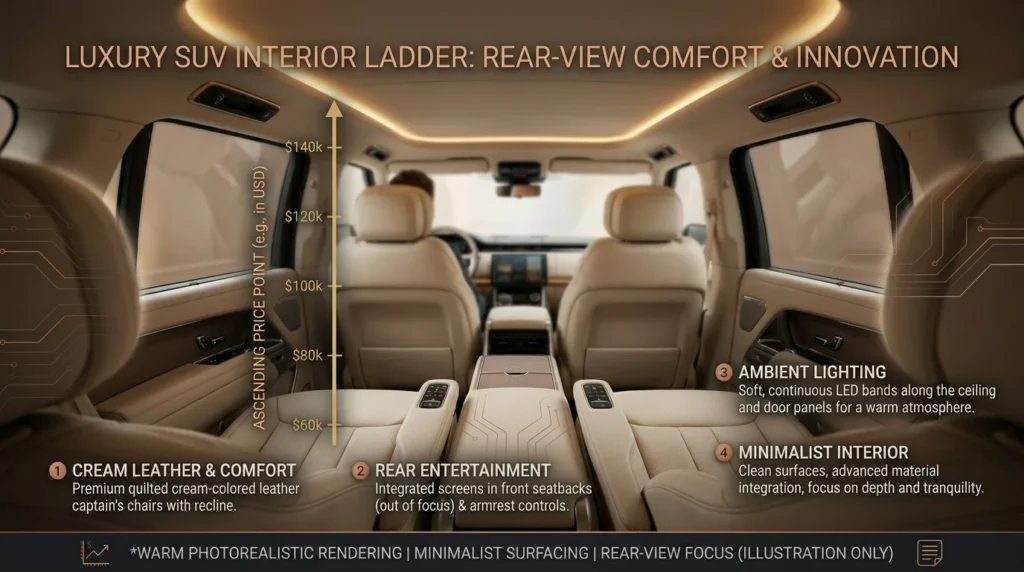
If the exterior whispers, the cabin is where a Genesis flagship traditionally shouts — quietly, in cashmere.
The Neolun Concept’s interior previewed the direction: a lounge-first layout with swiveling seats, ambient architecture over dashboard clutter, and materials chosen for touch rather than gloss. Production cabins always retreat from concept purity, but the GV90’s brief is legible from its market: this is a vehicle designed to be ridden in as much as driven, which means the second row — not the driver’s seat — is where the flagship statement lives. Expect reclining, ventilated, massaging rear thrones on upper trims, generous captain’s-chair configurations, and the group’s full suite of screens and software in its most elaborate deployment.
Genesis interiors have been the brand’s most reliable overachievement for years — routinely rated against cars costing far more — and the GV90 is the first time that skill gets a full-size, six-figure canvas. Technology expectations follow the group’s current best: expansive display real estate, over-the-air updates, digital key, and the complete driver-assistance suite as standard, per Genesis’s established equipment philosophy across the current Genesis EV lineup.
Until the reveal, specifics stay expectations. But the pattern from every recent Genesis launch — under-promise the cabin, over-deliver it — is the best available predictor.
Genesis GV90 vs the Flagship Field
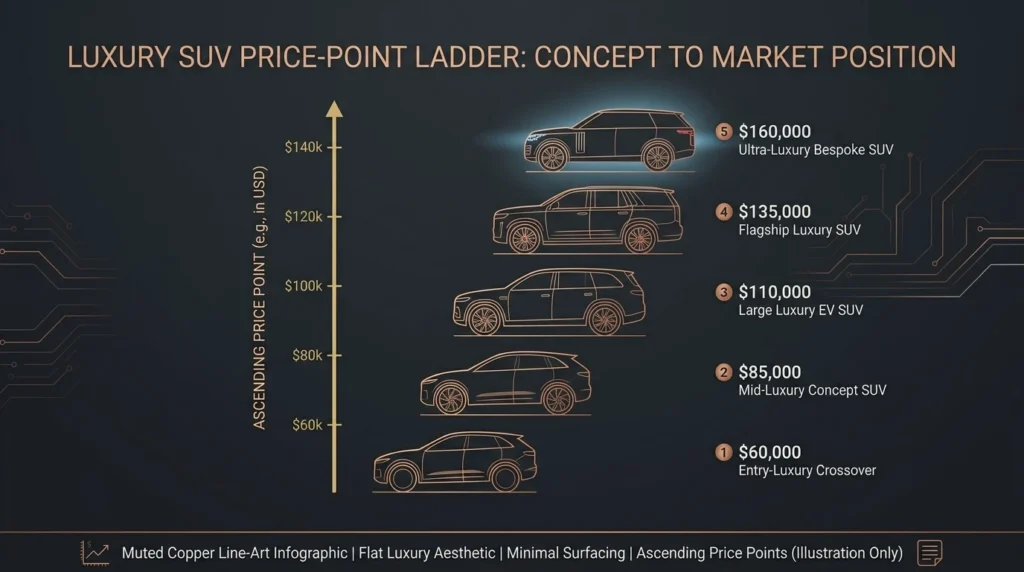
The GV90 enters the thinnest-aired segment in the EV market. Here’s the field it must beat, with the honest state of each:
| Genesis GV90 (expected) | Mercedes EQS SUV | Cadillac Escalade IQ | Range Rover EV | Hyundai Ioniq 9 (value check) | |
|---|---|---|---|---|---|
| Positioning | New flagship, design-led | Established, tech-led | American presence, huge battery | Heritage badge, arriving | Premium value, same group |
| Approx. starting price | ~$100,000 (expected) | ~$105,000+ | ~$130,000 | TBD (expected six figures) | ~$60,500 |
| Three rows | Yes | Yes | Yes | Yes | Yes |
| Signature feature | Coach doors (top trims) | Hyperscreen cabin | Scale + 55-inch display | Badge + off-road pedigree | Charging speed + value |
| Status | Debuts Sept 2026 | On sale | On sale | Launching | On sale |
Figures are approximate and shift with model years; verify current pricing when you shop.
The strategic read: the Germans sell established tech, Cadillac sells presence, Range Rover sells heritage — and Genesis is betting that design theater plus the group’s charging superiority plus a relative-value price carves a lane between them. It’s the same formula that made the GV80 a legitimate German-fighter, executed one class higher.
And the value check in the last column is deliberate. The Ioniq 9 shares corporate DNA and the three-row EV mission at roughly 60% of the expected price. What the GV90 buys over it is genuine — flagship materials, the design statement, the badge trajectory, likely more power and newer platform tech — but every GV90 shopper owes themselves one honest hour with that comparison before signing. Our best luxury electric SUVs ranking maps the full territory between them.
Where the GV90 Fits in the Genesis Electric Lineup
For readers arriving via the badge rather than the model: the GV90 caps an electric range Genesis has been assembling since 2021.
Genesis GV60 — the compact crossover and the brand’s first dedicated EV, on the group’s E-GMP platform with its 800V charging. The entry point, and still one of the segment’s most distinctive designs.
Electrified GV70 — the electric version of the brand’s volume SUV; conventional-looking, seriously quick, and the stealth pick of the lineup.
Electrified G80 — the electric flagship sedan experience, soon to hand the overall flagship title upward.
GV90 — the new summit: first full-size model, first of the next platform generation, and the vehicle that defines what Genesis means by “flagship” for the electric era.
The trajectory matters more than the roster: Genesis converted from a combustion upstart to a brand whose halo product is electric in under five years — among the fastest such pivots in the luxury tier. For buyers, that translates into a practical benefit: the GV90 doesn’t arrive as a first EV experiment but as the fourth act of an experienced program, inheriting proven charging architecture, software, and battery management from millions of group-wide EV miles. First-generation model, yes; first-generation company, no.
Living With Coach Doors: The Questions Nobody Asks Until They Own Them
Since the doors are the search query bringing many readers here, they deserve the full ownership-reality treatment — the considerations that follow the theater home.
Parking geometry changes. Rear-hinged doors sweep backward, which transforms how the car occupies a parking space. Tight parallel spots that a conventional door handles with a careful squeeze can pin a coach door against the car behind; conversely, the pillarless opening makes curbside chauffeur stops more graceful than anything with a B-pillar. Expect the production car to manage this electronically — powered operation, obstacle sensing, and opening-angle limits are the established solutions in the segment above — but the geometry itself is physics, and urban owners should think through their daily parking reality before optioning the feature.
Child seats and family logistics get easier, mostly. The unobstructed opening is genuinely transformative for installing child seats and loading small passengers — no pillar to work around, no contortion. The flip side: rear-hinged doors and self-managing children require house rules, since a door that opens into traffic flow behaves differently from one that opens against it. Powered soft-close operation, near-certain at this price, resolves most of it.
Wind, weather, and the pillarless question. Removing the B-pillar historically cost cabins some structural hush at speed — which is precisely what those Hyundai reinforcement patents exist to solve, relocating stiffness into the doors and sills. The measure of the GV90’s engineering won’t be whether the doors open dramatically; it’ll be whether the cabin at highway speed is indistinguishable from a pillared one. That’s a test-drive item, and one worth performing on the highway, not the dealership loop.
Insurance and repair reality. Doors that carry crash structure are, by definition, more expensive doors. A parking-lot ding on a structural coach door is a different repair event than on a conventional panel, and insurers will price the hardware accordingly. None of this is disqualifying at the flagship tier — Rolls-Royce owners have accepted it for decades — but it belongs in the ownership budget conversation, alongside the premiums our luxury EV ownership coverage flags across the class.
The honest summary: coach doors are a genuine daily-luxury upgrade for driveway-and-chauffeur lifestyles, and a considered trade-off for tight-city ones. Knowing which lifestyle you’re buying for is the whole decision.
The Bigger Bet: What the GV90 Means for Genesis — and Why That Matters to Buyers
A flagship launch is a brand telling you its ten-year plan. Reading the GV90’s tea leaves is unusually useful for anyone about to hand the brand six figures.
The residual-value question every luxury EV buyer should ask — will this badge hold prestige? — turns on trajectory, and Genesis’s is unambiguous: design awards accumulating annually, US sales climbing across a decade, and now a flagship program ambitious enough to attempt features only Rolls-Royce ships. Brands investing at this level are playing for permanence, which is the best available (if imperfect) signal for long-term value retention. The counterweight is honest too: Genesis still lacks the German brands’ decades of flagship-resale history, and first-generation flagships from any maker depreciate on the steep end of the curve. Buyers planning three-year cycles should lease the uncertainty rather than own it; ten-year keepers can care less.
The dealer-experience dimension deserves a paragraph luxury reviews usually skip. Genesis has been building out standalone showrooms and concierge-style service — valet pickup for maintenance among them — but coverage density still varies sharply by region, and a six-figure ownership experience is only as good as its nearest touchpoint. The pre-purchase homework writes itself: locate your servicing point, ask precisely how flagship-EV service and coach-door bodywork will be handled, and weigh the answer as heavily as any spec. The same geography rule we’ve documented across EV ownership applies double at the flagship tier, where expectations are highest.
And the platform-generation timing cuts in buyers’ favor. Arriving as the first vehicle of the group’s next architecture means the GV90 inherits the lessons of millions of E-GMP miles — the charging curves, thermal management, and battery durability record that made the group’s EVs benchmarks — while resetting the ceiling above them. First vehicle on a new platform is normally a risk flag; first vehicle on a new platform from the industry’s most successful EV-platform operator is a substantially better bet. It doesn’t erase first-year diligence. It does explain why expectations for this particular launch run as high as they do.
Should You Wait for the GV90?
The question every luxury three-row shopper reading this is actually asking. The honest matrix:
Wait for it if: the design and coach-door theater speak to you specifically; you want the newest platform generation rather than the current one; your timeline tolerates the US arrival window (2027 model-year reality); and you’re comfortable with flagship pricing on a first-year vehicle. The GV90 is shaping up to be the most interesting entry in its class, and for statement-car buyers, interesting is the product.
Buy the field instead if: you need the vehicle within months (the EQS SUV and Escalade IQ exist today, and discount pressure on established rivals typically intensifies right as a hyped newcomer lands); you prioritize proven first-model-year reliability over novelty — a theme our EV reliability coverage keeps confirming across brands; or the value math keeps pulling you toward the Ioniq 9 with $40,000 left over for, well, anything.
The middle path most shoppers should consider: let the September 9 reveal convert this article’s “expected” into “confirmed,” watch the first-delivery reviews out of Korea, and decide with full information — which, given US timing, costs you almost nothing. Patience is unusually cheap here.
Practical Tips
- Calendar the September 9, 2026 debut. Pricing, specs, and trim structure land then; every pre-launch assumption in the market — including this guide’s — gets graded that day.
- If the coach doors are the draw, budget for the top of the range and ask about allocation early. Limited-availability flagship versions of hyped vehicles sell out on deposit lists, not showroom floors.
- Register interest with a dealer now, spend nothing yet. Early hand-raisers get launch allocations; deposits before final specs exist are for the theater-committed only.
- Price the field the week the GV90 launches. Newcomer hype is historically the best moment to negotiate on the incumbents it targets.
- Do the Ioniq 9 test drive even if you’re sure. Same group, same mission, colossal price gap — certainty that survives that drive is real certainty.
- If you buy the first model year, buy it knowingly. Delayed-for-technical-reasons programs deserve some credit for shipping right rather than fast — and first-year flagship buyers should still expect software maturation via OTA updates as part of the deal.
Common Mistakes to Avoid
Assuming every GV90 gets coach doors. The defining misconception. Reporting points to limited flagship versions; volume trims are expected to carry conventional doors. Verify trim-by-trim at reveal before falling for the renders.
Treating expected specs as confirmed. Battery size, range, power, and US pricing remain reported expectations until September 9. Any purchase math built on “over 100 kWh and 300+ miles” needs re-running against the actual sheet.
Ignoring the launch-market sequence. Korean debut and sales come first; US cars follow as 2027 models. Shoppers who miss this plan their driveway timeline a season early.
Comparing launch-hype pricing against undiscounted rivals. The established competition negotiates; the new arrival won’t. Compare transaction prices, not MSRPs, or the value picture distorts.
Writing off the delay — or over-weighting it. “Unresolved technical challenges” pushed this program back; that’s a real data point about complexity and a reassuring one about priorities. Neither panic nor dismissal is the informed response — first-year diligence is.
Skipping the group-sibling comparison out of badge pride. The Ioniq 9 shares the corporate parts bin and the three-row mission at a fraction of the price. The GV90’s premium may be entirely worth it to you — but that’s a conclusion to earn through comparison, not assumption.
FAQs
Genesis has confirmed the GV90’s official launch for September 9, 2026, debuting in its home Korean market first after an earlier delay for technical development. The US arrival is expected to follow as a 2027 model, meaning American deliveries land months after the debut, with final timing confirmed at launch.
Official pricing hasn’t been announced. Korean reporting points to roughly 100 million won for standard versions, with coach-door flagships reported near 200 million won (about $130,000). In the US, credible expectations center on a starting price around $100,000 as a 2027 model — to be verified when Genesis publishes official figures.
Top versions are expected to offer B-pillarless coach doors — rear-hinged doors opening opposite the fronts, previewed on the Neolun Concept and supported by Hyundai patents for pillarless structural strength. However, reporting consistently indicates they’ll be limited to flagship or special-edition trims, with conventional doors on standard versions.
The GV90 is expected to debut Hyundai Motor Group’s next-generation EV platform — the successor to E-GMP — which the group has suggested could improve driving range by up to 50% versus earlier EVs. Expectations include a battery over 100 kWh, 300+ miles of range, and the group’s signature 800-volt ultra-fast charging.
Yes — the GV90 is Genesis’s first full-size SUV, positioned above the GV80 in size, price, and mission, with three-row seating and flagship status for the entire brand. It takes over the range-topping role previously held by the G90 sedan.
The flagship electric SUV field: Mercedes EQS SUV, Cadillac Escalade IQ, and the arriving Range Rover EV, with coach-door versions brushing against Maybach territory. Within its own corporate family, the far cheaper Hyundai Ioniq 9 serves as the value alternative every GV90 shopper should at least drive.
The GV90 launches as a fully electric vehicle and serves as the flagship of Genesis’s EV lineup alongside the GV60, Electrified GV70, and Electrified G80. Genesis has explored range-extender technology at the group level for future products, but the GV90 as revealed is a battery-electric flagship.
Official seating configurations arrive with the September reveal, but as a full-size three-row flagship, expect six- and seven-seat layouts, with second-row captain’s chairs — likely reclining and massaging on upper trims — as the signature configuration. The Neolun Concept’s lounge-style, swiveling-seat cabin previewed the direction, though production versions typically simplify concept seating.
Verdict: The Most Interesting Car of the Fall — Pending One Reveal
Everything about the GV90 describes a brand swinging for permanence: a first full-size flagship, launched electric, wearing concept-car doors and a decade of design credibility, priced to shame the Germans it studies. If the September 9 reveal delivers the Neolun’s promise at the reported pricing, the flagship EV segment gets its most compelling new argument in years.
The disciplined take, though, is the one this guide has held throughout: the GV90 is currently a confirmed date, a credible expectation set, and a delayed program that chose to ship right rather than fast. That’s a genuinely promising combination — and an incomplete one, by exactly 27 days as this is written.
So here’s the practical next step: bookmark the debut, register interest if the theater calls to you, and spend one of the intervening weekends driving the Ioniq 9 and the current luxury electric SUV field. When the covers come off, you’ll be the rare shopper deciding with both the hype and the context — which is the only position worth negotiating from at $100,000.