

Important review note: The Telo MT1 is still an upcoming vehicle. Telo is accepting reservations and currently lists estimated pricing and specifications, while independent outlets have driven prototypes rather than a final customer-production truck. This review therefore separates Telo’s current claims, reported prototype experience, and verified current status. It does not present prototype driving as Go Electric Hub firsthand testing. Telo’s official build page also says price and specifications can change before reservation fulfillment.
Key Takeaways
The current Telo configurator lists the MT1 at $41,520 for single-motor rear-wheel drive and $46,019 for dual-motor all-wheel drive. The long-range battery is listed as a $3,980 option, giving buyers a 350-mile estimated range instead of the standard 260-mile estimate.
There is, however, an important caveat: the MT1 hasn’t reached normal customer production yet. Car and Driver says Telo has not delivered MT1s to customers and is targeting production by the end of 2026. Telo’s founders told InsideEVs that initial output will be intentionally low, with the company targeting about 500 vehicles in year one and 5,000 in year two before attempting larger-scale production.
Production Status
The MT1’s unusual packaging is its strongest selling point. Telo says it has the 60-inch bed length of a Toyota Tacoma, yet the whole truck is only 152 inches long. The bed can extend from 60 to 96 inches according to Telo’s specifications, using its folding mid-gate concept.
Independent prototype testing is encouraging but also shows what still needs work. MotorTrend drove a prototype and found convincing packaging and performance potential, while criticizing road and wind noise, ergonomics, ride refinement and the buttonless interior. Crucially, that vehicle was not production-spec.
So the Telo MT1 isn’t yet a normal “buy it today” electric truck.
It’s a highly interesting low-volume EV startup project that could become one of the most useful small electric pickups if Telo successfully moves from prototypes into compliant customer production.
What Is the Telo MT1?
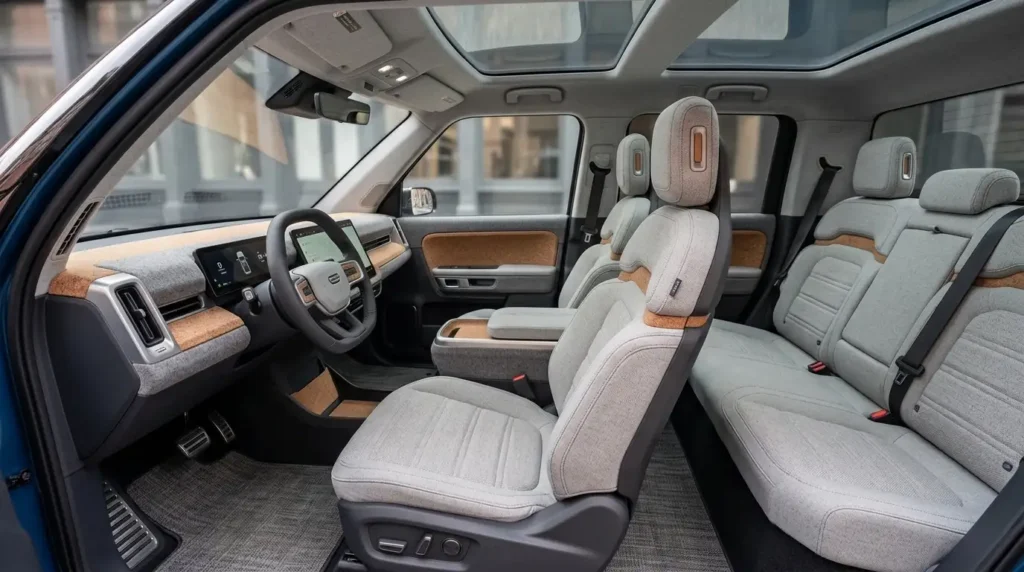
The Telo MT1 is a compact, four-door battery-electric pickup truck designed around a simple problem: traditional pickups have become too large for many urban environments.
Telo’s solution is extreme packaging.
The MT1 measures only:
152 inches long × 73 inches wide × 67 inches high.
That’s remarkably short for a four-door pickup.
Telo says the truck is roughly the same length as a two-door MINI Cooper while providing the interior space of a Toyota Tacoma and a 60-inch pickup bed.
The concept is therefore different from simply building a smaller version of a conventional American pickup.
Instead, Telo redesigned the vehicle around maximizing usable space inside a compact footprint.
That produces some unusual design decisions.
The front seats sit unusually far forward.
The battery is packaged underneath the passenger compartment.
The bed has a folding mid-gate that allows it to carry longer objects.
And the truck’s overall length stays short enough to make parking and maneuvering easier in dense cities.
The result is intended to be a vehicle that works for both daily urban driving and occasional truck duties.
Telo describes the MT1 as suitable for urban living and weekend use, while its commercial division also markets it for deliveries, contractors, municipal applications and job sites.
That dual role is important.
The MT1 isn’t supposed to compete only with other electric trucks.
It is also trying to compete with the idea that you need a huge pickup to have useful truck capability.
Why Is the Telo MT1 So Small?

The answer is packaging.
A conventional midsize pickup typically uses significant front-end space for an internal-combustion engine, transmission, cooling systems and associated hardware.
An EV doesn’t need all of that.
Telo therefore has more freedom to push the cab and other components into a smaller footprint.
The company uses the resulting space to create a four-door, five-seat truck with a comparatively long cargo bed.
Telo says the MT1 has a 60-inch bed while being only 152 inches long overall. The company’s current specification page lists a bed range of 60–96 inches, with the longer configuration made possible by the truck’s cargo-pass-through design.
This is arguably the MT1’s defining engineering feature.
It’s not about the horsepower, nor is it simply about the range. Instead, it’s the ability to put pickup-truck utility into an unusually small vehicle.
The Packaging Trade-Off
The downside is that extreme packaging leaves less room for error.
MotorTrend’s prototype drive found that front-seat room was reasonable even for a 6-foot-10-inch driver, but also noted that second-row legroom was limited.
That isn’t surprising.
A 152-inch truck can’t magically create the interior volume of a much longer vehicle.
Telo is using clever packaging to make the most of the available space, but the laws of physical dimensions still apply.
That means buyers should think about the MT1 as:
a compact truck with clever space utilization
rather than:
a midsize truck that somehow became physically smaller without compromise.
How Much Does the Telo MT1 Cost?
The current Telo MT1 price starts at $41,520 for the single-motor 2WD configuration on Telo’s build configurator.
The dual-motor AWD configuration starts at $46,019.
Those prices are current Telo-listed configuration prices, but they’re not necessarily final transaction prices.
Telo’s own build page says the price and specifications are subject to change before reservation fulfillment.
The reservation deposit is currently $152, and Telo describes it as fully refundable. The number is also tied to the MT1’s 152-inch overall length.
Current Telo MT1 Starting Prices
| Configuration | Current listed price | Drivetrain |
|---|---|---|
| MT1 Single Motor | $41,520 | 2WD / RWD |
| MT1 Dual Motor | $46,019 | AWD |
| Long-range battery | +$3,980 | 350-mile estimated range |
Source: Telo’s current build configurator.
One useful way to look at this is that Telo isn’t pricing the MT1 like a conventional premium startup vehicle.
The company is aiming for a relatively accessible starting price despite the unusual packaging and electric drivetrain.
But because production hasn’t reached normal scale, buyers should treat these numbers as current manufacturer-listed estimates, not a guarantee of the final delivered price.
Is the Telo MT1 Available Yet?
Not in the conventional sense.
Telo is currently taking reservations, but the MT1 has not yet been delivered to normal customers. Car and Driver currently says the truck is on track to enter production by the end of 2026.
Telo’s founders have provided a more cautious production strategy.
In an August 2026 interview with InsideEVs, CEO Jason Marks said Telo isn’t aiming for 100,000 vehicles in its first year. Instead, the company expects approximately 500 units in year one, followed by around 5,000 units in year two before scaling further.
That is a very different approach from launching immediately into mass-market production.
It also means early buyers should understand the normal startup risks:
- Production timing can change
- Specifications can change
- Pricing can change
- Homologation can take longer than expected
- Supplier schedules can change
- Service infrastructure is initially small
- Parts availability may be more limited than at established manufacturers
That doesn’t mean Telo will fail.
It means the buying decision is different from purchasing an established electric pickup from Ford, Rivian or Chevrolet.
How Is Telo Planning to Manufacture It?
Telo is taking a low-capital approach rather than building a giant factory immediately.
InsideEVs reports that Telo is hand-assembling early vehicles at its San Carlos, California headquarters, with a plan to start production at low volume and scale after proving the process.
Forbes reported that Telo plans to contract production of the MT1’s body to Michigan-based Schwab Industries while installing its battery and other components in San Carlos. Forbes also reported Telo’s intention to start around 500 vehicles and then reach a 5,000-vehicle annual run rate.
That approach reduces the enormous capital burden of building a conventional automotive factory.
But it also reinforces the fact that the MT1 should be considered an early-stage production vehicle, not a mass-market pickup.
What Is the Telo MT1 Range?
The Telo MT1 range is currently listed as:
- 260 miles estimated with the standard battery
- 350 miles estimated with the long-range battery
Telo’s current official site lists a 106-kWh battery and 350-mile estimated range for the long-range configuration. Its configurator lists the long-range battery as a $3,980 upgrade.
These are manufacturer estimates, not independently verified EPA range figures.
That’s an important distinction.
Telo is still moving toward production, and the final certified range may differ from the current estimate.
Car and Driver similarly describes the MT1 as having a claimed range as high as 350 miles.
260 Miles or 350 Miles?
For a small truck, 260 miles is already useful.
But the 350-mile version is the more compelling configuration for road-trip buyers.
The long-range battery costs another $3,980 according to Telo’s current configurator.
That makes the estimated-range upgrade approximately:
$3,980 ÷ 90 additional miles = $44.22 per additional estimated mile
That’s only a simple comparison of the manufacturer’s configuration price and range estimate.
It doesn’t mean that you’re literally purchasing “miles of range.”
Battery capacity, efficiency, weight and configuration all affect the final result.
Range Reality
Real-world range will depend on:
- Highway speed
- Temperature
- Payload
- Towing
- Tire selection
- Weather
- HVAC use
- Driving style
- Terrain
Towing can reduce EV range substantially, so buyers planning to use the MT1 as a working truck should not treat the 350-mile estimate as a towing-range figure.
What Battery Does the Telo MT1 Use?
Telo’s current official specifications list a 106-kWh battery for the MT1’s long-range configuration.
The battery is packaged to support the company’s compact architecture.
That helps Telo achieve the unusual combination of:
four doors + five seats + truck bed + small exterior dimensions.
The battery isn’t simply being used to maximize range.
It’s part of the packaging solution.
Telo’s battery architecture is one reason the company can keep the vehicle relatively short while still claiming a long driving range.
But again, the final certified battery specification should be treated as subject to change until customer-production vehicles are homologated.
Telo explicitly warns that its price and specifications can change before reservation fulfillment.
How Fast Does the Telo MT1 Charge?

Telo currently says the MT1 can charge from 20% to 80% in about 20 minutes.
That’s one of the most impressive claims attached to the vehicle.
The company has also discussed a high-voltage fast-charging architecture.
InsideEVs previously reported that Telo was targeting 400 kW sustained charging, while its August 2026 founder interview described the MT1 as using 800V charging.
However, Telo’s current public retail specification page does not present the 400-kW figure as prominently as its 20-to-80% time.
For that reason, the safest wording in a buyer guide is:
Telo currently claims approximately 20 minutes for a 20–80% charge, while the company has discussed an 800V/400-kW charging capability.
That’s different from saying an independently verified production truck has demonstrated 400-kW sustained charging.
Why This Matters
Charging speed could become one of the MT1’s biggest advantages.
A small electric truck is particularly attractive for urban owners, but fast charging makes it more practical for longer trips.
The ability to recover most of the battery in roughly 20 minutes would reduce one of the major inconveniences of EV road trips.
But the exact charging curve matters more than the peak number.
A charger delivering very high power for a few minutes isn’t necessarily better than a lower peak rate sustained over a larger part of the charging session.
That’s why Telo’s 20–80% time is the more useful buyer-facing figure.
Does the Telo MT1 Have NACS?
The U.S.-market MT1 has been associated with NACS charging, and current third-party reporting identifies NACS as the planned connector.
For U.S. buyers, that means the vehicle fits naturally into the current North American charging environment.
However, because Telo’s own current consumer specification page emphasizes charging time rather than providing a complete final connector specification, buyers should verify the exact connector and charging-network access before final vehicle delivery.
For this article, the market distinction matters:
United States: NACS context.
UK/EU: local-market charging specification must be confirmed; don’t automatically apply U.S. NACS information.
Australia: local-market availability and connector specification are not currently established from Telo’s official retail material reviewed for this article.
This also highlights an important issue with Telo’s current geographic market.
Can You Buy the Telo MT1 in the UK, Europe or Australia?
At present, the MT1 is primarily a U.S.-market vehicle.
Telo’s current reservation/configuration experience is built around U.S. customers and U.S. specifications. Its privacy notice says its services are intended for visitors located within the United States, while current European reporting says the MT1 is initially being commercialized in the United States and that Telo has not announced European availability.
That means:
USA
Relevant now.
Telo is taking reservations and preparing for production.
UK
No confirmed official retail launch established.
Don’t convert the U.S. price into pounds and present it as a UK MSRP.
Europe
No confirmed official European retail launch established.
A French automotive report states the MT1 is currently intended for the United States and that Telo has not announced European availability.
Australia
No confirmed official Australian retail launch established.
A U.S. price converted to Australian dollars would only be an exchange-rate estimate, not an Australian retail price.
This distinction is particularly important for Go Electric Hub because the target audience includes all four markets.
At present, the Telo MT1 is primarily a U.S. opportunity, while UK, European and Australian readers should treat it as an interesting future/import possibility rather than a confirmed local-market vehicle.
How Much Can the Telo MT1 Tow?
Towing figures are one of the areas where Telo’s current published information and founder comments need to be separated carefully.
Telo’s current official specification lists:
6,600 lb maximum towing
alongside:
2,000 lb payload.
But in August 2026, Telo CEO Jason Marks told InsideEVs that the company expects the MT1 to tow up to 8,000 lb.
Those are not the same thing.
Therefore this article should not state “the Telo MT1 definitely tows 8,000 pounds.”
The safer current conclusion is:
Telo’s official retail specification currently lists 6,600 lb towing, while company leadership has discussed an 8,000-lb target. Final certified capacity should be verified when production vehicles are homologated.
That distinction protects the accuracy of the article.
It also gives readers useful information without pretending the higher target is already certified.
Can a Tiny Truck Really Tow 6,600 Pounds?
That’s one of the questions the MT1 will have to answer in production.
The physical size is unusual, but the electric powertrain can produce substantial torque.
The bigger concerns are:
- Cooling
- Braking
- Chassis strength
- Payload while towing
- Trailer stability
- Range loss
- Certification
The final production vehicle will have to demonstrate that it can perform these duties safely and legally.
What Is the Telo MT1 Payload?
Telo currently lists 2,000 pounds of payload capacity.
That’s a strong figure for such a compact truck.
Payload includes more than cargo in the bed.
Depending on the applicable rating, the vehicle’s occupants and other load considerations can affect available payload.
That means buyers shouldn’t think:
“2,000 pounds in the bed.”
Instead, treat 2,000 pounds as the vehicle’s listed payload capability and check final production documentation for the exact certified limits.
For tradespeople and small businesses, this figure could be more important than peak horsepower.
A compact truck that can carry serious payload without requiring a full-size footprint could be genuinely useful.
How Big Is the Telo MT1?
The Telo MT1’s dimensions are a major part of its appeal.
Current Telo specifications list:
| Specification | Telo MT1 |
|---|---|
| Length | 152 in |
| Width | 73 in |
| Height | 67 in |
| Wheelbase | 111 in |
| Ground clearance | 10 in |
| Seating | 2–5 seats |
| Bed | 60–96 in |
| Payload | 2,000 lb |
| Towing | 6,600 lb listed by Telo |
Source: Telo official specifications.
Best Electric Car 2026
Telo MT1 vs Toyota Tacoma Size
Telo’s comparison is intentionally provocative.
The MT1 is roughly the length of a two-door MINI Cooper, while Telo says its usable interior and 60-inch bed are comparable to the Toyota Tacoma’s utility.
The point isn’t that the two trucks are dimensionally equivalent.
They’re not.
The point is that Telo is trying to deliver similar utility in a much smaller package.
That’s why the truck could be particularly attractive for:
- San Francisco
- Los Angeles
- New York
- Dense suburbs
- Small construction sites
- Urban delivery work
- Municipal fleets
A full-size pickup can simply be inconvenient in those environments.
What Is the Telo MT1 Bed Size?

The standard bed is listed at 60 inches, with Telo’s specification page showing a range of 60–96 inches.
That is made possible by the MT1’s flexible mid-gate design.
The rear portion of the cab can open into the bed so longer items can extend forward.
Telo has specifically talked about the ability to carry 8-foot-long objects with the folding mid-gate arrangement. InsideEVs reported that the company believes the design can combine a five-foot bed with the ability to carry long materials.
This is the kind of feature that could matter more than the truck’s acceleration.
A contractor doesn’t necessarily need a 3-second 0–60 time.
They need a truck that can carry:
- Lumber
- Pipes
- Ladders
- Tools
- Sheets
- Equipment
while remaining easy to park.
The MT1 is designed around that use case.
What Is the Telo MT1 Monster Tunnel?
The MT1’s packaging also creates additional storage opportunities.
One of the most notable features discussed around the truck is its long storage tunnel through the vehicle.
This concept uses the electric architecture to create cargo space that a conventional pickup with a combustion engine and conventional transmission wouldn’t package in exactly the same way.
The result is a vehicle that can carry bulky or long equipment without requiring a massive external footprint.
Again, the key benefit isn’t a headline number.
It’s space efficiency.
How Many Seats Does the Telo MT1 Have?
Telo’s current retail site lists the MT1 as a four-door, five-seat vehicle, with its specifications showing 2–5 seat configurations.
The early prototype program also included discussion of a possible third-row arrangement.
MotorTrend reported that Telo had considered an optional third row, but the publication questioned whether squeezing that many people into such a short vehicle made sense.
That’s worth separating from the current product.
The current core MT1 specification is a five-seat pickup.
The optional third-row concept should not be presented as a confirmed mainstream production feature.
For buyers, five seats is the more useful assumption until Telo confirms otherwise.
What Is the Telo MT1 Interior Like?
Telo has clearly tried to avoid making the MT1 feel like a stripped commercial vehicle.
The company’s official site describes the cabin as minimalist and uses natural fabrics and a design-focused interior.
Independent prototype impressions were mixed in an interesting way.
MotorTrend liked the interior’s appearance and found it reasonably comfortable, but questioned whether the soft materials would hold up to the hard use expected by contractors and fleet operators.
That distinction is important.
The MT1 is positioned partly as a lifestyle vehicle.
But Telo also wants commercial customers.
Those two audiences have different expectations.
A weekend owner may love:
- Fabric
- Cork
- Aluminum
- Minimalist design
- Glass roof
A contractor may prefer:
- Durable vinyl
- Washable surfaces
- Physical controls
- Hard-wearing trim
- Easy cleaning
Telo may eventually need different interior specifications to satisfy both markets.
Does the Telo MT1 Have Apple CarPlay?
Telo’s prototype reporting indicates that Apple CarPlay and Android Auto are expected to be standard equipment. MotorTrend reported that the company viewed smartphone integration as an expected part of the software experience.
But because the production vehicle is not yet delivered, this should be treated as planned equipment, not a feature Go Electric Hub has independently verified on a final customer vehicle.
That’s an important distinction for an upcoming vehicle.
What Is the Telo MT1 Performance?
Telo currently lists the MT1 with single- and dual-motor configurations.
Car and Driver reports estimated outputs of approximately:
- 300 hp for single-motor RWD
- 500 hp for dual-motor AWD
and describes the dual-motor model as the higher-performance configuration.
Telo’s official configurator currently shows the single-motor version as the base 2WD configuration and dual-motor as AWD.
The remarkable thing is how much power is going into such a small vehicle.
MotorTrend drove a prototype with an estimated 500 hp and found it quick and promising, though ride, steering and pedal tuning still needed refinement.
That testing is valuable evidence, but the vehicle was a prototype.
So:
Prototype performance: independently observed.
Production performance: still requires final verification.
What Was Wrong With the Telo MT1 Prototype?
This is where the review becomes more useful than a manufacturer specification list.
MotorTrend’s 2025 drive identified several areas Telo needed to improve.
Road and Wind Noise
The second prototype reportedly had substantial wind and road noise at speeds above 30 mph. MotorTrend said this level of noise would not be acceptable in a production vehicle.
That’s important because a compact truck has less space for acoustic insulation.
Ride Quality
MotorTrend described the prototype’s ride as needing refinement.
That’s normal for an early prototype, but it’s something to watch.
Steering
The steering was considered a little too light, according to the prototype test.
Accelerator Response
MotorTrend also noted inconsistent accelerator-pedal response in the prototype.
Physical Controls
MotorTrend strongly criticized the buttonless interface and recommended restoring physical controls for basic functions such as climate and driver assistance.
These criticisms aren’t necessarily problems with the final truck.
They’re a list of things Telo needs to resolve before production.
That’s much more valuable than pretending a prototype is the finished product.
Is the Telo MT1 Safe?
Safety is one of the most important unanswered questions.
The MT1’s extremely short front end is visually unusual.
That has caused understandable questions about crash structure and occupant protection.
Telo says its vehicle uses advanced safety technology, sensors, airbags and structural engineering.
But claims about safety technology are not the same thing as a completed independent crash-test rating.
TechCrunch reported in 2025 that Telo was still working toward homologation and crash testing, describing safety validation as a critical part of the production process.
Therefore this review should not assign the MT1 an unverified safety rating.
Current Safety Status
Telo safety engineering: Manufacturer claim.
Final crash-test rating: Not verified here.
Customer-production crash history: Not available because customer deliveries have not yet begun.
This distinction is especially important when comparing the MT1 with established pickups.
A Ford, Chevrolet or Rivian already has real-world and regulatory safety data.
The Telo still has to prove itself.
Who Is the Telo MT1 Actually For?
The MT1 could make the most sense for four groups.
Urban Drivers
If you live somewhere a normal pickup feels enormous, the MT1’s 152-inch length is a major advantage.
You get a truck bed without driving a vehicle approaching the dimensions of a conventional full-size pickup.
Small Businesses
Telo is specifically targeting commercial applications.
The company advertises the MT1 for deliveries, contractors, municipal fleets and job sites.
Weekend Outdoor Buyers
The MT1 can potentially carry bikes, boards, camping gear and other equipment without needing a large truck.
EV Enthusiasts
For people who want something genuinely different, the MT1 is difficult to ignore.
It’s not another electric version of an existing pickup.
It’s a completely different packaging approach.
Who Should Not Buy the Telo MT1 Yet?
There are also clear reasons to wait.
You Need a Truck Today
Telo hasn’t delivered customer vehicles yet.
If you need a truck now, this isn’t the safe choice.
You Need Proven Service Infrastructure
Telo is a startup.
Its service network won’t match Ford, Chevrolet, Toyota or other established manufacturers.
You Tow Frequently
Even though Telo currently lists 6,600 lb towing, heavy towing is likely to reduce range substantially.
Final certified towing capability should also be confirmed once production vehicles are homologated.
You Want a Large Cabin
The MT1 is compact.
Five seats are possible, but rear-seat space is inevitably constrained by the vehicle’s dimensions.
You Are Outside the U.S.
Current evidence supports a U.S.-focused launch rather than established UK, EU or Australian availability.
Telo MT1 vs Ford Maverick
The Ford Maverick is one of the most logical comparisons.
Why?
Because the Maverick also targets buyers who want truck utility without the size of an F-150.
The Telo has advantages in:
- Electric powertrain
- Compact dimensions
- Claimed range
- Innovative bed packaging
- Very high power potential
The Maverick has advantages in:
- Established production
- Proven service network
- Existing crash and reliability data
- Immediate availability
- Conventional dealership support
For a buyer who needs a dependable work truck now, the Maverick has the much lower execution risk.
For someone willing to wait for an innovative electric truck, the Telo is much more interesting.
Telo MT1 vs Rivian R1T
The Rivian R1T is much larger.
It is also much more established.
That gives the Rivian advantages in:
- Proven production
- Service infrastructure
- Towing
- Range validation
- Off-road capability
- Cargo flexibility
The Telo’s advantage is almost the opposite:
Size efficiency.
The MT1 is designed for urban environments where an R1T may simply be too large.
They’re therefore not direct substitutes for every buyer.
Telo MT1 vs Ford F-150 Lightning
The F-150 Lightning is a full-size electric pickup.
The Telo is approximately Mini Cooper-sized.
That’s the whole story.
The F-150 Lightning is better for:
- Large payloads
- Larger towing tasks
- Full-size truck cabin
- Worksite capability
- Established fleet support
The Telo is better suited to:
- Urban driving
- Small jobs
- Daily commuting
- Compact parking
- Buyers who don’t want a giant truck
The two vehicles are solving different problems.
Telo MT1 vs Tesla Cybertruck
The Cybertruck is another fascinating comparison because its design is almost the philosophical opposite of the Telo.
The Cybertruck is visually and physically enormous.
The MT1 is tiny.
Cybertruck priorities include:
- Large size
- High towing
- Strong performance
- Tesla ecosystem
- Adventure use
Telo priorities include:
- Compactness
- Urban maneuverability
- Space efficiency
- Moderate-size truck utility
- Lower energy consumption
The Telo doesn’t need to defeat the Cybertruck.
It just needs to convince buyers that smaller is smarter for their use case.
Telo MT1 Pros and Cons
| Pros | Cons |
|---|---|
| Extremely compact 152-inch length | Customer deliveries haven’t started |
| Five-seat, four-door layout | Small startup with limited production scale |
| 60-inch bed | Final production specification can change |
| 260/350-mile estimated range | Current range figures aren’t independently verified here |
| $41,520 current starting configuration | Options can raise price |
| AWD available | Final production performance remains unverified |
| 2,000-lb payload listed | Heavy towing will reduce range |
| 6,600-lb towing listed | Company has separately discussed an 8,000-lb target |
| 20–80% charging in 20 minutes claimed | Peak charging claims need production validation |
| Excellent urban packaging | Rear-seat space is constrained |
| Potential commercial applications | Service network is still developing |
The information below is based on Telo official specifications, current configurator and independent prototype reporting.
Telo MT1 Specs at a Glance
| Specification | Current information |
|---|---|
| Body style | 4-door electric pickup |
| Seats | Up to 5 |
| Length | 152 in |
| Width | 73 in |
| Height | 67 in |
| Wheelbase | 111 in |
| Ground clearance | 10 in |
| Standard estimated range | 260 miles |
| Long-range estimated range | 350 miles |
| Battery | 106 kWh listed for long-range configuration |
| Base drivetrain | Single-motor RWD |
| AWD | Dual motor |
| Estimated power | Up to 500 hp |
| Payload | 2,000 lb listed |
| Towing | 6,600 lb listed |
| Towing target discussed by Telo leadership | 8,000 lb |
| Bed | 60–96 in |
| Charging | 20–80% in about 20 min claimed |
| Starting configuration price | $41,520 |
| Dual-motor starting price | $46,019 |
| Long-range battery option | +$3,980 |
| Reservation deposit | $152 |
Telo’s specifications and current pricing are subject to change before reservation fulfillment.
Is the Telo MT1 Worth Waiting For?
That depends heavily on your use case.
For a buyer who needs a truck today, no.
There are too many unknowns.
You don’t yet have the complete production vehicle, a broad independent crash-testing record, customer reliability history or a mature service network.
But for an EV enthusiast, urban driver or small business that can wait, the MT1 is worth watching very closely.
The concept is unusually coherent.
Telo isn’t trying to build a normal pickup with an electric powertrain.
It’s asking:
How small can a useful pickup be?
The answer, at least on paper, is:
152 inches long.
And despite that tiny footprint, Telo is targeting:
- Five seats
- A 60-inch bed
- 2,000-lb payload
- 6,600-lb listed towing
- Up to 350 miles of estimated range
- 20-minute 20–80% charging
- AWD
- Up to 500 hp
Those specifications are ambitious.
The question is execution.
What Does Telo Need to Prove Before Production?
There are five things I would watch most closely.
1. Crash Safety
The company needs to complete homologation and demonstrate that its compact front-end structure provides appropriate protection.
2. Noise and Refinement
MotorTrend’s prototype had too much road and wind noise.
That must be fixed.
3. Real-World Range
The claimed 260/350-mile range figures need final certification and independent real-world validation.
4. Charging Curve
A 20-minute 20–80% claim is impressive.
The production vehicle needs to deliver that consistently.
5. Manufacturing Scale
Going from prototypes to 500 vehicles is one challenge.
Going from 500 to 5,000 per year is another.
Telo’s founders acknowledge that they’re intentionally starting at low volume.
That is sensible from a startup perspective, but it means the vehicle will initially be rare.
Telo MT1 Review: Information Gain vs the Headline Claims
The most useful way to understand the MT1 is to separate what Telo says from what has been independently demonstrated.
| Topic | Current evidence | Confidence |
|---|---|---|
| 152-inch length | Telo specification | Verified manufacturer specification |
| 60-inch bed | Telo specification | Verified manufacturer claim |
| 260-mile standard range | Telo estimate | Manufacturer estimate |
| 350-mile long range | Telo estimate | Manufacturer estimate |
| 106-kWh battery | Telo specification | Manufacturer specification |
| $41,520 starting price | Telo configurator | Current listed estimate |
| $46,019 AWD | Telo configurator | Current listed price |
| 2,000-lb payload | Telo specification | Manufacturer-listed rating |
| 6,600-lb towing | Telo specification | Manufacturer-listed rating |
| 8,000-lb towing | Founder statement | Target/claim, not treated as certified |
| 20–80% in 20 min | Telo claim | Manufacturer claim |
| 800V charging | Company/InsideEVs reporting | Reported capability |
| 400-kW charging | Company/InsideEVs reporting | Reported capability |
| Prototype driving | MotorTrend | Independent prototype test |
| Customer production | Not yet established | Not available |
| Independent production-car crash rating | Not available | Not verified |
This distinction is deliberate.
The supplied Go Electric Hub framework requires important claims to be classified as manufacturer claims, official tests, independent tests, firsthand observations, calculations or estimates rather than blending them together.
Telo MT1 Review FAQ
The current Telo configurator lists the MT1 from $41,520 for single-motor RWD and $46,019 for dual-motor AWD. The long-range battery is listed as a $3,980 option. Telo says its price and specifications can change before reservation fulfillment.
Telo currently estimates 260 miles for the standard battery and 350 miles for its long-range configuration. These are manufacturer estimates rather than an independently verified EPA range for a customer-production vehicle.
Not as a normal customer-delivery vehicle. Telo is accepting reservations, but Car and Driver reports that customer deliveries haven’t started and the company is targeting production by the end of 2026.
The MT1 is offered in single-motor rear-wheel drive and dual-motor all-wheel drive configurations. Telo’s current configurator lists the single motor as 2WD and dual motor as AWD.
Telo currently lists 6,600 pounds of towing capacity. CEO Jason Marks told InsideEVs the company expects an eventual 8,000-pound capability, but this article does not treat that higher figure as a certified production rating.
Telo currently lists 2,000 pounds of payload capacity. The final certified rating should be confirmed once production vehicles are homologated.
The MT1’s standard bed is approximately 60 inches, while Telo lists a 60–96-inch bed range with its flexible mid-gate design.
Current evidence points to a U.S.-focused launch. European reporting says Telo has not announced European availability, while Telo’s own current service material is U.S.-oriented. A UK or European MSRP should not be inferred by converting the U.S. price.
A current official Australian retail launch or MSRP is not verified in the sources reviewed for this article. Australian readers should therefore treat the MT1 as a U.S.-focused upcoming EV rather than assume local availability.
Telo says the vehicle uses advanced safety sensors, airbags and structural technology, but a final independent production-car crash rating was not available in the sources reviewed. Crash certification and homologation remain important production milestones.
MotorTrend reported that Telo expected Apple CarPlay and Android Auto to be standard, but the customer-production implementation should be confirmed when production vehicles are delivered.
Telo MT1 Buying Tips
Check the battery before reserving
The $3,980 long-range battery upgrade substantially changes the vehicle’s estimated range.
Check the drivetrain
The $41,520 starting configuration is rear-wheel drive.
AWD starts higher.
Don’t use the 8,000-lb figure as a confirmed rating
Telo’s current official website lists 6,600 lb.
That’s the number to use for current published specifications.
Treat the 350-mile range as an estimate
The vehicle has not yet established a broad production-car EPA testing record.
Expect options to change the price
The current configurator includes:
- $1,200 tonneau cover
- $2,700 solar tonneau
- $2,000 camper shell
- $3,500 solar camper shell
alongside the long-range battery option.
Think carefully about service
A startup vehicle needs a different ownership mindset from an established truck.
What Are the Biggest Telo MT1 Advantages?
The MT1’s greatest strength is not one specification.
It’s the combination of size and utility.
A 152-inch vehicle with five seats and a 60-inch bed would have been difficult to package using conventional automotive architecture.
Electric propulsion gives Telo the freedom to rethink that packaging.
Then it adds:
350-mile estimated range
2,000-lb listed payload
6,600-lb listed towing
20-minute 20–80% charging claim
and AWD.
That makes the concept genuinely interesting.
The second major strength is urban practicality.
The truck doesn’t require the owner to sacrifice an enormous amount of space simply to have a pickup bed.
The third advantage is price.
At $41,520 before additional options, Telo is targeting a much more accessible starting point than many premium electric trucks.
What Are the Biggest Telo MT1 Risks?
The biggest risk is execution.
Telo hasn’t delivered customer vehicles yet.
The production plan is intentionally low-volume.
The final safety certification isn’t yet represented by a broad public production-car crash record.
Prototype refinement remains unfinished.
And the company’s published specifications can still change.
Those aren’t reasons to dismiss the MT1.
They’re reasons to evaluate it differently from a conventional production vehicle.
Final Verdict: Is the Telo MT1 Worth Watching?
The Telo MT1 may be one of the most interesting electric pickup ideas of 2026.
Not because it has the biggest battery.
Not because it has the most horsepower.
And not because it can out-tow every full-size truck.
Its appeal is much simpler:
Telo wants to make a useful pickup small again.
At just 152 inches long, the MT1 is dramatically smaller than conventional pickups while maintaining a four-door cabin, up to five seats and a 60-inch bed.
On paper, it also offers an unusually strong set of numbers for such a compact vehicle:
260–350 miles of estimated range
106-kWh battery
2,000-lb payload
6,600-lb listed towing
up to 500 hp estimated
20–80% charging in about 20 minutes
and an entry price of $41,520.
But the most important word in those sentences is estimated.
The MT1 isn’t yet an established production truck.
Independent testing has only covered prototypes. MotorTrend’s experience was promising, but it also identified noise, ride, ergonomics, controls and refinement that needed work before production.
Telo’s current strategy is also intentionally cautious.
The company isn’t planning to flood the market with tens of thousands of trucks immediately. Its founders told InsideEVs that initial output is expected to be around 500 vehicles in the first year, followed by roughly 5,000 in year two.
That may actually be the right strategy for a young automaker.
A smaller production run gives Telo an opportunity to solve problems before scaling.
But it also means early owners are effectively buying into the launch phase of a startup.
For U.S. buyers who need a truck right now, the Telo MT1 isn’t the obvious choice.
However, an urban EV buyer who can wait, doesn’t need a huge truck and values clever packaging may find the MT1 much more compelling.
For UK, European and Australian readers, the situation is different because current evidence supports a U.S.-focused launch rather than established local availability.
Overall Assessment
Concept: Excellent
Packaging: Highly innovative
Current price proposition: Strong on paper
Range claim: Promising, but manufacturer-estimated
Charging claim: Very promising, production verification still needed
Utility: Exceptionally strong for the vehicle’s footprint
Production confidence: Still developing
Safety validation: Requires final certification/public results
Best buyer: U.S. urban EV buyer who wants truck utility and can tolerate startup risk
Not ideal for: Buyers who need an immediately available, fully proven work truck
Bottom line: The Telo MT1 is worth serious attention, but it’s still a vehicle to evaluate on execution rather than specifications alone.
The numbers are impressive.
The packaging is clever.
The business strategy is deliberately low-volume.
Now Telo has to turn the promising prototype and reservation configurator into a production truck that can pass safety requirements, meet its range and charging targets, deliver the promised utility and support customers after delivery.
That’s the real Telo MT1 test.