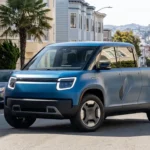
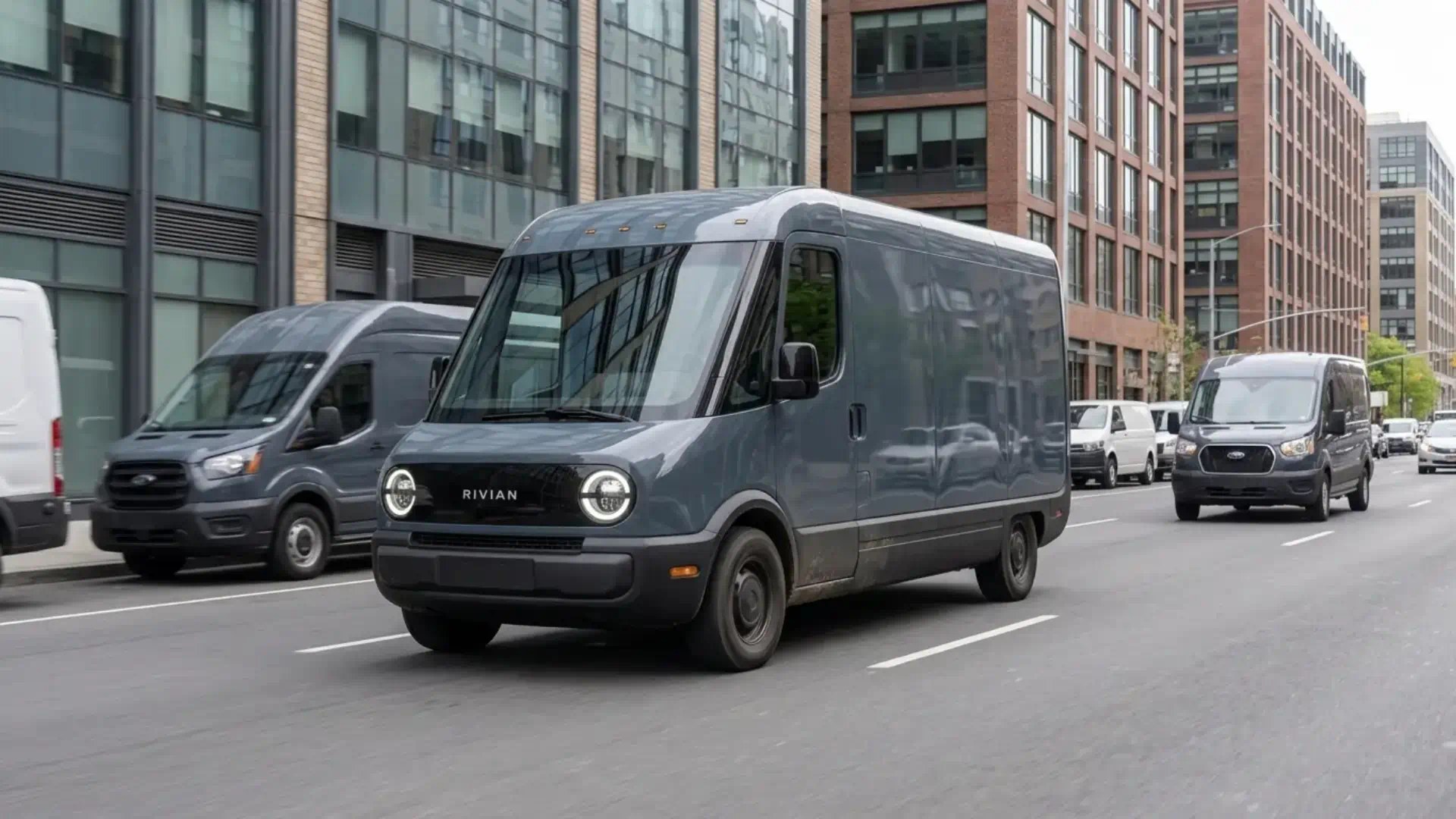
Important editorial note: The Rivian EDV story has changed since the original Amazon-only launch. Rivian now sells its Commercial Van to businesses outside the original Amazon-exclusive arrangement, while Amazon continues to operate a very large Rivian delivery-van fleet. Current NHTSA documentation identifies 2026 EDV/Rivian Commercial Van configurations including 500 and 700 variants, with both single-motor front-wheel-drive standard-pack and dual-motor all-wheel-drive large-pack configurations appearing in the model-year VIN documentation. Exact range, equipment and availability vary by configuration, so this article separates established specifications from newer variants still being developed.
Key Takeaways
The Rivian EDV is Rivian’s purpose-built electric delivery-van platform, originally developed with Amazon and now available more broadly through Rivian’s Commercial Van business. The vehicle is designed around last-mile delivery rather than private passenger use, with features such as a walk-through cargo area, automatic bulkhead, driver-focused ergonomics, and cargo-oriented body designs. Rivian currently offers the commercial platform in 500 and 700 configurations, while developing larger-battery and AWD variants intended to expand fleet route coverage.
The current 2026 model-year NHTSA documentation identifies Delivery 500 and Delivery 700 configurations and lists both a single-motor front-wheel-drive standard battery configuration and a dual-motor AWD large-battery configuration in the VIN structure. That means the EDV lineup is broader than the original Amazon delivery vans that many consumers recognize from U.S. streets.
Range and Variants
The older publicly documented Delivery 500 is rated at 161 miles of EPA-estimated range, while the Delivery 700 is listed at 160 miles in a current California reference guide. Those figures apply to the documented versions and should not be automatically transferred to the newer larger-battery/AWD variants that Rivian says are being developed.
The EDV’s real advantage isn’t long-distance range.
It’s fleet efficiency.
Rivian says more than 40,000 Rivian Electric Delivery Vans were operating in Amazon’s network by the second quarter of 2026, and the platform had surpassed one billion miles driven. Rivian also says the partnership is expanding into larger-battery and AWD variants for routes where additional range and traction are needed.
That makes the Rivian EDV an interesting case study in how electric commercial vehicles can be designed around a specific duty cycle.
A delivery van doesn’t necessarily need 300 or 400 miles of range.
It needs enough range for a route, predictable charging, low operating costs, easy package access and a comfortable driver’s environment.
That’s where the EDV makes the most sense.
What Is the Rivian EDV?
The Rivian EDV stands for Electric Delivery Van.
It is a commercial electric van developed by Rivian initially in collaboration with Amazon.
The original vehicle was designed specifically around the requirements of package delivery.
That distinction matters.
The EDV isn’t simply a passenger van that has been converted into an electric delivery vehicle.
Its entire design revolves around fleet use.
Rivian’s commercial platform includes features such as:
- Automatic bulkhead door
- Walk-through cargo area
- Tall roof
- Driver-focused controls
- Cargo-area access optimized for delivery work
- Curb-side sliding door
- Rear roll-up door
- Fleet-focused software
- Purpose-built commercial packaging
Rivian describes these features as part of its effort to improve productivity, safety and total cost of ownership.
The original EDV partnership with Amazon was one of the most significant commercial-EV programs in the U.S.
Rivian’s commercial-vehicle platform wasn’t built merely to sell a few hundred vans.
Amazon originally committed to an initial volume of up to 100,000 vehicles globally, subject to modification.
That large fleet commitment gave Rivian an unusual opportunity.
Instead of designing an EV van first and looking for fleet applications afterward, it could develop the vehicle around the specific demands of package delivery.
Is the Rivian EDV Only for Amazon?
No.
That’s one of the biggest changes in the EDV story.
The original Rivian Electric Delivery Van became strongly associated with Amazon because Amazon was Rivian’s first major commercial customer.
But Rivian eventually moved beyond the exclusive arrangement.
Rivian announced in February 2025 that its electric commercial vans were available for purchase by businesses more broadly. The company described interest from tradespeople, delivery services, grocery businesses, bakeries, florists, dry-cleaning businesses and other commercial operators.
That expansion matters because the vehicle’s potential market is much larger than Amazon.
Possible customers include:
- Parcel delivery fleets
- Food delivery
- Grocery delivery
- Plumbing companies
- Electrical contractors
- Mobile service businesses
- Municipal fleets
- Maintenance businesses
- Retail delivery
- Laundry and linen services
- Small logistics companies
Rivian’s commercial-van business is therefore increasingly a fleet product rather than an Amazon-specific curiosity.
What Is the Difference Between Rivian EDV and Rivian Commercial Van?
The terminology can be confusing.
EDV refers to the Electric Delivery Van, particularly the vans associated with Amazon’s delivery program.
Rivian Commercial Van, or RCV, is the broader commercial offering that Rivian now sells to other business customers.
Mechanically and visually, the vehicles can be closely related.
Rivian’s emergency-response documentation says the EDV 500, EDV 700 and Rivian Commercial Van 500 share the same basic vehicle family, with differences tied to fleet configuration and application rather than completely different architectures.
The most useful way to understand the naming is:
EDV = original delivery-focused fleet identity
Commercial Van = broader Rivian business-van product
For an article targeting rivian edv, both should be covered because searchers use “EDV” broadly to refer to Rivian’s electric delivery vans.
What Is the Rivian EDV 500?
The Rivian EDV 500 is the shorter and narrower commercial-van configuration.
Rivian’s product documentation describes it as a smaller version of the EDV 700 designed for applications where a more compact footprint is useful.
That makes it particularly suitable for:
- Dense urban routes
- Smaller delivery zones
- Streets with limited parking
- Businesses that don’t need maximum cargo capacity
- Routes where maneuverability matters
The 500 designation refers to the van’s approximate cargo-volume class, rather than an indication that it has a 500-mile range.
That’s an important clarification.
EDV 500 does not mean 500 miles.
The currently documented Delivery 500 has an EPA-estimated range of about 161 miles.
For a fleet vehicle completing a predictable local delivery route, 161 miles can be much more meaningful than it sounds.
An urban delivery van may spend an entire workday traveling relatively short distances while repeatedly stopping and starting.
What Is the Rivian EDV 700?
The Rivian EDV 700 is the larger version.
Rivian describes it as the approximately 700-cubic-foot cargo model, with a longer body designed around higher-volume delivery work.
The 700 is more appropriate when the operator needs:
- More packages
- More cargo volume
- Longer routes
- Higher daily delivery density
- Larger loads
The currently documented Delivery 700 has an EPA-estimated range of about 160 miles in the California reference documentation.
That might seem counterintuitive.
Why would a larger van have essentially the same range?
Because the range figure belongs to a specific older configuration, and the larger body can consume more energy.
But Rivian is now developing larger-battery versions specifically to improve route coverage.
The company’s Q2 2026 information says the larger battery is expected to increase range by approximately 30%, while AWD is intended to improve traction in mud and snow.
That means future or newer commercial configurations should not automatically be judged by the older 160-mile figures.
How Much Range Does the Rivian EDV Have?
The answer depends on the exact vehicle.
For the documented 2025/2026-generation Delivery 500 and 700 configurations, current reference data lists:
| Version | EPA-estimated range |
|---|---|
| Delivery 500 | 161 miles |
| Delivery 700 | 160 miles |
These figures come from a California reference guide using Rivian’s published specification data and are identified as pre-production values in the source.
But Rivian is developing newer configurations.
Its 2026 shareholder materials say the existing standard-pack variant is already on the road while larger-battery and AWD versions are being developed. Rivian expects the larger battery to deliver about a 30% increase in range.
That difference is crucial.
A page published years ago might say:
“Rivian EDV range is 153 miles.”
A current 2026 article should be more precise.
The correct answer is:
The documented standard-pack Delivery 500/700 variants are around 160 miles EPA-estimated, while Rivian is developing larger-battery variants designed to increase route coverage by approximately 30%.
Don’t present the future larger-battery range as a certified exact figure until Rivian publishes final figures.
Why Doesn’t the Rivian EDV Need 300+ Miles of Range?
This is one of the most common misunderstandings about commercial EVs.
A fleet van doesn’t operate like a family road-trip vehicle.
A delivery van might:
- Leave a depot in the morning.
- Complete a dense delivery route.
- Return to the depot.
- Charge overnight.
- Repeat the same cycle.
That means route predictability can make a lower-range EV commercially useful.
For example, a fleet operator might have a van assigned to a 100-mile daily route.
A 160-mile vehicle could potentially provide an appropriate operational buffer.
A 350-mile battery would add weight and cost without necessarily creating additional business value.
That’s why fleet EV economics are different from passenger EV economics.
The key question is not:
“How far can the van travel?”
It’s:
“Can it complete the assigned route without disrupting operations?”
That’s a much better commercial-EV metric.
How Much Cargo Can the Rivian EDV Carry?
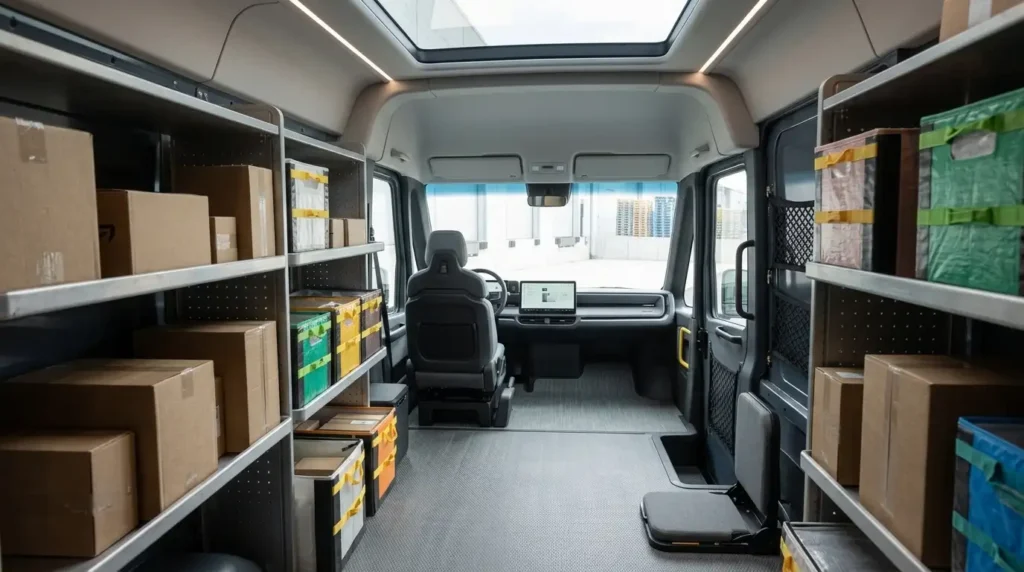
The EDV 500 provides approximately 487 cubic feet of cargo volume, while the EDV 700 provides approximately 652 cubic feet, according to current published vehicle reference data.
That makes the 700 substantially more capable for high-volume parcel operations.
The numbers illustrate why both body lengths exist.
The 500 is the maneuverability-focused option.
The 700 is the cargo-volume-focused option.
EDV 500
Approximate cargo volume:
487 cubic feet
EDV 700
Approximate cargo volume:
652 cubic feet
That is a difference of:
652 − 487 = 165 cubic feet
The 700 therefore adds a substantial amount of usable cargo space.
For a delivery company, that can mean more packages per route.
A contractor, meanwhile, could use the extra space for more tools and equipment.
Similarly, a retailer could make fewer trips between a warehouse and customers.
How Much Payload Does the Rivian EDV Have?
Current published reference data lists:
Delivery 500: approximately 2,663 pounds payload
Delivery 700: approximately 2,258 pounds payload
The source explicitly notes that payload includes the driver and all cargo under USDOT/NHTSA regulations.
That distinction matters.
Payload isn’t the same thing as cargo capacity.
A van can have enormous cubic-foot volume while still being limited by its weight rating.
For fleet operators, you therefore need to evaluate both:
Volume
and
Payload
A parcel-delivery business may run into the volume limit first.
A business carrying dense equipment may reach the payload limit first.
That difference can determine whether the 500 or 700 is the better fit.
Does the Rivian EDV Have AWD?
The original standard-pack commercial configuration is front-wheel drive.
However, current 2026 NHTSA documentation identifies a dual-motor AWD, large-battery configuration within Rivian’s commercial-van model-year VIN structure.
Rivian’s 2026 shareholder information also says it is developing AWD specifically to improve traction in conditions such as mud and snow.
That’s useful for fleets operating in:
- Snow
- Mountain regions
- Mud
- Rural roads
- Poor-weather environments
But AWD isn’t automatically necessary for every delivery operator.
For a flat urban route in a warm climate, FWD may be perfectly adequate.
For a fleet operating in Michigan, Colorado or other snow-prone regions, AWD could provide more meaningful operational value.
How Does the Rivian EDV Charge?

The documented commercial vans use DC fast charging and can also charge using AC equipment, depending on the exact configuration and model year.
A current California reference guide lists the Delivery 500 with charging capability up to 100 kW and a 161-mile EPA estimate.
Older reference material identifies J1772 and CCS1 charging for the commercial vans.
However, charging specifications should be checked against the exact model year and configuration.
This matters because Rivian’s consumer vehicles have transitioned toward NACS in North America, but commercial vans have their own platform and legacy charging specifications.
U.S. Charging
For the documented commercial-van configurations, CCS1/J1772 information applies to the published versions.
Don’t automatically assume that because Rivian’s R1 and R2 products use NACS, every commercial van configuration uses the same connector.
UK/EU/Australia
A current official regional commercial-van configuration for these markets wasn’t established in the sources reviewed.
So Go Electric Hub should not manufacture a local connector specification or assume that the U.S. vehicle can simply be sold unchanged elsewhere.
This is especially important because the target audience includes multiple regions.
Does the Rivian EDV Use NACS?
This is one area where you should be careful.
Rivian’s consumer EV lineup is transitioning to NACS in North America, but the documented commercial vans have been associated with CCS1/J1772 hardware. Current California reference documentation continues to specify the commercial van charging architecture separately from Rivian’s newer consumer models.
The current commercial van model-year documentation doesn’t give us enough evidence to claim that every new EDV or RCV has adopted the same connector strategy as R1/R2.
So the correct buyer advice is:
Verify the connector on the exact commercial-van configuration before purchasing or installing fleet charging equipment.
For a business, this is more important than it sounds.
A fleet doesn’t simply buy one charger.
It may need:
- Multiple depot chargers
- Electrical upgrades
- Load management
- Software
- Charging scheduling
- Backup charging
- Route planning
A connector decision can therefore affect the entire fleet infrastructure.
How Much Does a Rivian EDV Cost?
Rivian’s commercial pricing is more complicated than consumer EV pricing.
Rivian announced that its commercial van became available for purchase by businesses in 2025, but commercial pricing can vary based on configuration, upfitting, fleet agreements and commercial equipment.
Car and Driver’s published pricing for the 2025 Rivian Commercial Van was approximately:
$86,325–$90,325
for the versions it reviewed.
That figure should be treated as a 2025-market reference, not automatically as the current 2026 retail price.
That’s important because the commercial-van platform has evolved and newer configurations are appearing.
Don’t Use Amazon Fleet Pricing as Retail MSRP
Amazon’s fleet procurement isn’t directly comparable with a normal small-business purchase.
A fleet buyer can negotiate:
- Vehicle volume
- Service
- Upfitting
- Charging
- Financing
- Fleet software
- Maintenance
- Route management
A small business buying a single commercial van may have a very different total cost.
Therefore, for current fleet purchasing:
Get a current commercial quote from Rivian.
The article shouldn’t pretend that a single old published MSRP applies to every 2026 commercial customer.
What Does the Rivian EDV Cost to Operate?
This is where the electric delivery van can become more interesting than its purchase price suggests.
Rivian says its commercial vans are designed to reduce total cost of ownership and highlights lower energy and service costs compared with internal-combustion delivery vehicles.
The commercial van has several potential operating advantages:
- Electricity can cost less per mile than gasoline or diesel
- Electric motors have fewer moving parts
- Regenerative braking can reduce friction-brake wear
- Fleet software can optimize routes
- Home/depot charging can reduce reliance on public fast charging
- Quiet operation can improve urban delivery environments
But these benefits depend on the fleet’s actual energy rates and operating pattern.
A fleet that charges mostly at an expensive public charger may have different economics from one charging overnight at a depot with managed electricity rates.
That’s why businesses should calculate their own cost per mile.
Fleet Cost Calculation
Here’s a simple example framework rather than a claim about Rivian’s exact fleet economics.
Suppose a fleet vehicle travels:
100 miles per workday
and operates:
250 days per year
Annual mileage:
100 × 250 = 25,000 miles
Now suppose the vehicle consumes an assumed:
0.8 kWh/mile
Annual electricity:
25,000 × 0.8 = 20,000 kWh
At an assumed fleet electricity cost of:
$0.15/kWh
Annual energy cost:
20,000 × $0.15 = $3,000
This is a hypothetical calculation, not a Rivian operating-cost claim.
Change the assumptions and the result changes.
A fleet operator should replace those inputs with:
- Actual route mileage
- Actual van energy consumption
- Depot electricity price
- Charging losses
- Seasonal usage
- HVAC load
- Towing or payload requirements
The Go Electric Hub framework requires calculations to show inputs, assumptions, formula, result and limitations rather than presenting an unexplained cost number.
Why Is the Rivian EDV Good for Delivery Fleets?
The van’s strongest feature isn’t its battery.
It’s the workflow design.
Rivian built the vehicle around repeated delivery stops.
That means seemingly small features can have a major impact.
Automatic Bulkhead Door
Rivian describes an automatic bulkhead door that opens as the driver reaches a destination.
The goal is to reduce the number of physical actions required during a delivery.
For one delivery, that’s a tiny convenience.
For 150 deliveries in a day, repeated hundreds of times across a fleet, it becomes operationally meaningful.
Walk-Through Cargo Area
The driver’s ability to move through the cargo area can reduce unnecessary stepping in and out of the van.
That matters for:
- Time
- Driver fatigue
- Safety
- Productivity
Curb-Side Sliding Door
The curb-side configuration keeps package access away from moving traffic in many delivery environments.
That’s another example of fleet-specific design.
Why Does Amazon Use Rivian EDVs?

Amazon was Rivian’s launch commercial customer and a major reason the EDV became widely visible.
Amazon needed a vehicle specifically designed around last-mile delivery.
A normal passenger van has compromises.
A converted cargo van has compromises.
Rivian designed the EDV around Amazon’s workflow.
That included:
- Package storage
- Driver visibility
- Automated systems
- Route efficiency
- Cargo access
- Driver ergonomics
The results have become significant at fleet scale.
Rivian’s Q2 2026 investor materials reported that Amazon had more than 40,000 Rivian Electric Delivery Vans operating across thousands of cities in North America and that the commercial-van platform had surpassed one billion miles driven.
That’s important because it provides a level of real-world fleet deployment that most startup electric vans can’t match.
Rivian EDV vs Ford E-Transit
The Ford E-Transit is one of the most obvious alternatives for a commercial fleet.
Ford has a major advantage:
Established commercial-vehicle infrastructure.
That includes:
- Ford Pro
- Fleet support
- Large service network
- Commercial dealers
- Long-running Transit platform
The Rivian’s strengths are different.
The EDV was designed specifically around electric delivery workflows rather than adapting a conventional van.
That can make its driver-focused delivery features particularly attractive for last-mile operators.
For a business choosing between the two, the key questions are:
Can my route be completed on the EDV’s range?
Where will the fleet charge?
What’s the total cost over the vehicle’s useful life?
Which manufacturer gives my business better service coverage?
Rivian EDV vs Mercedes Electric Vans
Mercedes-Benz Vans has a major commercial-vehicle presence in Europe and other markets.
For European businesses, an electric Mercedes van may therefore have an important advantage in local availability and service.
The Rivian EDV is primarily a North American story in the current evidence reviewed here.
This creates an important regional split:
USA
Rivian EDV is a meaningful fleet option.
UK / Europe
Rivian EDV availability is not established as a normal local-market product in the evidence reviewed.
Established commercial EV van manufacturers may therefore be much more practical.
Australia
Again, current official local EDV retail availability is not established here.
For Australian fleets, local commercial EV availability and service coverage should be checked before considering an import.
Rivian EDV 500 vs EDV 700
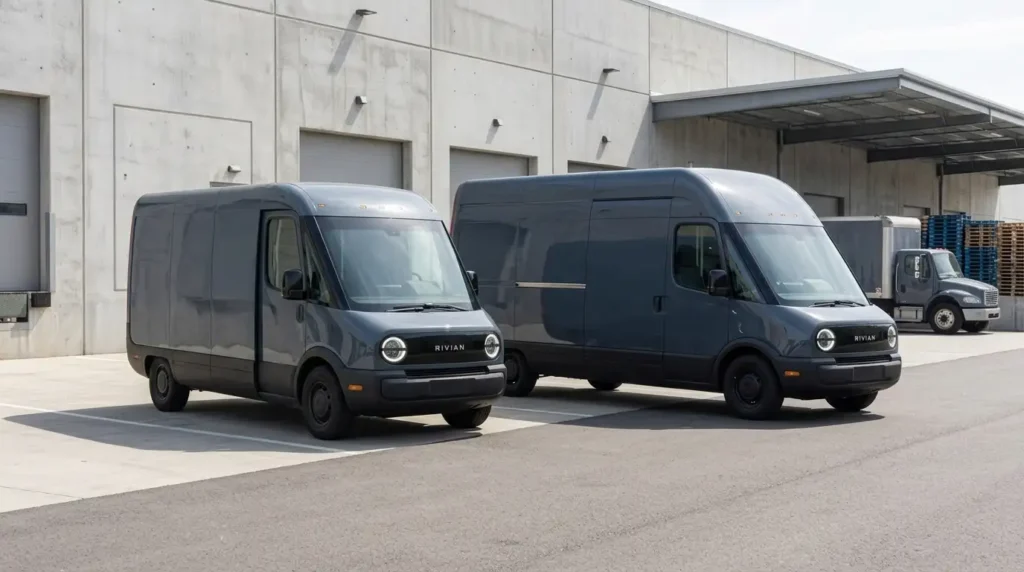
| Category | EDV / Commercial Van 500 | EDV / Commercial Van 700 |
|---|---|---|
| Cargo volume | About 487 cu ft | About 652 cu ft |
| Body size | Smaller | Larger |
| Intended use | Dense/urban routes | Higher-volume routes |
| Wheelbase | 157.5 in in published 2025 reference | 178.0 in |
| Overall length | 248.5 in | 278.0 in |
| EPA range in current reference | 161 mi | 160 mi |
| Payload in current reference | 2,663 lb | 2,258 lb |
| Best fit | Smaller delivery routes | Larger cargo loads |
Published specifications vary by model year and configuration. The range and payload figures above are from the documented 2025/2026 reference data and shouldn’t be transferred automatically to newer large-battery/AWD variants.
The table shows an interesting trade-off.
The larger 700 carries more cargo volume but has lower published payload and roughly the same range in the documented configuration.
That makes the 500 a surprisingly interesting choice for a fleet that prioritizes maneuverability and weight capacity.
What Are the Biggest Rivian EDV Advantages?
Purpose-built for delivery
The EDV was designed around the delivery workflow rather than simply converted from a passenger van.
Huge real-world fleet deployment
Amazon has more than 40,000 Rivian EDVs operating in North America according to Rivian’s 2026 reporting, and the platform has passed one billion miles.
Strong cargo design
The 500 and 700 provide different volume choices.
Driver-focused ergonomics
Features such as the automatic bulkhead and walk-through cargo area are directly relevant to delivery work.
Electric operating model
The powertrain can potentially reduce energy and maintenance costs compared with internal-combustion fleet vans, depending on operating conditions.
Larger-battery and AWD roadmap
Rivian says newer configurations are being developed to expand routes and improve traction.
What Are the Biggest Rivian EDV Drawbacks?
Range Is Not Designed for Long-Distance Hauling
The documented standard-pack range is around 160 miles.
That’s ideal for predictable delivery routes, not interstate freight.
Charging Infrastructure Needs Planning
A commercial fleet can’t rely on improvisation.
Depot charging needs to be designed before the vans arrive.
Commercial Pricing Can Be High
Published commercial-van pricing has been around the $86,000–$90,000 range for documented versions, before additional fleet equipment and upfitting.
Newer Battery/AWD Versions Still Need Final Validation
Rivian’s larger-battery and AWD variants are developing.
Don’t treat their projected range improvements as final certified numbers.
Regional Availability
The EDV is primarily a North American proposition in the current evidence reviewed.
UK, Europe and Australia shouldn’t assume normal retail availability.
Rivian EDV Review: Who Should Buy It?
The EDV makes the most sense for a commercial fleet, not a private family buyer.
It’s particularly attractive when the operation has:
- Predictable routes
- Overnight depot charging
- Frequent stops
- High annual mileage
- Dense urban deliveries
- Need for driver-friendly cargo access
- A business case for reducing fuel use
A parcel fleet can potentially extract much more value from the EDV than an individual owner.
The reason is repetition.
A fleet might operate 100 vans.
Each van might make dozens or hundreds of stops.
Small improvements in:
- route time
- driver comfort
- loading
- charging
- maintenance
can multiply across thousands of operating hours.
That’s where a purpose-built electric van can create value.
Who Should Not Buy a Rivian EDV?
A private buyer who wants a family vehicle isn’t the target customer.
Someone who frequently drives 300 miles between cities isn’t the ideal user either.
And a small business without access to charging infrastructure should carefully calculate depot investment before committing to a fleet EV.
The EDV works best when the operating environment matches the vehicle.
That’s true for every commercial EV.
Are Rivian EDVs Reliable?
There isn’t enough independent long-term reliability evidence to give the EDV a simple reliability score.
What we do know is that the platform has achieved substantial fleet mileage.
Rivian says it crossed one billion miles on its Commercial Van platform in Q2 2026.
That’s valuable evidence of real-world deployment.
But fleet mileage isn’t the same thing as an independent reliability study.
The vehicles are used intensively, and fleet operators may also maintain them differently from private owners.
So the correct conclusion is:
The EDV has substantial real-world fleet experience, but a comprehensive independent long-term reliability rating should not be invented from that alone.
What Does One Billion Miles Tell Us?
A billion miles is useful because it means the platform isn’t theoretical.
The vans have experienced:
- Different climates
- Repeated charging
- Heavy daily use
- Frequent braking
- Thousands of delivery stops
- High utilization
- Urban operation
- Long-term fleet servicing
That’s much stronger evidence than a press-release prototype.
But it still doesn’t answer every reliability question.
To evaluate reliability properly, we’d want independent data on:
- Battery degradation
- Motor failures
- HVAC failures
- Door mechanisms
- Charging failures
- Software faults
- Suspension
- Brake wear
- Body damage
- Service downtime
Those figures aren’t available in the sources reviewed here.
So we shouldn’t pretend they are.
Rivian EDV and Fleet Charging Strategy
Fleet charging is arguably more important than the van itself.
A company buying 20 EDVs may need to install:
- 10 or more overnight chargers
- Electrical service upgrades
- Load management
- Charging software
- Backup charging
- Fleet scheduling
The fleet should calculate its average daily energy requirement before ordering vehicles.
A useful planning formula is:
Daily miles × energy consumption per mile = daily energy requirement
Then:
Daily energy × number of vehicles = fleet energy requirement
For example, a hypothetical fleet of 20 vans traveling 100 miles daily at 0.8 kWh/mile would require:
100 × 0.8 = 80 kWh per van per day
Then:
80 × 20 = 1,600 kWh per day
Again, this is an example calculation only, not a claim about actual EDV energy consumption.
The fleet would then need to consider:
- Charging losses
- Winter conditions
- HVAC loads
- Vehicle payload
- Route variability
- Charging windows
- Utility rates
A properly designed depot can therefore be a major part of the commercial-EV business case.
Rivian EDV: Current 2026 Status
The most important current developments are:
Amazon deployment continues.
Rivian reported more than 40,000 EDVs operating for Amazon across North America in Q2 2026.
The platform has exceeded one billion miles.
That’s significant real-world fleet experience.
Rivian sells commercial vans outside Amazon.
The broader Commercial Van business opened to other customers in 2025.
New variants are under development.
Rivian says larger batteries and AWD are being developed to improve route coverage and traction.
2026 NHTSA documentation confirms multiple configurations.
The model-year VIN information identifies standard-pack single-motor FWD and large-pack dual-motor AWD configurations, along with 500 and 700 body variants.
That is why older EDV articles can become misleading.
The commercial van is evolving.
Rivian EDV: Quick Specs
| Specification | Current documented information |
|---|---|
| Vehicle type | Electric commercial delivery van |
| Primary market | North America |
| Main versions | 500 and 700 |
| Original major customer | Amazon |
| Other commercial customers | Yes |
| Standard documented drivetrain | Single-motor FWD |
| Newer configuration identified | Dual-motor AWD + larger battery |
| Delivery 500 range | 161 miles EPA estimate |
| Delivery 700 range | 160 miles EPA estimate |
| Delivery 500 cargo volume | 487 cu ft |
| Delivery 700 cargo volume | 652 cu ft |
| Delivery 500 payload | 2,663 lb |
| Delivery 700 payload | 2,258 lb |
| Published charging capability | Up to 100 kW in documented reference |
| New larger battery | Approx. 30% range increase expected by Rivian |
| Fleet mileage | More than 1 billion miles |
| Amazon fleet | More than 40,000 vans as of Q2 2026 reporting |
Figures vary by model year/configuration. Current and future configurations should be verified separately.
Rivian EDV vs an Electric Passenger Van
This distinction matters.
The EDV is optimized for:
package delivery
not:
family transportation
Passenger vans prioritize:
- Seats
- Comfort
- Visibility
- Climate control
- Interior access
The EDV prioritizes:
- Cargo
- Driver workflow
- Package access
- Route efficiency
- Fleet operation
That’s why comparing the EDV directly with a passenger electric van can produce misleading conclusions.
The correct benchmark is another commercial electric delivery van.
Is the Rivian EDV Good for Last-Mile Delivery?
Yes, that’s exactly where it makes the most sense.
Last-mile delivery typically involves:
- Short distances
- Frequent stops
- Heavy low-speed use
- Repeated acceleration/braking
- Loading and unloading
- Urban streets
Those characteristics align well with an electric drivetrain.
Regenerative braking can recover some energy during repeated slowing.
Instant electric torque can make stop-and-go driving easy.
And a purpose-built cargo area can reduce driver time per stop.
The fact that Rivian’s EDV fleet has already surpassed one billion miles provides strong evidence that the concept is functioning at large scale.
Final Verdict: Is the Rivian EDV Worth It?
The Rivian EDV is one of the strongest examples of an electric vehicle being designed around a specific commercial job rather than simply replacing an internal-combustion vehicle with a battery.
Its strengths are easy to understand.
It’s designed around last-mile delivery.
It has a walk-through cargo area.
The truck also offers driver-focused features such as the automatic bulkhead.
It comes in two major body-volume classes.
And, most importantly, it already has enormous real-world fleet exposure.
Rivian reported more than 40,000 vans operating in Amazon’s network and more than one billion miles driven by its Commercial Van platform by Q2 2026.
That’s the strongest part of the story.
Range and Future Variants
The weakness is range.
The documented standard versions are around 160 miles EPA-estimated, making them far more suitable for predictable delivery routes than long-distance commercial travel.
But Rivian understands that limitation.
That’s why it is developing larger-battery variants expected to add about 30% more range and AWD variants for more challenging routes.
The commercial-van story is therefore moving into its next phase.
The original EDV proved the basic concept.
The newer Commercial Van variants are intended to expand the addressable fleet market.
For a U.S. delivery operator with predictable routes and depot charging, the Rivian EDV deserves serious consideration.
For a UK, European or Australian fleet, the first question isn’t whether the van is technically good.
It’s whether Rivian currently offers the commercial vehicle locally with the required service, certification, charging and fleet support.
That availability should be verified before making a purchase decision.
Overall assessment: The Rivian EDV is a mature commercial-EV platform with unusually strong real-world fleet evidence, but buyers need to choose the exact body, battery and drivetrain carefully. The newer large-battery and AWD variants may ultimately be more compelling than the original short-range configurations, but their final certified specifications should be verified before publication or purchase.
Rivian EDV FAQ
EDV stands for Electric Delivery Van. Rivian developed the platform initially with Amazon for package delivery and later expanded its commercial-van business to other fleet customers.
Published current reference data lists approximately 161 miles EPA-estimated for the Delivery 500 and 160 miles for the Delivery 700. Rivian is developing a larger-battery version expected to increase range by around 30%, but the final certified figure should be checked for the specific vehicle.
The published Delivery 500 offers approximately 487 cubic feet of cargo volume, while the Delivery 700 offers about 652 cubic feet.
Published reference specifications list a maximum payload of approximately 2,663 pounds for the Delivery 500 and 2,258 pounds for the Delivery 700, including the driver and cargo under the applicable payload definition.
Yes. Rivian announced in 2025 that its Commercial Van was available for purchase by businesses beyond the original Amazon program.
Newer 2026 model-year documentation identifies a dual-motor AWD, large-battery commercial-van configuration, while Rivian’s existing standard-pack vans use single-motor FWD.
The documented commercial-van configurations have historically used J1772/CCS1 charging hardware. Buyers should verify the connector on the exact current model because Rivian’s consumer vehicles and commercial vans have evolved separately.
A current official UK retail/commercial launch wasn’t established in the sources reviewed for this article. UK businesses should confirm local Rivian commercial availability directly rather than assuming a U.S. vehicle can be imported as a normal fleet purchase.
A current official retail/commercial launch in Europe or Australia was not established in the evidence reviewed here. Local availability, homologation, service and charging requirements should be confirmed before considering an import.