
Important review note: Aptera’s 2026 Launch Edition is still moving through validation and production preparation. Aptera received an EPA Certificate of Conformity in June 2026, but the company says remaining federal safety/compliance work is still required before customer deliveries. Aptera is targeting production of its first 40 production vehicles in Q4 2026. Its current reservation system describes the vehicle as being in testing and validation and says specifications can change; its displayed $40,000 figure is a target price, with the final purchase price to be announced before delivery.
Key Takeaways
The Aptera Solar EV is one of the most unusual electric vehicles heading toward production. Instead of trying to look like a conventional sedan, hatchback or crossover, it uses a lightweight three-wheel design with an extremely aerodynamic body and integrated solar cells.
The current Launch Edition is targeted at $40,000 and is designed around a 400-mile range. Aptera says the 44-kWh battery uses 21700 NMC 811 cells and that the integrated solar system can provide up to 40 miles of additional driving per day in favorable conditions.
But those figures need careful wording.
The $40,000 number is currently a target price, not a final retail transaction price.
The 400-mile figure is Aptera’s intended Launch Edition range, not a claim that every future Aptera configuration will travel 400 miles.
And the solar contribution depends heavily on location, weather, parking orientation, season and energy consumption.
The most important recent development is production.
On August 20, 2026, Aptera announced a strategic production partnership with Launch Design covering tooling, testing, pilot production and high-volume production work. The company says the first parts for its initial 40 production vehicles are expected to arrive in October, with assembly targeted for Q4 2026.
Aptera had already received its EPA Certificate of Conformity for the 2026 Launch Edition on June 18, 2026. However, Aptera says FMVSS compliance using vehicles from its low-volume validation assembly line is still needed before customer deliveries can begin.
So the Aptera isn’t yet an ordinary mass-production EV.
It’s a production-intent solar EV approaching its first customer vehicles.
What Is the Aptera Solar EV?
The Aptera is a battery-electric vehicle built around efficiency rather than conventional automotive packaging.
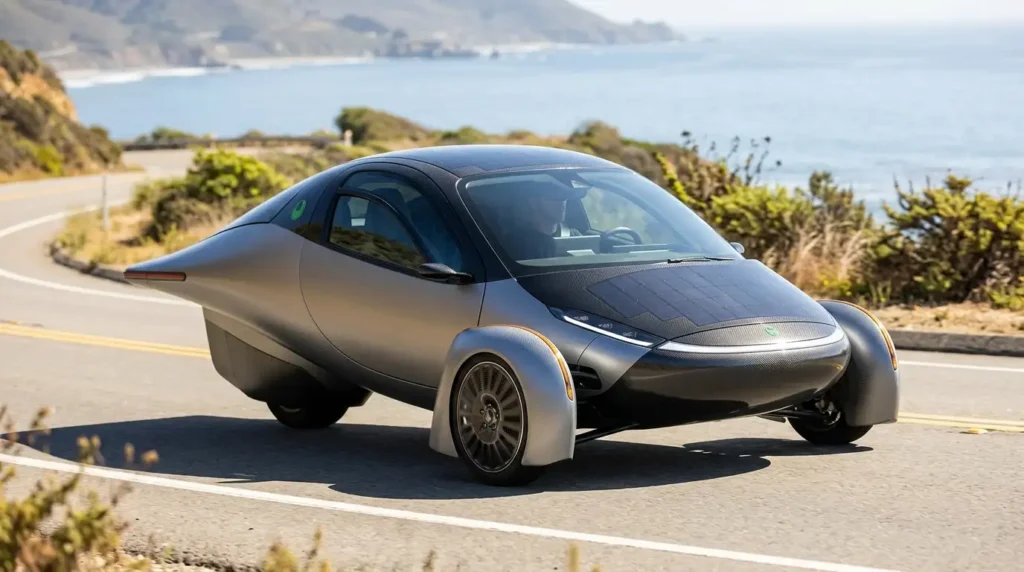
Its body has three wheels, an enclosed aerodynamic shape and integrated solar cells.
That design looks dramatically different from almost every mainstream EV.
The reason is efficiency.
A conventional EV has to move a relatively large frontal area through the air.
The Aptera minimizes aerodynamic drag and vehicle weight to reduce the amount of energy required to travel each mile.
That allows it to pursue unusually long range from a relatively small battery.
Aptera says its Launch Edition uses a 44-kWh battery with 2,304 cylindrical cells. The company says that battery is designed for a 400-mile range.
That is a very different engineering philosophy from large electric SUVs with batteries exceeding 100 kWh.
The Aptera’s argument is:
Use less energy instead of carrying vastly more energy.
That distinction is central to understanding the vehicle.
Why Three Wheels?
The three-wheel layout gives Aptera more freedom to shape the body around aerodynamic efficiency.
It also potentially reduces weight and mechanical complexity.
Aptera describes its architecture as using roughly 90% fewer parts than a traditional internal-combustion vehicle, although that is a company-level design claim rather than an independently verified production comparison.
The vehicle is also designed around hub or in-wheel motor technology and a highly streamlined body.
The resulting shape isn’t primarily about styling.
It’s about reducing energy consumption.
How Much Does the Aptera Cost?
The current Aptera price is best described as a $40,000 target price for the Launch Edition.
Aptera’s reservation configurator currently shows:
Target Price: $40,000
and a $100 amount due today to reserve the vehicle. It also explicitly says the final purchase price will be announced before delivery.
That’s an important distinction.
This is not the same as saying:
“The Aptera costs exactly $40,000.”
The safer statement is:
Aptera currently targets a $40,000 price for the 400-mile Launch Edition.
The configurator also displays an estimated price after fuel savings of $32,500, but that is a calculated marketing figure, not the actual vehicle purchase price. Aptera’s calculation assumes 10,000 miles of solar driving per year and compares it with a gasoline vehicle under its specified assumptions.
For a buying guide, the important number is therefore:
$40,000 target price
not $32,500.
The lower number shouldn’t be treated as the amount a customer pays for the car.
What Is the Aptera Launch Edition?
The Launch Edition is Aptera’s initial production configuration.
Aptera says the first 5,000-plus vehicles are planned around the 400-mile Launch Edition before future 250-, 600- and 1,000-mile variants. The timing of those later versions hasn’t been announced.
Current Launch Edition specifications include:
- 400-mile target range
- 44-kWh battery
- Integrated solar
- Front-wheel drive
- Three-wheel configuration
- Approximately 700 watts of solar generation capacity
- $40,000 target price
- Three-door-style enclosed body
- Two-person seating arrangement
The exact final specifications remain subject to change.
That’s particularly important because Aptera’s current reservation page says the vehicle shown is still in testing and validation.
Why Start With 400 Miles?
The 400-mile version gives Aptera a useful balance.
It doesn’t need the enormous battery required for a conventional 400-mile EV because its body consumes much less energy.
A 44-kWh battery at a 400-mile target implies approximately:
44 kWh ÷ 400 miles = 0.11 kWh/mile
or:
110 Wh/mile
That’s an exceptionally low theoretical energy figure.
But this is a calculation based on Aptera’s stated 44-kWh battery and 400-mile target, not an independent measured consumption result.
The actual certified energy consumption should be used once final production data is available.
The calculation demonstrates why aerodynamics matter so much.
How Much Range Does the Aptera Have?
The current Launch Edition target is 400 miles on a single charge.
Aptera’s official reservation system also shows future range options of:
- 250 miles
- 400 miles
- 600 miles
- 1,000 miles
but the company says the first 5,000-plus vehicles will use the 400-mile Launch Edition and has not announced timing for the later variants.
This is an important distinction.
Only the 400-mile Launch Edition is currently the near-term production focus.
The 600- and 1,000-mile versions should not be presented as vehicles buyers can currently order for near-term delivery.
Is 400 Miles Real?
At this stage, treat it as the manufacturer’s target/specification.
Aptera has built validation vehicles and has reported real-world solar testing, but the vehicle is not yet an established customer-production model with a broad independent road-test record.
That doesn’t make the figure meaningless.
It means the article needs to label the evidence correctly.
The supplied Go Electric Hub framework specifically requires manufacturer claims, official tests, independent tests and firsthand observations to remain separate.
How Does Aptera Solar Charging Work?
Solar charging is the feature that makes the Aptera fundamentally different.
The vehicle has integrated photovoltaic cells across much of its upper body.
Aptera says the Launch Edition has approximately 700 watts of integrated solar cells and can generate up to 40 miles of driving per day from solar energy in favorable conditions.
That’s the manufacturer’s maximum/target claim.
It does not mean every driver will gain 40 miles every day.
Solar energy depends on:
- Location
- Latitude
- Season
- Cloud cover
- Parking position
- Shade
- Day length
- Panel exposure
- Temperature
- Vehicle efficiency
A vehicle parked under trees all day won’t produce the same amount of energy as one sitting in full sun.
Real-World Solar Validation
Aptera announced in June 2026 that its validation testing exceeded the company’s expectations for solar charging. The company said its solar system was generating useful energy during real-world testing.
That provides more meaningful evidence than simply a theoretical calculation.
However, the result still shouldn’t be converted into a universal promise.
The correct takeaway is:
Aptera’s solar system has demonstrated useful real-world energy generation, but the number of miles produced by solar will vary considerably by conditions.
Can an Aptera Really Drive Without Plugging In?
Potentially for some daily driving patterns, yes.
Aptera says that in optimal sunny locations, its solar system could provide more than 10,000 miles of driving per year, based on its own assumptions. It says the figure can exceed 1,000 solar miles in a summer month.
But this is where marketing claims need context.
The phrase “drive without plugging in” shouldn’t be interpreted as:
Every Aptera never needs a charger.
It means that a driver with relatively low daily mileage and favorable solar exposure may generate enough energy over time to cover a significant portion of their driving.
For example, someone who drives 20 miles per day might use approximately:
20 miles × 250 operating days = 5,000 miles per year
If their solar system provides a significant proportion of that energy, grid charging could become relatively infrequent.
Someone driving 70 miles every workday would have a very different energy requirement.
So solar is best understood as:
a supplemental energy source that can reduce charging demand.
Not a replacement for all external charging in every situation.
What Happens on Cloudy Days?

The solar panels still produce energy under diffuse light, but output falls as available solar radiation decreases.
That’s why the 40-mile figure should always be described as a maximum/optimal-condition claim rather than an everyday guarantee.
A buyer in:
- Phoenix
- Los Angeles
- San Diego
will generally have a different solar opportunity from someone in:
- Seattle
- London
- Manchester
- Hamburg
and the difference can be substantial.
That’s especially important for Go Electric Hub’s international audience.
The Aptera’s solar advantage is potentially strongest in sunny climates with secure outdoor parking.
How Efficient Is the Aptera?
Efficiency is the entire point of the vehicle.
Aptera’s shape minimizes aerodynamic drag and reduces the amount of energy required to move the vehicle.
The company describes its design philosophy as “Efficiency First.”
Its low-energy approach has several advantages.
Smaller Battery
A smaller battery reduces:
- Weight
- Material requirements
- Charging energy
- Potential battery cost
Less Energy per Mile
Using less electricity per mile means a fixed battery can deliver more range.
Solar Becomes More Useful
This is particularly important.
Suppose two EVs each have 700 watts of solar generation.
The vehicle that uses less energy per mile can travel farther on the same amount of harvested solar energy.
That’s one reason Aptera’s ultra-efficient shape matters.
Solar panels alone aren’t enough.
The vehicle also has to use the energy efficiently.
What Battery Does the Aptera Use?
Aptera says the Launch Edition uses a 44-kWh battery pack made from 2,304 21700 NMC 811 cylindrical lithium-ion cells.
The cells are packaged beneath the seats.
Aptera says the pack is designed to deliver the Launch Edition’s 400-mile range.
The use of NMC chemistry isn’t especially unusual.
What’s unusual is how much range the vehicle aims to obtain from a battery of this size.
That again comes back to efficiency.
For context, many long-range electric SUVs use batteries roughly two to three times larger.
Aptera is trying to avoid that requirement through:
aerodynamics + lightweight construction + low rolling resistance + efficient powertrain + solar assistance.
Is the Aptera AWD?

The current Launch Edition reservation configuration is shown with front-wheel drive.
Aptera also displays an all-wheel-drive configuration with a sub-four-second 0–60 mph target for the more performance-oriented configuration.
But the AWD version isn’t the initial production configuration.
The initial Launch Edition is focused on efficiency and front-wheel drive.
That’s actually logical.
Adding another motor can improve traction and acceleration, but it also adds weight, cost and energy consumption.
For a vehicle designed around efficiency, front-wheel drive is an obvious starting point.
How Fast Is the Aptera?
The current Launch Edition reservation information says the front-wheel-drive version targets 0–60 mph in under six seconds.
The AWD version is shown with a target of under four seconds.
The interesting point is that Aptera doesn’t need huge power to feel reasonably quick.
A lightweight vehicle requires less energy to accelerate.
That’s another advantage of reducing mass.
But these are current manufacturer targets rather than independently verified production-car test times.
Until customer-production vehicles reach independent testing, they should be presented as such.
How Does the Aptera Charge From a Plug?
Solar isn’t the only way to charge an Aptera.
The vehicle is designed to accept conventional external charging as well.
That’s essential.
Solar energy is variable.
Plug-in charging provides predictable energy when required.
For daily use, an ideal Aptera owner might use:
solar during the day + home charging when necessary.
The lower energy consumption also means that slower charging can recover meaningful driving range.
A very efficient EV doesn’t necessarily need an enormous charging rate to be practical.
However, the final production charging specifications should be verified when Aptera completes the customer-production vehicle.
Does the Aptera Use NACS?
The charging connector should be treated as a U.S.-market specification that requires final production verification.
For the U.S., Go Electric Hub should use NACS terminology where Aptera’s final production configuration confirms it.
For the UK/EU/Australia, don’t automatically transfer U.S. connector information.
The local-market version, if Aptera eventually expands outside the U.S., would need its own confirmed specification.
At present, the strongest evidence supports a U.S.-focused initial production program, so international buyers shouldn’t assume a local charging configuration exists.
This market separation follows the Go Electric Hub EV connector rule: U.S./North America uses NACS context, while UK/EU/Australia require Type 2/CCS2 context where applicable.
How Much Does the Aptera Weigh?
Aptera’s extremely low energy consumption depends partly on keeping mass low.
The company has discussed a lightweight construction approach centered around its Body in Carbon structural technology.
However, final production curb weight should be treated carefully until the customer-production specification is finalized.
The company is still making validation and production-intent changes.
That’s one reason not to quote a single “final” weight without a production document.
The broader point is more important:
The Aptera’s range strategy doesn’t rely solely on battery capacity.
Weight reduction is part of the architecture.
What Is Aptera Body in Carbon?
Body in Carbon, often shortened to BinC, is Aptera’s structural approach using composite construction.
The goal is to create a lightweight, strong vehicle structure while reducing manufacturing complexity.
Aptera says its architecture is expected to use significantly fewer components than a conventional internal-combustion vehicle.
This could potentially provide benefits in:
- Weight
- Assembly
- Parts count
- Corrosion resistance
- Structural efficiency
But again, some of those are manufacturer expectations rather than long-term independently demonstrated ownership results.
Until thousands of customer vehicles are on the road, questions about long-term repairability and body-panel replacement remain open.
Is the Aptera Safe?
Safety is one of the most important questions surrounding any unusual vehicle design.
The Aptera’s three-wheel shape and aerodynamic body look dramatically different from conventional passenger cars.
That does not automatically mean it’s unsafe.
It does mean the vehicle needs to meet applicable crash and safety requirements.
Current U.S. Regulatory Status
Aptera received an EPA Certificate of Conformity for its 2026 Launch Edition on June 18, 2026.
That is an important regulatory milestone, but it is not the same as saying every applicable safety requirement is complete.
Aptera explicitly says the EPA certificate is one of the two primary federal certifications needed before the vehicle can legally be sold in the U.S.; its remaining major federal requirement is compliance with Federal Motor Vehicle Safety Standards (FMVSS) using vehicles built on its validation assembly line.
So:
EPA Certificate of Conformity: achieved.
Full federal safety/compliance process: still in progress according to Aptera.
That distinction is essential.
When Will the Aptera Be Produced?
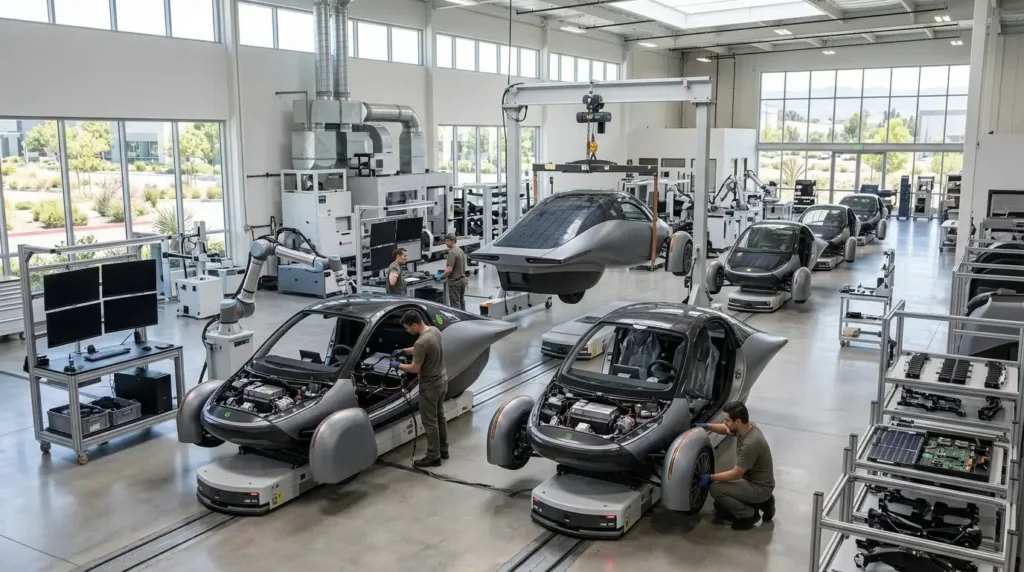
This is one of the most important current updates.
On August 4, 2026, Aptera announced it had ordered bodies and chassis for its first 40 production vehicles, with components expected to begin arriving in October.
Then, on August 20, 2026, Aptera announced a strategic partnership with Launch Design.
The company said the partnership covers tooling, assembly fixtures, testing, pilot production and eventual high-volume production.
Aptera is targeting construction of its first 40 production vehicles in Q4 2026.
This is a major change from older Aptera articles.
The company is no longer simply showing prototypes.
It’s moving from validation builds toward actual production tooling.
But it still hasn’t reached normal customer-scale manufacturing.
First Five Validation Vehicles
In May 2026, Aptera reported that the first five validation vehicles had driven off its low-volume validation assembly line in Carlsbad.
Those vehicles are important because they let Aptera validate both:
the vehicle
and
the production process.
That’s exactly what a validation line is supposed to do.
How Many Aptera Reservations Are There?
Aptera reported approximately 50,000 reservation holders for its first vehicle as of its August 12, 2026 financial-results announcement.
That doesn’t mean 50,000 confirmed vehicle sales.
A reservation is not the same thing as a completed purchase.
It does, however, demonstrate significant consumer interest.
For a company transitioning from a startup development program into manufacturing, that reservation base provides a potential initial customer pool.
The challenge is converting reservations into finished vehicles.
How Is Aptera Going to Build the Car?
Aptera is retaining final assembly in Carlsbad, California.
Its August 20 partnership with Launch Design is intended to give the company access to tooling, production engineering, components and a wider supplier network while maintaining final assembly in California.
The first bodies and chassis are expected in October 2026.
The first 40 production vehicles are targeted for Q4.
This is an important production strategy because Aptera doesn’t need to build an enormous factory immediately.
Its initial goal is low-volume manufacturing.
That can reduce the capital required to start production.
But eventually, if demand remains strong, the company will need to scale.
Is Aptera Available Outside the United States?
At present, the Aptera’s production and regulatory story is primarily focused on the United States.
The EPA Certificate of Conformity applies to the U.S. 2026 Launch Edition.
For UK, European and Australian buyers, there is currently no verified local-market MSRP or confirmed normal retail delivery program in the sources reviewed here.
That means:
USA
Primary launch market.
UK
No confirmed local retail launch verified.
Europe
No confirmed local retail launch verified.
Australia
No confirmed local retail launch verified.
Don’t convert the $40,000 target into pounds or euros and call that an official local price.
That would only be a currency conversion.
Local taxes, compliance, shipping, specification and homologation would all change the actual cost.
What Is the Aptera Solar EV’s Biggest Advantage?
The biggest advantage is efficiency.
That sounds obvious because Aptera markets the vehicle around solar power.
But solar isn’t actually the full story.
The real equation is:
Solar generation × vehicle efficiency = useful driving range from sunlight.
A less efficient EV could have the same solar-panel output and gain much less driving range.
Aptera’s aerodynamic body means more of the harvested energy can translate into miles.
That makes the 700-watt solar array more meaningful than it would be on a conventional SUV.
What Is the Biggest Aptera Weakness?
The biggest weakness is that the vehicle is still entering production.
The concept is compelling.
The engineering is distinctive.
The reservation base is large.
Regulatory progress is real.
Production tooling is now being ordered.
But customers don’t yet have years of reliability data.
There isn’t a large fleet of production Apteras from which to measure:
- Battery degradation
- Crash performance
- Repair costs
- Insurance costs
- Service frequency
- Solar output over multiple seasons
- Long-term body durability
That’s normal for a new vehicle.
But buyers need to understand that they’re early adopters.
Can the Aptera Replace a Normal Car?
For some people, yes.
For everyone, no.
The Aptera makes most sense for someone who:
- Drives one or two people regularly
- Has secure parking
- Lives in a sunny climate
- Wants high efficiency
- Doesn’t need a large cargo area
- Doesn’t need a conventional five-seat family car
- Is comfortable buying from an emerging manufacturer
It makes less sense for:
- Large families
- Frequent passengers
- Heavy cargo use
- People needing conventional rear-seat access
- Buyers who want widespread dealer support
- People who need an established production vehicle immediately
The Aptera is fundamentally a specialized efficiency vehicle.
It isn’t trying to replace the entire car market.
Aptera vs Tesla Model 3
The Tesla Model 3 is a useful comparison because both can serve as efficient long-range EVs.
The differences are obvious.
Aptera advantages
- Potentially much lower energy consumption
- Integrated solar
- 400-mile Launch Edition target
- Very lightweight design
- Distinctive vehicle architecture
Model 3 advantages
- Four-wheel conventional layout
- Five-person passenger capability
- Established production
- Extensive service and charging ecosystem
- Much more conventional everyday usability
For someone who wants a normal car, the Model 3 makes more sense.
For someone specifically interested in ultra-efficient solar mobility, the Aptera is far more distinctive.
Aptera vs Hyundai Ioniq 6
The Ioniq 6 is another good efficiency comparison.
Both are designed with aerodynamics in mind.
But they use radically different strategies.
The Ioniq 6 uses a conventional four-wheel sedan layout.
The Aptera reduces energy consumption through:
- Three wheels
- Very narrow body
- Low frontal area
- Lightweight construction
- Solar panels
The Hyundai therefore offers much more conventional practicality.
Aptera offers a fundamentally different approach.
Aptera vs Lucid Air
Lucid’s Air has demonstrated that excellent aerodynamics and efficient powertrain engineering can produce very long range in a conventional luxury sedan.
Aptera takes the idea much further.
It strips away conventional assumptions about:
- Number of wheels
- Cabin width
- Vehicle weight
- Body shape
- Battery size
The Lucid Air is a luxury sedan.
The Aptera is an efficiency-first mobility vehicle.
They shouldn’t be evaluated by the same comfort or practicality standards.
Aptera Solar Charging: Myth vs Reality
Myth: “The Aptera never needs to plug in.”
Reality: Solar can reduce charging demand dramatically for some owners, but energy production depends on weather, location, parking and daily driving.
Myth: “40 solar miles every day is guaranteed.”
Reality: Aptera describes up to 40 miles per day under favorable conditions. Actual solar output varies.
Myth: “The $32,500 price is what the customer pays.”
Reality: Aptera’s current configurator shows a $40,000 target price and separately displays an estimated price after fuel savings. The final purchase price will be announced before delivery.
Myth: “The Aptera is already a fully certified production car.”
Reality: It has received an EPA Certificate of Conformity, but Aptera says remaining FMVSS/compliance work is required before customer deliveries.
Myth: “The 600- and 1,000-mile models are available now.”
Reality: Aptera says the first 5,000-plus vehicles will be the 400-mile Launch Edition; timing for later battery versions hasn’t been announced.
Aptera Launch Edition Specs
| Specification | Aptera Launch Edition |
|---|---|
| Vehicle type | Solar electric three-wheel vehicle |
| Target range | 400 miles |
| Battery | 44 kWh |
| Battery cells | 2,304 × 21700 NMC 811 |
| Solar cells | Approx. 700 W |
| Solar contribution | Up to 40 miles/day claimed |
| Drive | Front-wheel drive |
| Target 0–60 mph | Under 6 sec |
| Target price | $40,000 |
| Reservation payment | $100 |
| First production target | Q4 2026 |
| First production batch | 40 vehicles |
| Reservation holders | Approx. 50,000 |
| Future range variants | 250 / 600 / 1,000 miles |
| Final purchase price | Not yet announced |
Sources: Aptera official reservation/configuration and 2026 company disclosures.
Is the Aptera Worth Buying?
The answer depends on how comfortable you are being an early adopter.
If you want an efficient EV that looks and works like a normal car, the Aptera probably isn’t the easiest choice.
But that misses the point.
The Aptera isn’t trying to be normal.
Its design is built around one question:
How little energy can a practical road vehicle use?
That leads to its three-wheel configuration.
It leads to the highly aerodynamic body.
It leads to the 44-kWh battery.
And it leads to integrated solar cells.
The result is a vehicle targeting 400 miles from a relatively small battery while potentially generating some of its own energy from sunlight.
That’s the compelling part.
The difficult part is production.
Aptera has made real progress in 2026.
It has:
- Built validation vehicles
- Received its EPA Certificate of Conformity
- Ordered production bodies and chassis
- Established a validation assembly line
- Secured a production partnership
- Maintained a large reservation base
But customer deliveries have not yet become normal production operations.
That’s the remaining test.
Aptera Review: Who Should Reserve One?
Reserve consideration makes sense for:
Solar enthusiasts:
You get a vehicle where solar energy is part of the core engineering rather than an aftermarket accessory.
Efficiency-focused drivers:
The entire platform is designed around using as little energy as possible.
Sunny-climate commuters:
Solar generation is more useful where vehicles receive consistent sunlight.
Early adopters:
The Aptera is undeniably one of the most unusual EV projects currently approaching production.
Think twice if you need:
Five conventional seats:
The Aptera isn’t designed like a normal family sedan.
Large cargo capacity:
It isn’t an SUV or pickup.
A vehicle immediately:
Production is still ramping.
Established service coverage:
Aptera’s national service program is being built rather than inherited from a decades-old dealership network.
What Does Aptera Need to Prove in 2026?
The remaining milestones matter.
Safety Certification
The company needs to complete applicable FMVSS work.
Production Consistency
The first 40 production vehicles will provide important evidence that the assembly system works.
Real-World Efficiency
Independent testing needs to establish actual energy consumption.
Solar Output
Long-term testing across different climates will show how much energy the panels provide over real ownership periods.
Reliability
Thousands of customer miles will eventually tell us more than prototypes can.
Service
The RepairPal partnership is intended to establish certified service coverage nationwide. Aptera announced that partnership in July 2026.
These are more important than another press release about range.
A successful EV ultimately needs to be:
safe + buildable + serviceable + reliable + efficient.
Aptera Solar EV FAQ
Aptera currently lists a $40,000 target price for the 400-mile Launch Edition. Its reservation configurator says the final purchase price will be announced before delivery, so $40,000 should not be treated as a guaranteed final transaction price.
The Launch Edition is designed for up to 400 miles on a charge. Aptera also displays future 250-, 600- and 1,000-mile configurations, but says the first 5,000-plus vehicles will be the 400-mile Launch Edition.
Aptera says its approximately 700-watt solar system can provide up to 40 miles of driving per day in favorable conditions. Actual solar generation depends on sunlight, location, season, shade and parking conditions.
The Launch Edition is designed around a 44-kWh NMC 811 battery containing 2,304 cylindrical 21700 cells. Aptera says the battery is designed to support the vehicle’s 400-mile target range.
Aptera is targeting construction of its first 40 production vehicles in Q4 2026. It has ordered the bodies and chassis for those vehicles, with components expected to begin arriving in October. Exact customer delivery timing remains subject to production and regulatory progress.
Aptera received an EPA Certificate of Conformity for its 2026 Launch Edition in June 2026. The company says applicable federal motor-vehicle safety compliance using validation-line vehicles remains necessary before customer deliveries.
Aptera reported approximately 50,000 reservation holders for its first vehicle as of its August 12, 2026 financial-results release. A reservation is not the same as a completed purchase.
A current official UK retail launch or local MSRP was not established in the sources reviewed. The current production and certification program is focused on the United States.
A confirmed normal retail launch in Europe or Australia was not established in the sources reviewed. Buyers in those markets should not treat a converted U.S. $40,000 target as a local price.
Final Verdict: Is the Aptera Solar EV Worth Watching?
The Aptera Solar EV is one of the few electric vehicles where the unusual design actually has a clear engineering purpose.
The three wheels aren’t simply a styling trick.
The narrow aerodynamic body isn’t just futuristic.
The solar panels aren’t an accessory.
They’re all parts of the same strategy:
use dramatically less energy per mile.
Aptera’s current Launch Edition targets 400 miles of range from a 44-kWh battery, while its roughly 700-watt solar system is designed to provide up to 40 additional miles per day under favorable conditions.
That’s an impressive target.
But the more important development in August 2026 is that Aptera is finally moving closer to actual production.
The company has received its EPA Certificate of Conformity.
It has built validation vehicles.
It has ordered bodies and chassis for its first 40 production vehicles.
And it has announced a production partnership with Launch Design aimed at supporting pilot and eventual higher-volume manufacturing.
That makes the Aptera much more credible as a near-term vehicle than it was several years ago.
Still, the final test hasn’t happened.
The company must turn validation vehicles into customer vehicles.
It must complete applicable safety requirements.
It must establish service support.
And it must demonstrate that the production vehicle delivers on its efficiency, range and solar expectations.
For a buyer who wants a conventional five-seat car, the Aptera isn’t the obvious answer.
For a driver who wants maximum efficiency, solar charging and an entirely different approach to EV design, it could be one of the most interesting vehicles of the decade.
Overall assessment: Highly promising, but still an early-production EV rather than an established mass-market car.
The $40,000 target and 400-mile Launch Edition are compelling.
The solar capability is genuinely unusual.
The 2026 production progress is significant.
But until customer vehicles are being delivered at scale, the smartest Aptera buyer is an informed early adopter who understands the remaining production and certification risks.