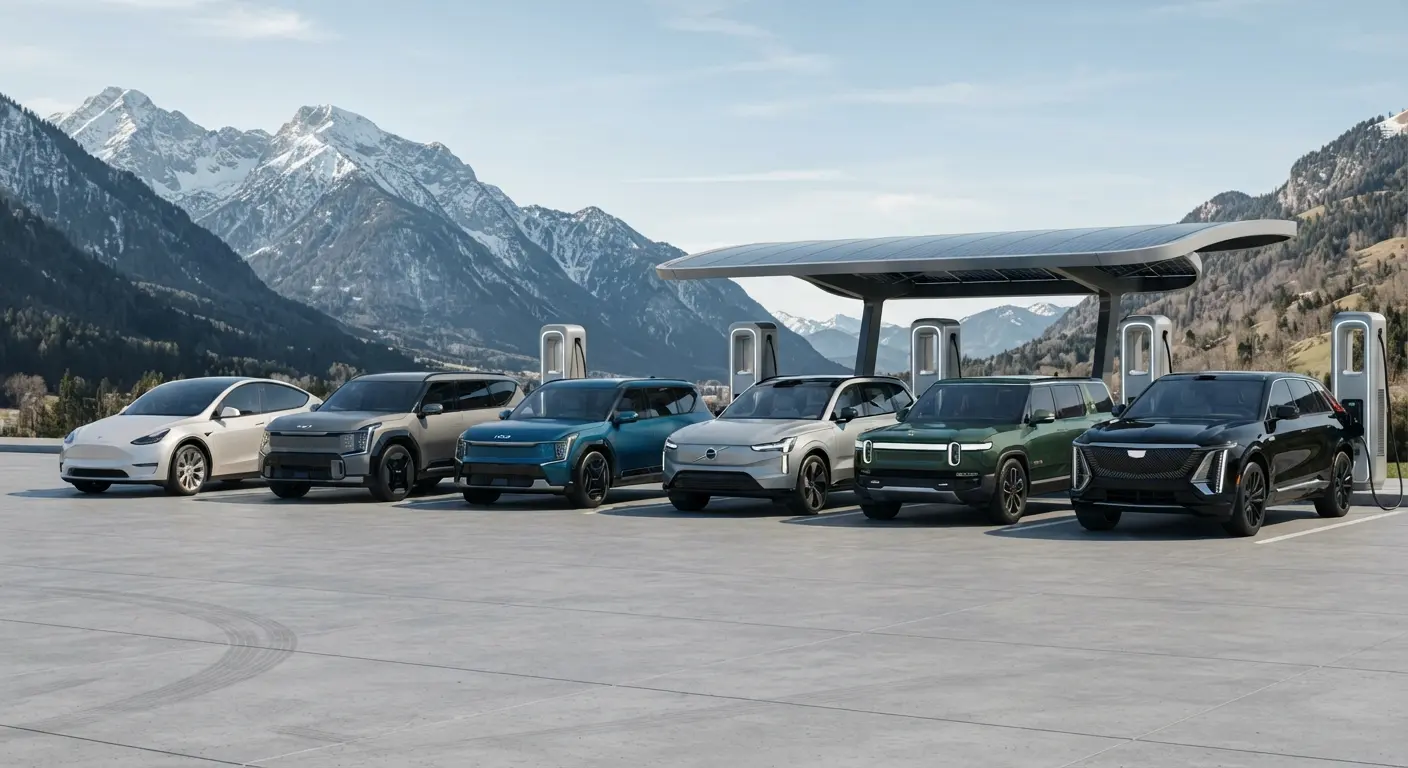
Electric SUVs have become the hottest segment in the EV market, thanks to their blend of range, space, and performance. In 2026, the lineup spans compact crossovers to full-size family haulers and luxury SUVs – often with multiple seating rows and advanced tech. The best electric SUVs offer a balance of EPA-rated range, charging speed, passenger comfort, and price. Models like the Cadillac Escalade IQ (EPA ~460 mi), Volvo EX90 (~305 mi), Tesla Model Y (~294–357 mi) and others lead the pack. This guide quickly answers “which electric SUV is best?” and then dives deep into each contender. We’ll compare range, price, seats, and other features in an easy-to-read table, plus expert tips on choosing and owning an EV. Whether you need a three-row family SUV or a luxury off-roader, these top 15 EVs will be covered in detail.
[Best Electric Cars 2026] [EV Charging Guide 2026] [How EV Batteries Work] | [EV Maintenance Guide] | [ Cheapest Electric Cars 2026] | [Longest Range EV]
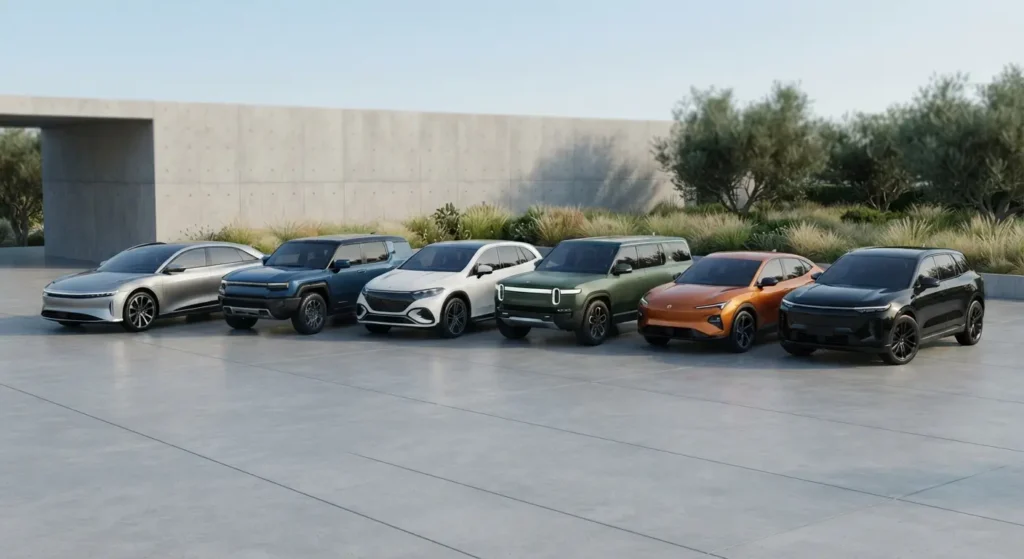
Top Electric SUVs 2026 – Quick Comparison
Electric SUVs vary from affordable two-row crossovers to luxury 7-seat behemoths. Below is a quick comparison of our top 15 picks, highlighting the EPA range, seating, and starting price (prices are approximate and may vary by market). These values give a snapshot of each SUV’s strengths:
| Vehicle | Starting Price (USD) | EPA Range (mi) | Seating | Key Feature/Note |
|---|---|---|---|---|
| Cadillac Escalade IQ | ~$105,000 | 460 | 7 seats | Full-size luxury, 205 kWh battery |
| Volvo EX90 | $78,090 | 305 | 6–7 seats | Premium 3rd-row, 670 hp (Performance) |
| Mercedes-Benz EQS SUV | $91,300 | 312–317 | 5–7 seats | Hyperscreen dashboard, 536 hp max |
| Audi Q6 e-tron | $64,500 | ~321 | 5 seats | 21-min fast-charge (10–80%) |
| Polestar 3 | $67,500 | 350 | 5 seats | Sports-sedan handling, 517 hp |
| Rivian R1S | $83,990 | 258–371 | 7 seats | Off-road capable, up to 1025 hp |
| Tesla Model Y | $41,630 | 294–357 | 5 seats | Strong range/charging, refreshed 2026 |
| Hyundai Ioniq 5 | $40,800 (RWD) | 318 | 5 seats | Retro-futuristic, optional AWD, 84 kWh |
| Ford Mustang Mach-E | $47,000 (est) | 240–320 | 5 seats | GT and Rally performance versions |
| Kia EV9 | ~$55,000 (est) | 280–305 | 6–7 seats | Three rows, 516 lb·ft torque, NACS |
| Genesis GV60 | $52,525 | 306 | 5 seats | Performance variant (483 hp) available |
| Cadillac Lyriq | $60,995 (est) | 326 | 5 seats | 33” infotainment display, 615 hp |
| Chevrolet Equinox EV | $35,000 (est) | 319 | 5 seats | Affordable, 5kW V2L (under 2026 model) |
| Honda Prologue | ~$48,000 (est) | 308 | 5 seats | Jointly-developed EV with GM |
| VW ID.4 | $45,095 | 291 | 5 seats | Best-selling global EV, AWD option |
Prices are starting MSRPs (including destination) and vary by country; range is EPA-estimated (US standard). Estimates are for base models (larger wheels and AWD can reduce range). See each section below for details and context.
What to Look for in an Electric SUV
When choosing an electric SUV, consider how you’ll actually use it. Here are some key factors:
- Range vs. Size: Larger SUVs with third rows (Escalade IQ, EX90, EV9) often have bigger batteries but also greater weight. While the Escalade IQ offers ~460 mi, a full charge, a luxury mid-size like the Lyriq offers ~326 mi. Decide if you need that extra cargo and seating space or prefer better efficiency.
- Seating & Cargo: Most electric SUVs seat 5, but many new models add a third row. The Kia EV9 and Mercedes EQS SUV can carry 6–7 people. However, third rows often suit kids or shorter trips. If you rarely use the 3rd row, a 5-seat model (e.g. Polestar 3, Mach-E) can save weight and cost.
- Charging Speed: Faster charging is crucial for road trips. Premium models tend to have 800-volt architectures (e.g. the Kia EV9, Genesis GV60) allowing 350 kW charging (10–80% in ~18-22 minutes). Make sure your region’s fast-charge network supports the SUV (some need adapters to use Tesla Superchargers, others use CCS/DC).
- Performance: Electric SUVs can range from efficient commuters to performance crossovers. The Escalade IQ and GV60 Performance have over 600+ hp (with 0–60 as low as ~4–4.5s), whereas models like the Ioniq 5 or ID.4 are more moderate (around 318 hp and ~7s). Think about whether you want a sporty driver’s SUV or a more sedate cruiser.
- Technology & Luxury: Many EV SUVs pack advanced driver aids and infotainment. For example, the Cadillac Escalade IQ has a massive 55” display span, and the Hyundai/Kia twins offer NACS compatibility for Tesla chargers. Interiors can range from utilitarian (Equinox EV, ID.4) to opulent (Mercedes EQS SUV, Polestar 3).
- Price & Incentives: EVs often cost more up front but may qualify for government rebates or tax credits. Check local incentives (which vary by country/state). An Equinox EV ($35k est.) may qualify for maximal credits, whereas a luxury Escalade IQ (~$105k) likely won’t.
- Warranty & Service: Battery warranties can make a big difference. Kia offers 10-year/100k-mile coverage on the EV9 (and all Kia EVs). Compare warranties and dealer/service availability. A strong warranty provides confidence in such expensive tech.
No single spec (“longest range” or “biggest battery”) guarantees the best SUV for your use. This guide will walk through our top picks, highlighting their unique strengths. Later sections cover practical buying tips, things to avoid, and FAQs about owning an electric SUV.
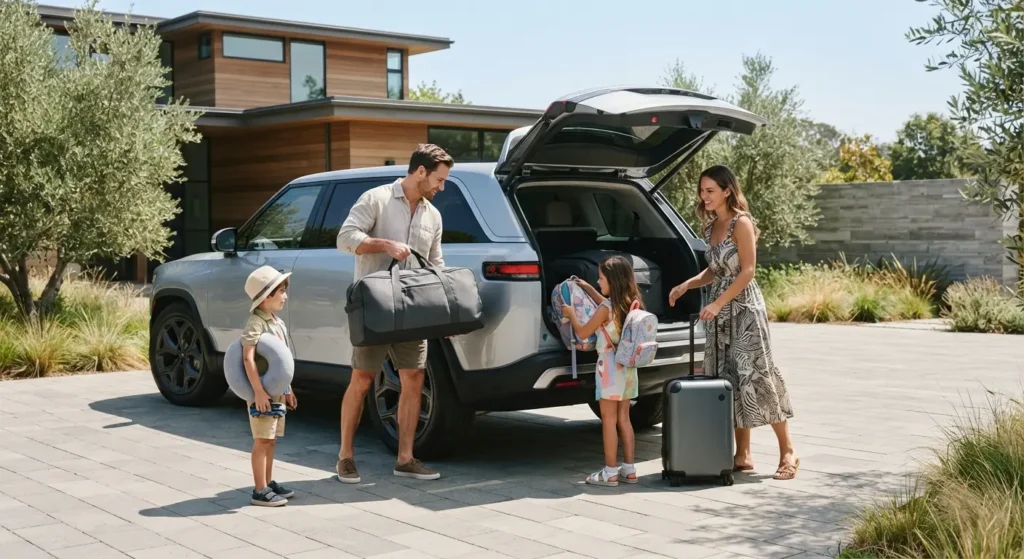
Top 15 Electric SUVs in 2026
Each of the following EVs is notable in its category. We’ve ranked them by a mix of range, features, practicality and value. Where possible we cite range and performance from EPA figures and expert tests.
Cadillac Escalade IQ
A flagship three-row luxury SUV, the Escalade IQ is massive in every sense. It seats up to seven with captain’s chairs and still has generous cargo room. This “electric limo” packs a 205 kWh battery – among the largest in any production EV – giving it up to 460 miles EPA range. Its dual-motor AWD powertrain makes up to 750 hp, yet it can still sprint 0–60 mph in ~4.5 seconds. Despite the size, the Escalade IQ is easy to drive for its class, thanks to a smooth ride and a 352 kW peak charging rate. Inside, it wows with Cadillac’s “Curved OLED” 55-inch driver+passenger display setup, plus Super Cruise hands-free driving on compatible roads. Drawbacks: it’s very expensive and huge (maneuvering and parking can be tricky). The Escalade IQ is best for large families or anyone who needs full-size utility without sacrificing luxury. With its best-in-class range, it’s the long-range champion of this list.
Volvo EX90
Volvo’s new flagship three-row electric SUV emphasizes safety and comfort. The EX90 seats 6 or 7, with all passengers pampered by high-quality materials and gentle suspension. It starts at around $78k and offers up to 305 miles EPA range (293 mi on single-motor RWD, 305 mi AWD). Charging 10–80% takes as little as 22 minutes on a 350 kW DC charger. The EX90’s top trim makes 670 horsepower (Twin Motor Performance) for a 0–60 of about 4.0 s, while the base AWD still has 442 hp and ~5.3 s. Standard safety tech is rich (aeroscreen display, 360° lidar). For tech-minded families, features like Google built-in and built-in dashcam are highlights. The EX90 is best for those wanting a family hauler with Scandinavian luxury and advanced safety. Its practical range and calm ride make it ideal for road trips or daily errands alike.
Mercedes-Benz EQS SUV
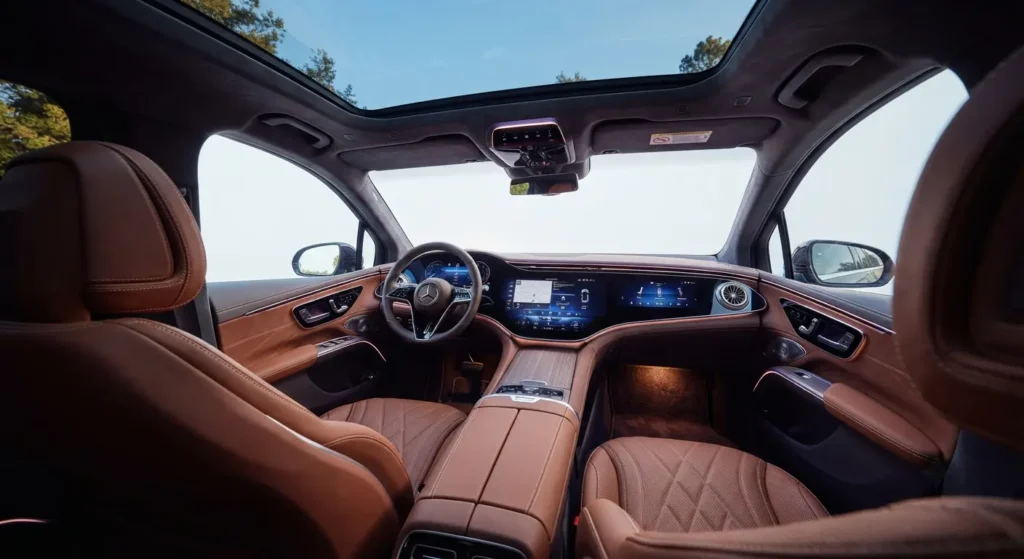
The EQS SUV is Mercedes’ ultra-luxury EV wagon with high seating. It’s big but retains typical Benz refinement. The entry EQS400 4MATIC (two-motor AWD) has 355 hp and ~312 miles EPA range, while the EQS550 tops 536 hp and ~317 mi. All have a 118 kWh battery. Inside you’ll find the massive Hyperscreen (and seven seats optionally), triple-screen dash, and air suspension. Charging speeds are excellent (800V system, up to 200 kW/350 kW rates). The ride is supremely comfortable, and rear-axle steering makes the big SUV surprisingly nimble. Downsides: it’s very expensive (MSRP ~$91k and up) and the touchscreen interface still has the Mercedes quirky side. Overall, the EQS SUV suits luxury buyers who want a plush, tech-laden EV with up to three rows – think of it as the electric S-Class of SUVs.
Audi Q6 e-tron
The Q6 e-tron is Audi’s latest compact luxury SUV, built on the new Premium Platform Electric (PPE). It replaces the Q5 in the EV lineup. Starting around $64,500, it offers up to 456 hp (in launch edition) and up to 321 miles EPA range on a 100 kWh battery. Crucially, it can charge from 10–80% in ~21 minutes at 270 kW. The Q6 delivers a familiar Audi blend of refined ride and quick acceleration (0–60 in about 4.5s for Quattro). Interior and infotainment mirror other new Audis, with a digital cockpit and high-quality finishes. Cargo space (60 cu ft behind front seats) is ample for the class. This SUV is a strong choice for buyers wanting a premium EV with quick charging and everyday practicality. Its range and build quality beat rivals like the BMW iX (no BMW iX3 in US).
Polestar 3
Polestar’s first true SUV is built alongside the Volvo EX90 (both share a platform) but with a sportier focus. The Polestar 3 (starting near $67,500) combines fastback styling with performance. Its dual-motor AWD powertrain makes up to 517 hp, enough for 0–60 around 4.5s. The big news: up to 350 miles EPA range on a charge (thanks to an 111 kWh battery). That’s exceptional for a performance SUV. Polestar partners with Google, so the interface is Android-based with integrated apps. Ride quality is firm and engaging, reflecting Polestar’s sports-car pedigree. Cargo room is decent but slightly less than the Volvo. Polestar emphasizes minimalist design (echoing Volvo) and lots of USB-C ports. The Polestar 3 is best for buyers who want a spacious 5-seat SUV that can double as a near-sports car. It’s quicker and longer-range than similarly fast luxury SUVs, and it comes at a lower price than the hottest European rivals.
Rivian R1S
The Rivian R1S is a fully off-road-capable luxury SUV with genuine 3-row seating. It’s built like a truck (aluminum body, solid construction) and earns praise for both rough-road ability and on-road refinement. Range varies by battery: the Quad-Motor Launch Edition claims up to 371 miles (EPA dual-motor RWD), while quad-motor AWD trims are around 258–320 mi. It has an astounding 1025 hp in quad-motor “Ultra Performance” trim, yet its base dual-motor RWD (78 kWh) still yields ~316 hp. Even heftier models do 0–60 in ~3.5s (quad). The R1S can tow 7,700 lbs and handle 30” water wading or 3ft obstacles. Inside, the cabin is modern and techy (15.6” and 12.3” screens) with lots of gear storage. Charging tops ~200 kW. For adventure seekers, the R1S is unbeatable. It rivals nothing else if you want true off-road electric performance plus luxury. (As a comparison, Car&Driver noted it’s a MotorTrend favorite.) The trade-off is price ($80k+), and city driving can feel big (though its air suspension is smooth).
Tesla Model Y
The Model Y remains the best-selling electric SUV globally. It’s a compact crossover by size, but with 5+2 seating (optional third row). After its 2026 facelift, it offers more range and refined interior. EPA range is about 294–357 miles depending on battery and RWD/AWD. Even the new entry “Standard” trim (smaller pack) still does ~314 mi. Performance is strong (Performance AWD ~3.5s 0–60) and charging is fast on Tesla’s Supercharger network (up to 250 kW). The interior is minimalist, centered on a 15” touchscreen. The refreshed Model Y improved materials and added a wireless charging pad, but it still lacks some standard features (no base model phone mirroring). In summary, the Model Y offers excellent range and a charging network advantage at a competitive price (starting in the low-$40k range). It’s a top choice if range and charging convenience matter most, and it’s available worldwide. Downsides are the simplistic cabin and build issues some owners report.
Hyundai Ioniq 5
The Ioniq 5 is a compact 5-seat crossover with a distinctive retro-futuristic look. It’s very popular thanks to its comfort, fast charging, and price/value. For 2026 Hyundai gave it a refresh (new interior, larger battery options, and Tesla NACS charging port). The largest 84 kWh pack in RWD form yields an EPA 318-mile range. That drops to ~260–300 mi on AWD, depending on wheels. The 63 kWh base pack is ~243 mi (AWD less). Performance is brisk (225–320 hp) with a top Mach 2.5 version at 74 hp. One highlight: Ioniq 5 charges ridiculously fast on 800V (10–80% in ~18 min on 350 kW). It also features a clear HUD and nice interior space. A new off-road “XRT” trim adds rugged styling and all-terrain tires. The Ioniq 5 blends every-day usability with quick charging and moderate price ($40k+). It’s ideal for buyers who want a fun, techy EV that’s roomy and comfortable.
Ford Mustang Mach-E
The Mach-E gave Ford a strong entry into EV SUVs. Named after the Mustang, it emphasizes sporty design and driving. It’s a two-row 5-seater. Range and power depend on battery: Standard (68 kWh) RWD is ~260 mi; Extended (88 kWh) RWD is ~320 mi. AWD models shave off ~20 mi. The GT Performance model makes ~600 hp (3.6s 0–60), but even the base is peppy (266 hp, ~6s). Charging is not class-leading (max ~150 kW), so it takes 45 min for 10–80%. The cabin is sleek with a tall 15.5” screen and optional BlueCruise hands-free driving. Cargo space is good (70 cu ft with seats down). The Mach-E’s ride is firm and driving feel is engaging. Overall, it’s best for buyers wanting a sharp-handling SUV with Mustang-like fun, and who value brand familiarity. It’s competitively priced ($44–65k range), but keep in mind some rivals now best it in range and charging speed.
Kia EV9
Kia’s EV9 is one of the few modern 3-row electric SUVs. It seats up to 7 and rivals the EV6 Ioniq’s sister. The EV9 comes with 99.8 kWh battery (800V system). RWD models reach 305 miles EPA range. In AWD GT-Line/GT trims, expect ~270–300 mi. It starts in the mid-$50k range. The base EV9 Light (RWD) is around 55k, while loaded Land AWD tops near 70k. Power ranges from ~379 hp (RWD LR) to 516 lb-ft torque (AWD with boost mode). Charging speed is up to 350 kW (10–80% in ~22 min). The cabin is spacious and loaded with tech (dual 12.3” displays, 12-speaker audio, rear seat entertainment on higher trims). Its towing capacity is 5,000 lbs. Fueling at Tesla Superchargers is supported with adapter. At nearly 198” long, the EV9 is designed as a family hauler with creature comforts (e.g. available lounge seats). It’s best for large families who want a stylish, well-equipped 3-row EV. The main compromise is that its range, while excellent, is a bit lower than full-size rivals like the Escalade IQ (due to weight). Still, as Kelley Blue Book noted, EV9 offers “Best Buy of the Year among 3-row EVs”.
Genesis GV60
The GV60 is an entry-level luxury EV crossover from Genesis (Kia/Hyundai’s luxury brand). It’s smaller (about Audi Q4 size) but packed with premium features. The GV60 only has two rows (5 seats) and starts around $53k. Its 84 kWh battery delivers up to 306 miles EPA range on RWD. The dual-motor AWD model still hits ~303 mi. A high-output Performance trim has 483 hp, but even the standard AWD makes 314 hp. Quick facts: 0–60 can be as low as 3.5s (in AWD), and DC fast charging can reach 235 kW (10–80% in ~18 min). Inside, the GV60 flaunts rotating “Crystal Sphere” shifter, plus two 12.3” screens. It also introduced NACS port compatibility and a 10-year battery warranty. The ride is smooth and quiet, but some rivals (like the Polestar 3) offer more range. The GV60 is a strong pick for buyers wanting Genesis luxury on a smaller budget – it looks sharp, accelerates hard, and includes many features standard.
Cadillac Lyriq
Cadillac’s Lyriq is a stylish midsize luxury SUV (5 seats) and a sister to the future Optiq. It’s larger than the XT4/XT5 it replaces. The Lyriq starts around $61k (est.) and offers a 326-mile range EPA on the AWD model (RWD is ~312 mi). Dual-motor AWD versions make up to 500 hp, so it’s reasonably quick (0–60 in ~4.6s). It features Cadillac’s signature curved OLED display (33 inches wide) and elegant interior with optional “sharkskin” accents. Charging supports ~200 kW DC. The ride is firm but composed. Like the Escalade IQ, it has Super Cruise on highway. The Lyriq is best if you want Cadillac luxury without going full-size. Its styling is more modern than the boxy Escalade, and its range is very competitive. On the downside, cargo space is only about average for its class. It’s a strong choice for buyers prioritizing comfort and tech (and a lower starting price) over maximum family space.
Chevrolet Equinox EV
The Equinox EV (2026) is Chevy’s affordable, compact 5-seat crossover. It starts low (around mid-$30k) and targets budget-conscious buyers. Despite the low price, it offers up to 319 miles EPA range on the long-range RWD model. (Lower trims with smaller battery do ~250–280 mi.) Its power is modest (210–290 hp), and it’s not sporty, but it is practical. Cargo volume is a generous 57 cu.ft with seats down. The interior borrows from the gas Equinox (simple design, no massive screens). Equinox EV includes a digital gauge cluster, 17” infotainment, and standard Super Cruise (hands-free driving on compatible roads). Charging caps at ~190 kW. The main advantage is cost and efficiency – it has one of the best ranges per dollar here. For example, an Equinox EV Long Range RWD ($45k est.) delivers similar range to a much pricier luxury SUV. This makes it a must-consider for urban buyers or families on a budget. Just note: the base price in Europe might be higher, and cheaper trims (RS) have shorter range. Overall, it’s Chevrolet’s answer to the VW ID.4.
Honda Prologue
The Prologue is Honda’s first all-electric SUV, developed jointly with GM. It replaces the Passport/Crosstourer style by 2026. The Prologue looks like a conventional five-seat crossover but with a boxy rear for cargo. It should be fully launched in late 2024/’25 as a 2026 model. Early specs indicate a range up to 308 miles EPA for its largest pack, with around 268 hp (similar to a CR-V hybrid) and optional AWD. It includes the Honda Sensing safety suite and is expected to have level 2 (hands-free) driving assist via GM’s BlueCruise. Honda’s focus is on reliability and affordability – the Prologue is projected to start in the high-$40k range, making it cheaper than most luxury EVs. Given Honda’s popularity, expect good availability. The Prologue will suit buyers wanting a familiar brand and steady performance. It’s basically a mainstream family SUV, so not the longest-range or flashiest, but it could be very practical for daily use. It’s essentially Honda’s mainstream competitor to the Chevy Blazer EV or VW ID.4.
Volkswagen ID.4
The VW ID.4 is a globally successful compact EV SUV. The 2026 model was refreshed with updated styling and tech. It’s a 5-seater that prioritizes practicality. With the RWD Pro trim’s 77 kWh battery, it delivers up to 291 miles EPA, which is less than some rivals here, but its advantage is availability and price. Starting around $45,095, it undercuts many. Even so, the ID.4 is roomy (64 cu.ft cargo), and VW has improved charging (up to 200 kW DC). AWD versions do ~240 mi. It’s not high performance (0–60 in ~7.0s), but it handles solidly and rides comfortably. Inside, you get a 12.9” screen and reasonable material quality. The ID.4 is a good all-rounder – not class-leading in any one spec, but balanced. It’s ideal if you want a no-nonsense EV SUV at a mainstream price, especially in Europe/Asia where ID.4 incentives may apply. In the US, it competes directly with the Equinox EV and Tesla Model Y (to some extent). If you’ve narrowed your budget, the ID.4’s lower entry cost and VW’s long history make it worth consideration despite lower range.
Practical Tips for Buying and Owning an Electric SUV
- Match Range to Your Use: Most drivers use far less than a full tank (or battery) daily. If you only commute 30–40 miles roundtrip, a 250–300 mi SUV is more than enough for week-long trips (with one charge stop). Only pay for extreme range if you frequently do >200 mi drives without easy chargers. Remember: using high power (fast charging often, towing, or lots of cargo) will reduce range.
- Home Charging: Plan to install a Level 2 charger at home. It’s the most convenient way to keep your SUV ready each morning. Even on a 40-amp circuit, many EV SUVs (like the Equinox or ID.4) can gain 25–30 miles of range per hour. Plugging in overnight fully replenishes a full battery. If overnight charging isn’t possible, look into smart charging networks and workplace chargers.
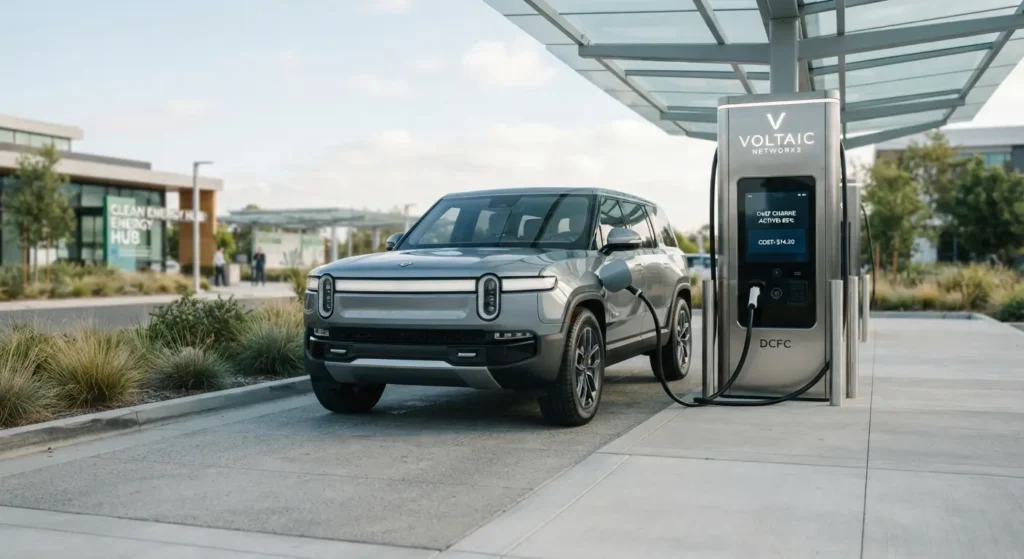
- Public Charging: In long-distance use, charging stops are the new “gas station stops.” Use apps (PlugShare, Electrify America network, etc.) to find DC fast chargers on your route. Many high-end SUVs support Tesla’s NACS plug (or via adapter), meaning access to Tesla Superchargers (for faster speeds). Vehicles on CCS (like most Audis, Ford) will use Electrify America or other networks. Always check charger compatibility and speed – a 350 kW charger can do 10–80% in ~15–20 min on capable EVs.
- Drive Efficiently: Smooth acceleration and moderate speeds maximize range. Avoid heavy right-foot driving or sustained 75+ mph highway runs. Use regenerative braking (often a pedal lift) to recapture energy in stop-and-go. Keep tires inflated and remove roof racks when not needed. Pre-conditioning the cabin (heat/cool while plugged in) saves energy from the battery once you depart, especially in extreme weather.
- Consider Total Cost of Ownership: Beyond MSRP, factor in fuel/charging costs (usually ~$0.03–$0.06 per mile versus $0.10–$0.15 for gas), EV tax credits or incentives, maintenance (EVs often have lower service needs), and insurance (EVs can be higher due to repair costs). Battery warranties typically cover 8–10 years or ~100k miles (check capacity warranty too). Some manufacturers offer free unlimited fast charging (rare) or offer convenient auto payments.
- Test Drive and Inspections: Seat comfort, visibility, and cargo fit vary widely. If you need third-row space, try loading your car seats or luggage. Check infotainment usability and blind-spot camera/mirror quality (since EVs often have cameras instead of mirrors, e.g. Mercedes EQS SUV offers digital mirrors). Also inspect build quality – early models of new EVs sometimes have finish issues. Finally, verify charging: plug in and see how charging engages (should show quickly on dash), and test any included charging adapters.
Common Mistakes to Avoid
- Focusing Only on “Biggest Battery” – More kWh ≠ better choice if you won’t use it. A modest-range SUV that charges quickly can be more cost-effective than paying extra for, say, a 300 kWh pack you’ll rarely fully utilize.
- Ignoring Charging Reality – If you can’t easily install a home charger (no garage/outlet), or your area has few public chargers, a shorter-range SUV is risky. Likewise, don’t assume all fast chargers are equal; some networks require separate accounts or have limited spots.
- Skipping Warranty Research – Battery degradation varies. Check each brand’s warranty and battery retention guarantee. For example, Kia and Hyundai offer 10-year/100k mile coverage on battery capacity, while Tesla’s is 8 years with a mileage cap.
- Forgetting Seasonal Effects – Cold or very hot weather can cut real-world range ~10–25%. In winter, plan for about 80% of EPA range unless preconditioning battery.
- Overlooking Space Needs – A “sporty” SUV (like the Mach-E or Tesla Y) has a lower ride height and less cargo than a boxy one (Equinox, ID.4). If you haul gear or have tall adults in back, double-check headroom and trunk volume.
- Neglecting Soft Costs – The most range or power doesn’t help if your SUV has poor reliability or service network. Read owner forums (e.g. EV discussion boards) for common issues (software bugs, body panel gaps, etc.). Consider how long you plan to keep it; an EV is a multi-year investment.
FAQs
What is the best electric SUV with the longest range?
Full-size electric SUVs like the Cadillac Escalade IQ (up to 460 mi EPA) and Rivian R1S (~371 mi) offer the greatest distance on a charge. However, these are luxury vehicles. Among smaller SUVs, the Kia EV9 (~305 mi) and Genesis GV60 (306 mi) are top rangeers. Always check EPA vs WLTP figures by region.
Are electric SUVs more expensive to maintain than gas SUVs?
Generally, no. EVs have fewer moving parts (no oil changes or spark plugs). Routine maintenance is usually cheaper. Electric SUVs do have expensive batteries, but most have robust warranties. Charging (electricity) often costs less per mile than gasoline. Insurance can be higher, but EVs benefit from government incentives that can offset purchase price.
How long does it take to charge an electric SUV?
It varies by charger and battery: Level 2 (home) chargers add ~20–40 mi of range per hour. DC fast chargers can add several hundred miles in an hour. For example, many modern SUVs (EV9, GV60, EQS SUV) can go from 10% to 80% in about 20–25 minutes on a 150–350 kW charger. Check each model’s “charging curve” – some EVs charge very fast at low state-of-charge and taper off.
How do I choose between an electric SUV and a gas SUV?
Consider your driving patterns and priorities. EV SUVs usually cost more up front but have lower fuel & maintenance costs. If your daily drive plus errands fits under ~200 miles, an EV SUV can handle virtually all your travel with home charging. Benefits include instant torque, quiet drive, and environmental impact. However, if you often drive routes with no fast chargers or you need ultra-long range/reliability currently (e.g., for remote travel), a gas/diesel might still be practical. Fortunately, today’s EVs are bridging those gaps rapidly.
Which electric SUV is best for families?
For families, look at seating and safety. The three-row Kia EV9, Volvo EX90, Mercedes EQS SUV, or Cadillac Escalade IQ can carry 6–7 passengers. Among these, the EV9 and EX90 offer many seats plus long range (305 mi, 293–305 mi respectively) without the ultra-luxury price. The Lyriq, Ioniq 5, and Mustang Mach-E (5 seats) are also family-friendly if you can sacrifice a bit of legroom. Always check child-seat fit and cargo space with kids.
Do electric SUVs have towing capacity?
Many do. For example, the R1S can tow 7,700 lbs, Escalade IQ 7,500 lbs, and EV9 about 5,000 lbs. Typically, SUV EVs with AWD tow more, and towing will greatly reduce range. If towing is a priority, compare towing ratings and remember it’s best on long trips to plan extra charging stops when hauling.

Conclusion
The best electric SUV depends on your priorities: how many people you carry, how far you drive, and what premium features you want. This list highlights models from longest-range family haulers (Escalade IQ, Volvo EX90) to sporty crossovers (Polestar 3, Mach-E) and value-packed commuters (Equinox EV, ID.4). Always check up-to-date EPA (or WLTP) range for your market, and plan for home and public charging. An EV SUV with a lower advertised range can still work well if you charge frequently at high-power stations and drive efficiently.
In 2026, EV technology has matured so that you can find an electric SUV to match almost any lifestyle. Review the ranges, prices, and features above, then take a few test drives. The right electric SUV will give you long range, quick charging, and the space you need – all with a modern, quiet drive and low running costs. Remember to account for local incentives, warranty terms, and your personal needs. If you have more questions about choosing or owning an EV, see our related guides on [ EV Charging Guide 2026]), [EV battery care]([How EV Batteries Work].