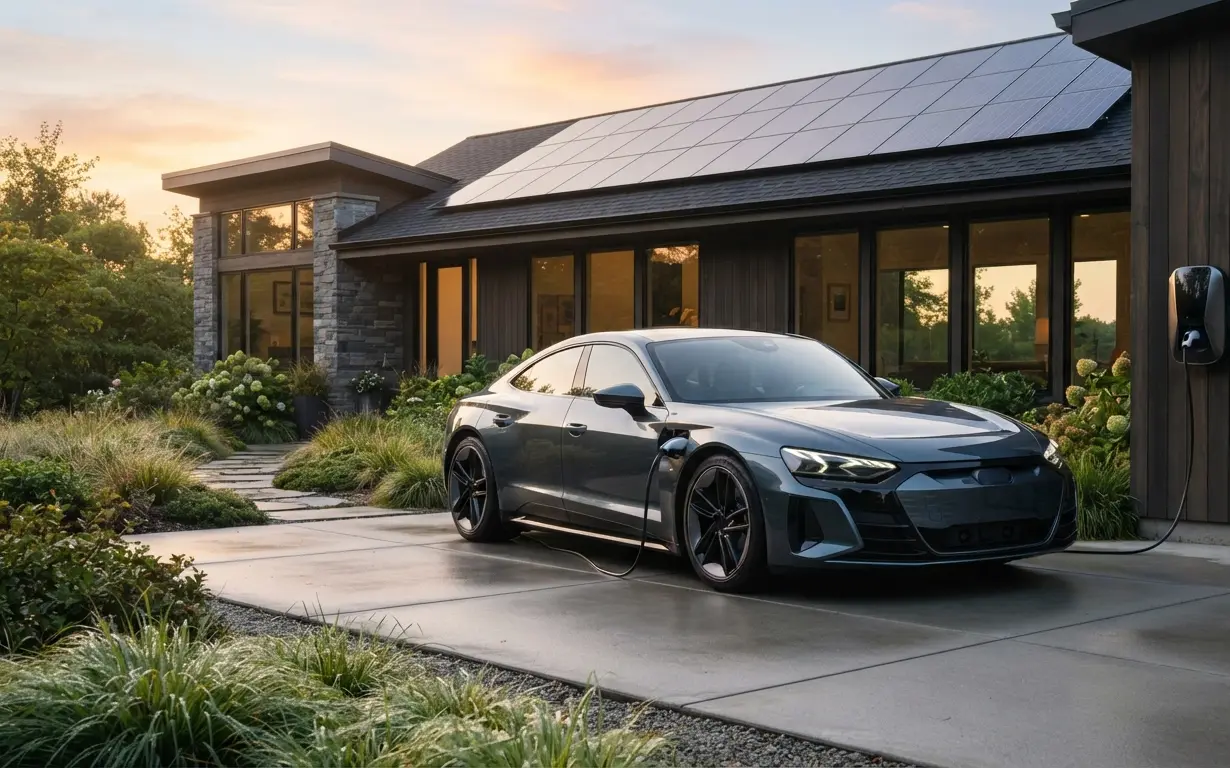
Electric vehicles are no longer a niche choice. In many parts of the world, they’re becoming the default option for drivers looking to reduce fuel costs, lower emissions, and enjoy modern technology. If you’re searching for the best electric cars 2026, you’ll find more choices than ever before—from affordable city hatchbacks to premium luxury sedans and rugged electric pickup trucks.
The best EV for you isn’t simply the one with the longest range or the fastest acceleration. It’s the one that fits your budget, driving habits, charging options, and long-term ownership plans. Some drivers need maximum highway range, while others care more about value, cargo space, or fast charging.
This guide compares the leading electric cars available or officially announced for 2026 using verified manufacturer information where available. If final specifications, pricing, or release schedules haven’t been officially confirmed, that is clearly noted.
Quick Answer:
The best electric cars of 2026 combine strong driving range, dependable charging, modern safety technology, and competitive pricing. Models from Tesla, Hyundai, Kia, BMW, Volvo, Mercedes-Benz, Porsche, Rivian, Lucid, BYD, and several other electric cars brands continue to lead different segments, with the right choice depending on your budget and driving needs.
Why 2026 Is a Great Time to Buy an Electric Car
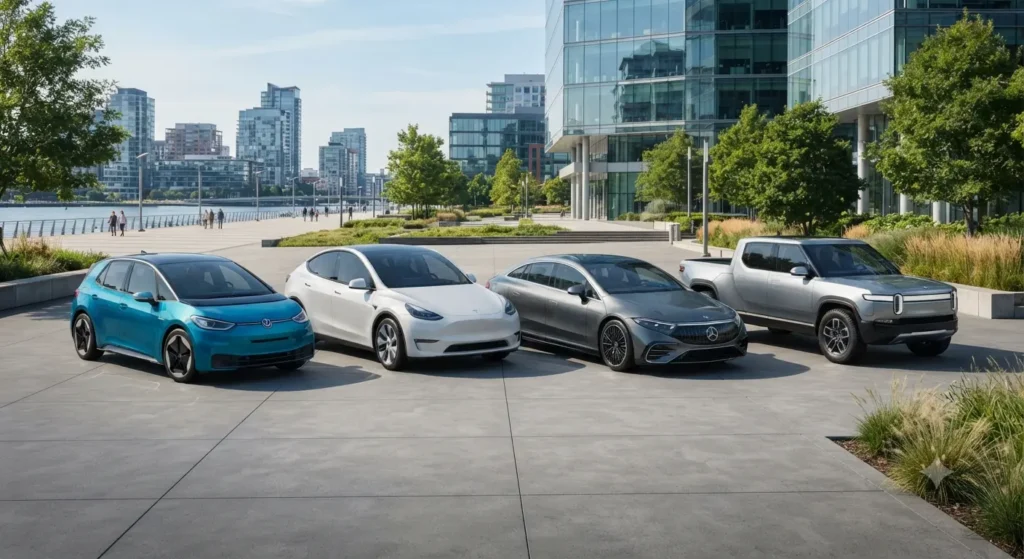
Several trends are making 2026 one of the strongest years yet for EV buyers.
Manufacturers continue expanding their electric lineups, giving buyers more options across nearly every price range. Improvements in battery efficiency, software, and charging infrastructure are also making ownership easier than it was only a few years ago.
Many new electric cars now include features that were once limited to luxury models, such as:
- Advanced driver assistance systems
- Over-the-air software updates
- Heat pumps for improved winter efficiency
- Bidirectional charging on selected models
- Larger infotainment displays
- Improved battery thermal management
- Faster DC charging
Charging networks are also expanding in many regions. North America is seeing increased adoption of the North American Charging Standard (NACS), while Europe continues using the CCS standard for most public charging stations. Connector availability still varies by manufacturer and country, so buyers should always check local compatibility before purchasing.
Government incentives can also reduce ownership costs, although eligibility changes frequently and differs by country, state, or province. Always verify current programs before making a purchase.
How We Compare the Best Electric Cars
Choosing the right EV involves much more than comparing advertised driving range.
The following factors provide a better picture of real-world ownership.
Driving Range
Range remains one of the first specifications buyers check.
Official figures are usually measured using EPA testing in the United States or WLTP testing in Europe. Since these testing methods differ, identical vehicles may receive different ratings depending on the market.
Real-world range is affected by:
- Outside temperature
- Driving speed
- Tire choice
- Passenger and cargo weight
- Terrain
- Use of heating or air conditioning
Drivers who regularly travel long distances should also consider charging speed instead of focusing only on maximum range.
Charging Performance
Fast charging reduces waiting time during road trips.
Important considerations include:
- Maximum DC fast charging capability
- Charging curve consistency
- Availability of compatible charging stations
- Home charging compatibility
A vehicle that maintains high charging speeds over a larger portion of its battery can often complete charging sessions faster than one with a higher advertised peak speed.
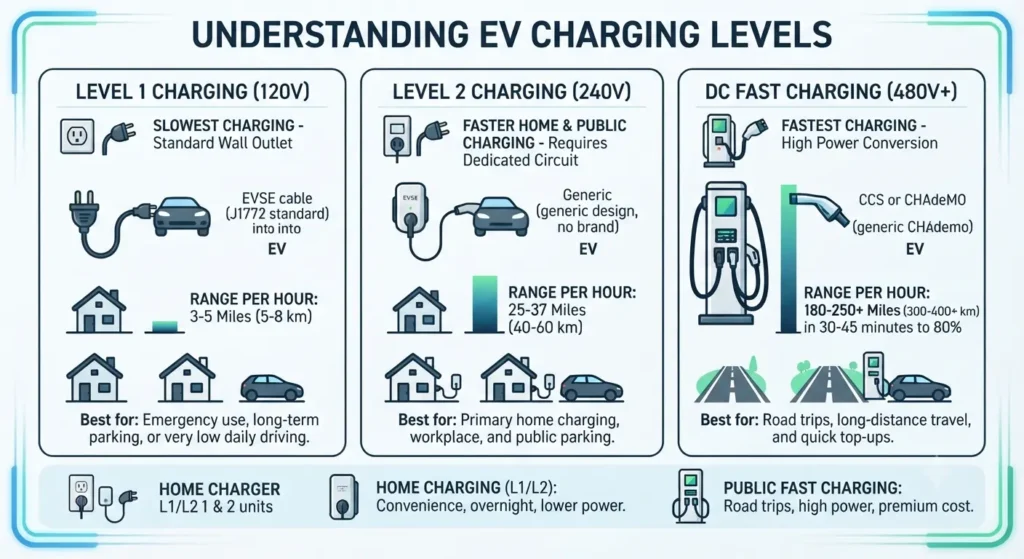
For a detailed explanation, see Level 2 vs DC Fast Charging
Purchase Price
Electric vehicle prices vary significantly between countries because of taxes, incentives, shipping costs, and trim levels.
Instead of focusing only on the lowest advertised price, compare:
- Standard equipment
- Warranty coverage
- Battery warranty
- Safety technology
- Available charging accessories
Some premium EVs may cost more initially but offer additional technology or longer warranties.
Running Costs
Many buyers underestimate the long-term savings associated with EV ownership.
Compared with gasoline vehicles, electric cars generally require less routine maintenance because they have fewer moving parts.
Owners usually spend less on:
- Oil changes
- Engine servicing
- Transmission repairs
- Exhaust system maintenance
However, electricity prices, insurance premiums, and tire replacement costs vary by location.
For a complete breakdown, see EV Maintenance Guide.
Safety and Technology
Most modern EVs include a wide range of safety systems.
Look for features such as:
- Automatic emergency braking
- Adaptive cruise control
- Blind-spot monitoring
- Lane-keeping assistance
- Rear cross-traffic alert
- Multiple airbags
- High crash-test ratings where available
Technology matters too, but ease of use is just as important as having a large touchscreen.
Practical Everyday Use
Specifications alone don’t tell the whole story.
Think about how the vehicle fits your daily routine.
Questions worth asking include:
- Can you charge at home?
- How often do you travel more than 300 km (186 miles) in one trip?
- Do you need all-wheel drive?
- Is cargo space important?
- Will the rear seats comfortably fit your family?
- Does your area have reliable public charging?
Answering these questions often narrows the list more effectively than comparing horsepower figures.
Best Electric Cars 2026 by Category
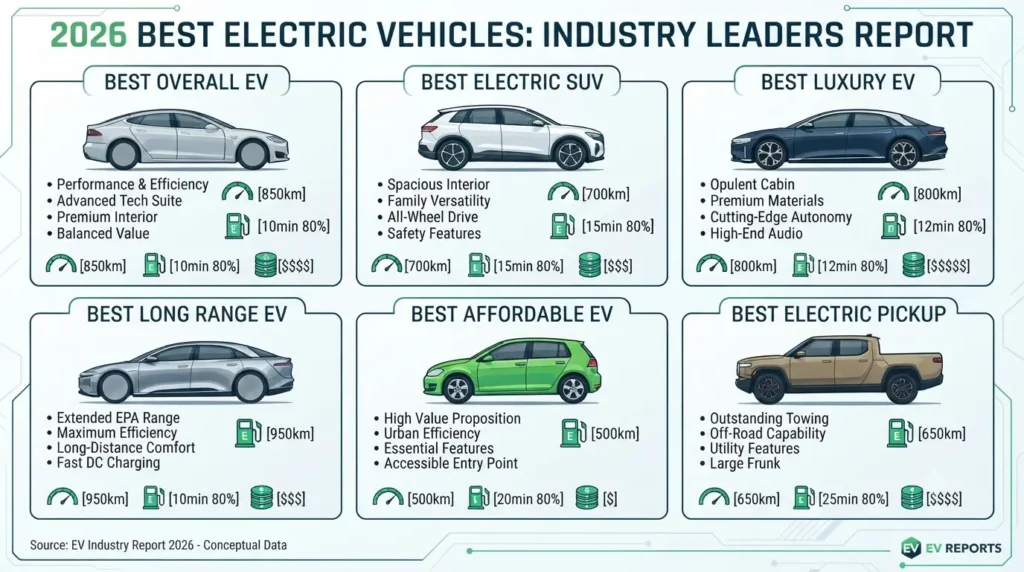
No single EV is the perfect choice for everyone. Different models excel in different areas.
The following categories highlight where each vehicle stands out based on officially available information.
Best Overall Electric Car: Tesla Model 3
The Tesla Model 3 continues to be one of the strongest all-around choices thanks to its balance of efficiency, performance, charging convenience, and software features.
Its advantages include:
- Excellent energy efficiency
- Access to Tesla’s Supercharger network in many markets
- Frequent software updates
- Strong safety reputation
- Multiple trim levels
Potential drawbacks include:
- Minimalist interior design may not appeal to everyone.
- Physical controls are limited compared with many competitors.
- Equipment and pricing vary by market.
The Model 3 remains one of the benchmark best electric cars for everyday drivers.
Best Family Electric SUV: Hyundai IONIQ 5
The Hyundai IONIQ 5 combines practicality with impressive charging capability.
Highlights include:
- Spacious cabin
- Comfortable ride quality
- Modern interior
- Available all-wheel drive
- Ultra-fast charging capability on suitable high-power chargers
Families also benefit from generous rear-seat space and flexible cargo capacity.
The IONIQ 5 remains one of the easiest EVs to recommend for buyers wanting comfort without moving into the luxury segment.
Best Electric SUV for Long Trips: Kia EV9
The Kia EV9 offers three-row seating while maintaining competitive charging performance.
Why buyers like it:
- Large interior
- Family-friendly layout
- Advanced safety features
- Modern technology
- Multiple seating configurations
Depending on trim level and market, the EV9 is available with either rear-wheel drive or all-wheel drive.
Its size makes it particularly attractive for larger families needing extra passenger space.
Best Luxury Electric Sedan: BMW i5
Drivers wanting a traditional luxury experience may appreciate the BMW i5.
It combines:
- Premium interior materials
- Quiet cabin
- Refined ride quality
- Advanced driver assistance features
- Strong performance across multiple trims
Unlike some technology-focused competitors, the i5 maintains familiar controls alongside its digital displays, making it easier for drivers transitioning from conventional luxury sedans.
Best Luxury Performance EV: Porsche Taycan
The Porsche Taycan continues to stand out for drivers prioritizing handling and performance.
Notable strengths include:
- Excellent steering precision
- Strong braking performance
- High-quality interior
- Fast charging capability
- Multiple body styles depending on market
Its premium pricing places it outside many budgets, but it remains one of the most rewarding electric sports sedans available.
Best Premium Long-Range EV: Lucid Air
The Lucid Air continues to attract attention for its outstanding efficiency and impressive officially rated driving range on selected versions.
Its strengths include:
- Exceptional highway range on certain trims
- Spacious luxury cabin
- Strong acceleration
- Premium materials
- Advanced driver-assistance technology
It’s important to note that range differs considerably between trims, wheel sizes, and markets. Buyers should always compare the official specifications for the exact version they’re considering.
Best Electric Pickup Truck: Rivian R1T
Electric pickup trucks continue to gain popularity, especially in North America, where many buyers want a vehicle that can handle both daily commuting and weekend adventures.
The Rivian R1T remains one of the most capable electric pickups currently available.
Its strengths include:
- Impressive off-road capability
- Available quad-motor and dual-motor configurations (depending on trim)
- Adjustable air suspension
- Large front trunk (frunk)
- Innovative storage solutions such as the Gear Tunnel
- Strong towing capability for an EV
The R1T isn’t the least expensive pickup on the market, but it offers a balance of performance, practicality, and technology that few competitors currently match.
Potential downsides include:
- Premium pricing
- Towing significantly reduces driving range, as it does with all electric pickups
- Availability varies by region
Best Electric Cars with Longest Range
Driving range remains one of the most searched topics among EV buyers. However, range alone shouldn’t determine your decision. Charging speed, efficiency, and infrastructure often matter just as much during real-world ownership.
The following models are widely recognized for offering some of the longest officially rated ranges available on selected trims.
| Model | Approximate Official Range* | Best For |
|---|---|---|
| Lucid Air | Among the highest available on select versions | Maximum highway range |
| Tesla Model S | Long-distance travel | Premium sedan |
| Mercedes-Benz EQS Sedan | Luxury touring | Comfort and refinement |
| Tesla Model 3 Long Range | Everyday efficiency | Daily commuting and road trips |
| Hyundai IONIQ 6 | Excellent efficiency | Value-focused buyers |
*Official range figures vary depending on testing standards (EPA or WLTP), trim level, wheel size, weather conditions, and driving style.
If you regularly drive less than 50 miles (80 km) per day—which is common for many drivers—you may not need the longest-range EV available. Instead, factors like charging convenience and purchase price could have a greater impact on your ownership experience.
Best Affordable Electric Cars
Not everyone needs a luxury EV. Fortunately, several manufacturers now offer capable electric cars at more accessible price points.
Popular affordable choices include:
BYD Dolphin
BYD has become one of the world’s fastest-growing EV manufacturers.
The Dolphin offers:
- Competitive pricing in supported markets
- Practical interior
- Good energy efficiency
- Modern safety technology
- LFP battery chemistry on many versions
Availability depends on the country, and it’s not sold in every market.
MG4 Electric
The MG4 has earned praise in many markets for delivering strong value.
Reasons buyers like it include:
- Competitive pricing
- Rear-wheel-drive platform
- Comfortable ride
- Practical hatchback design
- Good driving dynamics
It’s particularly attractive for buyers entering the EV market for the first time.
Hyundai Kona Electric
The latest Kona Electric continues to be a practical crossover with:
- Comfortable interior
- Good efficiency
- User-friendly controls
- Modern driver assistance features
- Strong warranty coverage in many markets
It suits commuters, small families, and anyone looking for a compact SUV.
Best Electric Cars Brands in 2026
Several manufacturers continue leading the transition to electric mobility. Each has its own strengths.
Tesla
Best known for:
- Charging ecosystem
- Software updates
- Efficiency
- Performance
Ideal for buyers who prioritize charging convenience and technology.
Hyundai
Hyundai focuses on:
- Excellent value
- Fast charging
- Comfortable interiors
- Reliable engineering
Its E-GMP platform has become one of the industry’s most respected EV architectures.
Kia
Kia offers:
- Spacious SUVs
- Practical family vehicles
- Strong warranties in many regions
- Fast charging capability
BMW
BMW continues to blend traditional luxury with modern electric technology.
Buyers who prefer familiar controls instead of touchscreen-heavy interiors often appreciate BMW’s approach.
Mercedes-Benz
Mercedes-Benz focuses on:
- Luxury
- Quiet cabins
- Long-distance comfort
- Premium technology
The EQ lineup targets buyers looking for refinement over outright sportiness.
Porsche
Porsche remains one of the leaders in electric driving performance.
Drivers seeking sports-car handling often place the Taycan near the top of their list.
Rivian
Rivian specializes in:
- Adventure-focused vehicles
- Off-road capability
- Innovative storage
- Premium electric trucks and SUVs
Lucid
Lucid emphasizes:
- Efficiency
- Luxury
- Long driving range
- High-performance electric sedans
BYD
BYD has expanded rapidly across Asia, Europe, Australia, and several other markets.
Its strengths include:
- Competitive pricing
- Battery expertise
- Wide model range
- LFP battery technology
Battery Technology: Why It Matters
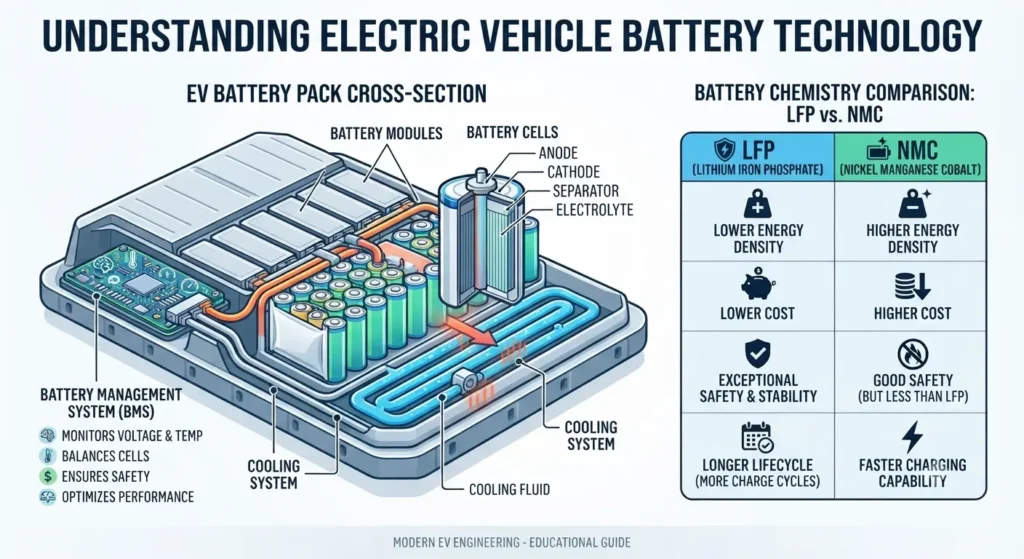
The battery is the most expensive component of an electric vehicle.
Today’s mainstream EVs generally use one of two lithium-ion chemistries.
| Battery Type | Advantages | Trade-offs |
|---|---|---|
| LFP (Lithium Iron Phosphate) | Long lifespan, lower cost, improved thermal stability | Lower energy density, typically shorter range |
| NMC (Nickel Manganese Cobalt) | Higher energy density, longer driving range | Higher production cost, greater reliance on critical minerals |
Neither chemistry is universally better.
For example:
- City drivers may benefit from the durability of LFP batteries.
- Long-distance drivers often prefer the higher energy density of NMC batteries.
Manufacturers choose battery chemistry based on the intended purpose of each vehicle rather than following a one-size-fits-all approach.
For a deeper explanation, see How EV Batteries types.
Charging Connectors Around the World
Charging compatibility depends on where you live.
The most common standards include:
| Connector | Common Markets | Typical Use |
|---|---|---|
| NACS | North America (growing adoption) | AC and DC charging |
| CCS | Europe, many global markets | Public DC fast charging and AC charging |
| CHAdeMO | Older Japanese EVs | Limited use in newer vehicles |
Some manufacturers now provide adapters or are transitioning between connector standards, so buyers should confirm compatibility before purchasing a vehicle.
What Should You Consider Before Buying an EV?
A long specification sheet doesn’t guarantee you’ll enjoy living with a vehicle every day.
Ask yourself these questions before making a purchase:
1. Can You Charge at Home?
Home charging is usually the most convenient and cost-effective way to own an EV.
If you have off-street parking, installing a Level 2 charger can significantly reduce charging times.
Read more in Best Home EV Chargers.
2. How Far Do You Usually Drive?
Be realistic.
Many buyers overestimate how much range they actually need.
If your daily commute is only 30–40 miles (50–65 km), almost any modern EV can comfortably handle it.
3. Do You Take Frequent Road Trips?
If you regularly drive hundreds of miles in a single day, prioritize:
- Fast charging
- Reliable charging networks
- Efficient highway performance
These factors often matter more than a slightly larger battery.
4. Consider Long-Term Ownership Costs
Look beyond the purchase price.
Also compare:
- Insurance
- Electricity costs
- Tire replacement
- Warranty coverage
- Battery warranty
- Service availability
The cheapest EV upfront isn’t always the least expensive to own over several years.
5. Test Drive Multiple Models
Paper specifications can’t tell you:
- Seat comfort
- Cabin noise
- Visibility
- Driving position
- Suspension comfort
- Infotainment usability
A short test drive often changes buyers’ opinions more than hours of online research.
Practical Tips Before Buying an Electric Car in 2026
Buying an EV is slightly different from buying a traditional gasoline vehicle. The ownership experience depends heavily on your driving habits, charging access, and local conditions.
These practical steps can help you choose the right electric car.
1. Calculate Your Real Driving Needs
Don’t buy an EV based only on the highest advertised range.
Start by tracking your normal driving:
- Average daily distance
- Weekly commuting needs
- Weekend travel habits
- Frequent long-distance routes
For many drivers, a vehicle with 250–300 miles (400–480 km) of official range is already more than enough.
A larger battery may increase the purchase price and vehicle weight without providing meaningful benefits for your daily life.
2. Check Charging Options Before Buying
Charging availability should be one of your first considerations.
Look at:
- Home charging possibilities
- Workplace charging options
- Public charging stations near your regular routes
- Charging network reliability
Drivers with home charging usually experience the biggest convenience advantage because they can start each day with a full battery.
Apartment residents or people without private parking should research public charging access before choosing an EV.
3. Compare Total Ownership Cost
The purchase price is only one part of EV ownership.
Consider:
Purchase Costs
- Vehicle price
- Taxes and registration fees
- Available incentives
- Charging equipment installation
Long-Term Costs
- Electricity rates
- Insurance
- Tires
- Maintenance
- Repairs outside warranty
An EV with a slightly higher upfront price may become more affordable over time because of lower energy and maintenance costs.
4. Understand Battery Warranty Coverage
Battery technology has improved significantly, but the battery remains the most expensive component of an EV.
Before buying, check:
- Battery warranty length
- Mileage limits
- Coverage conditions
- Transferability if buying used
Most manufacturers provide separate battery warranties from the rest of the vehicle, but terms vary by region.
5. Consider Climate Conditions
Weather affects electric vehicle performance.
Cold temperatures can reduce range because:
- Batteries operate less efficiently
- Cabin heating requires energy
- Tire resistance increases
Hot climates can also affect battery performance, especially without effective thermal management.
Features such as heat pumps and advanced battery cooling systems can improve efficiency in challenging conditions.
Common Mistakes EV Buyers Should Avoid
Electric vehicles can be excellent choices, but buyers sometimes make decisions based on incomplete information.
Here are common mistakes and how to avoid them.
Mistake 1: Choosing Only by Maximum Range
A longer range number looks attractive, but it may not provide better value.
A vehicle with slightly less range but faster charging and better efficiency may be more practical for long trips.
Better approach:
Match range to your actual driving habits.
Mistake 2: Ignoring Charging Infrastructure
Some buyers purchase an EV without checking charging availability.
This can create frustration, especially for people who cannot install home charging.
Better approach:
Research charging stations around your home, workplace, and common travel routes before purchasing.
Mistake 3: Assuming Every EV Charges at the Same Speed
Two vehicles with similar battery sizes can have very different charging performance.
Charging depends on:
- Battery architecture
- Charging curve
- Temperature
- Charger power
- Software management
Better approach:
Check real charging performance, not only battery capacity.
Mistake 4: Buying More Vehicle Than You Need
A large electric SUV or high-performance model may seem attractive, but it can increase:
- Purchase cost
- Insurance expenses
- Tire costs
- Energy consumption
Better approach:
Choose the smallest EV that comfortably meets your needs.
Mistake 5: Forgetting About Resale Value
EV technology changes quickly, and depreciation can vary between models.
Factors affecting resale value include:
- Brand reputation
- Battery health
- Warranty coverage
- Software support
- Market demand
Research current used EV prices before making a decision.
Frequently Asked Questions About the Best Electric Cars 2026
What are the best electric cars 2026 has to offer?
The best electric cars in 2026 depend on your needs. The Tesla Model 3 is a strong all-round choice, Hyundai IONIQ 5 and Kia EV9 are excellent family options, Porsche Taycan suits performance buyers, Lucid Air targets luxury long-range driving, and Rivian offers one of the most capable electric trucks.
Which electric cars have the longest range?
Some of the electric cars with longest range include selected versions of the Lucid Air, Tesla Model S, Mercedes-Benz EQS Sedan, Tesla Model 3 Long Range, and Hyundai IONIQ 6. Exact range depends on trim level, battery configuration, testing method, and market.
Are electric cars cheaper to own than gasoline cars?
In many cases, EVs can cost less to operate because they typically require less routine maintenance and electricity can be cheaper than gasoline. However, savings depend on local electricity prices, fuel costs, insurance rates, and vehicle pricing.
How long do electric car batteries last?
Modern EV batteries are designed to last many years. Battery lifespan depends on factors such as climate, charging habits, battery chemistry, and usage patterns. Most manufacturers provide long-term battery warranties, but exact coverage differs by region.
Is it better to buy an EV in 2026 or wait?
For many buyers, 2026 offers a strong selection of EVs with improved range, charging capability, and technology. However, waiting may make sense for people who need lower prices, more charging infrastructure, or a specific upcoming model.
The right decision depends on your current vehicle needs and local market conditions.
Which EV brand is the most reliable?
Reliability varies by model rather than brand alone. Established manufacturers such as Hyundai, Kia, Tesla, BMW, Mercedes-Benz, and others have developed significant EV experience, but buyers should research the specific model, warranty, service availability, and owner feedback.
Best Electric Cars 2026: Final Thoughts
The best electric cars 2026 are not defined by one feature. A great EV combines practical range, convenient charging, reasonable ownership costs, strong safety technology, and a driving experience that fits your lifestyle.
Tesla continues to lead in efficiency and charging convenience, Hyundai and Kia provide some of the strongest value-focused EVs, luxury brands offer premium electric experiences, and companies like Rivian, Lucid, and BYD continue expanding what electric vehicles can offer.
Before buying, focus less on chasing the biggest battery or fastest acceleration numbers. The right electric car is the one that matches your daily driving, charging situation, budget, and long-term expectations.
For most buyers, a practical EV with reliable charging access and a comfortable interior will deliver a better ownership experience than a more expensive model with features they rarely use.