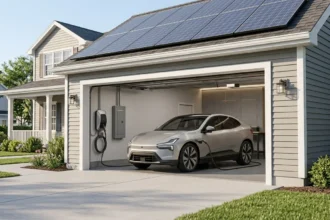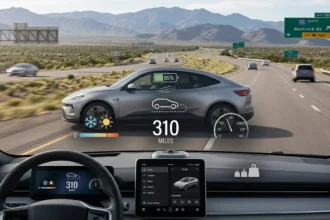
How long does it take to charge an electric car? It depends on the EV, battery size, charger power, starting battery level, and charging method.
Our EV charging time calculator estimates how long a charging session will take based on your vehicle and charger. You can select an EV, enter its usable battery capacity and charging limits, choose a home or public charger, and set the battery window you want to charge.
The calculator also estimates energy added, charging power, range added, range gained per hour, and a benchmark 10% to 80% charging time.
For DC fast charging, it also accounts for the fact that charging power usually falls as the battery gets closer to full. That makes the estimate more useful than simply dividing battery size by the charger’s advertised maximum power.
EV charging time calculator
How long does a charge take? Pick your car and charger, set the battery window, and see the estimated time — including the slowdown above 80% on fast chargers.
How this works: time = energy added ÷ effective charging power. On AC, power is the lower of the charger and your car’s on-board charger, with ~10% charging losses included. On DC, real cars don’t hold their peak: we assume an average of 70% of peak power up to 80% state of charge and 35% of peak above 80%, which matches typical published charging curves. Cold batteries, shared chargers and preconditioning change real times. Model figures compiled from Open EV Data and manufacturer specs — approximate values, estimates only.
How to Use the EV Charging Time Calculator
Start by selecting your electric car from the vehicle list.
The calculator loads approximate values for:
- usable battery capacity
- maximum AC charging power
- maximum DC charging power
- estimated efficiency
You can adjust these values manually when you know the figures for your exact vehicle.
Next, choose the charger.
The calculator includes regular household outlets, home wallboxes, public AC charging, DC fast charging, and higher-power DC charging. You can also enter a custom charger.
Finally, set your starting and target battery percentages.
For example, a 20% to 80% session means you’re asking the calculator to estimate the time needed to add 60 percentage points of battery charge.
The result is an estimate, not a guaranteed charging time.
How Long Does It Take to Charge an Electric Car?
There is no single charging time that applies to every EV.
A small electric car with a relatively small battery connected to a modest charger can need several hours. A larger EV connected to a high-power DC fast charger may reach 80% much more quickly.
The main variables are:
Battery size: A larger battery generally takes longer to fill when all else is equal.
Starting state of charge: Charging from 60% to 80% requires much less energy than charging from 10% to 80%.
Charger power: A 11-kW AC charger can deliver energy much faster than a 1.4-kW household outlet.
Vehicle charging limit: A powerful charger does not automatically mean the car will accept that much power.
Charging method: AC home charging and DC fast charging behave differently.
Battery temperature and condition: Temperature management and battery conditioning can change charging performance.
The U.S. EPA’s own home EV charging calculator also focuses on the relationship between the vehicle, daily driving needs, and available charging hours rather than treating charging as one fixed number.
How the EV Charging Time Calculator Works
The basic idea is simple:
Charging time = energy needed ÷ effective charging power
The energy needed depends on the battery capacity and the amount of charge you’re adding.
For example, a 75-kWh usable battery charged from 20% to 80% requires:
75 × 0.60 = 45 kWh
At that point, the calculation needs to consider how much charging power the vehicle can actually use.
For AC charging, the effective charging power is limited by the lower of the charger output and the vehicle’s onboard AC charging limit. The calculator also includes an approximately 10% charging-loss assumption in its time estimate.
For DC fast charging, the calculation uses a reduced average power rather than assuming the vehicle holds its advertised peak power for the entire session.
That distinction matters because real DC fast charging normally tapers as the battery fills.
Why Your Car’s Maximum Charging Power Matters
One of the easiest mistakes is to look only at the charger.
Imagine an EV whose onboard AC charger accepts a maximum of 11 kW.
Connecting that vehicle to a 22-kW AC charger does not turn it into a 22-kW charging vehicle.
The car remains the limiting factor.
That’s why the calculator asks for both:
Maximum AC charging power
and
Charger power
It then uses the lower value for the AC calculation.
The same principle applies to DC fast charging. A vehicle may be connected to a 350-kW charger but still have a much lower maximum DC charging rate.
Level 1 EV Charging Time
Level 1 charging uses a standard household outlet in markets where that setup is appropriate.
In the U.S., a common example is a 120-volt household outlet. Charging power is relatively low, so adding a large amount of energy can take many hours.
Level 1 can still be useful for drivers with modest daily mileage because an EV doesn’t necessarily need to be fully recharged every day.
The EPA notes that some drivers may be able to meet their daily charging needs with a standard home outlet depending on how far they drive and how much time the vehicle is parked.
Level 2 EV Charging Time
Level 2 charging is substantially faster than a standard household outlet and is commonly used for home wallboxes and public AC charging.
Your actual charging time depends on both the charger’s output and the vehicle’s onboard AC limit.
For example, a car limited to 7.4 kW AC won’t gain an advantage from a 22-kW AC connection beyond what the vehicle can accept.
This is why Level 2 EV charging time should always be considered together with the vehicle’s AC charging capability.
For many drivers, Level 2 charging is useful because the car can replenish energy while parked overnight or during a workday.
DC Fast Charging Time
DC fast charging is designed to add a substantial amount of energy in a shorter period.
But advertised peak power doesn’t equal average charging power.
A vehicle may reach a high peak rate for part of a charging session and then reduce its power as the battery fills.
That behavior is called charging taper.
It is one reason a claim such as “this EV charges at 250 kW” doesn’t mean the vehicle will charge at 250 kW from 20% all the way to 100%.
The actual session can be much more complicated.
Our calculator therefore estimates DC fast-charging time using reduced effective charging power and separately accounts for charging above 80%, where the slowdown can become more significant.
That approach reflects the basic limitation of using advertised peak power as a proxy for an entire charging session.
Why Charging Slows Above 80%
The final part of an EV charging session often takes longer than the early and middle portions.
When the battery approaches a high state of charge, charging power can taper.
This is especially important with DC fast charging.
For road-trip planning, the difference matters because stopping for an extra percentage point of charge can take disproportionately longer as the battery approaches full.
That’s why 10% to 80% or 20% to 80% comparisons are often more informative for fast charging than simple 0% to 100% calculations.
Your actual vehicle’s charging curve will still depend on its battery, temperature, state of charge, software, and other conditions.
How Long Does It Take to Charge an EV From 20% to 80%?
A 20% to 80% session adds 60% of the usable battery.
For a 50-kWh usable battery:
50 × 0.60 = 30 kWh
For a 75-kWh usable battery:
75 × 0.60 = 45 kWh
For a 100-kWh usable battery:
100 × 0.60 = 60 kWh
The time then depends on the effective charging power.
This is why two EVs connected to the same charger can have different charging times.
How Long Does It Take to Charge an EV to 100%?
Charging to 100% can take longer than a simple battery-capacity calculation suggests, particularly when using DC fast charging.
The final portion can be affected by charging taper, so the last part of the session may take considerably longer than the earlier part.
For that reason, the calculator is better treated as an estimate of charging time, especially for DC charging, rather than a promise of an exact plug-in-to-unplug time.
For home AC charging, the result can often be easier to estimate because charging is generally more stable than DC fast charging, although the vehicle can still adjust its charging power.
EV Charging Time by Charger Power
Charging power provides a useful way to understand the difference between charger types.
| Charger type | Typical use | Charging-time behavior |
|---|---|---|
| Household outlet | Basic home charging | Slowest |
| Level 2 / home wallbox | Home and workplace charging | Much faster than a standard outlet |
| Public AC | Destination charging | Depends on vehicle and station |
| DC fast | Road trips and rapid charging | Fast, but charging power tapers |
| High-power DC | Modern fast-charging sites | Very fast when the EV can accept the available power |
The exact result still depends on your vehicle.
A larger charger does not guarantee a proportionally faster charge if the car cannot accept the additional power.
EV Charging Speed vs Charging Time
Charging speed and charging time are related but not identical.
A charger with a higher power rating can potentially deliver more energy per hour.
But your real charging speed is constrained by the vehicle and the battery’s charging behavior.
For example, a vehicle might accept high DC power briefly and then reduce its rate.
This means two EVs connected to the same 150-kW charger can have different real-world charging times.
A useful way to think about the difference is:
Charging power = how quickly energy can be delivered
Charging time = how long it takes to add the energy you need
The calculator combines those two ideas.
How Much Range Can an EV Add Per Hour?
Charging time isn’t always the most useful number.
For road trips, you may also want to know how much driving range you’re adding during a charging stop.
The calculator estimates range added and range added per hour using the vehicle’s efficiency.
A more efficient EV can gain more driving range from the same amount of electrical energy than a less efficient EV.
This is another reason that charger power alone doesn’t tell the whole story.
Does a Bigger Battery Always Take Longer to Charge?
Usually, all else being equal, adding more energy takes more time.
But battery capacity isn’t the only factor.
A larger EV battery paired with a much higher charging power can potentially recharge faster than a smaller battery connected to a much slower charger.
Vehicle charging limits and the shape of the charging curve also matter.
For this reason, comparing battery size alone isn’t enough when you are evaluating charging performance.
What Can Make EV Charging Take Longer?
Real charging sessions can differ from calculator estimates because of several factors.
Battery temperature
Very cold or very hot battery conditions can affect the rate at which the vehicle accepts power.
Battery state of charge
Charging behavior can change as the battery moves from a low state of charge toward a high one.
Charger sharing
Some charging sites can dynamically manage power, and the power available to an individual vehicle may not always remain constant.
Battery preconditioning
Vehicles may prepare the battery before fast charging to improve charging performance under the right conditions.
Vehicle software
Charging behavior can change through software updates or vehicle-specific battery management strategies.
These variables are why calculator outputs should always be described as estimates rather than exact guarantees.
What Is the Fastest Way to Charge an EV?
For most EVs, DC fast charging is the quickest common charging method.
But “fastest charger” and “fastest possible charging session” aren’t necessarily the same thing.
The EV must support the available charging power, and its charging curve determines how long it can maintain a high rate.
For example, plugging a vehicle with a 150-kW maximum into a 350-kW charger doesn’t make the car charge at 350 kW.
The vehicle remains the limiting factor.
How Long Does It Take to Charge an EV at Home?
Home charging time depends primarily on:
- battery size
- starting battery percentage
- target percentage
- home charger power
- vehicle’s AC charging limit
- charging losses
A standard outlet can take much longer than a dedicated wallbox.
A Level 2 wallbox can substantially reduce charging time, especially for drivers who regularly add a large amount of energy overnight.
The EPA’s home charging calculator similarly frames home charging around the relationship between daily driving, available charging hours, and charger speed.
How Long Does It Take to Charge an EV at a Charging Station?
A public charging session can range from relatively slow AC charging to high-power DC charging.
Public AC is often used when the car will be parked for longer periods.
DC fast charging is more relevant when you need to add meaningful range during a shorter stop.
The most important details are the station’s available power and your vehicle’s charging capability.
The advertised charger rating alone isn’t enough to predict the exact session length.
EV Charging Time Calculator vs. a Simple Formula
A simple formula can be useful:
Time = energy required ÷ charging power
But it becomes less reliable when the charger power doesn’t remain constant.
For AC charging, the simplified approach can work reasonably well when the effective power is stable and the vehicle’s onboard charger is known.
For DC fast charging, a flat-rate calculation can become misleading because the vehicle can taper its power as the battery fills.
That is why this calculator uses different logic for AC and DC.
It is still an estimate, but it is more realistic than assuming the charger will hold peak power throughout the complete session.
Why Your EV May Charge Slower Than the Calculator
The calculator uses approximate vehicle and charging figures.
Your real vehicle may differ by model year, battery configuration, software version, wheel configuration or charging conditions.
Temperature can also matter.
The same EV may therefore show different real charging times on different days.
For a precise calculation, use the exact usable battery capacity and official charging limits for your vehicle configuration whenever those figures are available.
The PDF’s EV-specific SEO rules also require model year, trim, drivetrain, battery, configuration, market, and source date to be verified before treating EV specification data as exact.
How to Get a More Accurate EV Charging-Time Estimate
For the best estimate:
Use usable battery capacity rather than gross battery capacity when the manufacturer distinguishes between them.
Consider the vehicle’s actual AC charging limit.
Use the actual DC maximum rate for your configuration.
Set the correct starting state of charge.
Choose a realistic target state of charge.
Don’t assume the advertised peak DC rate lasts through the entire session.
Consider temperature and battery conditioning.
The more accurate the inputs, the more useful the estimate.
EV Charging Time in 2027
Charging technology continues to evolve, but a single universal 2027 charging time would still be misleading.
Different EVs will have different batteries, charging architectures, and charging curves.
Likewise, a 2027 EV connected to a high-power charger may charge differently from an older EV using the same station.
That’s why an input-based calculator is more useful than a single headline number.
Rather than asking only “How long does an EV take to charge?”, the better question is:
How long will my EV take to charge from my current battery level to my target level on this charger?
That is the question this calculator is designed to answer.
Frequently Asked Questions
It depends on the battery size, starting state of charge, target state of charge, charger power, and vehicle charging limits. Home AC charging can take several hours, while DC fast charging can add substantial range much more quickly.
There is no single charging time for every EV. A useful estimate requires the battery size, charge window, and effective charging power.
It depends on whether you’re using a standard household outlet or a Level 2 wallbox, plus your car’s onboard AC charging limit and battery size.
No. The vehicle’s own charging limit can be the bottleneck. A car that cannot accept more than 150 kW won’t charge at 350 kW simply because the station can provide it.
DC fast charging can add significant energy in a relatively short time, but the exact duration depends on the EV’s maximum DC rate, battery temperature, state of charge, and charging curve.
Final Verdict
There isn’t one universal answer to how long it takes to charge an electric car.
The answer depends on your EV, battery size, charger, charging power, and the percentage of the battery you’re trying to add.
For home charging, the vehicle’s onboard AC limit is particularly important.
For DC fast charging, the advertised peak power is only part of the story because real charging power can fall as the battery approaches a high state of charge.
Use the EV charging time calculator above to estimate your own charging session rather than relying on a generic number.
For the most reliable result, enter the specifications for your exact EV and use a realistic starting and target battery level.